

JOLA DALLAS — OVERTREATMENT / RESTRAINT AND NATURAL-LOOKING CARE
One of the biggest fears patients in Dallas and Highland Park have is not looking like themselves after treatment. Many people are not afraid of treatment itself — they are afraid of too much treatment. They have seen faces that look overfilled, over-frozen, or subtly unlike the person they know. That fear is reasonable, and it points to a real concern: an aesthetic treatment plan is too much when it prioritizes volume, quantity, or trend-driven correction over harmony, anatomy, and long-term judgment.
Recognizing when a plan has crossed that line is a skill — and it is one patients can develop. The signs are usually visible before any treatment begins: in how the plan is built, in what the provider recommends, and in whether anyone is willing to edit. At JOLA Dallas, elegant results come from editing, not excess. Treatment philosophy at JOLA is consultation-led — which means the plan is driven by what the face needs, not by how many treatments can be performed.
This article explains how to tell when an aesthetic treatment plan is too much, what warning signs to watch for, what questions to ask, and how JOLA's approach to treatment planning and facial balancing keeps natural-looking results at the center.
What "Too Much" Actually Means in Aesthetic Medicine
"Too much" does not only mean too much product. An aesthetic treatment plan is too much when it exceeds what the face needs — whether that means too many areas treated at once, too many categories combined without logic, poor timing, or treating the wrong concern entirely. Overtreatment can affect identity, balance, movement, and the overall impression a face makes. The issue is not always the treatment itself — it is whether the treatment fits the face.
"Too much is not measured in syringes or sessions. It is measured in whether the face still looks like the patient. When a plan stops serving the face and starts serving volume, it has crossed a line — and that line is visible before treatment begins."
This is a critical distinction. A plan that includes multiple treatments is not automatically excessive — combination therapy can be excellent when it is sequenced and prioritized. But a plan that stacks treatments without clear logic, treats every small concern instead of the main structural issue, or defaults to more product as the answer to everything is a plan that may be too much. Provider judgment is what separates thoughtful combination from careless accumulation.
The key question is not "How many treatments are in the plan?" but "Why is each one there?" If the answer is clear, prioritized, and grounded in assessment, the plan is likely well-constructed. If the answer is vague, trend-driven, or volume-oriented, the plan may be too much — regardless of how many products or devices are involved.
Signs a Treatment Plan May Be Too Aggressive
Recognizing the warning signs of an overly aggressive plan is one of the most useful skills a patient can develop. These signs are not about fear — they are about clarity. A plan that shows several of the following patterns may warrant a second conversation or a second opinion.
01
Too Many Areas at Once
The plan treats every concern simultaneously rather than prioritizing the most impactful intervention first.
02
No Clear Priority
There is no diagnosis guiding the plan — only a list of treatments to perform.
03
Product as Default
More filler or more treatment is offered as the answer to every concern, regardless of the underlying issue.
04
No Timing Discussion
The plan does not address staging, healing, or what should come before what.
05
No Willingness to Say No
The provider agrees to every request without questioning whether it serves the face.
JOLA DALLAS — CANDIDACY AND CLINICAL JUDGMENT
Too Many Areas at Once
A plan that treats every area of concern simultaneously — cheeks, lips, jawline, temples, under-eyes, forehead, neck — without prioritization is a plan that may be too much. Thoughtful treatment often means choosing the most impactful intervention first, letting it settle, and then evaluating what else is needed. When everything is treated at once, it becomes difficult to see what is working, what is not, and whether the face is moving toward harmony or away from it. Full-facial balancing does not mean treating everything — it means evaluating the whole face and choosing what matters most.
No Clear Priority or Diagnosis
If a plan includes a list of treatments but no diagnosis — no clear statement of what the face actually needs and why — that is a warning sign. A well-built plan starts with assessment. The provider identifies the structural priority: volume loss, skin laxity, movement patterns, texture concerns, or proportional relationships. Then the plan is built around that priority. When there is no diagnosis, the plan is not serving the face — it is serving the catalog. An aesthetic treatment plan is too much when it is built from products up rather than from assessment down.

More Product as the Default Answer
When a patient expresses a concern and the provider's answer is always more filler, more product, or more treatment — that is a pattern worth questioning. Not every concern requires product. Some concerns are better addressed by laser treatments, some by skincare, some by structural tightening like XERF, and some by simply waiting. A provider who defaults to more product for every concern may be treating requests rather than diagnosing faces. The art of restraint is knowing when less product and better placement create a better result than more product.
No Discussion of Timing or Staging
A plan that treats everything in one session with no discussion of staging, healing, or sequencing may be too much. Staged care — treating one area, letting it settle, then evaluating the next step — often produces better results than treating everything at once. The face changes as treatments settle, and a plan that does not account for those changes is a plan that is not responding to the face. Good treatment planning includes timing as a variable, not an afterthought.
No Willingness to Say No
Perhaps the clearest sign that an aesthetic treatment plan is too much is the absence of any willingness to say no. A provider who agrees to every request — who never questions, edits, or redirects — is not exercising judgment. Saying no is one of the most important tools in aesthetic medicine. It protects the patient, the result, and the long-term quality of the face. A practice that never says no is a practice that treats volume, not faces.
01
PRIORITY
What matters most for this face?
02
PACING
What is the right rhythm of treatment?
03
RESTRAINT
What should be left untreated?
04
SEQUENCING
Does something need to come first?
05
CATEGORY CHOICE
Is this the right tool for the concern?
06
NATURAL-LOOKING OUTCOME
Result that looks like the patient — refined
JOLA DALLAS — RESTRAINT, SEQUENCING, AND CONSULTATION-LED CARE
Why More Is Not the Same as More Sophisticated
There is a common assumption that more treatment equals a better result — that more filler is more elegant, more devices make a better plan, and combining categories automatically creates sophistication. None of this is true. More filler is not necessarily more elegant; it can push the face past its natural relationships into an overfilled look. More devices are not necessarily a better plan; they can add unnecessary intervention when one well-chosen treatment would suffice. Combining categories only works when there is logic behind it — when each treatment serves a specific purpose within a sequenced, prioritized plan.
True sophistication often looks quieter, not more obvious. The most refined results are the ones where the treatment is invisible — where the face looks like the patient, just rested, supported, and balanced. Luxury in aesthetic medicine is not measured in syringes or sessions. It is measured in judgment, editing, and the willingness to do less when less is what the face needs. An aesthetic treatment plan is too much when it confuses quantity with quality — when the plan adds rather than edits.
Clinical fluency — the ability to read a face and determine what will and will not serve it — is what makes this distinction possible. A provider with strong clinical fluency will often recommend fewer treatments than expected, because the goal is not maximum intervention but the right intervention.

What a Thoughtful Treatment Plan Usually Includes
A well-constructed plan has recognizable structure. It is built from assessment outward, not from products inward. When a plan includes the following elements, it is likely serving the face rather than serving volume:
Consultation
A full assessment before any treatment is recommended.
Full-Face or Full-Skin Assessment
The whole face is evaluated — no feature in isolation.
Prioritization
A clear statement of what matters most for this face.
Staged Timing
A plan that sequences treatments rather than doing everything at once.
Realistic Goals
Expectations grounded in anatomy, not in filtered photographs.
Choosing What to Leave Untreated
Explicit decisions about what not to do.
Built-In Restraint
A willingness to recommend less when less serves the result.
When these elements are present, the plan feels intentional. It has a spine — a logical structure that connects each treatment to a specific need. When they are absent, the plan feels inflated — a collection of treatments without a unifying purpose. A JOLA consultation is designed to establish exactly this kind of structure.
How Overtreatment Can Happen Even With Good Intentions
It is important to acknowledge that overtreatment does not always come from bad intentions. Many providers and patients enter treatment wanting the best outcome — and yet the plan still becomes too much. Understanding why this happens helps patients recognize the patterns before they become problems.
Patient impatience is one driver. Patients who want to see results quickly may push for more treatment than the face needs, and a provider who accommodates that pressure without editing is contributing to overtreatment. Provider over-agreement is another — when a provider says yes to every request without questioning whether it serves the face, the plan grows beyond what anatomy calls for. Social media trend pressure can steer both patients and providers toward treatments that are popular but not necessarily appropriate for the individual face. Mistaking visibility for quality — the assumption that a more dramatic result is a better result — leads to plans that prioritize change over refinement.
And perhaps most subtly, treating every small concern instead of addressing the main structural issue can lead to an aesthetic treatment plan that is too much. A patient who mentions five small concerns may receive five small treatments — when one structural intervention would have addressed the root cause and made the five small concerns disappear. Editing means seeing the forest, not just the trees.

Questions Patients Should Ask if a Plan Feels Too Big
If a treatment plan feels large, patients should feel empowered to ask questions. The right provider will welcome them. These questions are not challenges — they are the conversation that should accompany every plan:
What is the priority?
What happens if we do less?
What can wait?
What would you not treat today?
Is this plan staged or all at once?
What does natural-looking look like in this case?
These questions reveal whether the provider thinks in terms of priority and staging, or in terms of volume and fulfillment. A provider who can answer each one clearly — who can explain the why, the sequence, and the alternative — is a provider who is exercising judgment. A provider who deflects these questions may not be the right fit for a patient who values natural-looking results. Natural-looking results require this level of conversation.
Why This Matters for Injectables
Overtreatment is often associated with injectables because they are the most visible when poorly planned. Neuromodulators, dermal fillers, and biostimulatory treatments all require judgment to produce natural-looking results. An aesthetic treatment plan is too much when it uses injectables as the answer to every concern — when filler is the default for structural issues that might be better served by a different category, or when neuromodulators suppress more movement than the face needs.
Facial balancing is where injectable judgment becomes most visible. A well-balanced face does not look treated — it looks like the patient, supported and refined. Lip enhancement, under-eye rejuvenation, Sculptra and other biostimulatory treatments all depend on the same principle: the right amount, in the right place, at the right time. Natural-looking injectable work depends on editing, structure, and restraint — sometimes less filler and better placement create a better result than more product.
Why This Also Matters for XERF and Laser Planning
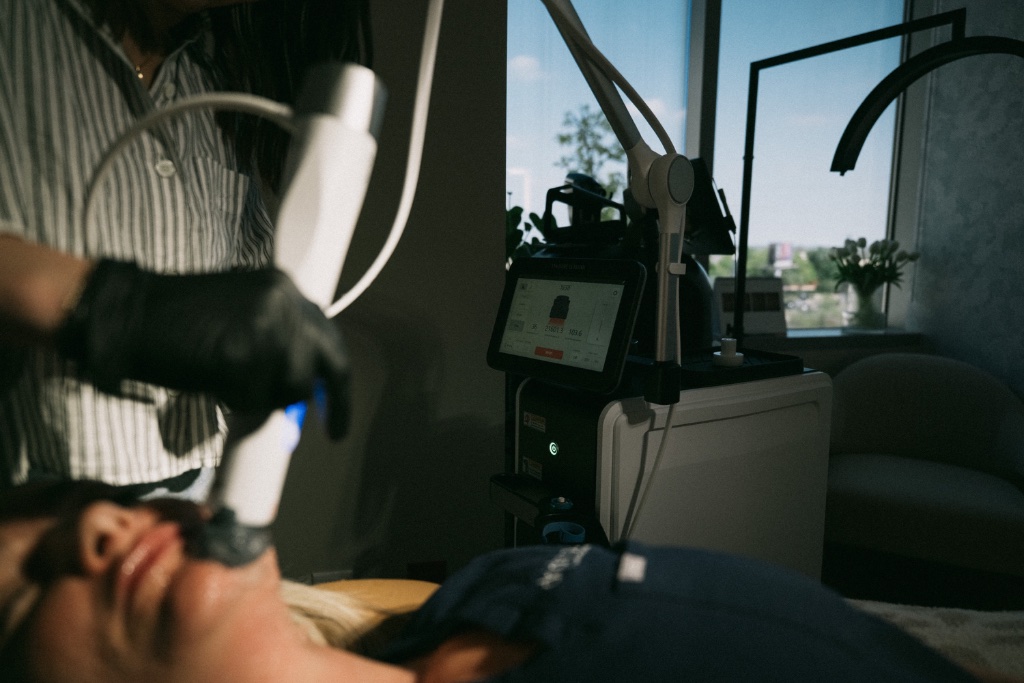
Overtreatment is not just an injectable issue. Device-based plans can also become excessive if they are not based on candidacy, timing, and category logic. Laser treatments and energy-based devices are tools — and like any tool, they can be overused. More energy-based treatment is not automatically better. A plan that includes multiple laser sessions, RF treatments, and resurfacing procedures without clear candidacy assessment may be too much — not because the devices are bad, but because the plan is not grounded in what the skin actually needs.
XERF is a good example of why provider judgment matters. XERF is a multifrequency monopolar radiofrequency treatment designed to support collagen remodeling and structural firmness. But the question is not only "does the practice offer XERF?" — it is "who is deciding whether XERF is right for me?" For some patients, XERF may be central to the plan — the primary structural intervention. For others, it may be a supportive element alongside injectables or skincare. For others still, it may be unnecessary — the concern is better addressed by a different category entirely.
Understanding what XERF is, how many treatments are needed, and how it compares to other options is part of understanding whether it fits the plan. XERF and facial balancing can work together — but only when the provider determines the right sequence and priority. An aesthetic treatment plan is too much when devices are added without this judgment — when the plan includes energy-based treatments because they are available, not because they are needed.
What JOLA Does Differently
JOLA's approach is built around the principle that an aesthetic treatment plan is too much when it stops serving the face. Consultation-led care means the plan is driven by assessment, not by request. Anatomy-first planning means decisions are grounded in clinical observation of the face — bone structure, fat pad support, movement, skin quality, and proportional relationships. The consultation is where every plan begins and where editing is built in from the start.
Facial balancing at JOLA means evaluating the whole face and choosing what matters most — not treating every concern at once. Injectables are planned with dose, placement, and restraint in mind. Laser treatments are selected based on skin type, concern, and timing. XERF is recommended when structural tightening is the right priority, deferred when something else should come first, and declined when it is not the right fit. Skin rejuvenation and collagen are integrated into the plan as structural support.
Restraint over excess is not a slogan — it is how the practice operates. Timing and sequencing are part of every plan. Saying no, waiting, or simplifying is part of protecting the patient and the result. Luxury in the details, not in quantity — that is the principle. The luxury med spa experience in Dallas is not defined by how many treatments are performed. It is defined by how thoughtfully each one is chosen.

How to Know You're in the Right Hands
Recognizing the right provider is not about credentials alone — it is about how the provider thinks and communicates. There are signs that a practice values judgment over volume, and they are visible in the consultation itself.
The provider can explain the "why"
Every treatment in the plan has a reason grounded in assessment, not in availability.
The plan feels prioritized, not inflated
There is a clear hierarchy — a sense that the most important treatment comes first, and others follow.
There is room for questions
The provider welcomes the questions listed above and answers them with clarity, not defensiveness.
The provider is comfortable recommending less
If the face does not need a treatment, the provider says so — and recommends waiting, staging, or choosing differently.
The overall strategy feels calm, clear, and intentional
The plan does not feel rushed, pressured, or sales-driven. It feels like medicine.
When these signs are present, the patient is in the right hands. When they are absent — when the plan feels pressured, the provider cannot explain the why, and no one is willing to recommend less — the plan may be too much, and a second conversation may be warranted. For patients in Dallas, Highland Park, University Park, Preston Hollow, and the Park Cities, JOLA offers exactly this kind of consultation.
Begin With a Consultation at JOLA Dallas
If you are concerned about overtreatment — if you want a plan that is edited, prioritized, and built on judgment rather than volume — begin with a consultation at JOLA Dallas. The best care starts with assessment, and that assessment includes the willingness to do less when less is what the face needs.