
JOLA DALLAS
SKIN,
IN DETAIL.
What the ULTRA laser is designed to address — and where it fits in a thoughtful skin plan.
What Is the ULTRA Laser?
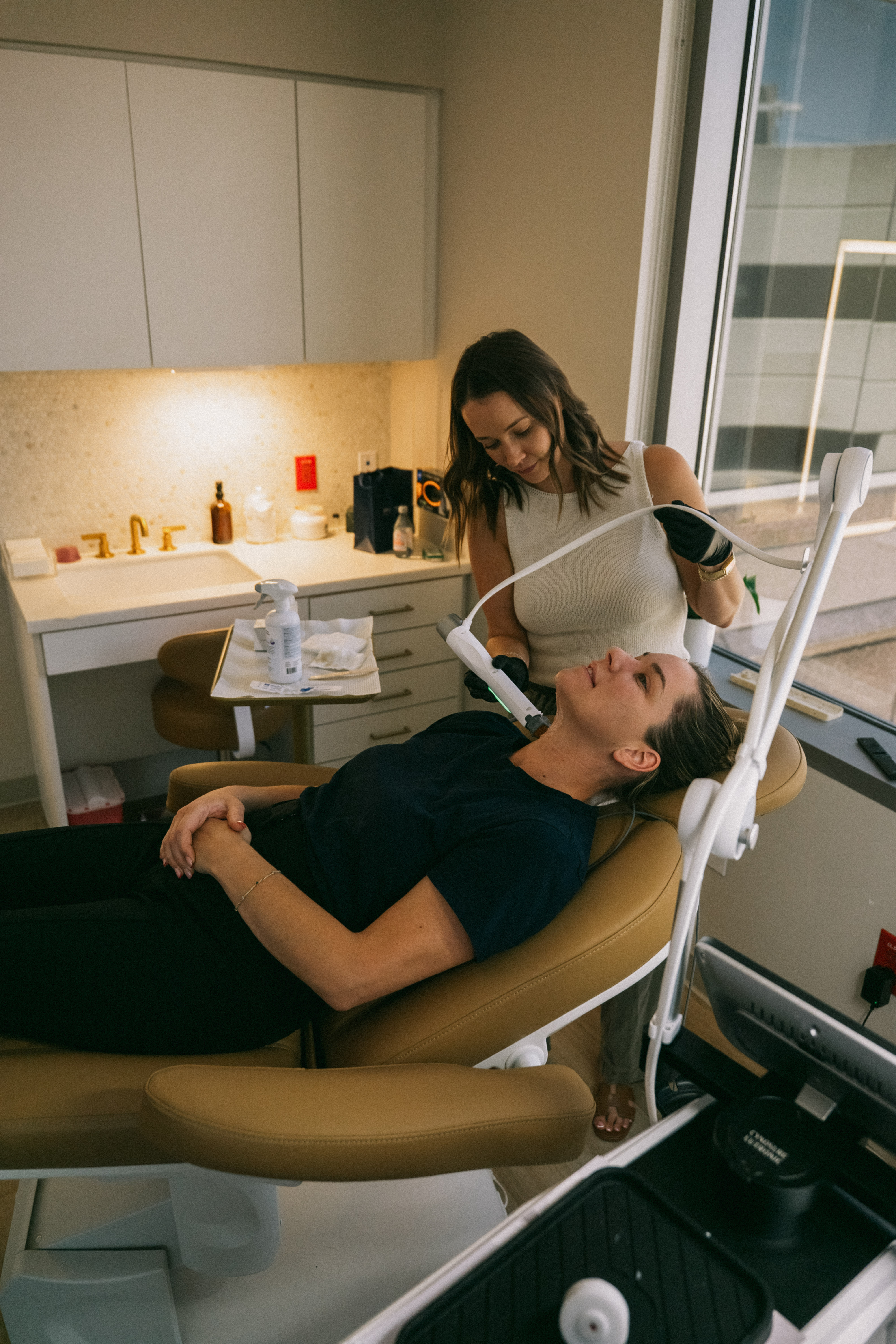
The ULTRA laser — also marketed as LaseMD Ultra — is a non-ablative fractional thulium laser made by Cynosure Lutronic that uses a 1927 nm wavelength to improve skin quality concerns such as uneven tone, sun-related pigment, texture, and early signs of photoaging. It is a laser resurfacing treatment, not a radiofrequency skin-tightening device, and it should not be confused with XERF. Whether ULTRA is the right laser for any one person depends on the specific concern, skin tone, pigment history, downtime tolerance, and treatment goals — and at JOLA Dallas, in Highland Park, that matching begins with a consultation, not with the device.
ULTRA is primarily a
non-ablative fractional thulium laser (1927 nm)
Used for
skin quality concerns — texture, pigment, sun damage, tone, fine lines, and related surface changes — within its cleared indications
Not the same as
XERF radiofrequency, RF microneedling, IPL/BBL, ablative CO₂, or injectables
LASER IS A CATEGORY. ULTRA IS A SPECIFIC TECHNOLOGY.
Who Makes the ULTRA Laser?
The ULTRA laser is manufactured by Cynosure Lutronic — the combined entity of Cynosure, LLC and Lutronic Aesthetic, Inc. The device is also referenced in clinical materials as LaseMD Ultra. Lutronic is a registered trademark of Lutronic Corporation, and LaseMD Ultra, IntelliTrak, and Controlled Chaos are trademarks of Lutronic Corporation. Cynosure is a registered trademark of Cynosure, LLC.
For patients researching ULTRA laser Dallas or Lutronic ULTRA Dallas, the naming matters because it ties the device to a specific manufacturer, wavelength, and mechanism — not a generic "laser facial." Keeping the manufacturer identity accurate is part of how JOLA Dallas keeps the rest of the conversation accurate.
How Does the ULTRA Laser Work?
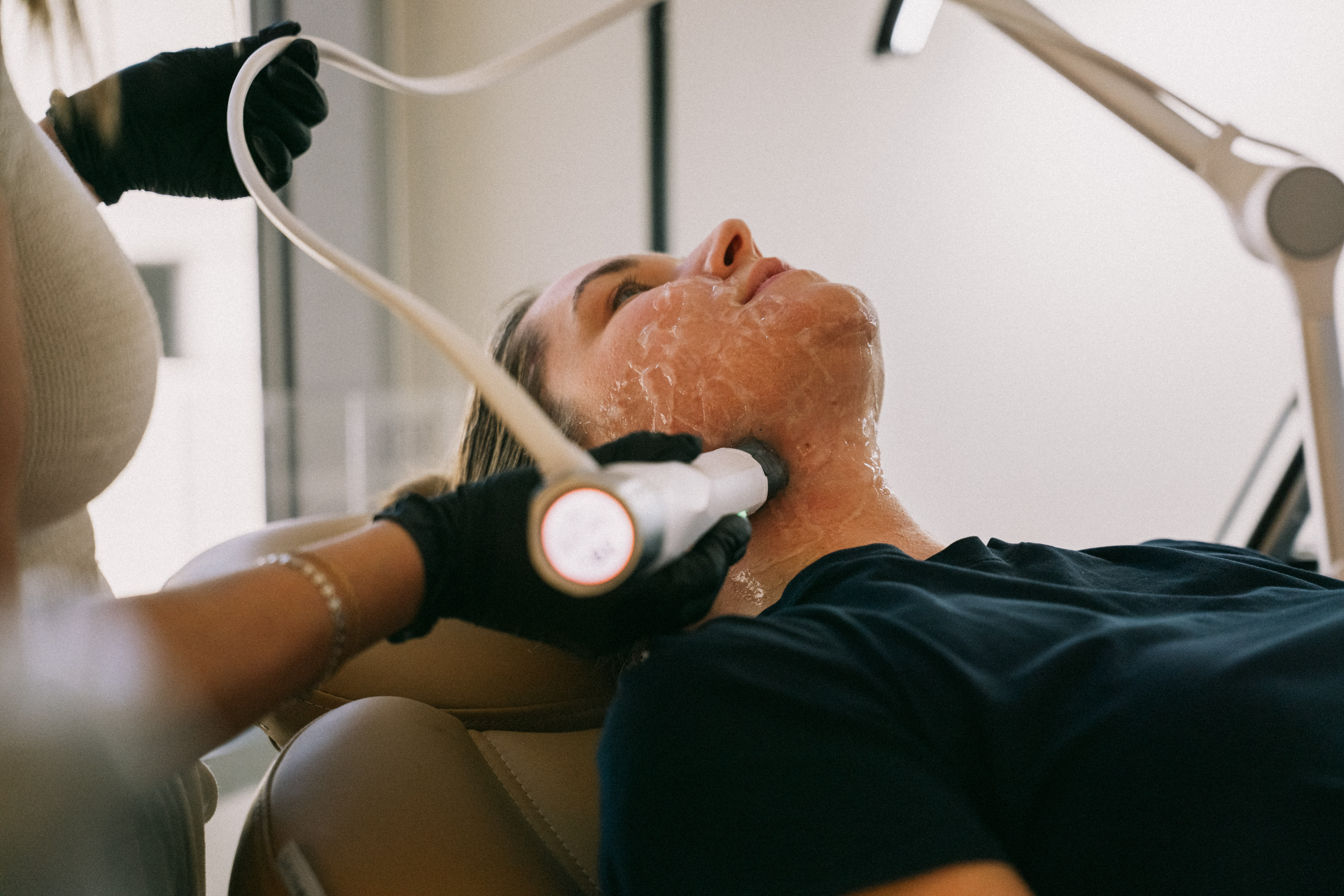
ULTRA delivers fractional 1927 nm thulium laser energy into the skin. The wavelength has a strong affinity for water in tissue. Rather than removing the entire surface, the fractional pattern creates a pattern of treated microzones — sometimes described as dehydrated microchannels — surrounded by untreated skin. That untreated skin supports recovery. The treated zones stimulate a skin-revitalization response, and the patterned delivery is designed to improve tone and texture with less downtime than full-surface ablation.
The platform uses a 200 μm microbeam with magnetic roller tracking (IntelliTrak) and Controlled Chaos Technology to help keep energy delivery consistent across the treatment area. Because the mechanism targets water rather than pigment alone, the conversation is about skin quality — texture, tone, surface renewal — rather than a single lesion.
Wavelength
1927 nm (thulium)
Delivery
Fractional — patterned microzones of treated tissue
Tissue target
Water in the skin (soft-tissue coagulation)
Classification
Non-ablative fractional laser
THE WAVELENGTH MATTERS. SO DOES WHAT THAT WAVELENGTH IS BEING ASKED TO TREAT.
Is ULTRA a Fractional Laser?
Yes. ULTRA is a fractional laser. "Fractional" means the laser energy is delivered to a fraction of the surface — a pattern of treatment zones — rather than the entire area at once. The untreated skin between the zones helps support the healing response. This is different from a full-field treatment, which treats the entire surface in one pass.
The practical result is that fractional delivery is part of why ULTRA is associated with less downtime than more aggressive full-field resurfacing. It is still a real treatment with a real skin response — "fractional" describes the pattern, not the absence of treatment.
Is ULTRA Ablative or Non-Ablative?
ULTRA is classified as a non-ablative fractional laser. In simple terms: ablative lasers remove or vaporize tissue at the surface; non-ablative lasers heat and treat tissue without the same degree of surface removal. ULTRA creates thermal microzones that stimulate a skin response while leaving surrounding tissue intact, which is why it is described as non-ablative.
ABLATIVE
Removes or vaporizes tissue to a degree that depends on the technology and settings. Typically more downtime and a more visible recovery.
NON-ABLATIVE
Heats or treats tissue without the same degree of surface ablation. Generally less downtime, often built cumulatively over a series.
ULTRA sits in the non-ablative fractional category. Some materials describe its effect as sub-ablative, meaning it is close to the boundary but is not a full ablative resurfacing device. The distinction matters because it shapes downtime, candidacy, and how many sessions may be part of a plan.
What Does ULTRA Treat?
ULTRA's FDA-cleared indications include the coagulation of soft tissue, treatment of actinic keratosis, and treatment of benign pigmented lesions such as lentigos (age spots), solar lentigos (sunspots), and ephelides (freckles). In practice, practices use it for a broader set of skin-quality concerns. The list below reflects the categories ULTRA is commonly associated with — not a promise that it treats every case of each.
01
TEXTURE
Surface irregularity, roughness, fine textural change
02
SUN DAMAGE
Photoaging, sunspots, sun-related tone and texture
03
PIGMENT
Benign pigmented lesions within cleared indications
04
FINE LINES
Fine surface and photoaging-related lines
05
PORES
Pore appearance and related texture
06
ACNE MARKS / SCARS
Post-acne marks and certain acne scarring
07
SKIN TONE
Uneven tone and dyschromia
08
EARLY PHOTOAGING
Early signs of sun-related aging
09
SKIN QUALITY
Overall radiance, smoothness, and refinement
Comparing ULTRA with Fraxel? Fraxel is a brand family, not a single wavelength. For the full specification-led ULTRA vs. Fraxel comparison, read the dedicated guide. Comparing ULTRA with Morpheus8? ULTRA is a laser and Morpheus8 is RF microneedling — for the full ULTRA vs. Morpheus8 comparison, read the mechanism study. Comparing ULTRA with traditional microneedling? For the full ULTRA laser vs. microneedling comparison, read the surface/structure study. Comparing ULTRA with IPL or BBL? IPL and BBL are pulsed-light technologies, not lasers — for the full ULTRA laser vs. IPL/BBL comparison, read the color study.
ULTRA for Skin Texture
Texture is one of the most common reasons patients begin a laser conversation. Surface irregularity, roughness, and the fine, sandpaper-like changes that accumulate with sun exposure and time can make skin look older than it is. ULTRA's fractional 1927 nm energy is designed to support surface renewal and smoother-looking skin by treating a pattern of microzones and relying on the surrounding untreated skin to support recovery.
Realistic results for texture mean improvement — skin that looks more even, more refined, and more luminous in natural light — not "perfect texture." Skin is a living surface, not a finish. The goal at JOLA Dallas is visible, honest refinement that still looks like you.
For patients comparing options, laser treatments in Dallas span several technologies; ULTRA is one of the lower-downtime fractional options within that group.
ULTRA for Sun Damage
Sun damage is a broad term. It can include brown spots, uneven tone, and the textural changes that follow years of ultraviolet exposure. ULTRA's cleared indications include benign pigmented lesions such as solar lentigos (sunspots) and ephelides (freckles), and the 1927 nm wavelength is commonly associated with addressing photoaging-related pigment and tone.
Not every sun-related change is right for one laser. Some pigment is superficial; some sits deeper; some is mixed with redness or textural change. A consultation helps determine whether the concern is primarily pigment, primarily texture, or a combination — and whether ULTRA, another device, or a layered plan fits best.
See also: Laser Treatments Dallas.
ULTRA for Pigment
"Pigmentation" is not one diagnosis. It is a category that includes freckles, lentigines, post-inflammatory hyperpigmentation, melasma, and other conditions — each with a different biology and a different treatment conversation. ULTRA's cleared indications include benign pigmented lesions such as lentigos and freckles. Whether it fits any individual pigment concern depends on what the pigment actually is.
This is why a consultation matters before a laser decision. Two patients who both say "I have pigmentation" may be describing completely different things — and the right plan for one may be wrong for the other.
PIGMENT IS A CATEGORY. NOT A SINGLE CONDITION.
ULTRA for Melasma
Melasma is recurrent, complex, and often triggered by hormones, sun, and inflammation. Some practices use fractional 1927 nm lasers as part of a melasma-management plan; others do not. There is no cure for melasma, and any laser that delivers energy to pigmented skin can, in some patients, aggravate pigment rather than improve it.
For that reason, melasma requires individualized, evidence-aware planning — not a generic "laser for pigment" approach. Candidacy, settings, pretreatment, and aftercare all matter, and the decision should be made with a qualified provider who understands your pigment history. If ULTRA is not appropriate for your melasma, that is a clinical answer, not a limitation of the device.
JOLA Dallas approaches melasma conservatively and consultation-first. Contact the practice to discuss your specific history.
ULTRA for Pores
When patients say "large pores," they are usually describing the visible appearance of pore openings, often on the nose, cheeks, or central face. Pore appearance is influenced by oil production, skin structure, sun damage, and texture. ULTRA's resurfacing and texture-supporting mechanism can improve the appearance of pores as part of an overall refinement of surface quality.
Pores do not open and close like doors. They are structural openings, and no laser permanently closes them. The realistic goal is a visible improvement in the appearance and texture of the skin around the pore — not the elimination of pores.
PORES DO NOT OPEN AND CLOSE LIKE DOORS.
ULTRA for Fine Lines
Fine lines come in several forms. There are fine surface lines related to photoaging and sun exposure; there are deeper folds related to volume and support; and there are dynamic lines created by repeated movement. ULTRA's fractional resurfacing is associated with improving the appearance of fine, photoaging-related surface lines as part of a skin-quality plan.
If the primary concern is dynamic movement — the lines that appear when you smile, frown, or raise your brows — the conversation is different. Movement lines are often addressed with neuromodulators such as Botox or Dysport, not with a laser. Sometimes the right answer is both: a laser for surface quality and a neuromodulator for movement.
See: Botox in Dallas and Botox vs. Dysport.
ULTRA for Acne Scars
Acne scarring is not one thing. Rolling scars, boxcar scars, ice-pick scars, post-inflammatory marks, redness, and pigmentation are all different concerns with different treatment conversations. ULTRA's fractional resurfacing may support improvement in certain acne-scar texture and post-acne marks, but not every scar type is appropriate for a non-ablative fractional laser.
Deeper or more structural scarring often requires a different plan — sometimes a more ablative device, sometimes RF microneedling, sometimes a combination. The first question is what kind of scarring is present, not which laser to book.
Acne Scars vs. Acne Marks
SCAR
A change in skin structure or texture — a depression, a raised area, or a bound-down surface. Scarring is a structural change, and treatment is usually about remodeling that structure.
MARK
Pigment or redness left behind after inflammation resolves. The skin surface is flat; the color is the concern. Marks often respond to different treatment than structural scars.
Lumping scars and marks together is one of the most common reasons patients end up on the wrong treatment. A mark may improve with a pigment-focused plan; a scar may need a texture- or structure-focused plan. ULTRA may fit one and not the other.
Can ULTRA Help Redness?
Redness is often a vascular concern — visible vessels, flushing, or the background redness associated with rosacea-like patterns. ULTRA's 1927 nm thulium wavelength is primarily water-targeted and pigment/surface-oriented, not a vascular-specific technology. Diffuse redness and visible vessels are often better addressed with a vascular laser or with light-based devices such as IPL or BBL.
This is a case where forcing one device into every concern is a mistake. If the primary issue is redness, the right conversation may begin with a different technology entirely.
Does ULTRA Stimulate Collagen?
Non-ablative fractional lasers are understood to support a dermal remodeling response — a skin-revitalization process associated with collagen-related changes — as part of how they improve tone and texture over a series of treatments. ULTRA's mechanism, which creates thermal microzones in tissue, is consistent with that category.
JOLA does not make fixed percentage claims about collagen. The honest framing is that ULTRA supports a skin-quality response that develops progressively, and that response is part of why results are often described as cumulative over a series rather than complete after one session.
For a broader collagen conversation, see collagen-stimulating treatments in Dallas.
ULTRA Is Not a Skin-Tightening Substitute
ULTRA and XERF solve different skin questions. ULTRA is a laser, and its primary conversation is skin quality — texture, pigment, tone, and surface renewal. XERF is a radiofrequency device, and its primary conversation is skin firmness and laxity. They are different technologies addressing different layers of the aging face.
Calling one better than the other is a category error — like asking whether a paintbrush is better than a level. They do different things.
TEXTURE AND TIGHTENING ARE DIFFERENT GOALS.
ULTRA vs. XERF
ULTRA and XERF are the two technologies most often confused in patient research, and they are not the same category. ULTRA is a laser; XERF is radiofrequency. ULTRA's conversation is skin quality — texture, pigment, tone, surface renewal. XERF's conversation is skin firmness and laxity.
CRITERION
ULTRA
XERF
Technology
Laser (1927 nm thulium)
XERF
Primary conversation
Texture / pigment / resurfacing
Skin firmness / laxity
Needles
No
No
Downtime
Treatment-specific, generally low
Treatment-specific
Adds volume
No
No
Energy
Light (laser)
Radiofrequency
They may appear in the same long-term skin plan because they address different concerns. A patient with both texture changes and early laxity may benefit from both — at different times, in a considered sequence — not as substitutes for one another.
See: XERF Dallas.
Can ULTRA and XERF Be Combined?
Conceptually, yes — when one concern is skin quality or texture and another is firmness, a plan may include both technologies. The manufacturer even pairs ULTRA with Genius RF microneedling under the Ultra Skin Solutions umbrella, which reflects the broader principle that different devices can be layered when they address different layers.
Sequencing and timing are clinical decisions that depend on the individual, the concerns, and the skin. JOLA does not publish a fixed protocol; the plan is built in consultation.
COMBINATION TREATMENT SHOULD COMBINE CONCERNS. NOT JUST DEVICES.
ULTRA vs. RF Microneedling
ULTRA delivers laser energy from the surface; RF microneedling delivers radiofrequency energy through needles that pass into the skin. The delivery is different, the depth is different, and the treatment experience is different. ULTRA is more surface- and pigment-oriented; RF microneedling is more texture- and firmness-oriented, with needle-based delivery.
Pigment considerations, downtime, and candidacy all differ. Neither is universally stronger; each fits a different concern.
ULTRA vs. Morpheus8
Morpheus8 is an RF microneedling device. ULTRA is a laser. Different delivery, different treatment experience, different indications. Morpheus8's needle-based RF is often part of a texture- and firmness-oriented conversation; ULTRA's fractional laser is part of a surface-, pigment-, and tone-oriented conversation.
JOLA does not claim one is superior. The right choice depends on whether the concern is primarily surface and pigment, or primarily texture and firmness.
ULTRA vs. Microneedling
Microneedling is a mechanical, controlled micro-injury treatment; ULTRA is an energy-based laser. Microneedling creates physical channels; ULTRA creates thermal microzones with a specific wavelength. Both can support texture and skin-quality improvement, but the mechanism, precision, pigment considerations, and downtime differ.
For some patients, mechanical microneedling is appropriate; for others, the energy-based precision of a laser fits the concern better. The decision is clinical, not promotional.
ULTRA vs. Chemical Peel
A chemical peel uses a chemical solution to exfoliate the skin; ULTRA uses laser energy. They are different mechanisms. Peels vary widely in depth; ULTRA is a non-ablative fractional laser with a consistent, patterned delivery. Both can address tone, texture, and pigment, but the precision, depth control, downtime, and candidacy differ.
Neither is universally stronger. See chemical peels in Dallas for the peel conversation.
ULTRA vs. IPL / BBL
IPL and BBL are light-based devices, but they are not lasers in the strict technical sense — they deliver a broad spectrum of light rather than a single coherent wavelength. ULTRA is a laser: a single 1927 nm wavelength delivered in a fractional pattern. IPL and BBL are often used for pigment and redness; ULTRA is used for pigment, texture, and surface renewal.
If redness is a primary concern, IPL or BBL may be the more appropriate starting point. If texture and surface renewal are primary, ULTRA may fit better. The technologies overlap on pigment but differ on mechanism and precision.
ULTRA vs. CO₂ Laser
CO₂ lasers belong to a more aggressive resurfacing category. Ablative CO₂ removes more surface tissue and is associated with more downtime, more visible recovery, and a more intensive result. ULTRA is non-ablative and fractional, designed for lower downtime and cumulative improvement over a series.
ULTRA is not a substitute for CO₂-level resurfacing. A patient with deep scarring or advanced photoaging may be better served by a more ablative approach; a patient with early texture and pigment may be better served by ULTRA's lower-downtime profile. The intensity should match the concern.
ULTRA vs. Erbium Laser
Erbium systems span a range of wavelengths and behaviors — some ablative, some less so — and they should not be grouped casually. ULTRA's 1927 nm thulium wavelength has its own water-absorption profile and tissue interaction. The comparison is not "erbium vs. ULTRA" as a single category; it depends on which erbium system, which settings, and which concern.
At JOLA, the question is always which specific device fits the specific concern — not which wavelength family sounds more advanced.
Who Is a Good Candidate for ULTRA?
ULTRA may be worth discussing when the concern matches its supported indications — texture, pigment within cleared categories, sun damage, tone, fine lines, or skin quality — and when skin tone, pigment history, expected downtime, and goals all fit. Candidacy is not universal; it is individual.
01
The concern matches ULTRA’s supported indications
02
Skin tone and pigment history are appropriate
03
Expected downtime fits the patient’s life
04
Goals are realistic — improvement, not perfection
05
Medical history allows treatment
06
Previous procedures are considered
Who May Not Be a Good Candidate?
Contraindications and candidacy exclusions come from the manufacturer and current clinical guidance, not from marketing. Active skin infection, certain medications, recent isotretinoin use, pregnancy, and certain skin conditions may affect candidacy. Some pigment conditions, including active melasma in some patients, may make a different plan more appropriate.
The only way to know is a consultation. See treatment planning at JOLA.
Is ULTRA Safe for Darker Skin Tones?
The manufacturer states ULTRA can treat all patient skin types, and the 1927 nm thulium wavelength — which targets water rather than melanin — is generally associated with a more favorable safety profile across skin tones than pigment-targeting wavelengths. That said, no laser is "safe for every skin tone" in every situation. Melanin interaction, settings, pigment history, and PIH risk all matter.
At JOLA Dallas, treatment for darker skin tones is approached with attention to settings, history, and conservative planning — not with a universal claim. The conversation is individual.
Post-Inflammatory Hyperpigmentation
Post-inflammatory hyperpigmentation (PIH) is pigment that appears after inflammation or injury, and it is a real consideration in laser planning — for all skin tones, not only darker skin. A prior history of PIH matters. Prior PIH does not mean treatment is impossible, but it changes the settings, the plan, and the aftercare conversation.
Darker skin does not equal inevitable PIH, and lighter skin does not equal no PIH risk. The question is individual history and individual planning.
What Does ULTRA Feel Like?
According to the manufacturer, patients may experience mild to moderate discomfort depending on pain tolerance and treatment settings. The sensation is commonly described as a mild prickling or warmth as the handpiece passes over the skin. JOLA does not assign a fixed pain score; the experience varies by person, area, and settings.
Does ULTRA Require Numbing?
The manufacturer notes that for sensitive patients or treatments involving moderate to high settings, a topical numbing cream can be used to enhance comfort. Whether numbing is used at JOLA Dallas is a per-patient, per-treatment decision based on the area, settings, and the patient’s comfort — not a fixed rule.
How Long Does ULTRA Take?
A treatment session ranges from about 10 to 20 minutes depending on the size of the area, per the manufacturer. Total appointment time — including preparation and numbing if used — is longer than the laser pass itself. The 200 μm microbeam and roller tracking are part of why the pass itself is efficient.
Immediately After ULTRA
After treatment, patients may experience mild redness and can generally resume regular activities immediately, according to the manufacturer. Complete skin healing typically takes about 5 to 7 days before a dryness sensation fades. Some patients notice mild roughness or dryness as the skin responds; the specific experience varies by settings and individual.
JOLA does not copy generic fractional-laser aftercare. The aftercare conversation is specific to the treatment you actually received.
How Much Downtime Does ULTRA Have?
ULTRA is associated with minimal downtime. "Minimal" means patients can usually return to regular activity quickly, and visible redness is typically mild. It does not mean zero visible response, zero skin reaction, or zero aftercare. Social downtime — the period where you might not want a big event — is generally short, and full skin healing is commonly described as 5 to 7 days.
Downtime also depends on settings. A milder pass and a more aggressive pass on the same device produce different recoveries.
What “Low Downtime” Actually Means
"Low downtime" is one of the most overused phrases in aesthetic marketing. It does not mean nothing happens. A low-downtime laser still creates a real skin response — redness, dryness, roughness, or mild flaking — that requires aftercare and sun protection. It means the response is manageable and brief, not absent.
LOW DOWNTIME IS NOT THE SAME AS NO RESPONSE.
ULTRA Aftercare
Aftercare at JOLA Dallas is specific to the treatment received. In general, post-laser care centers on gentle cleansing, moisturizer, and rigorous sun protection. Active ingredients — retinoids, exfoliants, and certain acids — are typically paused during early recovery. Makeup, exercise, and heat exposure are reintroduced on a timeline determined by the provider.
JOLA does not publish a one-size-fits-all aftercare calendar. The timeline is part of the treatment plan, discussed in consultation and confirmed after your session.
See clinical skincare at JOLA for the between-treatment skin strategy.
When Will You See ULTRA Results?
Results develop progressively. The immediate appearance is recovery, not the result. As redness and dryness resolve, tone and texture begin to look more refined. Because non-ablative fractional lasers support a skin-revitalization response, further changes can continue to develop over the weeks following a session and cumulatively across a series.
JOLA does not publish a fixed day-by-day timeline. The honest answer is that pigment and texture changes develop on the skin’s biology, not a marketing calendar.
How Many ULTRA Treatments Do You Need?
The number of sessions varies by patient. The manufacturer notes that some individuals notice improvement after a single session, while others require a series to reach their desired outcome. In practice, a series is often discussed for cumulative concerns such as texture, pigment, or fine lines. The count depends on the concern, severity, skin, previous treatment, and desired result — not on a fixed package.
How Long Do ULTRA Results Last?
Result longevity varies by concern, sun exposure, ongoing skin health, continued aging, and pigment recurrence. Pigment can return with new sun exposure; texture continues to age. ULTRA does not stop time. Results are best understood as an improvement within an ongoing skin plan, not a permanent state.
Does ULTRA Need Maintenance?
Maintenance should follow the skin, the concern, the response, and ongoing changes — not a universal calendar. Some patients benefit from occasional sessions; others do not. The maintenance conversation is part of a long-term skin plan, built in consultation.
ULTRA Across Decades
YOUR 20s
In your 20s, a laser conversation is usually driven by a specific concern — acne marks, early texture, or pigment — not by age. There is no "everyone should start laser early." If there is a real concern, it is worth a consultation; if there is not, doing nothing yet is reasonable.
YOUR 30s
In your 30s, early photoaging, texture, tone, and pigment often become the conversation. ULTRA may fit when the concern is surface quality and the downtime profile suits your life.
YOUR 40s AND BEYOND
In your 40s and beyond, skin changes can include pigment, texture, fine lines, laxity, volume, and vascular changes. ULTRA addresses only the concerns appropriate to its technology — surface quality, pigment, texture. Laxity is a different conversation; volume is a different conversation.
ONE LASER SHOULD NOT BE EXPECTED TO TREAT EVERY LAYER OF AGING.
When ULTRA May Not Be the Answer
PRIMARY CONCERN: SKIN LAXITY
→ XERF / skin-firmness evaluation
PRIMARY CONCERN: DYNAMIC LINES
→ Botox / Dysport
PRIMARY CONCERN: VOLUME
→ Facial Balancing / Sculptra / filler
PRIMARY CONCERN: VASCULAR REDNESS
→ Appropriate vascular / light technology
PRIMARY CONCERN: DEEP SCARRING
→ Scar-specific treatment planning
PRIMARY CONCERN: NO SIGNIFICANT CONCERN
→ Possibly no treatment
The JOLA Skin Map
What do you actually see? Most patients describe a cluster of concerns. The work is to separate them — to find the layer that is the problem and match the technology that actually targets it.
Which layer is the problem? Which technology actually targets it?
SKIN QUALITY IS NOT ONE TREATMENT CATEGORY.
The Right Laser Starts With the Right Skin Question
CHEY COPE
Laser Specialist at JOLA Dallas
Laser planning at JOLA may consider skin tone, pigment history, PIH history, texture, acne scars, sun exposure, previous laser, previous RF, previous microneedling, filler, Sculptra, skin sensitivity, current skincare, downtime tolerance, and treatment goals — together, not in isolation.
The right laser decision is not which device is newest. It is which technology fits the concern, the skin, and the life of the person in the chair. That is the standard Chey applies at JOLA Dallas.
To discuss your skin with Chey, contact JOLA or book a consultation.
How JOLA Decides Whether ULTRA Is the Right Laser
JOLA does not begin with “which laser do you want?” The conversation begins with: what is the concern? Pigment? Texture? Scarring? Redness? Fine lines? Firmness? Only then does the technology question become precise — which technology, what intensity, what timing, what aftercare, and whether treatment is needed at all.
Sometimes the most honest answer is that a different device fits better. Sometimes the answer is skincare. Sometimes the answer is nothing yet.
What to Ask Before ULTRA
What is ULTRA designed to treat?
What concern are we treating in my skin?
What wavelength does ULTRA use?
Why does that wavelength make sense for me?
Is ULTRA fractional?
Is it ablative or non-ablative?
Does my skin tone affect candidacy?
Does my PIH history matter?
Does melasma change the plan?
Does previous laser matter?
Does previous RF matter?
Does previous microneedling matter?
Does current skincare matter?
Does ULTRA require numbing?
What will the treatment feel like?
What should I expect after treatment?
What is the downtime?
When can I wear makeup?
When can I exercise?
What skincare should I avoid?
How many treatments are recommended?
When should results be evaluated?
What will ULTRA not treat?
Would another laser or technology fit better?
Would doing nothing yet be reasonable?
What Is the ULTRA Laser? The Bottom Line
ULTRA is a specific laser technology — a non-ablative fractional thulium laser at 1927 nm, made by Cynosure Lutronic. The manufacturer identity matters; the wavelength matters; the fractional and non-ablative classifications matter. Its indications should be evidence-based, and its role is skin quality: texture, pigment within cleared categories, tone, and surface renewal.
Texture is different from pigment. Pigment is different from redness. Scars are different from acne marks. Fine lines are different from movement lines. Pores cannot literally be closed. Melasma requires nuance. Darker skin requires thoughtful, individualized planning. PIH history matters. Downtime should be described accurately — low, not zero. Numbing protocol should be accurate. Results develop according to treatment biology, not a fixed calendar. Treatment count is individual, not invented. Maintenance is individualized.
ULTRA and XERF are different. ULTRA and RF microneedling are different. ULTRA and Morpheus8 are different. ULTRA and IPL or BBL are different. ULTRA and CO₂ are different. No single device treats every skin concern. Some patients need another laser. Some need XERF. Some need injectables. Some need skincare. Some need no treatment.
If you are asking “is ULTRA the best laser for my skin?” — start with: what am I actually trying to change? Texture? Pigment? Sun damage? Pores? Fine lines? Scars? Once the concern is clear, the laser decision becomes much more precise. At JOLA Dallas, the goal is not to put every patient on the same device. It is to match the technology to the skin.
Frequently Asked Questions
The ULTRA laser — also known as LaseMD Ultra — is a non-ablative fractional thulium laser made by Cynosure Lutronic that uses a 1927 nm wavelength to improve skin-quality concerns such as texture, pigment, sun damage, tone, and fine lines.
ULTRA is manufactured by Cynosure Lutronic, the combined entity of Cynosure, LLC and Lutronic Aesthetic, Inc. It is also referenced as LaseMD Ultra.
ULTRA uses a 1927 nm thulium wavelength, which has a strong affinity for water in the skin.
ULTRA FOR SUN DAMAGE
Brown spots, sun spots, freckles & photoaging — where ULTRA fits.
READ THE SUN DAMAGE GUIDEULTRA FOR PIGMENTATION
Dark spots, PIH, acne marks & uneven tone — not all pigment is the same.
READ THE PIGMENTATION GUIDEULTRA FOR TEXTURE & PORES
Visible pores, roughness, fine lines & acne texture — what is creating the surface?
READ THE TEXTURE GUIDEULTRA FOR ACNE MARKS & SCARS
Not everything acne leaves behind is a scar — PIH, PIE, rolling, boxcar & ice-pick scars.
READ THE ACNE MARKS & SCARS GUIDEULTRA VS CO₂ LASER