
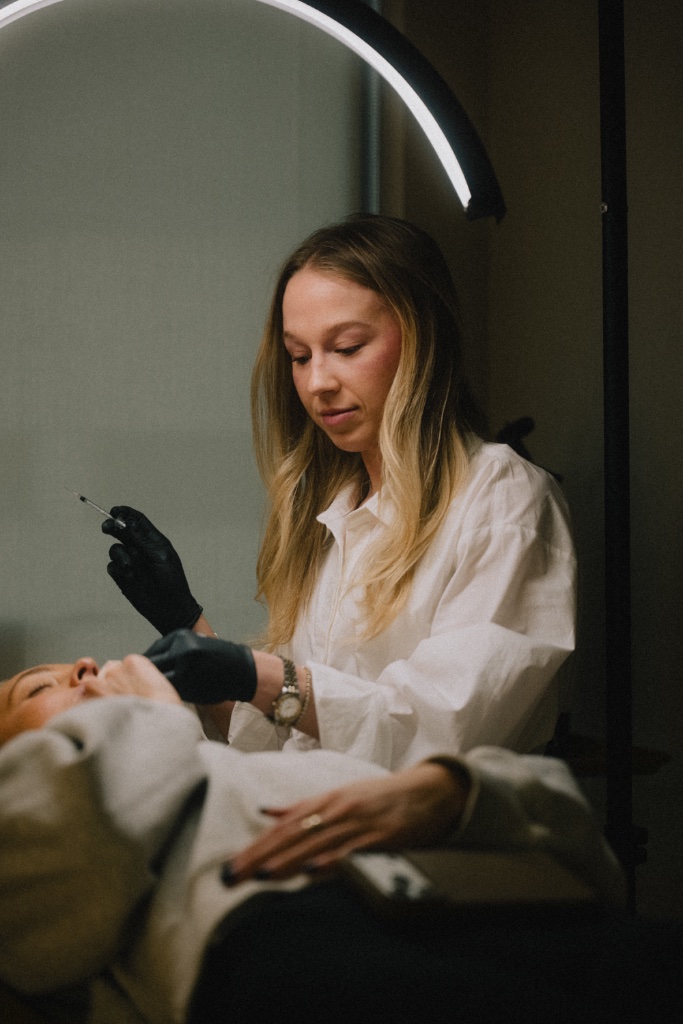
TREATMENT GUIDE / FACIAL HARMONY
JOLA DALLAS
FACIAL
BALANCING
IN DALLAS
How small adjustments create natural-looking harmony.
JOLA DALLAS / APRIL 2026
14 MIN READ
Something has shifted in the way aesthetic patients in Dallas, Highland Park, University Park, and the Park Cities are approaching their care. The question is no longer simply "what can I add?" — it has become "what will make the whole face look more like itself?" The shift from isolated treatment requests to full-face planning reflects a more sophisticated understanding of how aesthetic results actually work: not through the addition of more, but through the intelligence of proportion. Facial balancing dallas is the framework that makes this intelligence clinical rather than intuitive.
Natural-looking results rarely come from simply adding volume to where volume is low. They come from understanding how each feature relates to every other — how a small adjustment to the chin changes the way the lips read, how addressing temple hollowing restores the brow, how under-eye support affects the perceived height of the cheek. The most elegant outcomes in aesthetic medicine are often those that cannot be specifically identified by the observer, only felt: the patient simply looks better. More rested. More proportional. More like themselves.
At JOLA Dallas, facial balancing in dallas is not a treatment category — it is the planning framework that underlies every injectable and structural recommendation made at this practice. This guide explains what facial balancing means, how small adjustments can reshape the way the face reads as a whole, and why a consultation-first, anatomy-led approach consistently produces the most natural-looking results.
What Facial Balancing Actually Means
Facial balancing dallas refers to an approach to aesthetic planning that prioritizes proportion, structural harmony, and the relationships between facial features rather than the isolated correction of individual areas. It is not a specific treatment — it is a framework for deciding which treatments, if any, are appropriate for a given patient's face.
The fundamental premise of facial balancing is that the face is a composition. Individual features — the lips, the cheeks, the chin, the temples — do not exist in isolation. Each exists in relationship to every other, and the way the face reads as a whole depends on those relationships as much as on any individual feature in isolation. A face can have well-defined cheekbones and still look off-balance if the chin is recessive and the lips are overfilled. A face can have hollow temples and still read as harmonious if the midface is structurally supported and the brow is in its proper position. Proportion governs perception.
This is what distinguishes genuine facial balancing treatment dallas from trend-driven injectable care. Trend-driven treatment tends to respond to self-identified concerns in isolation — the patient says they want their lips enhanced, their cheeks volumized, their under-eyes filled — and each area is addressed without the context of the whole. Facial balancing reverses this logic: the whole face is assessed first, and individual treatment decisions flow from that assessment rather than preceding it. The outcome is not a collection of treated areas — it is a coherent, proportional face. For a deeper look at the philosophy underlying this approach, see Clinical Fluency at JOLA Dallas.

Why Small Adjustments Can Change the Whole Face
One of the most consistent observations in aesthetic medicine is that small, precisely considered adjustments often produce more compelling results than larger, more obvious ones. This is not intuitive — patients frequently assume that more treatment means more improvement. The clinical reality of natural facial balancing dallas suggests otherwise.
The reason is proportion. The face is perceived as a whole, and small changes in structurally significant areas can shift the entire composition in ways that far exceed the physical size of the intervention. A modest chin projection, carefully supported, can make the lips appear more balanced without touching the lips at all. A small amount of structural support in the temples can restore the lateral brow frame and make the eyes appear more open — without any brow treatment. Under-eye support can improve the apparent height of the cheek. These cascade effects are what make anatomy-led facial balancing dallas so powerful: the right adjustment in the right place affects everything around it.
The corollary is equally important. Treatment in the wrong area, or in excess in the right area, can disrupt these relationships rather than improving them. An overfilled lip can make the chin appear more recessive. Excessive midface volume can flatten the under-eye transition. Trend-driven treatment that follows a formula rather than the individual face produces exactly this kind of disruption — features that look treated in isolation, a composition that does not cohere. The goal of facial harmony dallas planning is to avoid this pattern entirely, through restraint, anatomical assessment, and a willingness to do less rather than more when less is what is needed. See The Art of Restraint for more on how JOLA applies this principle.
Forehead · Temples · Brow
Frame & lift
Under-Eye · Cheeks · Midface
Structure & support
Lips · Chin · Jawline
Proportion & definition
RELATIONSHIPS BETWEEN ZONES — NOT ZONES IN ISOLATION
TREATMENT SELECTION ALWAYS REFLECTS THE WHOLE FACE — CONFIRMED THROUGH CLINICAL CONSULTATION
What Areas Are Commonly Considered in Facial Balancing?
Every patient presents a different anatomical picture — and facial balancing in dallas does not involve a standard menu of areas that are automatically treated. The following zones are among those most commonly evaluated during a full-face assessment, and any treatment recommendation reflects the specific relationships within that individual's anatomy.
Lips and Perioral Balance
The lips are among the most emotionally significant features in the face — and among the most misunderstood in the context of aesthetic treatment. Lip enhancement, when considered within a facial balancing dallas framework, is not about adding volume to make lips look fuller. It is about restoring or refining the proportional relationship between the upper and lower lip, the lip and the philtrum, and the mouth and the lower third of the face as a whole. A lip that is beautifully proportioned in the context of the surrounding anatomy will look natural regardless of its actual size. A lip that has been treated without this context will often look out of place regardless of technical quality. Explore lip enhancement in Dallas for more on how JOLA approaches perioral balance.
Chin and Jawline Support
The chin and jawline define the lower facial frame — and their relationship to the lips, midface, and overall facial profile is one of the most structurally significant in the composition. A recessive chin can make the lips appear more prominent, the neck appear less defined, and the lower face look disproportionate in profile. Modest, anatomy-appropriate chin support — not the exaggerated projection associated with trend-driven "snatched" aesthetics — can quietly reorganize the entire lower-face composition, improving the lip relationship, the profile line, and the overall sense of facial cohesion without any single change being identifiable in isolation.
Temples and Upper-Face Frame
The temples are among the most consequential and most consistently overlooked zones in facial aesthetic planning. They form the lateral upper frame of the face, support the brow, and define the transition between the forehead and the upper cheek. When they hollow — through aging, genetics, or weight change — the upper face narrows, the brow appears heavier, and the side profile loses its gently curved fullness. Addressing temple hollowing in Dallas as part of a facial balancing treatment dallas plan can quietly restore the upper facial frame and improve features throughout the face without touching them directly.
Under-Eyes and Midface Harmony
The under-eye area is the junction between the upper and middle thirds of the face, and its quality — both structurally and in terms of skin — affects how both thirds read. Hollowing or shadowing in the under-eye zone can make the cheeks appear lower, the face appear more tired, and the overall midface appear less supported. Under-eye treatment, whether through carefully placed volume or regenerative approaches like PRF under-eye rejuvenation in Dallas, can improve the midface transition and enhance the apparent quality of the cheek without touching the cheek itself. Not every under-eye concern is a volume problem — and the most elegant approach is always the one that addresses what is actually present in the anatomy.

Why Facial Balancing Is Not Just About Filler
Facial balancing in dallas is often associated with filler — and filler is certainly one of the tools that may be used within this framework. But genuine facial balancing planning encompasses much more than a single treatment category. The structure of the face, the quality of the skin, the density of the underlying tissue, and the trajectory of aging across multiple facial zones all matter — and the optimal approach addresses what is actually present rather than defaulting to filler as the universal answer.
Within a comprehensive facial balancing strategy, the relevant treatment categories may include:
- Targeted filler in selected areas — when specific, well-defined hollowness or structural deficit benefits from direct, precise volume placement through injectables in Dallas.
- Biostimulatory treatments — such as Sculptra in Dallas, which provides gradual, collagen-focused structural support across the midface and temples over time rather than adding immediate synthetic volume. For patients with diffuse structural loss, this approach often produces a more natural and harmonious result than targeted filler placement.
- Temple restoration — addressing upper-face framework hollowing through either filler or biostimulatory approaches, depending on the degree of concern and the patient's goals.
- Regenerative under-eye support — approaches such as PRF EZ Gel that address skin quality and tissue support in the periorbital zone through the body's own biology rather than synthetic volume.
- Collagen-focused strategies — including the broader category of regenerative and advanced treatments that support the biological quality of the facial tissue over time, building a better foundation for structural harmony rather than correcting surface changes in isolation.
- Skin quality treatment — because structural harmony is not only about volume and support. The quality, texture, and radiance of the skin itself affects how the face reads — and integrating skin rejuvenation and collagen support into a broader facial plan ensures that structural improvements are complemented by the quality of the tissue they sit within.
The breadth of this approach is what distinguishes a genuine full-face assessment dallas from a single-modality treatment session. Explore specialty treatments in Dallas for more on the full range of structural and regenerative options available at JOLA.

What Makes Facial Balancing Look Natural?
The single most important quality that separates natural-looking facial balancing dallas outcomes from those that look treated is restraint. Not technical skill alone, not the quality of the product used, not the reputation of the clinic — but restraint in the clinical judgment that determines what to do, how much to do, and crucially, when to stop.
Natural-looking results preserve the identity of the face. The patient's expressions remain their own. Their features remain recognizable. The improvement is apparent — but it is apparent as the patient looking more rested, more supported, more vital — not as a set of visible cosmetic corrections. This quality requires the provider to hold the patient's identity as the primary reference rather than an idealized template, and to resist the temptation to over-treat or to treat areas that do not require treatment simply because they could benefit in theory.
Natural-looking injectables dallas patients seek also depend on anatomy-first planning — the discipline of evaluating what the specific face actually needs before deciding what to do. Many of the most compelling aesthetic outcomes are the product of unusually minimal interventions: a small amount of chin support, temple restoration that subtly restores the brow frame, under-eye improvement that changes the quality of the midface without a single additional injection in that area. The art is in knowing which adjustments matter most — and having the clinical confidence to stop there.
At JOLA, the best treatment outcome is often the one that does the least while achieving the most. This is the practical expression of the philosophy described in The Art of Restraint.

Who Is a Good Candidate for Facial Balancing?
Because facial balancing dallas is a planning framework rather than a fixed treatment, it is relevant for a wide range of patients — not only those with obvious aesthetic concerns or advanced signs of aging. The following presentations often indicate that a full-face, proportion-led assessment would be meaningful:
- Patients who feel something looks "off" but cannot identify what — one of the most common presentations in aesthetic consultations. The sense that the face has changed but the specific cause is unclear often reflects a proportion or structural concern that a full-face assessment can identify and address.
- Patients interested in natural-looking improvement — those who want to look better without looking treated, whose primary goal is a refreshed, proportional version of themselves rather than a visibly altered one.
- Patients with profile imbalance — those who notice a concern with their side profile — chin, jawline, or the relationship between the nose and the lower face — that affects how the face reads in conversation or in photographs.
- Patients with age-related structural changes — those who have noticed gradual changes in the upper face, midface, or lower face and want to address them thoughtfully, with a plan that reflects the full pattern of change rather than isolated individual concerns.
- Patients who value consultation-led care — those who want their treatment designed around their specific anatomy and goals, and who understand that the most elegant aesthetic outcomes come from a clinical conversation rather than a product selection.
- Patients who have been dissatisfied with previous isolated treatments — those who have had filler or other treatments in individual areas and felt that something remained unresolved, or that the result did not improve the face as a whole in the way they had hoped.

What to Expect During a Facial Balancing Consultation
A facial balancing dallas consultation at JOLA begins with a full-face anatomical assessment — not a conversation focused on the area the patient has identified as a concern, but a comprehensive evaluation of the entire facial structure. Your provider examines the relationships between the upper, middle, and lower thirds of the face, the symmetry and proportion of individual features, the quality of the structural support in the temples and midface, and the way the profile reads from the side.
This assessment identifies what is actually driving the patient's concern — which may be different from what the patient arrived expecting. A patient who comes in focused on their lips may have a chin relationship issue that is making the lips appear disproportionate. A patient who describes hollow cheeks may have a structural deficit in the temples that is affecting the midface appearance. The consultation is designed to surface these connections and to design a plan that addresses root causes rather than surface symptoms.
Your provider will discuss your goals, explain what the anatomy suggests, and outline a realistic treatment plan — including which interventions would have the most meaningful impact, whether any should be staged over time, and whether certain treatments are not indicated for your specific anatomy. Part of a good consultation is saying no to unnecessary treatment. A provider who recommends the same approach for every patient is not practicing anatomy-first care. Explore treatment planning at JOLA Dallas to understand how this coordination shapes every recommendation.
How Facial Balancing Fits Into a Larger Aesthetic Strategy
Facial balancing in dallas is not a standalone treatment — it is the framework that makes all other treatments make more sense. When a patient has a clear, proportion-led plan for the full face, every individual treatment decision becomes more meaningful: the chin support is selected because it improves the lip relationship, the temple treatment because it restores the brow frame, the biostimulatory strategy because it builds the structural foundation that supports every feature above and around it.
The following treatment categories may all play a role within a facial balancing treatment dallas strategy, depending on the individual anatomy and goals:
- Injectables in Dallas — neurotoxins, filler, and biostimulatory treatments coordinated within the broader facial balancing framework.
- Sculptra in Dallas — collagen-stimulating biostimulatory treatment that provides gradual structural support as the foundation of a longer-term facial plan. For the comparison between Sculptra and filler in this context, see Sculptra vs Filler in Dallas.
- Temple Restoration in Dallas — structural upper-face support that restores the brow frame and side-profile contour as part of a full-face plan.
- Under-Eye Rejuvenation in Dallas — regenerative and structural support in the periorbital zone, improving the midface transition and overall upper-face harmony.
- Regenerative and Advanced Treatments at JOLA Dallas — PRF, collagen banking, and biologically-driven facial support as a layer of the broader plan.
- Specialty Treatments in Dallas — including Sculptra and targeted structural approaches within the JOLA treatment ecosystem.
- Treatment Planning at JOLA Dallas — the consultation-first coordination process that ensures every treatment decision reflects the anatomy, the goals, and the most intelligent sequence.
For the broader exploration of facial balancing dallas as a philosophy and service — including who it is for and how JOLA approaches it — see Facial Balancing in Dallas: What It Is and Who It's For.

Begin Your Facial Balancing Consultation at JOLA Dallas
If you are exploring facial balancing dallas — or simply want an anatomy-first clinical assessment of your facial proportions and an honest conversation about what subtle refinement may offer — the appropriate next step is a consultation at JOLA Dallas. Patients in Dallas, Highland Park, University Park, Preston Hollow, and the Park Cities are welcome to begin with a conversation.
214.515.0002 / info@joladallas.com
Frequently Asked Questions
Explore Facial Balancing at JOLA Dallas
JOLA Dallas offers consultation-led, anatomy-first facial balancing for patients in Dallas, Highland Park, University Park, Preston Hollow, and the Park Cities. Begin with an honest clinical conversation about your facial proportions — and what subtle, considered refinement may offer.
BEGIN CONSULTATION