

FACIAL VOLUME / GLP-1 GUIDE
GLP-1 & YOUR FACE
How to protect and restore facial volume if you're on Ozempic or Mounjaro.
JOLA DALLAS / MAY 2026
14 MIN READ
GLP-1 receptor agonist medications — including semaglutide (Ozempic, Wegovy) and tirzepatide (Mounjaro, Zepbound) — have become part of a broader health conversation that extends well beyond weight management. For patients in Dallas, Highland Park, University Park, Preston Hollow, and the Park Cities, these medications are now a clinical reality. And for many, they are working: meaningful, sustained weight loss that has changed how patients feel in their bodies and how they approach long-term health.
But alongside those changes, a separate conversation has emerged: GLP-1 and your face. Specifically, some patients using these medications have noticed that their face looks different — more hollow, more angular, more tired — even as their body has changed favorably. This is not a side effect of the medication itself. It is the facial consequence of significant weight loss, and it is a real, addressable aesthetic concern that a thoughtful, consultation-led approach can help manage.
This guide explains what is happening, why it happens, and how a strategic, anatomy-first treatment plan can protect facial harmony during GLP-1 use — or help restore it afterward.

What "GLP-1 Face" Actually Means
The term "GLP-1 face" — or the more commonly heard "Ozempic face" — is shorthand for a cluster of facial changes that some patients notice during or after significant weight loss on GLP-1 medications. It is worth being precise about what this means, because the term can be misleading.
GLP-1 face is not a drug side effect. It is the facial consequence of weight loss — the same changes that can occur with any form of significant weight reduction, made more visible because of how quickly and substantially GLP-1 medications may work.
When people describe GLP-1 and your face in clinical terms, they are typically describing: hollowing or thinning in the temples; increased shadowing or apparent darkness under the eyes; loss of fullness in the cheeks and midface; softening or descent of lower-face structure. Individually, any one of these changes can make a person look more tired or older than they feel. Together, they can significantly alter the harmony and freshness of the face — even when the body looks and feels better than it has in years.
Understanding this distinction — that the medication is not the cause, weight loss is — is important both for managing expectations and for developing an appropriate treatment response. The issue is structural. The solution should be, too.
Why Facial Volume Loss Happens
The face contains an intricate system of fat compartments — deep and superficial — that provide the structural volume responsible for youthful proportion. These compartments sit in the temples, the periorbital area, the cheeks, the nasolabial region, and the lower face. They do not all age or change at the same rate, and they do not all respond to weight loss identically. But they can all be affected.
During significant weight loss, the body draws from fat stores throughout — including in the face. Because facial fat is both structurally and aesthetically important in ways that body fat is not, even moderate losses in facial volume can create disproportionate visual changes. The cheeks may appear to deflate. The temples may become visibly concave. The under-eye area may look darker and more hollowed due to reduced periorbital support.
Compounding this, many patients who begin GLP-1 medications are in their 40s, 50s, or older — an age range at which collagen production has already begun to decline, and baseline facial volume is already somewhat reduced. When GLP-1-related weight loss is layered on top of this pre-existing trajectory, the combined effect on the face can appear more significant than weight loss alone would produce in a younger patient.
Why some patients notice dramatic changes and others notice very little varies significantly by individual anatomy, rate of weight loss, starting volume, skin elasticity, and genetic factors. This variability is why a personalized assessment — not a protocol — should always guide the treatment conversation.
What Areas of the Face Are Commonly Affected
Facial volume loss associated with GLP-1 medications tends to follow predictable anatomical patterns — though the degree and distribution vary widely from patient to patient. Understanding which areas are most commonly affected helps frame what an effective treatment plan should address.
Temples
The temporal region is often one of the first areas where GLP-1-related facial changes become visible. As temporal fat diminishes, the side of the face may appear sunken or concave, which creates a visual narrowing of the upper face and can make the skull architecture more apparent. This change has a disproportionate effect on overall facial harmony because the temples help frame the face from the front and the side. See our guide on temple hollowing in Dallas for more detail on what causes this and how it is treated.
Under-Eyes
The periorbital area is particularly sensitive to volume loss because even small structural changes here affect how rested, vital, and youthful a face appears. When periorbital fat decreases, the under-eye area may develop increased hollowness, more visible shadowing, and a tired or aged appearance that is often described as one of the most distressing aspects of GLP-1-related facial change. Under-eye rejuvenation in selected patients may address this concern — but anatomy and candidacy always guide whether and how to treat.
Cheeks and Midface
The cheeks are the largest fat compartment region of the face and contribute the most to the characteristic fullness of youth. When GLP-1-related weight loss reduces midface volume, the cheeks may appear flatter or more deflated, the nasolabial folds may become more prominent, and the overall face may appear to have descended — even if no actual structural descent has occurred. This is the region most associated with what patients describe as looking "older" or "more tired" despite feeling healthier.
Jawline and Lower Face
In the lower face, volume changes may manifest as a softening or loosening of the jawline, increased jowling, or a general decrease in the structural definition that gives a face its sense of support and form. These changes are often less dramatic than midface volume loss, but they can affect the overall balance of the face — particularly in patients who already had some lower-face laxity before GLP-1 use.
FACIAL VOLUME + GLP-1
TEMPLES
Concavity and narrowing of upper face frame
Structural filler or biostimulatory support
UNDER-EYES
Hollowing, shadowing, tired appearance
PRF or targeted filler in selected patients
CHEEKS
Deflation, flatness, apparent descent
Sculptra, biostimulatory, or filler planning
LOWER FACE
Softened jawline, reduced definition
Structural balancing and collagen support
INDIVIDUAL RESULTS VARY / CONSULTATION REQUIRED
How to Protect Facial Harmony While on GLP-1 Medications
For patients currently on GLP-1 medications — or considering them — one of the most valuable steps is an early aesthetic consultation. Not necessarily to begin treatment immediately, but to establish a baseline assessment of facial structure, understand where volume exists now, and develop a forward-looking plan that accounts for the changes that may occur as weight loss progresses.
This kind of proactive planning is a meaningful differentiator. A provider who sees a patient before or early in GLP-1 use — rather than after significant facial change has already occurred — has more options, more nuance, and more structural information to work with. Early, modest, well-timed interventions often produce more elegant long-term outcomes than larger corrections made reactively after the fact.
Key principles for protecting facial harmony during active GLP-1 use include:
- 01
Full-face assessment first
Evaluating the face as a whole — not just the areas that look visibly changed — allows for a more complete understanding of where support may be needed and how the face is likely to continue evolving.
- 02
Collagen-supportive planning
Biostimulatory treatments such as Sculptra, which stimulate the body's own collagen production gradually over time, can help maintain structural support as weight continues to change — rather than simply replacing volume.
- 03
Strategic timing
Not every concern needs to be addressed immediately. Understanding which changes are likely to stabilize and which are likely to progress helps prioritize where early intervention makes the most sense.
- 04
Maintenance over correction
When treatment begins during active weight loss, the goal is often maintenance — preserving structural integrity — rather than full restoration, which is best pursued once weight has stabilized.

What Treatments May Help Restore Facial Volume?
Restoration of GLP-1-related facial volume loss is not a single-product conversation. The most appropriate approach depends on the individual's anatomy, the degree and distribution of change, whether weight has stabilized, and what the patient's aesthetic goals actually are. That said, several treatment categories are relevant to this discussion.
Sculptra is a biostimulatory treatment that works by stimulating the body's own collagen production over a series of sessions. Because GLP-1-related facial changes often involve diffuse, multi-area volume loss rather than focal hollowing in one spot, Sculptra's broad, gradual approach frequently aligns well with the clinical picture. Rather than adding localized product, Sculptra rebuilds structural support from within — over weeks and months — which tends to produce naturally progressive results that are difficult to attribute to a specific treatment.
Facial Balancing with Hyaluronic Acid Filler
For patients with specific focal areas of hollowing — temples, midface, or along the jawline — targeted structural filler placement within a full-face balancing approach may provide more immediate support. The key is that filler should be deployed as part of a considered, proportional plan, not as a piecemeal response to individual complaints. See our facial balancing guide for context on how this approach works in practice.
Under-Eye Rejuvenation in Selected Patients
For patients whose most prominent concern is under-eye hollowness or darkening, regenerative options including PRF (platelet-rich fibrin) or carefully placed hyaluronic acid filler may provide meaningful improvement. The under-eye area requires a particularly precise and conservative approach — overcorrection here is one of the more common aesthetic missteps in volume restoration, and anatomy-appropriate technique matters greatly.
Temple Restoration
Temporal hollowing responds well to targeted volume restoration, often with relatively modest product placement producing a significant visual impact on upper-face framing. Given how visible temporal hollowing can be — and how readily it resolves with appropriate treatment — this is one of the areas where early intervention often makes the most sense for patients on GLP-1 medications.
Regenerative and Advanced Treatments
Beyond traditional fillers and Sculptra, regenerative approaches including PRF EZ Gel and combined protocols can support skin quality and structural integrity in ways that complement volume restoration. These treatments may be particularly valuable for patients whose skin quality — texture, elasticity, radiance — has also changed during GLP-1 use.
Sculptra, Filler, and Biostimulatory Support: What's the Difference?
Patients researching Sculptra Dallas options often ask how it differs from traditional filler — and why one might be recommended over the other for GLP-1-related facial changes. The distinction is meaningful and worth understanding clearly.
BIOSTIMULATORY / SCULPTRA
- Stimulates natural collagen production
- Gradual results over 3–6 months
- Multiple sessions required
- Diffuse, multi-area structural support
- Long-duration benefit (2+ years)
- Best for broad, distributed volume loss
HYALURONIC ACID FILLER
- Directly replaces volume
- Immediate, visible correction
- Single session can show results
- Focal, targeted placement
- Duration varies by product (6–18+ months)
- Best for specific structural hollowing
For patients with GLP-1-related facial changes, the answer is often not one or the other — it is a sequenced plan that may use Sculptra as a foundation, with targeted filler where focal structural support is needed. A provider who thinks in terms of the whole face and long-term planning will determine which combination, if any, is appropriate. Read more in our detailed comparison: Sculptra vs Filler in Dallas.

When to Treat and When to Wait
Timing is one of the most important clinical variables in GLP-1-related facial restoration — and it is one that a thoughtful consultation should address directly.
In general, patients who are still in active weight loss — particularly rapid weight loss — face a particular challenge: any volume added through treatment may continue to diminish as weight loss progresses. This does not mean treatment should never be considered during active GLP-1 use. But it does mean that the goals during this phase should be realistic, conservative, and maintenance-oriented rather than fully corrective. A biostimulatory approach like Sculptra may be better suited to the active-weight-loss phase than aggressive filler placement, precisely because it works with the body's own structure over time rather than introducing volume that may need to be revisited.
Once weight has stabilized — ideally for several months — a more complete structural assessment and comprehensive restoration plan becomes more viable and more durable. This is the right moment for a full-face evaluation and a considered treatment plan that addresses all affected areas in a proportional, harmonious way.
Overcorrecting too early — or treating areas that are still actively changing — can make subsequent correction more complex. The highest standard is elegant, strategic timing: treating when the anatomy is ready for a lasting result.
What a Consultation Should Evaluate
A consultation for GLP-1-related facial changes should be more thorough than a standard cosmetic injectable appointment. The provider should evaluate:
- 01
Overall facial structure and proportion
Bone architecture, fat compartment status, and baseline symmetry and balance.
- 02
Degree and distribution of hollowing
Which areas are most affected, how severe the change is, and where the most meaningful improvement is available.
- 03
Under-eye and periorbital changes
Hollowing, shadowing, skin quality, and whether regenerative, filler, or no treatment is most appropriate.
- 04
Temple status
Whether temporal hollowing is present, how visible it is from the front and side, and what degree of restoration would be proportionally appropriate.
- 05
Lower-face support and jawline definition
Whether jowling, softening, or structural loss is present and how it relates to the overall facial picture.
- 06
Volume vs skin quality
Whether the primary issue is structural (volume, support) or skin quality (texture, elasticity, tone) — or both — since these may warrant different treatment approaches.
- 07
Long-term planning and realistic goals
Particularly if weight loss is ongoing, the consultation should include an honest discussion of what is achievable now and what to plan for later.
How JOLA Approaches GLP-1-Related Facial Changes
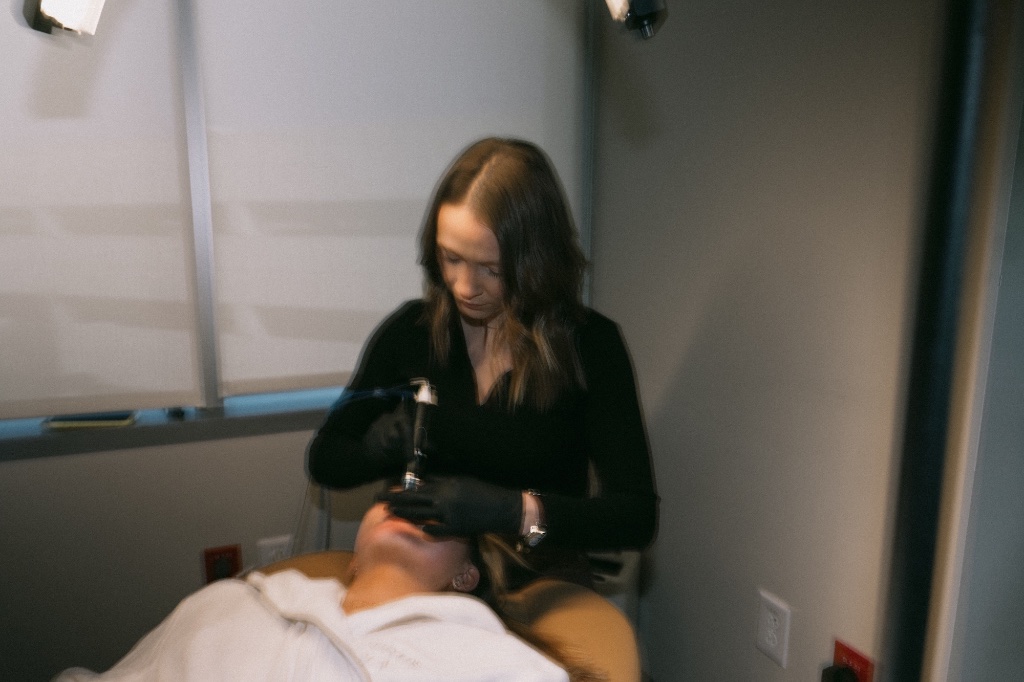
At JOLA Dallas, the approach to GLP-1 and your face begins with the same principle that guides every treatment we offer: the face is a whole structure, not a collection of disconnected areas. This matters especially in the context of GLP-1-related volume loss, where changes tend to be diffuse and multi-area rather than isolated.
Our consultation process evaluates the full face — temples, periorbital region, midface, and lower face — before any treatment recommendation is made. We build a plan around the individual's actual anatomy, the degree of change present, whether weight has stabilized, and what the patient's long-term goals are. We do not apply a standard GLP-1 protocol. We assess, plan, and treat based on what is in front of us.
Treatment options at JOLA for GLP-1-related facial changes may include Sculptra as a biostimulatory foundation; targeted facial balancing with hyaluronic acid filler where structural support is needed; under-eye rejuvenation for periorbital hollowing in appropriate candidates; temple restoration for upper-face framing; and broader regenerative and advanced treatments where skin quality is also a concern.
The goal is never the most treatment possible. It is the most considered treatment possible. Patients who come to JOLA should expect an honest, anatomy-led conversation — including the possibility that the timing is not yet right, or that a conservative first step is more appropriate than a comprehensive plan. That calibration, and the willingness to say "not yet," is itself a form of expertise. See our perspectives on The Art of Restraint and Clinical Fluency for more on how this shapes our approach.
If you are using a GLP-1 medication and have begun to notice facial changes — or if you want to establish a baseline plan before changes occur — we invite you to schedule a consultation at JOLA Dallas.
Frequently Asked Questions
BUILD THE PLAN
Facial Balancing Dallas
Full-face structural planning and proportional restoration.
Sculptra in Dallas
Biostimulatory collagen support — what it is, who it's for.
Temple Hollowing Dallas
What causes temporal volume loss and how it is treated.
Under-Eye Rejuvenation Dallas
Regenerative and injectable options for periorbital hollowing.
Regenerative & Advanced Treatments
PRF, EZ Gel, and structural collagen support at JOLA Dallas.
Treatment Planning
The consultation-led foundation for every JOLA plan.
Sculptra vs Filler Dallas
How to choose between biostimulatory and direct volume support.
The Art of Restraint
Why less is the most refined clinical choice.
JOLA DALLAS
GLP-1 and your face,
planned with care.
At JOLA Dallas, we approach GLP-1-related facial changes through consultation-led, anatomy-first planning — combining biostimulatory support, structural balancing, and long-term thinking to protect and restore natural-looking facial harmony.
214.515.0002