
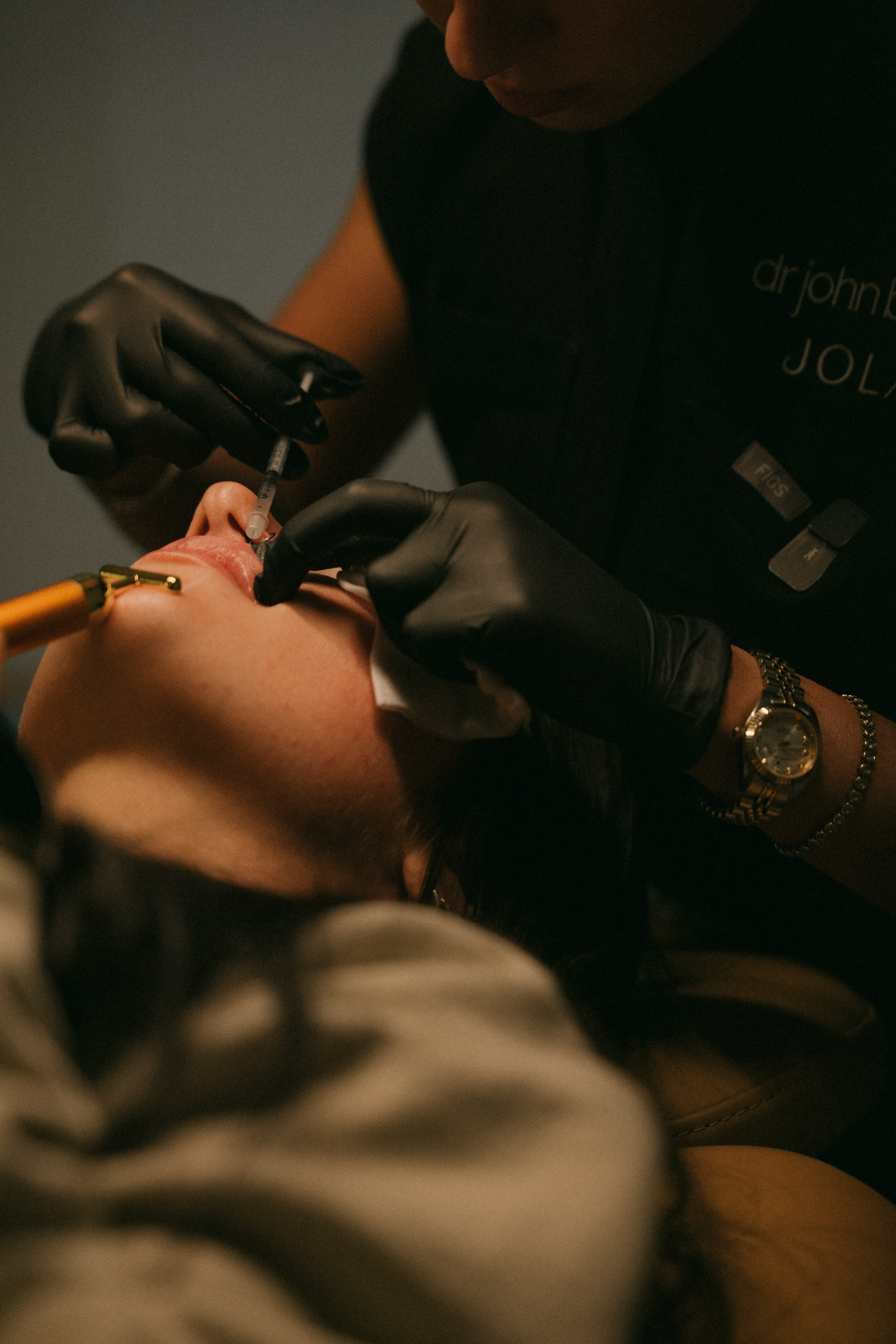
AFTER ACNE / 06
ULTRA LASER DALLAS — JOLA
ULTRA Laser for Acne Marks & Acne Scars: What Can It Actually Improve?
Not everything acne leaves behind is a scar. JOLA Dallas separates color from structure — and structure from surface — before selecting any device.
JOLA DALLAS / HIGHLAND PARK
WHAT DID ACNE LEAVE BEHIND?
Color and scarring are not the same thing.
What Exactly Is an Acne Scar?
A true acne scar involves a structural alteration of the skin following inflammation. When an acne lesion damages tissue deeply enough, the healing process may leave behind a change in the skin's surface — a depression, a raised area, or an irregularity in contour that persists after the inflammation itself has resolved.
This is different from temporary discoloration. A scar is not simply a mark that takes time to fade. It is a change in the architecture of the skin — the surface itself has been altered, which is why directional lighting changes how a scar looks. A scar may be shallow or deep, broad or narrow, soft-edged or sharply defined, depending on the type and depth of the original injury.
Understanding this distinction matters because a structural scar and a color mark are not interchangeable concerns. They involve different layers of the skin, different biological processes, and often different treatment categories.
What Is an Acne Mark?
"Acne mark" is a broad consumer term. It may refer to the brown pigmentation, red discoloration, or other residual color that remains after an acne lesion heals. Unlike a structural scar, a mark does not necessarily involve a change in the skin's surface — the skin may remain relatively flat even though the color has changed.
Brown marks may represent post-inflammatory hyperpigmentation (PIH) — a melanin response to inflammation. Red or pink marks may represent post-inflammatory erythema (PIE) — a vascular response. Both may fade over time, though the timeline varies significantly depending on skin tone, sun exposure, and individual biology.
The term "acne mark" does not automatically mean permanent scarring. But it also does not mean the concern is trivial. Persistent pigmentation or redness can be distressing, and identifying whether a mark is pigment-related or vascular-related is the first step in determining whether a resurfacing laser is even the right category of treatment.
Acne Marks vs. Acne Scars
This is one of the most important distinctions in post-acne treatment. A mark and a scar are not the same thing, and the difference determines which treatment category — if any — is appropriate.
ACNE MARK
PRIMARY CHANGE
Color.
SKIN SURFACE
May remain relatively flat.
POTENTIAL APPEARANCE
Brown, gray-brown, red, pink, or purple depending on biology and skin tone.
ACNE SCAR
PRIMARY CHANGE
Structure.
SKIN SURFACE
May be depressed, tethered, sharply edged, narrow, or raised.
POTENTIAL APPEARANCE
Changes with directional lighting because the skin surface itself has changed.
Color can exist without a scar. A scar can exist without pigment. And both can exist together.
What Are Red Acne Marks?
Red or pink acne marks may represent post-inflammatory erythema (PIE) — a vascular response to inflammation. Unlike brown PIH, which is melanin-related, PIE involves changes in the small vessels near the skin's surface. The result is redness that can persist after the acne lesion has healed.
This distinction matters because red is not simply "lighter pigmentation." A pigment-focused device is not automatically the correct treatment for a vascular concern. A laser that targets melanin may not effectively address vascular redness, and a vascular-targeted device may not address pigment. Using the wrong category of technology for the wrong concern is one of the most common reasons post-acne treatment disappoints.
Red marks may fade over time as vascular changes resolve, but the timeline is different from pigment fading and depends on individual biology, skin tone, and the severity of the original inflammation.
PIH vs. PIE
Post-inflammatory hyperpigmentation and post-inflammatory erythema are two of the most commonly confused post-acne concerns. They look different, they involve different biology, and they may respond to different treatment categories.
PIH
FULL NAME
Post-inflammatory hyperpigmentation.
PRIMARY VISUAL
Brown / darker discoloration.
PRIMARY CATEGORY
Melanin-related pigment.
PIE
FULL NAME
Post-inflammatory erythema.
PRIMARY VISUAL
Red / pink / purple discoloration.
PRIMARY CATEGORY
Vascular / inflammatory redness.
The appearance of PIH and PIE can vary by skin tone. In lighter skin, PIE may appear more visibly pink or red. In deeper skin tones, PIH may present as darker brown or gray-brown marks that are sometimes more persistent. Both can coexist in the same patient, and both can coexist with structural scarring.
BROWN AND RED ARE NOT THE SAME TARGET.
Can You Have PIH and PIE at the Same Time?
Yes. A patient can have both post-inflammatory hyperpigmentation and post-inflammatory erythema simultaneously — different lesions may leave different traces depending on depth, inflammation level, and individual biology.
A patient can also have combinations that include structural scarring: PIH with scarring, PIE with scarring, or PIH and PIE together with scarring. This is why post-acne treatment can require more than one strategy — a single device does not necessarily address pigment, vascular redness, and structural contour changes simultaneously.
When multiple concerns coexist, treatment planning should reflect the mixture. Prioritizing one concern — for example, active acne control — may need to come before addressing pigment or scarring. And different concerns may require different technologies, sequenced appropriately rather than applied all at once.
Rolling Acne Scars
Rolling scars are broad, shallow depressions with undulating, sloped edges. They create a wave-like contour across the skin rather than a sharply defined depression. Their appearance often changes significantly with lighting direction — overhead light may minimize them while side light or raking light makes them far more visible.
Rolling scars may involve tethering — fibrous attachments beneath the skin that pull the surface downward. When tethering is present, a surface resurfacing treatment alone may not fully address the depression because the underlying attachment continues to hold the scar in place. This is why some rolling scars may benefit from a scar-release technique before or alongside resurfacing.
This section is educational, not a self-diagnosis tool. Whether a particular scar involves tethering requires clinical assessment. Do not assume that all broad depressions are rolling scars or that all rolling scars require the same approach.
Boxcar Acne Scars
Boxcar scars are broader depressions with sharply defined, vertical edges. They resemble a rectangular or oval indentation pressed into the skin. Unlike rolling scars, boxcar scars have distinct edges that create a clear transition between the scar floor and the surrounding skin.
Boxcar scars vary in depth — some are shallow, others are deeper. Depth matters for treatment selection because a shallow boxcar scar may respond differently to resurfacing than a deep one. The width and edge definition also influence whether a fractional approach can soften the transition between the scar and surrounding skin.
No single treatment is universally appropriate for every boxcar scar. The treatment plan should reflect the specific scar's depth, width, and edge characteristics.
Ice-Pick Acne Scars
Ice-pick scars are narrow, deep, punctate depressions that resemble a small, sharp instrument pressed into the skin. They are the deepest of the common atrophic scar types and often extend more deeply than their surface width suggests.
Ice-pick scars present a particular challenge for resurfacing. Because they are narrow and deep, a fractional laser that treats the surface may not reach the full depth of the scar or meaningfully alter its architecture. This is why ice-pick scars may require a scar-specific strategy — such as TCA CROSS or other targeted techniques — rather than relying on resurfacing alone.
It would be inaccurate to imply that a fractional laser alone can eliminate ice-pick scars. Scar morphology matters, and narrow, deep scars often require a different approach than broad, shallow ones.
Raised Acne Scars
Raised acne scars — including hypertrophic scars and keloid-type scarring — represent a biologically different category from atrophic scars. Instead of tissue loss, the healing process has produced excess tissue, creating a raised, firm area on the skin's surface.
Raised scars belong to a different treatment conversation. Resurfacing a raised scar with a fractional laser is not automatically appropriate — in some cases, removing surface tissue from a raised scar may not address the underlying biology and could potentially worsen the concern. Raised scars may require approaches that address the proliferative healing response itself.
Patients with raised scarring should not assume that laser resurfacing is the default option. This is why identifying scar type before selecting a device matters — a resurfacing strategy designed for depressed scars is not the same as a strategy for raised scars.
Why Acne Scars Can Look Different in Photos
Photography introduces variables that can make scars appear more or less prominent than they do in person. The lens, angle, and directional lighting all influence how a depression or edge renders. Camera sharpening algorithms can exaggerate texture, while high dynamic range processing may flatten shadows that make scars visible in real life.
Beauty filters can blur texture entirely, making scars disappear in one photo and reappear dramatically in another taken seconds later under different conditions. This does not mean the scar has changed — it means the imaging conditions have.
Understanding this can reduce the anxiety of comparing your skin to photos. Scars are best assessed in consistent, natural lighting by a qualified provider — not by inspecting phone-camera images under varying conditions.
Why Active Acne Matters Before Scar Treatment
If acne is still creating significant new inflammation, scar treatment planning may need to account for ongoing disease activity. New lesions can create new scars, new pigmentation, and new redness — which means that treating existing scars while active acne continues may not be the most efficient use of treatment.
This does not mean every patient must have perfectly clear skin before any scar treatment can begin. Clinical judgment determines when the balance shifts from active acne management to scar treatment. Some patients may benefit from concurrent approaches; others may benefit from prioritizing acne control first.
JOLA does not prescribe acne medication. Acne management should be coordinated with the appropriate medical provider. What JOLA can do is assess whether active inflammation is a factor in treatment timing and help sequence the plan accordingly.
Should You Treat Active Acne or Scars First?
Generally, preventing new scars may be an important part of treatment planning. If active acne continues to create new lesions, each new lesion has the potential to leave additional marks or scarring. Addressing the underlying acne activity first can reduce the total burden of post-acne change that needs to be treated later.
However, the actual sequencing depends on clinical assessment. Some patients have minimal active acne with significant existing scarring — in that case, scar treatment may reasonably proceed. Others have active acne with mild existing marks — in that case, acne control may take priority.
There is no universal rule. The decision should reflect the individual's acne activity, scar severity, skin type, treatment goals, and overall treatment timeline.
How Fractional Laser Resurfacing Works
Fractional laser treatment does not remove the entire skin surface. Instead, it creates a pattern of microscopic treatment columns — tiny zones of treated tissue surrounded by untreated skin. This fractional approach allows the skin to heal from the untreated areas, which can support recovery compared to fully ablative resurfacing.
FRACTIONAL RESURFACING — CONCEPTUAL FLOW
Untreated skin
Fractional columns of treated tissue
Remodeling / resurfacing of treated zones
The healing response after fractional treatment involves renewal of the treated zones. The degree of surface change depends on treatment settings, the number of treatments, and individual healing. This is a conceptual overview — not a claim about specific collagen percentages or scar improvement rates, which should not be invented.
Why Wavelength Matters for Acne Scars
Different lasers are not interchangeable. A laser's wavelength determines what it targets — water, melanin, hemoglobin, or other chromophores — and how deeply the energy penetrates. The ULTRA laser's 1927 nm wavelength targets water in the tissue, which makes it relevant for resurfacing and surface renewal.
Other wavelengths target different chromophores. A vascular-targeted device, for example, interacts with hemoglobin — which is why it may be relevant for red marks (PIE) in ways a water-targeted resurfacing laser is not. A pigment-targeted device interacts with melanin differently than a water-targeted one.
When considering laser for acne scars in Dallas, the question is not simply "which laser is best?" but "which wavelength targets the concern I actually have?" Target, depth, skin type, scar morphology, and downtime all factor into the answer.
ULTRA for Acne Marks
"Acne marks" is not one indication. Brown marks and red marks involve different biology, and a resurfacing laser does not automatically address both. To discuss ULTRA for acne marks meaningfully, we must separate brown marks from red marks from structural scarring.
ULTRA's 1927 nm non-ablative fractional mechanism is primarily a resurfacing and surface-renewal approach. Where it may be relevant for post-acne marks depends on whether the mark is pigment-related, vascular-related, or something else entirely. Using "acne marks" as a single category obscures the fact that different marks may require different technologies.
The sections that follow separate brown marks, red marks, and each structural scar type so that ULTRA's potential role can be evaluated honestly for each.
ULTRA for Brown Post-Acne Marks
Brown post-acne marks — post-inflammatory hyperpigmentation — involve excess melanin deposited after inflammation. A fractional resurfacing laser like ULTRA may play a role in selected PIH concerns where surface renewal and pigment management are appropriate, depending on skin type, PIH severity, and treatment history.
However, PIH can also be worsened by additional inflammation — including from laser treatment itself. This is why skin type, PIH history, and treatment settings matter. A patient who develops dark marks easily after inflammation may need a more conservative approach, different settings, or a different treatment category entirely.
For a full discussion of PIH, pigment mechanisms, and where ULTRA fits, see our ULTRA laser pigmentation guide. This article does not attempt to replicate that discussion — it connects the pigmentation conversation to the post-acne context.
ULTRA for Red Post-Acne Marks
Red post-acne marks — post-inflammatory erythema — involve vascular changes, not melanin. A resurfacing laser that targets water in tissue is not inherently a vascular treatment. This is a critical distinction: using a pigment or resurfacing device for a vascular concern may not address the redness effectively.
If red marks are the primary concern, a vascular-targeted device — one that interacts with hemoglobin — may be more appropriate than a resurfacing laser. This is not a failure of ULTRA; it is a recognition that different concerns require different technologies.
This is a trust-building section. JOLA will not recommend ULTRA for red marks if a vascular approach is more appropriate. The goal is the right treatment, not the use of a particular device.
ULTRA for Rolling Scars
Rolling scars involve broad, undulating depressions that may include tethering beneath the skin. When tethering is present, a surface resurfacing treatment alone may not fully address the depression because the underlying attachment continues to hold the scar down.
A fractional laser like ULTRA may contribute to surface texture improvement in areas with rolling scarring, but it should not be positioned as a standalone solution for tethered rolling scars. Some rolling scars may benefit from a scar-release technique (such as subcision) before or alongside resurfacing.
Not all rolling scars respond equally. The scar architecture, tethering, skin type, and treatment history all influence whether resurfacing alone is sufficient or whether a combined approach is more appropriate.
ULTRA for Boxcar Scars
Boxcar scars have defined edges and variable depth. The width, depth, and edge sharpness all influence whether a fractional resurfacing approach can meaningfully soften the transition between the scar floor and the surrounding skin.
Shallow boxcar scars may respond differently to resurfacing than deep ones. A shallow scar with soft edges may benefit from surface renewal more than a deep scar with sharp, vertical walls. No universal promise can be made — the treatment plan should reflect the specific scar's characteristics.
ULTRA may play a role in selected boxcar scar cases where surface resurfacing is appropriate, but it should not be expected to eliminate deeper structural depressions on its own.
ULTRA for Ice-Pick Scars
Ice-pick scars are narrow and deep — the most challenging of the common atrophic scar types for resurfacing. A fractional laser that treats the surface may not reach the full depth of an ice-pick scar or meaningfully alter its narrow, deep architecture.
This is why ice-pick scars may require a scar-specific strategy — such as TCA CROSS or other targeted techniques — rather than relying on resurfacing alone. It would be inaccurate to claim that ULTRA alone can eliminate ice-pick scars.
A conservative approach is appropriate here. If ice-pick scars are the primary concern, the treatment plan should reflect their specific morphology — which may mean a different approach than a fractional laser.
ULTRA for Mixed Acne Scarring
Mixed acne scarring is likely the most common real-world presentation. A patient may have rolling and boxcar scars together, boxcar and ice-pick scars together, pigment and scars together, redness and scars together, or visible pores and scars together — or several of these simultaneously.
When multiple scar types and concerns coexist, treatment planning should reflect the mixture. A single device does not need to address every component. ULTRA may play a role in the resurfacing component of a mixed plan while other techniques address tethering, deep scars, vascular redness, or active acne.
This is why combination treatment exists — not because one device is insufficient, but because different components of post-acne change require different approaches.
Can Laser Completely Remove Acne Scars?
The word "remove" is not accurate for acne-scar treatment. The goal of acne-scar treatment is generally to improve scar appearance, texture, transition, and overall skin quality — not to promise restoration to skin that never had acne.
A scar represents a structural change in the skin. Treatment can soften the appearance of that change, improve the transition between scar and surrounding skin, and support surface quality — but the skin's history cannot be erased. This is not a limitation unique to ULTRA; it applies to every acne-scar treatment modality.
IMPROVEMENT IS A MEDICAL GOAL. ERASURE IS A MARKETING PROMISE.
ULTRA vs. RF Microneedling for Acne Scars
ULTRA delivers laser energy. RF microneedling combines physical needles with radiofrequency energy delivered through the needle tips. The mechanisms are fundamentally different — one is light-based resurfacing, the other is needle-delivered radiofrequency.
Different mechanisms mean different depth profiles, different tissue interactions, and different treatment considerations. RF microneedling may reach different depths than a non-ablative fractional laser and may be selected for different scar presentations.
The choice between ULTRA and RF microneedling for acne scars depends on scar type, depth, skin type, and treatment goals — not on which technology is universally "better."
ULTRA vs. Morpheus8 for Acne Scars
Morpheus8 is a branded RF microneedling platform. ULTRA is a laser. These are different technology categories — Morpheus8 uses needles plus radiofrequency energy, while ULTRA uses 1927 nm laser light for fractional resurfacing.
Comparing them is not about declaring a winner. It is about understanding which technology fits the specific scar presentation. A patient with primarily surface texture and pigment concerns may have a different conversation than a patient with deeper structural scarring.
For more on the RF microneedling conversation, see our RF microneedling comparison. For the full ULTRA vs. Morpheus8 comparison for acne scars, read the dedicated mechanism study.
ULTRA vs. CO2 for Acne Scars
CO2 laser resurfacing represents a more ablative category than ULTRA's non-ablative fractional approach. CO2 lasers — depending on the device and settings — remove more tissue, which can mean more significant surface change but also more significant recovery, risk, and downtime.
The comparison involves intensity, recovery, scar type, skin-tone considerations, and risk. A more aggressive treatment is not automatically a better treatment — particularly for patients with PIH history or deeper skin tones, where more aggressive resurfacing can carry higher pigmentation risk.
ULTRA and CO2 are not equivalent treatments and should not be expected to produce equivalent outcomes. The choice depends on scar severity, skin type, downtime tolerance, and risk profile.
ULTRA vs. Fraxel for Acne Scars
Fraxel is a brand family, not a single generic laser. The Fraxel platform includes multiple devices with different wavelengths and mechanisms. A technically accurate comparison depends on which specific Fraxel device and wavelength is being discussed.
ULTRA's 1927 nm thulium wavelength is a specific, identifiable technology. Comparing it to "Fraxel" without specifying which Fraxel device is not technically meaningful — different Fraxel devices target different chromophores and depths.
If you are comparing ULTRA to a specific Fraxel device, the comparison should be based on that device's exact wavelength, fractional mechanism, and tissue interaction — not on the brand name alone. For the full ULTRA vs. Fraxel comparison, read the dedicated specification guide.
ULTRA vs. Chemical Peels for Post-Acne Skin
Chemical peels and fractional lasers address different aspects of post-acne skin. Peels involve a chemical solution applied to the skin to promote exfoliation and surface renewal; ULTRA uses laser energy to create fractional treatment zones.
Peels may be relevant for pigmentation and surface texture depending on depth and formulation. They are not a structural scar-remodeling procedure — a peel does not repair deep structural depressions. For pigment and surface concerns, both peels and lasers may have roles; for structural scarring, the conversation is different.
Skin-tone considerations matter for both. Deeper peels carry PIH risk in some skin types, and laser settings must also account for pigmentation biology. For more on peels, see our chemical peels guide.
ULTRA vs. HydraFacial for Acne Marks
HydraFacial belongs to a different category entirely. It is a surface-level treatment focused on cleansing, exfoliation, and hydration — not a resurfacing or scar-remodeling procedure. It may support surface maintenance depending on protocol, but it is not a structural treatment.
A HydraFacial will not remodel acne scars. It will not address PIH at the level a resurfacing laser might. It may, however, play a role in ongoing skin maintenance between more substantive treatments.
Comparing ULTRA and HydraFacial for acne scars is somewhat like comparing a resurfacing procedure to a facial — they answer different questions. For more on HydraFacial, see our HydraFacial guide.
ULTRA vs. XERF for Acne Scars
ULTRA and XERF answer fundamentally different questions. ULTRA is a resurfacing and texture conversation — a fractional laser for surface renewal. XERF is a radiofrequency skin-tightening conversation — focused on firmness and laxity, not on surface resurfacing or acne scars.
XERF is not an acne-scar laser. It does not target pigment, vascular redness, or structural scarring. Forcing XERF into a scar-treatment conversation would be inappropriate.
However, a patient may have both acne scarring and facial laxity as two separate concerns. In that case, the treatment plan may address each independently — ULTRA or another resurfacing approach for the acne-scarring component, and XERF for the firmness component. These are different conversations, not competing treatments.
For more on XERF, see our XERF laser guide.
What About Subcision?
Some tethered depressed scars — particularly rolling scars with fibrous attachments beneath the skin — may be treated using techniques designed to release those underlying attachments. Subcision is one such concept: releasing the tethering that holds a scar downward, allowing the surface to elevate.
Not every rolling scar needs subcision. Whether subcision is appropriate depends on whether tethering is present, the scar's architecture, and the overall treatment plan. This is a clinical assessment — not a self-diagnosis determination.
This section is educational. JOLA does not provide procedural instructions or imply that every depressed scar requires subcision. The concept is included here because understanding that tethering exists helps explain why surface resurfacing alone may not always be sufficient.
What About TCA CROSS?
TCA CROSS is a technique that may be considered for selected narrow, deep scars — particularly ice-pick scars. It involves applying a chemical agent to the base of a deep scar to promote a localized healing response.
This is a scar-specific strategy that addresses the morphology of narrow, deep scars in a way that surface resurfacing alone may not. It is not appropriate for every scar type and is not a substitute for resurfacing where resurfacing is indicated.
JOLA does not provide concentrations, technique details, or DIY guidance. This section exists to explain why ice-pick scars may require a different approach than a fractional laser — and why scar morphology determines treatment selection.
What About Dermal Filler for Acne Scars?
Selected depressed scars may sometimes be approached with structural treatment — dermal filler — depending on anatomy and provider assessment. Filler may provide temporary elevation of a depressed scar by adding volume beneath it.
This is not a general acne-scar solution. Standard facial filler is not designed to treat acne scarring broadly, and not every depressed scar is appropriate for filler. The decision depends on scar type, depth, location, and the patient's overall treatment plan.
Filler for acne scars is typically temporary and may be used as part of a combination approach — for example, after subcision to support elevation of a released scar. For more on facial filler, see our filler guide.
Why Combination Treatment Exists
Different treatments answer different components of post-acne change. No single modality needs to "do everything" — and expecting one device to address pigment, vascular redness, structural scarring, tethering, and active acne simultaneously is not realistic.
COLOR
Pigment / vascular strategy
SURFACE
Resurfacing strategy
TETHERING
Scar-release strategy
DEPTH
Scar-specific approach
ACTIVE ACNE
Acne-management strategy
A patient with PIH, rolling scars, and active acne may need three different conversations — not one device that does everything. Combination treatment exists because real post-acne presentations are usually mixed.
Why More Aggressive Is Not Automatically Better
More aggressive treatment carries more risk — more downtime, higher PIH risk, longer recovery, and potentially more complications. For acne-scar treatment, aggressive is not automatically better. The right treatment is the one that fits the scar, the skin type, and the patient's goals and healing capacity.
A patient with PIH history may be poorly suited to aggressive resurfacing. A patient with minimal scarring may not need aggressive treatment at all. A patient with deep ice-pick scars may need a scar-specific approach rather than aggressive surface resurfacing.
The best scar treatment is not the most aggressive treatment. It is the one that fits the scar.
Why Skin Tone Matters
Skin tone influences how laser energy interacts with the skin. Melanin absorbs light — which means that patients with more active melanin production may have different considerations for laser treatment than patients with less. Wavelength selection, energy settings, preparation, and recovery monitoring all factor into safe treatment across skin types.
PIH susceptibility is particularly relevant. Patients who develop dark marks easily after acne, scratches, irritation, peels, or previous laser treatments may need a more conservative approach — lower settings, more treatments, longer intervals, or a different treatment category.
This is not about excluding any skin type from treatment. It is about matching the technology and protocol to the skin's biology so that treatment does not create the pigmentation it was intended to improve.
Acne Scar Treatment in Darker Skin Tones
Acne-scar treatment can be possible in darker skin tones, but the technology and protocol should account for pigment biology and PIH risk. A non-ablative fractional approach like ULTRA's 1927 nm wavelength may be considered for various skin types, but settings, preparation, and aftercare should be adjusted appropriately.
JOLA does not claim universal safety for every skin type. Treatment decisions for darker skin tones should involve careful assessment of PIH history, current skin condition, treatment goals, and the specific scar presentation. Conservative settings and careful post-treatment monitoring may be appropriate.
The goal is not to avoid treating darker skin tones — it is to treat them with the same standard of care and precision that any patient deserves, with protocol adjusted for pigment biology.
Why PIH History Matters
If someone develops dark marks easily after acne, scratches, irritation, peels, lasers, or inflammation, that history should be discussed before any laser treatment. PIH history is one of the most important factors in determining whether resurfacing is appropriate and at what intensity.
A patient with significant PIH history may still be a candidate for laser treatment — but the approach may need to be more conservative, with careful attention to settings, skin preparation, sun protection, and post-treatment monitoring. Pretreatment with appropriate skincare may also be relevant.
Disclosing PIH history is not a reason to be denied treatment. It is information that helps the provider design a safer, more appropriate plan.
Can Laser Make Acne Marks Darker?
Yes — laser treatment can cause post-inflammatory pigmentation, particularly in patients with PIH history or deeper skin tones. Any treatment that creates inflammation in the skin has the potential to trigger melanin response, which is why settings, skin preparation, and aftercare matter.
This is not a reason to avoid laser treatment. It is a reason to approach it carefully — with appropriate settings for the skin type, proper preparation, sun protection, and post-treatment monitoring. A conservative approach in a patient with PIH risk may be more appropriate than an aggressive one.
This is also why identifying whether a mark is pigment (PIH) or vascular (PIE) before treatment matters. Treating a vascular concern with a resurfacing laser that triggers PIH would be counterproductive — the redness may not improve and new pigmentation may appear.
Can Laser Make Acne Scars Worse?
Inappropriate treatment can create complications — additional inflammation, pigmentation, prolonged redness, or other unwanted outcomes. This is why treatment selection should match the scar type, skin type, and individual circumstances rather than applying a one-size-fits-all approach.
For example, aggressively resurfacing a raised scar may not address the underlying biology. Resurfacing over active acne may irritate lesions. Treating a tethered scar with surface resurfacing alone may not improve the depression. These are not reasons to avoid treatment — they are reasons to identify the concern correctly before selecting a device.
Current evidence supports careful, individualized treatment planning over blanket approaches. The risk of worsening is reduced when the treatment fits the concern.
What About Isotretinoin / Accutane History?
Patients should disclose current isotretinoin use, recent isotretinoin use, healing history, and acne-treatment history to their provider. Isotretinoin affects skin healing and oil production, which can be relevant to laser treatment planning.
Current evidence, manufacturer guidance, and JOLA protocol should guide any waiting period between isotretinoin use and laser treatment. JOLA does not automatically repeat outdated blanket rules — such as a specific mandatory waiting period — unless current evidence and protocol support that exact requirement for the specific treatment and patient.
The key message is disclosure. Your provider needs to know your full acne-treatment history — including oral medications — to plan safely. This information is not used to deny treatment; it is used to time and calibrate it appropriately.
What About Tretinoin, Retinol, Benzoyl Peroxide and Acids?
Active skincare should be disclosed before laser treatment. Products such as tretinoin, retinol, benzoyl peroxide, exfoliating acids, and other active ingredients can affect skin sensitivity and healing, which may be relevant to treatment timing and settings.
JOLA follows current protocol — not invented discontinuation periods. Whether specific products should be paused, and for how long, depends on the product, the treatment, the skin's condition, and the individual treatment plan. This should be discussed during the consultation.
Do not self-adjust your skincare routine before a scheduled laser treatment without consulting your provider. The consultation is where these details are addressed — not guessed at home.
What Does ULTRA Feel Like?
ULTRA treatment involves a laser handpiece passing across the treatment area. Patients may feel a sensation of heat and mild discomfort during the passage of the laser. The sensation is generally described as tolerable but noticeable — not painless.
Individual experience varies based on treatment area, settings, and personal sensitivity. JOLA does not assign invented pain scores. The sensation is discussed during the consultation so patients know what to expect before treatment begins.
Does ULTRA Require Numbing?
Topical numbing is typically used for ULTRA treatment at JOLA to support patient comfort. Whether numbing is used, and for how long it is applied, follows current JOLA protocol and depends on the treatment area, settings, and individual circumstances.
Numbing does not eliminate all sensation — patients may still feel warmth and pressure during treatment. The goal of numbing is to make the experience manageable, not to render the skin completely without sensation.
What Does Post-ULTRA Skin Look Like?
After ULTRA treatment, the skin typically appears red and may feel warm or sensitive — similar to a mild sunburn sensation. Depending on settings and individual response, mild swelling may occur. These are expected responses to fractional laser treatment.
In the days following treatment, microscopic treatment zones may create a fine pattern on the skin's surface — sometimes described as micro-crusting or MENDs (microscopic epidermal necrotic debris) — which typically resolves as the skin heals. This is specific to ULTRA's non-ablative fractional mechanism and should not be confused with the recovery description of ablative lasers like CO2.
JOLA does not borrow recovery descriptions from CO2, Fraxel, IPL, BBL, or RF microneedling. The recovery information provided here is specific to ULTRA's 1927 nm non-ablative fractional mechanism.
How Much Downtime Does ULTRA Have for Acne Scars?
ULTRA's non-ablative fractional approach is generally associated with less downtime than fully ablative resurfacing. Patients can typically expect redness and mild sensitivity for a period after treatment, with the micro-pattern resolving over several days.
Treatment intensity may influence visible recovery — higher settings may produce more redness or a longer healing phase than conservative settings. The specific downtime depends on the treatment plan, settings, treatment area, and individual healing.
JOLA provides specific recovery guidance during the consultation based on the individual treatment plan, not generic downtime estimates that may not apply to every patient.
When Will Acne Scars Look Different?
Surface healing occurs first — redness, sensitivity, and the micro-pattern typically resolve over the initial days after treatment. Early visible change in skin quality may become apparent as the surface heals.
Deeper remodeling — where supported by the treatment — may happen on a different timeline than surface healing. The full visible change from a treatment series may develop over weeks to months, depending on the number of treatments, the scar type, and individual healing.
JOLA does not promise exact improvement dates. The timeline is discussed during the consultation based on the specific treatment plan and scar presentation.
How Many ULTRA Treatments for Acne Scars?
The number of ULTRA treatments appropriate for acne scars depends on scar type, scar depth, severity, skin type, treatment intensity, individual response, and treatment goals. JOLA does not provide a universal treatment count — the plan is individualized.
A patient with mild surface texture and PIH may have a different treatment count than a patient with mixed structural scarring and pigmentation. A patient with PIH history may need a more conservative, multi-treatment approach rather than fewer aggressive sessions.
The treatment count is determined during the consultation and may be adjusted based on how the skin responds. Treatment intervals follow JOLA protocol and are not invented here.
Can One ULTRA Treatment Fix Acne Scars?
Acne-scar treatment is often a process rather than a single-event correction. One treatment may produce visible change in surface quality, but expecting a single session to fully address structural scarring, pigmentation, and texture simultaneously is not realistic for most presentations.
Some patients with mild concerns may see meaningful change after fewer treatments. Patients with mixed or deep scarring may need a series of treatments, potentially combined with other modalities, to achieve their goals.
The consultation provides a realistic treatment plan — not a promise that one session will resolve everything.
How Long Do Acne-Scar Results Last?
Structural improvements — changes in scar contour or surface texture — may differ in longevity from pigment clearance. Pigment can recur with new inflammation or sun exposure; structural changes to scar contour tend to be more stable but are not necessarily permanent.
Acne can also create new scars if active disease continues. A patient who achieves improvement in existing scars may develop new ones if acne remains active — which is why acne management may be an important part of long-term scar treatment planning.
JOLA does not claim permanent results without evidence. Longevity is discussed during the consultation based on the specific treatment, scar type, and ongoing acne activity.
The JOLA Scar Map
JOLA's eight-step framework for post-acne treatment planning. Each step builds on the previous one — the device comes last, not first.
HISTORY
What did the acne do?
COLOR
Brown? Red? Neither?
SURFACE
Flat? Depressed? Raised?
MORPHOLOGY
Rolling? Boxcar? Ice-pick? Mixed?
SKIN
How does this skin respond to inflammation?
CATEGORY
Pigment? Vascular? Resurfacing? Structural? Combination?
TECHNOLOGY
Choose the device after identifying the problem.
REASSESS
What changed?
SCAR TREATMENT IS NOT ONE PROCEDURE. IT IS A PROCESS OF IDENTIFICATION.
The Scar Should Determine the Treatment — Not the Device Menu.
Chey Cope, Laser Specialist at JOLA Dallas, approaches post-acne laser planning by first identifying what acne actually left behind — not by starting with a device. Post-acne laser planning may account for:
Active acne
Acne history
Scar morphology
Pigment
Redness
Skin tone
PIH history
Isotretinoin history
Previous lasers
Previous microneedling
Previous RF microneedling
Previous peels
Current skincare
Sensitivity
Downtime tolerance
Treatment goals
The consultation exists to identify these factors before any device is selected. The goal is not to find a reason to use ULTRA — it is to find the right treatment for what acne left behind.
Why JOLA May Not Recommend ULTRA
Not every patient who asks about ULTRA for acne scars should receive ULTRA. There are clinically supported reasons why ULTRA may not be the right recommendation:
The concern is primarily vascular
Active acne should be addressed first
The scar is too deep for the proposed resurfacing strategy
Scar tethering requires another approach
The patient has raised scarring requiring different management
Another laser or treatment category better fits the concern
Skin condition or recent treatment changes candidacy
The "scar" is actually pigmentation
The concern is minimal and treatment is unnecessary
THE GOAL IS NOT TO FIND A REASON TO USE ULTRA. THE GOAL IS TO FIND THE RIGHT TREATMENT.
30 Questions to Ask Before Laser for Acne Scars
A saveable checklist for your consultation. Print it, screenshot it, or bring it with you.
Do I actually have acne scars?
Are these acne marks instead?
Are my marks brown or red?
Do I have PIH?
Do I have PIE?
Do I have structural scarring?
What type of acne scars do I have?
Are they rolling scars?
Are they boxcar scars?
Are they ice-pick scars?
Do I have more than one scar type?
Is my acne still active?
Should active acne be addressed first?
Why are you recommending ULTRA?
What does ULTRA target?
What wavelength does ULTRA use?
Is ULTRA fractional?
Is ULTRA ablative or non-ablative?
Does my skin tone affect the plan?
Does my PIH history affect the plan?
Does my isotretinoin history matter?
Does my current skincare matter?
Would microneedling be more appropriate?
Would RF microneedling be more appropriate?
Does my scar need a structural treatment?
What will recovery look like?
How many treatments may be appropriate?
What improvement is realistic?
What will probably NOT change?
Would another treatment or no treatment be more appropriate?
ULTRA Laser for Acne Marks & Acne Scars: The Bottom Line
Acne marks and acne scars are different. A mark changes color; a scar changes structure. Some patients have both.
Brown marks may represent post-inflammatory hyperpigmentation — a melanin response. Red marks may represent post-inflammatory erythema — a vascular response. PIH and PIE are different targets, and a pigment-focused device is not automatically a vascular treatment.
Pigment and scarring can coexist. A patient may have brown marks alongside rolling scars, or red marks alongside boxcar scars, or several concerns simultaneously. This is why post-acne treatment can require more than one strategy.
Rolling, boxcar, and ice-pick scars are different morphologies with different treatment considerations. Rolling scars may involve tethering; boxcar scars vary in depth and edge definition; ice-pick scars are narrow and deep and may require a scar-specific approach rather than resurfacing alone. Raised scars belong to a different treatment conversation entirely.
Scar morphology matters. Scar depth matters. Skin tone matters. PIH history matters. Active acne matters. Isotretinoin history should be disclosed. Current skincare matters. All of these factors influence whether ULTRA — or any single device — is appropriate for a specific patient's post-acne concerns.
The ULTRA laser may play a role in selected post-acne concerns where surface resurfacing is appropriate — including some pigment concerns and some texture concerns. It should not be positioned as a universal acne-scar treatment. It is not a vascular device. It is not a scar-removal device. And it is not a treatment for active acne.
Acne scars cannot responsibly be promised to disappear completely. Improvement is a more accurate goal than erasure. Brown marks and red marks may require different technologies. Deeper scars may require other approaches — subcision, TCA CROSS, filler, or a combination strategy.
ULTRA and microneedling are different. ULTRA and RF microneedling are different. ULTRA and Morpheus8 are different. ULTRA and CO2 are different. ULTRA and Fraxel depend on which Fraxel device is being discussed. ULTRA and XERF answer different questions entirely — one is resurfacing, the other is radiofrequency firmness.
Aggressive treatment is not automatically better. Sometimes ULTRA is appropriate. Sometimes another modality is appropriate. Sometimes acne control should come first. And sometimes treatment is unnecessary — the concern is minimal and does not warrant intervention.
If you are searching for the best laser for acne scars in Dallas, start with one question: is it actually a scar?
Look at what acne left behind. Brown? Red? Flat? Depressed? Raised? Rolling? Boxcar? Ice-pick? Mixed?
Because "acne scars" is not one diagnosis. And one device should not be expected to solve every trace acne leaves behind.
At JOLA Dallas, treatment begins by separating color from structure, and surface from depth.
WHAT DID ACNE LEAVE BEHIND?
01
BROWN MARKS
Explore ULTRA for Pigmentation.
02
RED MARKS
Learn PIH vs PIE.
03
TEXTURE + PORES
Explore ULTRA for Skin Texture.
04
STRUCTURAL SCARRING
Explore Acne Scar Treatment Planning.
05
SUN DAMAGE
Explore ULTRA for Sun Damage.
06
FIRMNESS
Explore XERF.
07
NEW TO ULTRA?
Read the Complete ULTRA Guide.
08
NOT SURE WHAT YOU HAVE?
Explore Aesthetic Consultation.
ULTRA VS CO₂ FOR ACNE SCARS
Non-ablative vs. ablative resurfacing — which mechanism fits the scar?
READ THE ULTRA VS CO₂ COMPARISONTHE SURFACE STUDY
K-LUXE for Pigmentation, Texture & Pores.
Skin quality is a category, not a diagnosis. Read JOLA Dallas's guide to the ULTRA side of K-LUXE — and why not every skin concern needs both technologies.
K-LUXE FOR SKIN QUALITY →