
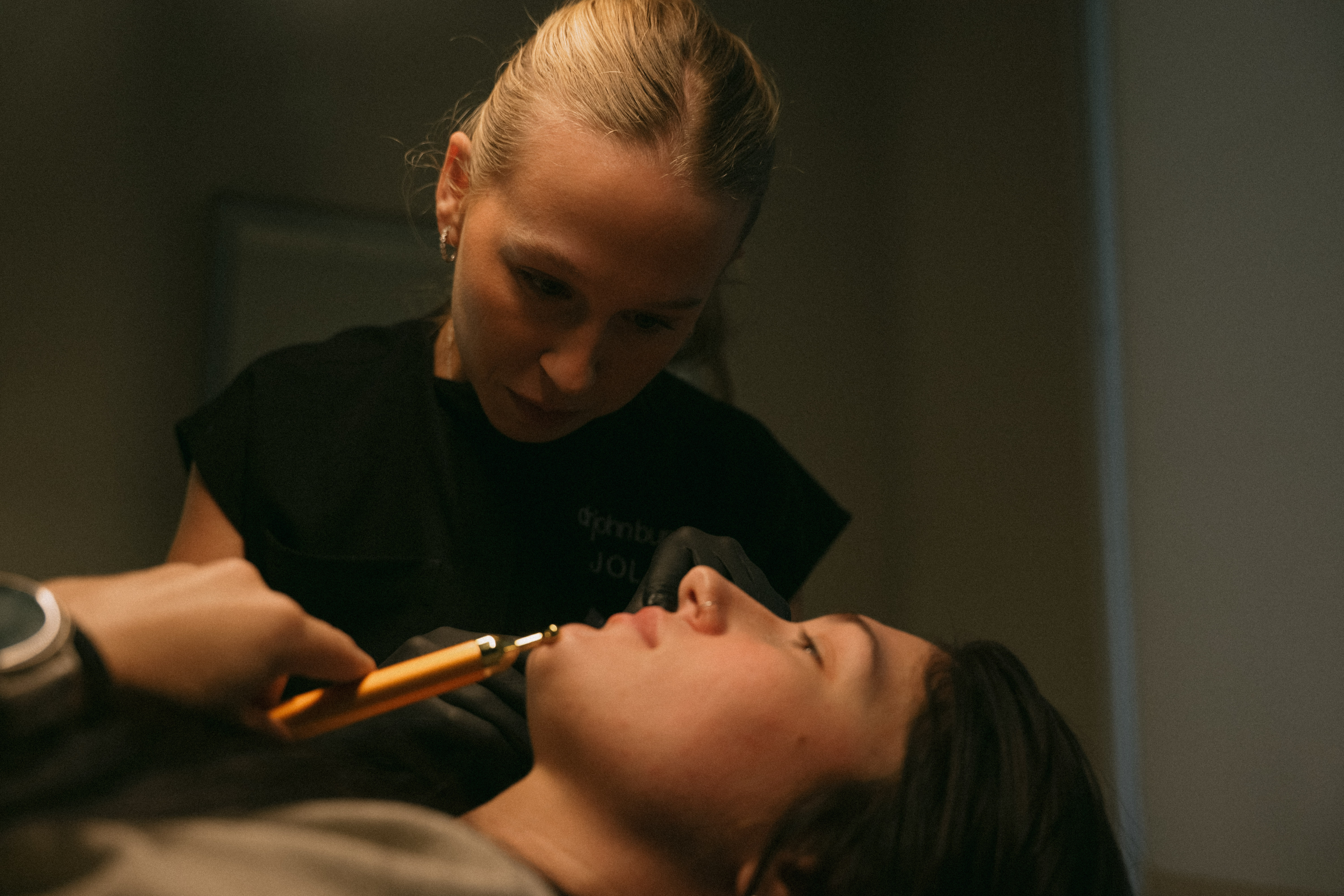
SURFACE
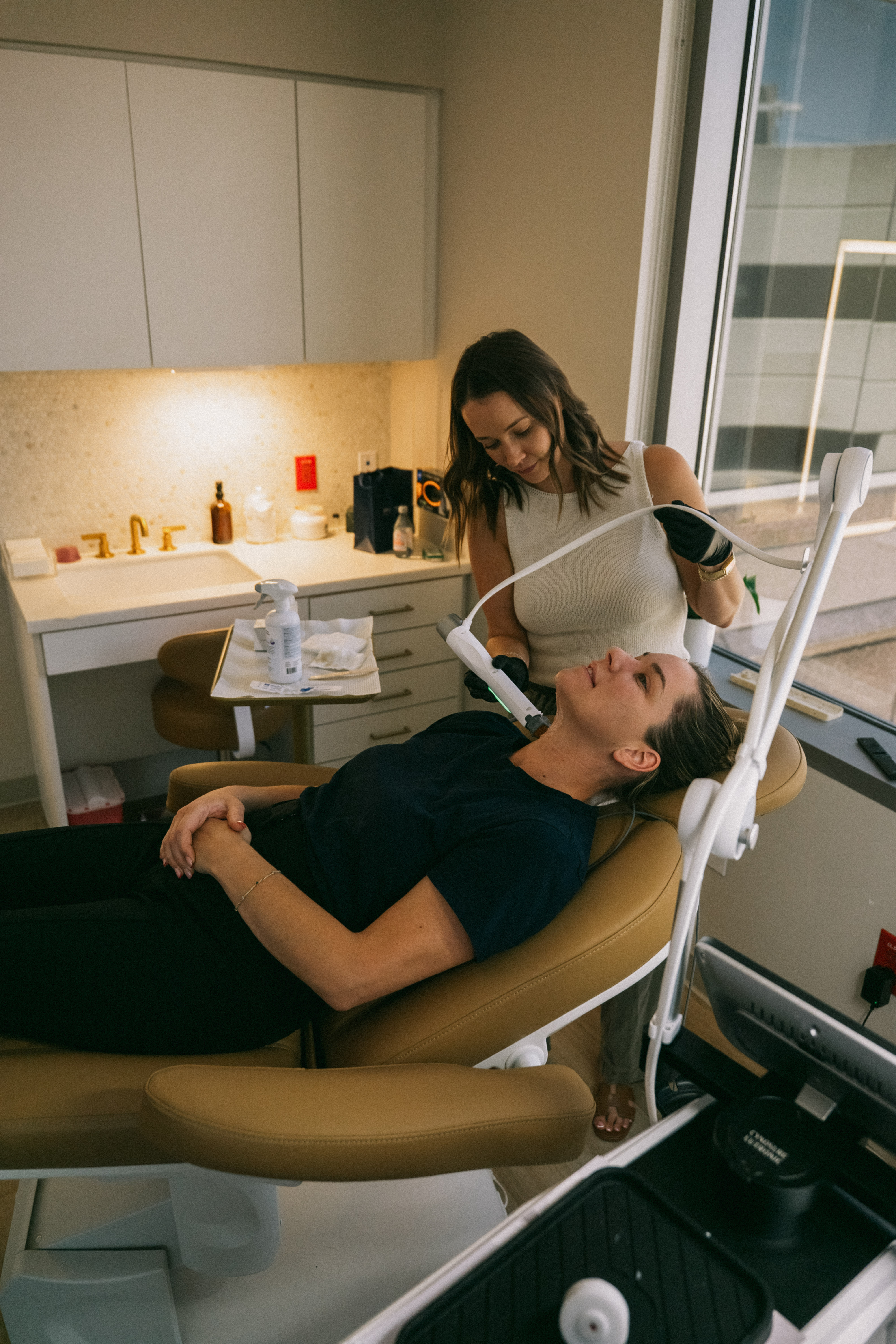
STRUCTURE
JOLA DALLAS
SURFACE /
STRUCTURE
Laser and microneedling create change through different mechanisms.
ULTRA Laser vs. Microneedling: Which Is Better?
Neither is universally better. The ULTRA laser uses laser energy at a specific wavelength — 1927 nm fractional thulium — to create controlled thermal microzones in the skin. Traditional microneedling uses fine sterile needles to create controlled mechanical micro-injury without laser or radiofrequency energy. The right choice depends on the concern, the depth, skin tone, pigment history, scar type, desired recovery, and treatment goals. At JOLA Dallas, in Highland Park, that matching begins with a consultation — not with the device.
Laser uses light. Microneedling uses needles. The target determines which mechanism makes more sense. This article is specifically about traditional, standard microneedling without radiofrequency — not RF microneedling or Morpheus8, which are a separate category with their own ULTRA vs. Morpheus8 comparison.
ULTRA
METHOD
Laser energy
1927 nm fractional thulium wavelength delivered in a patterned microzone array.
MICRONEEDLING
METHOD
Mechanical micro-injury
Fine sterile needles create controlled channels in the skin without laser or RF energy.
THE QUESTION IS NOT
Which sounds more advanced?
THE QUESTION IS
What are we trying to change?
LASER USES LIGHT. MICRONEEDLING USES NEEDLES. THE TARGET DETERMINES WHICH MECHANISM MAKES MORE SENSE.
What Is the ULTRA Laser?
The ULTRA laser — also known as LaseMD Ultra — is a non-ablative fractional thulium laser manufactured by Cynosure Lutronic that uses a 1927 nm wavelength to deliver fractional laser energy into the skin. The wavelength has a strong affinity for water in tissue, and the fractional pattern creates treated microzones surrounded by untreated skin that supports recovery. ULTRA is classified as a non-ablative fractional laser, meaning it treats tissue without the same degree of surface removal as an ablative device.
ULTRA's FDA-cleared indications include coagulation of soft tissue, treatment of actinic keratosis, and treatment of benign pigmented lesions such as lentigos, solar lentigos, and ephelides. In practice, it is commonly used for a broader set of skin-quality concerns including uneven tone, sun-related pigment, texture, pore appearance, and early photoaging. For the full foundational guide, read the complete ULTRA laser guide.
Device
ULTRA (LaseMD Ultra)
Manufacturer
Cynosure Lutronic
Wavelength
1927 nm (thulium)
Classification
Non-ablative fractional laser
Mechanism
Fractional laser energy — patterned thermal microzones
What Is Microneedling?
Traditional microneedling — sometimes called collagen induction therapy — is a mechanical skin treatment that uses a device with fine, sterile needles to create controlled micro-injuries in the skin. These micro-channels trigger a wound-healing response that may support collagen remodeling and skin repair over time. The treatment does not use laser energy, light energy, or radiofrequency energy. The mechanism is purely mechanical.
Needle depth can be adjusted depending on the device, the area being treated, and the concern. The evidence base for microneedling includes studies on acne scars, texture, and skin quality, though results vary by individual, device, needle depth, number of sessions, and the specific concern being addressed. Microneedling is not one uniform protocol — devices, needle counts, depths, and techniques differ.
It is important to understand what microneedling is not. It is not a laser. It is not RF microneedling. It is not Morpheus8. These terms are sometimes used loosely in marketing, but they describe fundamentally different mechanisms. Conflating them leads to confused treatment decisions.
Microneedling vs. RF Microneedling
This distinction is essential. Standard microneedling, RF microneedling, and laser are three different categories. They should not be used interchangeably. If a patient is told they are getting "microneedling," the question to ask is whether the device adds radiofrequency energy — because that changes the mechanism, the tissue interaction, and the treatment conversation.
STANDARD MICRONEEDLING
RF MICRONEEDLING
ULTRA
For RF microneedling comparisons — including Morpheus8, which is a specific RF microneedling platform — read the dedicated ULTRA vs. Morpheus8 comparison. This article focuses on traditional microneedling without RF.
THREE CATEGORIES. THREE DIFFERENT MECHANISMS.
The Mechanism Study
The comparison below reflects the fundamental differences in how ULTRA and traditional microneedling interact with tissue. These are not minor variations — they are different energy sources, delivery methods, and tissue interactions.
SPEC
ULTRA
MICRONEEDLING
ENERGY SOURCE
Laser (1927 nm thulium)
None — mechanical only
DELIVERY
Fractional laser energy — patterned microzones
Fine needles creating physical channels
NEEDLES
No
Yes
WAVELENGTH
1927 nm
N/A
FRACTIONAL PATTERN
Yes — treated zones surrounded by untreated skin
Needle pattern — varies by device
SKIN-BARRIER INTERACTION
Thermal coagulation of microzones
Physical micro-channels through the barrier
TYPICAL DEPTH
Determined by wavelength, energy, and settings
Adjustable needle depth — varies by device and protocol
PRIMARY CONVERSATIONS
Pigment, texture, tone, sun damage, pores, fine lines
Texture, selected scars, skin remodeling
NUMBING
May be used per JOLA protocol
May be used per provider protocol
RECOVERY
Redness, dryness, mild flaking — varies by settings
Redness, possible pinpoint bleeding — varies by depth
TREATMENT SERIES
Often discussed as a series
Often discussed as a series
SKIN-TONE CONSIDERATIONS
Wavelength-specific — PIH risk depends on settings and history
No wavelength, but PIH risk is not zero
Why the Mechanism Matters
Laser can interact with tissue according to its wavelength. A 1927 nm thulium wavelength has a specific affinity for water in the skin, which shapes how energy is absorbed and what tissue response follows. Microneedling creates mechanical channels — physical pathways through the skin barrier — and the tissue response follows from that mechanical injury. These are not variations of the same treatment. They are different conversations between the treatment and the skin.
This is why comparing ULTRA and microneedling only by "how aggressive" they are misses the point. A treatment that uses light to target water in the skin and a treatment that uses needles to create physical channels are not on the same intensity scale. They address different aspects of skin quality through different biology. The question is not which is stronger. The question is which mechanism reaches the concern appropriately.
A patient with brown pigment, a patient with depressed acne scars, and a patient with visible pores may each need a different conversation — even if all three are researching "laser vs. microneedling." The mechanism should follow the target, not the trend.
THE SKIN DOES NOT CARE WHICH TREATMENT IS TRENDING. IT RESPONDS TO THE MECHANISM.
ULTRA vs. Microneedling for Skin Texture
Texture is not one thing. It can mean roughness, uneven surface, fine lines, post-acne irregularity, dryness, visible pores, or scarring. Different texture problems may require different approaches. A patient whose texture concern is primarily sun-related pigment and fine lines may have a different conversation than a patient whose texture concern is primarily depressed acne scars.
ULTRA's fractional laser energy addresses texture through thermal microzones that stimulate a skin-revitalization response. Because the wavelength targets water, the conversation is about surface quality — tone, smoothness, radiance. Microneedling addresses texture through mechanical remodeling, which may be relevant for selected textural concerns, particularly those related to scarring or uneven surface.
For the full texture and pore conversation, read the ULTRA for Skin Texture and Pores guide. The right texture treatment starts with identifying what "texture" actually means for your skin.
ULTRA vs. Microneedling for Pores
Pores are normal structures. Every face has them. Neither ULTRA nor microneedling removes pores, and any claim of permanently shrinking pores should be met with skepticism. What both treatments may do — in appropriate patients — is improve the appearance of pores by addressing the texture, tone, and skin quality that make pores more visible.
ULTRA may improve pore appearance through resurfacing and skin-quality improvement. Microneedling may improve pore appearance through remodeling and texture refinement. Neither erases pores. The conversation is about making them less visible, not eliminating them.
Patients researching "laser for pores Dallas" or "best treatment for pores Dallas" should understand that pore appearance is influenced by oil production, genetics, skin elasticity, sun damage, and acne history — not just one factor. A treatment plan for visible pores may involve resurfacing, skincare, and sun protection, not a single procedure.
Why Pores Can Look Large
Understanding why pores appear large creates useful context for treatment selection. Several factors contribute:
OIL PRODUCTION
Higher sebum output can make pores appear more prominent
GENETICS
Pore size is partly inherited
SKIN ELASTICITY
Loss of firmness around the pore can make it appear wider
SUN DAMAGE
Photoaging affects skin texture and pore visibility
ACNE HISTORY
Previous acne can affect pore appearance
COMEDONES
Congested pores appear larger
Because multiple factors contribute, no single treatment "fixes" pores. The plan should reflect what is actually making pores visible for the individual patient.
ULTRA vs. Microneedling for Acne Marks
The first step is distinguishing a mark from a scar. An acne mark is a color change — brown, red, or pink — left after an acne lesion heals. An acne scar is a structural change — a depression, indentation, or textural irregularity in the skin. This distinction is essential because color and structure are different targets, and they may require different mechanisms.
ACNE MARK
Color change — brown (post-inflammatory hyperpigmentation) or red (post-inflammatory erythema). The skin surface is flat; the issue is pigment or vascular color.
ACNE SCAR
Structural change — depressed, raised, or textural. The skin surface itself has changed shape. This includes rolling, boxcar, and ice-pick scars.
COLOR AND STRUCTURE ARE DIFFERENT TARGETS.
Brown Acne Marks (PIH)
Brown acne marks are post-inflammatory hyperpigmentation — excess melanin deposited in the skin after inflammation. A wavelength-specific laser like ULTRA, which has a pigment-relevant mechanism, may be part of the conversation for appropriate patients. Mechanical microneedling does not target melanin through a wavelength; its mechanism is physical remodeling, not pigment-specific energy.
This does not mean every brown mark should be lasered. PIH can fade over time with sun protection and appropriate skincare. For some patients, a laser may accelerate the process; for others, patience and medical-grade skincare may be the more appropriate plan. Skin tone and PIH history matter — patients with darker skin tones or a history of pigmentation after injury may need a more conservative approach.
For the full pigmentation conversation, read ULTRA for Pigmentation and Dark Spots.
What About Red Acne Marks?
Red or pink post-acne marks are post-inflammatory erythema — vascular and inflammatory color rather than brown pigment. The mechanism is different from PIH, and the treatment conversation is different. Neither ULTRA nor microneedling should automatically be assumed to be the ideal treatment for red marks.
A vascular or light-based approach may sometimes belong in the discussion. Red marks often fade with time as inflammation resolves, but for patients where the timeline or severity warrants intervention, the treatment should match the vascular nature of the concern — not be selected by default.
This is why a consultation matters: the question is not "laser or microneedling for red marks?" but "what is causing the redness, and does it need treatment at all?"
ULTRA vs. Microneedling for Acne Scars
Acne scars are structural. They include rolling scars (wide, shallow depressions with sloping edges), boxcar scars (sharp-edged rectangular depressions), ice-pick scars (deep, narrow channels), tethered scars (anchored to deeper tissue), and mixed scars (combinations of multiple types). Scar morphology matters more than simply saying "I have acne scars" — because different scar types respond differently to different mechanisms.
A patient with primarily rolling scars may have a different conversation than a patient with primarily ice-pick scars. A patient with tethered scars may need a discussion that includes subcision — a procedure that releases the fibrous bands pulling the scar downward — before any resurfacing or remodeling. A patient with mixed scars may need a combination plan.
For the full scar morphology and treatment conversation, read ULTRA for Acne Marks and Scars. The right scar treatment starts with identifying the scar type.
When Microneedling May Make Sense for Scarring
Mechanical remodeling through microneedling may be useful for selected atrophic scars — particularly rolling and some boxcar scars where the goal is to stimulate remodeling and improve the transition between scarred and unscarred skin. The evidence base for microneedling in acne scarring includes studies showing improvement in scar appearance, though results vary by scar type, device, needle depth, number of sessions, and individual healing.
Not all scars respond equally. Ice-pick scars, which are deep and narrow, may not respond meaningfully to microneedling alone. Tethered scars may need subcision before any remodeling treatment makes sense. The claim that microneedling treats all acne scars is not supported.
For appropriate patients with the right scar morphology, microneedling may be a reasonable part of a scar plan. For others, it may not be the most logical mechanism. The scar type should determine the treatment, not the other way around.
When Laser May Make Sense for Scarring
ULTRA's fractional laser energy may fit into a scar plan where the goal includes surface quality, tone, and textural refinement around scars. As a non-ablative fractional laser, ULTRA does not remove tissue the way an ablative CO₂ laser does, and it should not be framed as equivalent to deeper resurfacing for more severe scarring.
For patients whose scars include a pigment component — brown PIH around scarred areas — the wavelength-specific mechanism may be relevant. For patients whose primary concern is deep structural scarring, a different or additional conversation may be needed. ULTRA should not be overstated as a scar treatment; its role depends on the scar type, the skin, and the plan.
JOLA's approach to scarring is consultation-led: identify the scar morphology, assess the skin, and build a plan that may include one mechanism or several. No single device treats all scars.
When Neither May Be Enough for a Scar
Some scars require more than resurfacing or remodeling. Tethered scars may need subcision to release the fibrous bands pulling the scar down before any surface treatment makes sense. Ice-pick scars may need TCA CROSS — a chemical reconstruction technique — or other scar-specific procedures. Deep boxcar scars may need a combination of subcision, resurfacing, and possibly filler to address the depression.
This is a trust section, not a limitation. A provider who tells you that one device treats all scars is not giving you the full picture. A provider who tells you that your scars may need multiple approaches — and that some procedures may not be available at their practice — is being honest about the complexity of scar treatment.
At JOLA Dallas, scar planning begins with morphology. If a scar requires a procedure JOLA does not offer, we say so. The goal is the right plan for the scar, not the most convenient plan for the practice.
THE RIGHT SCAR PLAN MAY INCLUDE TREATMENTS NEITHER LASER NOR MICRONEEDLING CAN PROVIDE.
ULTRA vs. Microneedling for Pigmentation
Pigmentation is not one diagnosis. Potential categories include freckles, sun spots (solar lentigos), age spots (lentigos), post-inflammatory hyperpigmentation, melasma, diffuse photodamage, and other benign pigmented lesions. Each has a different biology, a different behavior, and potentially a different treatment conversation.
Laser wavelength matters for pigmentation. ULTRA's 1927 nm wavelength has a mechanism that interacts with pigment-related targets. Mechanical microneedling does not target melanin through a wavelength — its mechanism is physical remodeling, not pigment-specific energy. This does not mean microneedling has no role in a pigmentation plan, but it does mean the conversation is different.
For the full pigmentation conversation, read ULTRA for Pigmentation and Dark Spots. The right pigmentation treatment starts with identifying the pigment type.
ULTRA vs. Microneedling for Sun Damage
Sun damage can include pigment changes, texture changes, fine lines, elasticity changes, and vascular changes. It is not one concern — it is a cluster of photoaging effects. A treatment plan for sun damage may need to address several of these, and the right mechanism depends on which effects are most prominent.
ULTRA's FDA-cleared indications include treatment of benign pigmented lesions such as solar lentigos and ephelides — directly relevant to sun-damage pigment. The fractional mechanism also addresses texture and tone. Microneedling may address texture and remodeling but does not have a pigment-specific mechanism.
For the full sun damage conversation, read ULTRA for Sun Damage and Brown Spots.
ULTRA vs. Microneedling for Melasma
Melasma requires nuance. Neither ULTRA nor microneedling cures melasma. Melasma is a chronic, recurrent condition influenced by inflammation, heat, UV exposure, visible light, and hormonal factors. Any treatment that causes inflammation or heat — including laser and microneedling — has the potential to worsen melasma in some patients.
Some lasers have been studied for melasma, but results are variable, and recurrence is common. The conversation for melasma is fundamentally different from the conversation for sun spots or PIH. A patient with melasma needs a plan that prioritizes sun protection, visible-light protection, and medical-grade skincare — and any procedural treatment should be approached conservatively, with realistic expectations about recurrence.
Do not assume that because a laser treats brown spots, it treats melasma. The biology is different, and the risk profile is different. A consultation should clarify whether the pigmentation is truly melasma before any treatment decision is made.
ULTRA vs. Microneedling for Fine Lines
Fine lines are not all the same. Surface etched lines — often related to sun damage and photoaging — are different from dynamic lines — caused by repetitive muscle movement — and both are different from deeper folds, which may involve volume loss and structural change. The treatment should match the line type.
ULTRA may address fine etched surface lines through fractional resurfacing and skin-quality improvement. Microneedling may address fine lines through remodeling. But dynamic lines — the wrinkles that appear when you smile, squint, or frown — belong to a neuromodulator conversation, not a resurfacing conversation. Botox and Dysport address movement; laser and microneedling address surface.
For the neuromodulator conversation, explore Botox in Dallas. The right fine-line treatment starts with identifying whether the line is surface, movement, or structure.
ULTRA vs. Microneedling for 'Glow'
"Glow" is a goal, not a diagnosis. What does glow actually mean? It may mean even tone, smooth texture, hydration, reflectivity, or less visible pigment. Each of these is a different target, and the treatment should match the actual issue — not a vague aspiration.
A patient whose "glow" concern is actually uneven pigment may benefit from a pigment-specific conversation. A patient whose "glow" concern is actually rough texture may benefit from a resurfacing or remodeling conversation. A patient whose "glow" concern is actually dehydration may benefit from a skincare and hydration conversation — not a procedure at all.
"GLOW" IS A GOAL. NOT A DIAGNOSIS.
ULTRA vs. Microneedling for Collagen
Both ULTRA and microneedling may be discussed in collagen-remodeling contexts, but the mechanism differs. ULTRA stimulates a skin-revitalization response through fractional thermal microzones. Microneedling stimulates a wound-healing response through mechanical micro-injury. Both may lead to collagen production as part of the skin's repair process, but the pathways are different.
Generic claims like "boosts collagen by X percent" should be met with skepticism. Collagen production varies by individual, age, skin condition, treatment settings, number of sessions, and the specific concern. There is no universally supported percentage that applies to all patients.
The collagen conversation should be specific: what collagen-related concern are we addressing, and which mechanism reaches it appropriately? For more on collagen-stimulating treatments, read about collagen-stimulating treatments in Dallas.
Which Goes Deeper?
Microneedling depth can be mechanically adjusted — needle length varies by device and protocol. Laser tissue interaction depends on wavelength, energy settings, and delivery parameters. Depth alone does not determine efficacy. A deeper treatment that does not target the right concern is not better than a shallower treatment that does.
The question "which goes deeper?" assumes that deeper is automatically better. It is not. A pigment concern in the epidermis does not require a treatment that reaches the deep dermis. A scar concern in the mid-dermis may not respond to a treatment that only addresses the surface. The depth should match the concern, not exceed it.
DEEPER IS NOT AUTOMATICALLY BETTER.
Which Is More Aggressive?
"Aggressive" is a vague word. It may mean more pain, more inflammation, more downtime, deeper treatment, or more visible reaction. These are not synonymous. A treatment can be deep without being painful. A treatment can cause significant visible reaction without being deep. A treatment can have long downtime without being "aggressive" in any meaningful clinical sense.
Comparing ULTRA and microneedling by "aggressiveness" is not useful. Both can be adjusted in intensity. Both can cause visible skin response. Both have variable recovery depending on settings, depth, and individual response. The question is not which is more aggressive. The question is which mechanism, at what intensity, with what recovery, addresses the concern appropriately.
Patients who are told one treatment is "more aggressive" should ask what that means. More pain? More downtime? More depth? More inflammation? The answer changes the conversation.
Which Hurts More?
There is no universal answer. ULTRA involves laser energy, which creates a heat sensation that varies by treatment area, settings, and individual sensitivity. Microneedling involves needles, which create a physical sensation that varies by needle depth, area, and individual pain tolerance. Some patients find the heat of laser more uncomfortable; others find the needles more uncomfortable.
Both treatments may use numbing to manage comfort. Treatment area matters — the face is not uniform in sensitivity. Individual sensitivity varies widely. A patient who had a painful microneedling experience may not have the same experience with laser, and vice versa.
The conversation about pain should be individual, not categorical. "Laser hurts more" or "microneedling hurts more" are both oversimplifications.
Which Requires Numbing?
Numbing decisions should follow JOLA's actual ULTRA protocol and evidence-based microneedling practice — not universal rules invented for marketing. ULTRA may use numbing depending on the treatment area, settings, and patient comfort needs. Microneedling may use numbing depending on needle depth, area, and patient sensitivity.
The numbing conversation is part of the consultation, not a fixed protocol. Some patients need more numbing; some need less. Some treatment areas require more attention to comfort than others. The provider should tailor the numbing approach to the patient, the treatment, and the area.
Do not assume that one treatment always requires numbing and the other does not. Both may use numbing. The specifics depend on the individual plan.
ULTRA vs. Microneedling Downtime
Downtime varies by treatment intensity, settings, individual response, and treatment area. ULTRA is generally associated with redness, dryness, and mild flaking — often described as low social downtime — though the specifics depend on the settings used and the individual's skin response. Microneedling is generally associated with redness and possible pinpoint bleeding, with recovery varying by needle depth and individual response.
Neither treatment has a fixed downtime. A lighter ULTRA session may have less visible recovery than an aggressive microneedling session, and vice versa. The conversation should be about what recovery to expect for the specific plan, not a universal claim about either category.
For the full recovery and aftercare conversation, read the ULTRA downtime and recovery guide.
What Will I Look Like the Next Day?
The day-after appearance varies by treatment, settings, and individual response. The descriptions below are general, not guaranteed.
ULTRA
Redness is common and may range from mild to moderate depending on settings. Dryness and a sandpaper-like texture may develop as the skin responds. Mild flaking may begin. The degree of visible recovery depends on the treatment intensity and individual skin response.
MICRONEEDLING
Redness is common and may range from mild to more pronounced depending on needle depth. Pinpoint bleeding may have occurred during treatment and typically resolves quickly. The skin may feel sensitive or warm. Recovery depends on depth and individual response.
These are general patterns, not promises. Individual responses vary. A consultation should set realistic expectations for the specific plan.
Which Can I Do Before a Weekend?
There is no universal Friday-treatment promise. Social downtime varies by treatment intensity, settings, individual response, and treatment area. A lighter treatment may allow a patient to return to normal activities by the weekend; a more intensive treatment may not.
The question is not "can I do this before a weekend?" but "what recovery should I expect for this specific plan, and does that fit my schedule?" A consultation should address the specific treatment, the specific settings, and the patient's specific social calendar.
Patients with events, travel, or social commitments should discuss timing during the consultation — not assume a universal recovery timeline.
Can I Wear Makeup After Each?
Post-treatment makeup guidance should follow verified aftercare instructions from the treating provider — not a universal 24-hour rule invented for convenience. The appropriate waiting period depends on the treatment, the skin's response, and the provider's specific aftercare protocol.
Applying makeup to skin that is still recovering — particularly after a treatment that compromised the skin barrier — may affect healing. The provider should give specific guidance for the individual plan, and the patient should follow it rather than relying on general internet timelines.
Can I Exercise After Each?
Exercise increases blood flow, body temperature, and sweating — all of which may affect freshly treated skin. Heat and sweat may increase irritation, redness, or discomfort after either treatment. The appropriate waiting period depends on the treatment intensity, the skin's response, and the provider's aftercare guidance.
No arbitrary timelines should be invented. A consultation should address the specific plan and provide aftercare instructions tailored to the treatment and the patient's activity level.
Can I Use Retinol After Each?
Active skincare — including retinoids, exfoliating acids, and other actives — should be restarted according to provider-specific instructions and the skin's actual recovery. There is no universal date that applies to all patients and all treatments. Restarting actives too early may irritate skin that is still healing; restarting too late is rarely harmful but may slow the return to a normal routine.
The provider should give specific guidance based on the treatment, the settings, the patient's skin, and the skincare routine. Patients should not create their own timeline from internet research.
Which Is Better Before a Wedding?
Treatment choice and timing before a wedding depend on the goal, the treatment series, whether this is a first treatment or part of an ongoing plan, the expected downtime, the event date, and sun exposure plans. There is no universal countdown.
A patient who wants skin-quality improvement before a wedding may need a series of treatments started months in advance — not a single treatment the week before. A patient who wants a single glow treatment may need a different conversation. The timeline should follow the goal, not a generic schedule.
For event planning, read about treatment timelines before events. The right pre-event plan starts with the event date and works backward.
Which Is Better Before Vacation?
Vacation often means increased sun exposure. A laser plan immediately around substantial UV exposure may require different timing — freshly treated skin is more sensitive to sun, and sun exposure after laser may increase PIH risk. The conversation should account for the travel destination, the season, the patient's sun-protection habits, and the treatment timeline.
There are no universal rules. A patient planning a beach vacation may need to time treatments differently than a patient planning a city trip. The consultation should address the specific travel plans and sun exposure.
ULTRA vs. Microneedling for Darker Skin Tones
Traditional microneedling does not depend on a laser wavelength, which means it does not have the same wavelength-specific pigment interaction as a laser. That does not mean PIH risk is zero — any treatment that causes inflammation in the skin can trigger post-inflammatory hyperpigmentation, particularly in patients with darker skin tones or a history of pigmentation.
Laser safety depends on the wavelength, the settings, the skin tone, the pigment history, and sun exposure. ULTRA's 1927 nm wavelength has a specific safety profile, but settings must be appropriate for the skin tone, and PIH history must be considered. Neither treatment is universally safer for all skin tones.
The conversation for darker skin tones should be individual: what is the concern, what is the skin tone, what is the PIH history, and which mechanism — at what settings — addresses the concern with appropriate caution? A provider experienced with diverse skin tones is essential.
What If I Have a History of PIH?
A history of post-inflammatory hyperpigmentation matters for both treatments. If you have darkened after acne, injury, previous peels, previous lasers, or previous microneedling, that history should be part of the consultation conversation. PIH history does not automatically rule out either treatment, but it changes the risk assessment and may affect settings, timing, and treatment selection.
Patients with PIH history may need a more conservative approach — lower intensity, longer intervals, and a strong sun-protection and skincare plan. The consultation should address the specific history, not a generic risk profile.
What If I Have Active Acne?
Active inflammatory acne changes treatment planning. Microneedling over active lesions may spread bacteria and worsen inflammation. Laser over active lesions may irritate already inflamed skin. Neither treatment should automatically be performed over active acne without a clear plan.
A consultation should distinguish three different conversations: active acne (which needs acne treatment, not resurfacing), post-acne marks (color change after acne heals), and acne scars (structural change after acne heals). These are not the same, and they require different approaches.
For active acne, explore acne treatments at JOLA Dallas. For marks and scars, the resurfacing and remodeling conversation begins after the acne is controlled.
What If My Skin Barrier Is Damaged?
If the skin is irritated, inflamed, or experiencing barrier compromise — from over-exfoliation, harsh skincare, dermatitis, or other causes — treatment timing may need to change. Treating compromised skin may worsen irritation and delay healing. The first step may be barrier repair, not a procedure.
SOMETIMES THE RIGHT SKIN TREATMENT IS: NOT YET.
A consultation should assess barrier health before recommending any treatment. If the barrier is compromised, the plan may start with skincare, sun protection, and time — then revisit the treatment conversation once the skin is ready.
What If I Already Tried Microneedling?
If you have already tried microneedling and are wondering whether to move to laser, the first questions are diagnostic: What were you treating? How many sessions did you have? Which device was used? What needle depth? What changed? What did not change? What was the recovery like?
If microneedling did not address the concern, the reason may be that the concern was not a good match for the mechanism — not that microneedling "failed." A pigment concern may not respond to mechanical remodeling. A deep scar may not respond to surface needling. Understanding why the previous treatment did not work helps determine whether a different mechanism is logical.
The decision to move to laser should follow the diagnosis, not the disappointment.
Does Moving to Laser Mean 'Leveling Up'?
No. Laser is not automatically an upgrade from microneedling. It is another mechanism. A patient whose concern is best addressed by mechanical remodeling may not benefit from switching to laser simply because laser sounds more advanced. A patient whose concern is best addressed by a wavelength-specific mechanism may benefit from laser — but that is a mechanism decision, not a hierarchy.
The framing of "leveling up" creates a false hierarchy. There is no ladder where microneedling is the entry level and laser is the advanced level. There are different mechanisms for different concerns. The right treatment is the one that matches the target — not the one that sounds more sophisticated.
MORE TECHNOLOGY DOES NOT AUTOMATICALLY MEAN BETTER TREATMENT.
Can I Have ULTRA After Microneedling?
Yes, potentially, for appropriate patients. Sequencing treatments — moving from microneedling to laser, or vice versa — may make sense if each treatment has a separate purpose in the plan. The timing between treatments should follow provider guidance based on the skin's recovery, the treatments performed, and the overall plan.
No waiting periods should be invented. The consultation should address the specific sequencing, the reason for each treatment, and the appropriate interval.
Can I Have Microneedling After ULTRA?
The same principle applies. Sequencing from laser to microneedling may make sense for appropriate patients if each treatment has a separate purpose. The timing should follow provider guidance — not arbitrary rules.
The question is not "can I?" but "does this sequencing make sense for my plan, and what is the appropriate interval?"
Can ULTRA and Microneedling Be Combined?
Combination treatment only makes sense if each treatment has a separate purpose. ULTRA may address pigment and surface quality; microneedling may address remodeling and selected scars. If both purposes are part of the plan, combining may be logical. But stacking treatments simply because they both "build collagen" is not a plan — it is a marketing strategy.
The consultation should clarify what each treatment is addressing and why both are needed. If one treatment can address the concern, adding the second may not be necessary. Combination should have a reason, not a reflex.
What About Microneedling with PRP?
Traditional microneedling may sometimes be paired with platelet-derived products — PRP (platelet-rich plasma) or PRF (platelet-rich fibrin). The theory is that the micro-channels created by needling may allow topical application of platelet-derived growth factors. This is sometimes called "vampire facial" or similar marketing terms.
The evidence base for microneedling with PRP varies by concern and study quality. It should not be presented as universally superior to microneedling alone. The decision to add PRP or PRF should follow the consultation, not a trend.
For JOLA's regenerative offerings, explore PRF and PRF vs. PRP.
What About Microneedling with Exosomes?
Exosomes are a trending topic in aesthetic medicine. The conversation requires care. Exosome products are not interchangeable — sources, processing, and quality vary. Regulatory status matters: exosome products are not FDA-approved for injection in the United States, and claims about their use should be made conservatively and accurately.
Microneedling with topical exosome application is sometimes discussed as a way to deliver exosome-associated factors through the micro-channels. The evidence base is evolving. Patients should ask about the specific product, the source, the regulatory status, and the evidence — not accept "exosomes" as a marketing buzzword.
For JOLA's exosome conversation, read What Are Exosomes?.
What About RF Microneedling?
RF microneedling is a different category from traditional microneedling. It combines needles with radiofrequency energy — the needles deliver RF heat into the dermis, adding a thermal mechanism to the mechanical micro-injury. Morpheus8 is a specific RF microneedling platform. This article is about traditional microneedling without RF.
For the full RF microneedling comparison — laser vs. needles-plus-radiofrequency — read the dedicated ULTRA vs. Morpheus8 comparison.
What About Fraxel?
Fraxel belongs to the fractional laser conversation — not the microneedling conversation. Fraxel is a brand family, not a single wavelength, and it includes both non-ablative and ablative fractional devices. Comparing ULTRA to Fraxel is a laser-to-laser comparison.
For the full fractional laser comparison, read ULTRA vs. Fraxel.
What About CO₂?
CO₂ is an ablative laser category. It removes tissue at the surface — a fundamentally different resurfacing intensity from ULTRA's non-ablative fractional mechanism. CO₂ belongs to a different resurfacing-intensity discussion, with different downtime, candidacy, and risk profiles.
ULTRA should not be framed as "mini CO₂." They are different categories with different mechanisms, different recoveries, and different conversations. A patient who needs CO₂-level resurfacing may not be served by ULTRA, and a patient who is appropriate for ULTRA may not need CO₂.
What About IPL / BBL?
IPL (intense pulsed light) and BBL (broadband light) are light-based technologies — not lasers and not microneedling. They use broad-spectrum light to target pigment and vascular concerns. The mechanism is different from both ULTRA's single-wavelength laser energy and microneedling's mechanical channels.
IPL/BBL, ULTRA, and microneedling are three different mechanisms. The treatment selection should follow the concern, not the technology category.
What About XERF?
If the main concern is laxity — loose skin, jawline softening, jowls, neck firmness — rather than pigment, texture, pores, or scar morphology, then neither traditional microneedling nor resurfacing laser may answer the entire question. XERF is a non-invasive radiofrequency skin-tightening treatment that addresses firmness and structural support through a completely different mechanism.
XERF uses multifrequency monopolar radiofrequency to heat tissue at depth, stimulating a tightening response. It does not use needles, laser energy, or light. It is a firmness conversation, not a surface conversation.
For the full XERF conversation, read XERF at JOLA Dallas.
TEXTURE IS NOT LAXITY.
ULTRA vs. Microneedling vs. XERF
Three mechanisms. Three different conversations. The right choice depends on whether the concern is surface (pigment, texture), structure (scars, remodeling), or support (firmness, laxity).
SPEC
ULTRA
MICRONEEDLING
XERF
MECHANISM
Laser (1927 nm)
Mechanical micro-injury
Radiofrequency (no needles)
PRIMARY CONVERSATION
Pigment / texture / resurfacing
Texture / selected scars / remodeling
Firmness / laxity / tightening
NEEDLES
No
Yes
No
ENERGY
Laser
None (mechanical)
Radiofrequency
DEPTH FOCUS
Surface to mid-dermis
Adjustable needle depth
Deep dermal heating
SURFACE. STRUCTURE. SUPPORT.
ULTRA vs. Microneedling vs. Morpheus8 vs. XERF
Four technologies, four combinations of variables. This matrix is designed to be one of the most extractable graphics on the page — a clear reference for which mechanism uses which energy and delivery.
SPEC
ULTRA
MICRONEEDLING
MORPHEUS8
XERF
LASER
Yes
No
No
No
NEEDLES
No
Yes
Yes
No
RADIOFREQUENCY
No
No
Yes
Yes
SUMMARY
Laser / no needles
Needles / no RF
Needles + RF
RF / no needles
The Surface / Structure Matrix
What do you see? Name the problem before naming the procedure.
WHAT DO YOU SEE?
BROWN PIGMENT
Determine pigment type — sun spot, PIH, melasma, or other
REDNESS
Determine vascular or inflammatory cause
ROUGH TEXTURE
Evaluate resurfacing or remodeling
VISIBLE PORES
Evaluate texture, oil, and elasticity
ACNE MARKS
Determine brown vs. red
ACNE SCARS
Determine morphology — rolling, boxcar, ice-pick, tethered
FINE LINES
Determine surface vs. movement
LAXITY
Evaluate structural support and firmness
WHAT MECHANISM FITS?
NAME THE PROBLEM BEFORE NAMING THE PROCEDURE.
The JOLA Treatment Filter
Treatment selection should get more specific as you move down the page. This filter is how JOLA approaches the conversation — from concern to mechanism to device, with reassessment built in.
What is the concern?
Is it color or structure?
If color: brown? red? diffuse?
If structure: surface? scar? laxity?
What depth?
What skin tone + pigment history?
What recovery is acceptable?
Which mechanism fits?
Which device?
Reassess.
TREATMENT SELECTION SHOULD GET MORE SPECIFIC AS YOU MOVE DOWN THE PAGE.
How JOLA Decides Between ULTRA and Microneedling
JOLA's approach is consultation-led. The decision between ULTRA and microneedling — or any other mechanism — follows from a full-face, full-skin assessment that considers the factors below, not a device-first recommendation.
No single factor determines the plan. The consultation weighs these together to identify which mechanism — at what settings, in what sequence — addresses the concern appropriately without doing more than necessary.
When ULTRA May Make More Sense
ULTRA may be the more logical mechanism when the primary concern includes pigment — sun spots, PIH, uneven tone within its cleared indications — or surface texture and tone where a fractional laser mechanism is appropriate. Patients whose concerns are primarily pigment-related may benefit from a wavelength-specific conversation rather than a mechanical one.
This is not a claim that ULTRA is superior. It is a statement about mechanism fit. For patients whose concerns match ULTRA's fractional laser mechanism, ULTRA may be the more logical starting point. For patients whose concerns do not, a different mechanism may make more sense.
When Microneedling May Make More Sense
Standard microneedling may be the more logical mechanism for selected patients whose primary concern is textural remodeling or certain atrophic scars where mechanical micro-injury is appropriate. Not every patient needs a laser. Not every concern requires a wavelength-specific mechanism.
A patient with mild texture concerns, no significant pigmentation, and a preference for a non-laser approach may be well-served by microneedling. A patient with specific scar morphology that responds to mechanical remodeling may benefit from microneedling as part of a scar plan.
JOLA does not pretend ULTRA is always necessary. The right treatment is the one that matches the concern — and for some concerns, microneedling is a reasonable, evidence-based option.
When RF Microneedling May Make More Sense
RF microneedling may be the more logical mechanism when the concern benefits from deeper, RF-assisted remodeling — combining mechanical micro-injury with thermal energy delivered into the dermis. This is a different conversation from both traditional microneedling and laser resurfacing.
For the full RF microneedling conversation, read ULTRA vs. Morpheus8.
When XERF May Make More Sense
If the dominant concern is laxity — loose skin, jawline softening, jowls, neck firmness — rather than surface quality, a tightening category may fit better than resurfacing or remodeling. XERF is a non-invasive radiofrequency skin-tightening treatment that addresses firmness and structural support.
For the full XERF conversation, read XERF at JOLA Dallas.
When Doing Less May Make More Sense
Sometimes the right plan is not the most treatments. Examples: a minimal concern that does not warrant a procedure; active irritation that needs barrier repair first; recent sun exposure that changes timing; an unclear diagnosis that needs clarification; unrealistic expectations that need recalibration; or inappropriate timing around an event or travel.
A provider who recommends doing less — or waiting — is not being cautious to the point of being unhelpful. They are being honest about what the skin needs. The most sophisticated plan is not always the most treatments.
THE MOST SOPHISTICATED PLAN IS NOT ALWAYS THE MOST TREATMENTS.
ULTRA vs. Microneedling Cost
Per-session pricing does not equal total treatment cost. The total cost of a treatment plan depends on the number of sessions, the products used, numbing, aftercare, maintenance, and follow-up visits. A lower per-session price does not necessarily mean a lower total plan cost if more sessions are needed.
JOLA does not publish generic pricing for ULTRA or microneedling, because the cost depends on the individual plan — the concern, the number of sessions, the treatment area, and the overall strategy. For current pricing, we direct readers to a consultation where the plan — and its cost — can be discussed specifically.
The conversation about cost should be about the plan, not the appointment. A treatment that costs less per session but requires more sessions may not be less expensive overall.
Is Microneedling Cheaper Than Laser?
Per-session pricing for microneedling may differ from laser pricing, but pricing varies widely by practice, device, area, and protocol. It is not accurate to make a universal claim that microneedling is always cheaper.
The less expensive session is not necessarily the less expensive plan. If microneedling requires more sessions to address the concern, the total cost may be comparable to or higher than a laser plan with fewer sessions. The comparison should be plan-to-plan, not session-to-session.
Do not use competitor prices without verified context. The consultation should address the specific plan and its total cost.
How to Compare Two Treatment Plans
When comparing two treatment plans — whether laser vs. microneedling or two different providers — use this checklist to compare the full plan, not just the appointment.
GOAL
MECHANISM
DEVICE
PROVIDER
NUMBER OF SESSIONS
DOWNTIME
AFTERCARE
RESULT TIMELINE
MAINTENANCE
TOTAL COST
COMPARE THE PLAN. NOT THE APPOINTMENT.
25 Questions to Ask Before Choosing Laser or Microneedling
These questions are designed to guide the consultation conversation — whether you are meeting with JOLA or another provider. The right provider welcomes these questions.
What exactly am I treating?
Is the concern pigment or structure?
Do I have acne marks or acne scars?
What type of scar do I have?
Is redness part of the problem?
Is pigmentation part of the problem?
What wavelength does the laser use?
What does that wavelength target?
Does microneedling use energy?
Is the microneedling standard or RF?
Does the treatment use needles?
How deep is the concern?
Does deeper treatment actually benefit my concern?
Does my skin tone change the plan?
Do I have a history of PIH?
Is my acne active?
Is my skin barrier healthy enough for treatment?
Will I need numbing?
What will recovery look like?
How many treatments might I need?
When should results be assessed?
What happens if the first treatment does not address the concern?
Why are you recommending this mechanism?
Would RF microneedling or XERF make more sense?
Is doing nothing yet a reasonable option?
ULTRA Laser vs. Microneedling: The Bottom Line
ULTRA uses laser energy at a specific wavelength — 1927 nm fractional thulium — to create controlled thermal microzones in the skin. Traditional microneedling uses fine sterile needles to create controlled mechanical micro-injury without laser or radiofrequency energy. These are different mechanisms with different tissue interactions, not variations of the same treatment.
Standard microneedling does not use radiofrequency. RF microneedling — including Morpheus8 — is a separate category that adds radiofrequency energy to the needles. ULTRA is not microneedling. These terms should not be used interchangeably, and conflating them leads to confused treatment decisions.
For laser, wavelength matters. For microneedling, mechanical depth matters. Deeper is not automatically better. More aggressive is not automatically better. Pores cannot be erased by either treatment. Acne marks and acne scars are different — color and structure are different targets. Brown marks and red marks are different. Scar morphology matters. Pigmentation is not one diagnosis. Melasma requires nuance and cannot be cured by either treatment. Fine lines and dynamic wrinkles differ — movement-related lines belong to a neuromodulator conversation, not a resurfacing conversation.
Skin tone matters. PIH history matters. Active acne matters — treating over active lesions is not automatically appropriate. Barrier health matters — treating compromised skin may worsen irritation. Downtime matters. Pain is individual. Numbing may differ by treatment, area, and patient. Treatment series may differ — both may be discussed as a series, but the number of sessions depends on the concern and the plan.
Previous microneedling matters — if it did not address the concern, the reason may be mechanism mismatch, not treatment failure. Previous laser matters. Moving to laser is not automatically "leveling up" — it is choosing a different mechanism. Combination treatment should have a reason, not a reflex. RF microneedling is a separate category. XERF is a separate firmness category. CO₂ is a different laser-resurfacing category. Fraxel belongs to another fractional-laser comparison.
Total treatment plan matters more than price per appointment. There is no universal winner. The right question is not "which is better?" but "which mechanism matches the target?"
If you are comparing ULTRA laser vs. microneedling in Dallas, start with a more useful question than "which one is better?" Ask: What exactly am I trying to change? Is it color? Texture? A pore concern? A scar? A fine line? Or laxity?
Then ask: At what depth does that concern live? What mechanism reaches it appropriately? What recovery am I willing to accept? And what treatment gives us the most logical path without doing more than necessary?
At JOLA Dallas, treatment selection should begin with the skin. Not the trend.
Frequently Asked Questions
01Is ULTRA laser better than microneedling?+
Neither is universally better. ULTRA uses laser energy at a specific wavelength to target pigment and surface quality. Microneedling uses fine needles to create mechanical micro-injury for remodeling. The right choice depends on the concern, depth, skin tone, and recovery goals.
02What is the difference between ULTRA and microneedling?+
ULTRA is a non-ablative fractional thulium laser that uses 1927 nm light energy to create thermal microzones. Microneedling uses physical needles to create mechanical channels in the skin. ULTRA uses light; microneedling uses needles. The mechanism and tissue interaction are fundamentally different.
03Is ULTRA microneedling?+
No. ULTRA is a laser, not a microneedling device. It uses laser energy, not needles, to create treatment zones in the skin.
04Does ULTRA use needles?+
No. ULTRA uses laser energy delivered through a fractional pattern. It does not use needles.
05Does microneedling use laser energy?+
No. Traditional microneedling uses fine sterile needles to create mechanical micro-injury. It does not use laser energy, light energy, or radiofrequency.
06Is microneedling a laser?+
No. Microneedling is a mechanical treatment that uses needles. It is not a laser and does not use light energy.
07Is microneedling the same as Morpheus8?+
No. Morpheus8 is RF microneedling — it combines needles with radiofrequency energy. Traditional microneedling uses needles only, without RF. They are different categories.
08What is RF microneedling?+
RF microneedling combines fine needles with radiofrequency energy. The needles deliver RF heat into the dermis, adding a thermal mechanism to the mechanical micro-injury. Morpheus8 is a specific RF microneedling platform.
09What is standard microneedling?+
Standard microneedling is a mechanical skin treatment that uses fine sterile needles to create controlled micro-injuries without laser, light, or radiofrequency energy. The mechanism is purely physical.
10What is the difference between microneedling and RF microneedling?+
Standard microneedling uses needles only. RF microneedling adds radiofrequency energy through the needles. The mechanisms, tissue interactions, and treatment conversations differ.
11ULTRA vs. microneedling for texture: which is better?+
It depends on what "texture" means. For sun-related texture and tone, ULTRA's fractional laser may be relevant. For mechanical remodeling of selected textural concerns, microneedling may be relevant. The right choice depends on the specific texture issue.
12ULTRA vs. microneedling for pores: which is better?+
Neither removes pores. Both may improve pore appearance by addressing the texture and skin quality that make pores more visible. The right choice depends on what is making pores prominent for the individual patient.
13Can either treatment remove pores?+
No. Pores are normal structures. Neither ULTRA nor microneedling removes or permanently shrinks pores. Both may improve pore appearance in appropriate patients.
14ULTRA vs. microneedling for acne marks: which is better?+
It depends on whether the mark is brown (PIH) or red (erythema). Brown marks involve pigment, where a wavelength-specific laser may be relevant. Red marks are vascular and may need a different conversation. The mark type determines the mechanism.
15ULTRA vs. microneedling for acne scars: which is better?+
It depends on scar morphology. Rolling and boxcar scars may respond to mechanical remodeling. Ice-pick and tethered scars may need scar-specific procedures. ULTRA may address surface quality around scars. No single mechanism treats all scar types.
16What is the difference between an acne mark and acne scar?+
An acne mark is a color change — brown or red — after an acne lesion heals. An acne scar is a structural change — a depression or textural irregularity. Color and structure are different targets.
17Which is better for rolling acne scars?+
Rolling scars may respond to mechanical remodeling from microneedling, or to subcision if tethered. ULTRA may address surface quality. The scar type and whether it is tethered determine the approach.
18Which is better for boxcar scars?+
Boxcar scars may benefit from resurfacing, remodeling, or a combination. The depth and sharpness of the edges affect treatment selection. No single mechanism is universally better.
19Which is better for ice-pick scars?+
Ice-pick scars are deep and narrow and may not respond meaningfully to microneedling or non-ablative laser alone. Scar-specific procedures like TCA CROSS may be needed. A consultation should clarify the scar type.
20ULTRA vs. microneedling for pigmentation: which is better?+
For pigmentation, ULTRA's wavelength-specific mechanism may be more directly relevant than mechanical microneedling. But the pigment type — sun spots, PIH, melasma — changes the conversation. Not all pigment should be treated the same way.
21Which is better for brown acne marks?+
Brown acne marks are PIH. A wavelength-specific laser like ULTRA may be part of the conversation for appropriate patients. Mechanical microneedling does not target melanin through a wavelength. Skin tone and PIH history matter.
22Which is better for red acne marks?+
Red acne marks are vascular and inflammatory. Neither ULTRA nor microneedling should be assumed to be the ideal treatment. A vascular or light-based approach may sometimes belong in the discussion.
23ULTRA vs. microneedling for sun damage: which is better?+
Sun damage includes pigment, texture, and fine lines. ULTRA's FDA-cleared indications include benign pigmented lesions like solar lentigos. Microneedling may address texture but does not have a pigment-specific mechanism. The plan should match the sun-damage effects.
24ULTRA vs. microneedling for melasma: which is better?+
Neither cures melasma. Melasma is chronic and recurrent, influenced by inflammation, heat, UV, and hormones. Any treatment that causes inflammation may worsen melasma. The approach should be conservative and consultation-led.
25ULTRA vs. microneedling for fine lines: which is better?+
Surface etched lines may respond to resurfacing or remodeling. Dynamic lines from muscle movement belong to a neuromodulator conversation, not laser or microneedling. The line type determines the treatment.
26Which treatment builds more collagen?+
Both may stimulate collagen as part of the skin's repair response, but through different mechanisms. Generic percentage claims are not reliably supported. The collagen conversation should be specific to the concern.
27Which treatment goes deeper?+
Microneedling depth is mechanically adjustable. Laser depth depends on wavelength and settings. Depth alone does not determine efficacy. Deeper is not automatically better.
28Is deeper treatment better?+
No. A treatment that reaches the right depth for the concern is better than a deeper treatment that does not target the concern. Depth should match the target.
29Which is more aggressive?+
"Aggressive" is vague. It may mean more pain, more downtime, or more depth. These are not synonymous. Both treatments can be adjusted in intensity. The question is which mechanism, at what intensity, addresses the concern.
30Which hurts more?+
There is no universal answer. ULTRA creates a heat sensation; microneedling creates a needle sensation. Individual sensitivity, treatment area, and numbing all affect the experience. Both may use numbing.
31Does ULTRA require numbing?+
Numbing may be used per JOLA's ULTRA protocol, depending on the treatment area, settings, and patient comfort. The decision is individual, not universal.
32Does microneedling require numbing?+
Numbing may be used depending on needle depth, area, and patient sensitivity. The decision follows the provider's protocol and the patient's needs.
33Which has more downtime?+
Downtime varies by treatment intensity, settings, and individual response. ULTRA is generally associated with redness and mild flaking. Microneedling is generally associated with redness and possible pinpoint bleeding. Neither has a fixed downtime.
34What will I look like after ULTRA?+
Redness, dryness, and a sandpaper-like texture are common. The degree depends on settings and individual response. These are general patterns, not guarantees.
35What will I look like after microneedling?+
Redness and possible sensitivity are common. Pinpoint bleeding may have occurred during treatment. Recovery depends on needle depth and individual response.
36Can I work after either treatment?+
Social downtime varies by treatment intensity and individual response. Some patients return to normal activities quickly; others prefer to wait. The consultation should set realistic expectations for the specific plan.
37Can I wear makeup after ULTRA?+
Post-treatment makeup guidance should follow the treating provider's specific aftercare instructions. There is no universal timeline.
38Can I wear makeup after microneedling?+
Makeup guidance should follow the provider's aftercare protocol. Applying makeup to skin that is still recovering may affect healing.
39Can I exercise after either treatment?+
Exercise increases heat, blood flow, and sweating, which may affect treated skin. The waiting period depends on the treatment and the provider's aftercare guidance. No arbitrary timelines should be invented.
40When can I use retinol again?+
Active skincare should be restarted according to provider-specific instructions and the skin's recovery. There is no universal date. The provider should give specific guidance.
41Which is better before a wedding?+
Treatment choice and timing depend on the goal, treatment series, downtime, and event date. There is no universal countdown. The timeline should follow the goal.
42Which is better before vacation?+
Vacation often means sun exposure. Laser timing around substantial UV exposure may need adjustment. The conversation should account for travel plans and sun protection.
43Which is better for darker skin tones?+
Neither is universally safer. Microneedling does not use a wavelength, but PIH risk is not zero. Laser safety depends on wavelength, settings, skin tone, and pigment history. The conversation should be individual.
44Can ULTRA cause PIH?+
Yes, PIH is possible with any treatment that causes inflammation. ULTRA's PIH risk depends on settings, skin tone, and pigment history. A consultation should assess individual risk.
45Can microneedling cause PIH?+
Yes. Any treatment that causes inflammation can trigger PIH, including microneedling. Patients with darker skin tones or PIH history need a cautious approach.
46Can I microneedle active acne?+
Microneedling over active inflammatory acne may spread bacteria and worsen inflammation. Active acne needs acne treatment, not resurfacing.
47Can I get ULTRA with active acne?+
Laser over active lesions may irritate inflamed skin. Active acne should be controlled before resurfacing. The consultation should distinguish active acne from post-acne marks and scars.
48Can I have ULTRA after microneedling?+
Yes, potentially, for appropriate patients. Sequencing should follow provider guidance based on the skin's recovery and the overall plan. No arbitrary waiting periods.
49Can I have microneedling after ULTRA?+
Yes, potentially. The same principle applies — sequencing should follow provider guidance with a clear reason for each treatment.
50Can ULTRA and microneedling be combined?+
Combination may make sense if each treatment has a separate purpose. Stacking treatments simply because they both "build collagen" is not a plan. Combination should have a reason.
51What is microneedling with PRP?+
Microneedling may be paired with platelet-rich plasma or PRF, where platelet-derived growth factors are applied through the micro-channels. The evidence varies by concern. It is not universally superior.
52What is microneedling with exosomes?+
Microneedling with topical exosome application is sometimes discussed. Exosome products are not interchangeable, and regulatory status matters. Exosomes are not FDA-approved for injection. Claims should be conservative.
53Is Morpheus8 better than microneedling?+
Morpheus8 is RF microneedling — a different category from standard microneedling. It adds radiofrequency energy to the needles. Whether it is "better" depends on the concern. For the full comparison, read ULTRA vs. Morpheus8.
54What is the difference between ULTRA and Morpheus8?+
ULTRA is a laser that uses light energy. Morpheus8 is RF microneedling that uses needles plus radiofrequency. The mechanisms, energy sources, and tissue interactions are different.
55What is the difference between ULTRA and Fraxel?+
Both are fractional lasers, but Fraxel is a brand family with multiple wavelengths. ULTRA is a specific 1927 nm thulium laser. The comparison is laser-to-laser. Read ULTRA vs. Fraxel for the full comparison.
56What is the difference between ULTRA and CO2?+
CO2 is an ablative laser that removes tissue at the surface. ULTRA is a non-ablative fractional laser that treats without the same degree of surface removal. They are different resurfacing-intensity categories.
57What is the difference between ULTRA and XERF?+
ULTRA is a laser for surface quality — pigment, texture, pores. XERF is non-invasive radiofrequency for firmness and laxity. They address different concerns through different mechanisms. Texture is not laxity.
58Is microneedling cheaper than ULTRA?+
Per-session pricing may differ, but total plan cost depends on the number of sessions, aftercare, and maintenance. The less expensive session is not necessarily the less expensive plan.
59How many ULTRA treatments do I need?+
The number of treatments depends on the concern, the plan, and the individual response. ULTRA is often discussed as a series. The consultation should address the specific plan.
60How many microneedling treatments do I need?+
The number of sessions depends on the concern, device, needle depth, and individual response. Microneedling is often discussed as a series. The consultation should set realistic expectations.
61How does JOLA decide between laser and microneedling?+
JOLA's approach is consultation-led. The decision follows from a full-face, full-skin assessment that considers the concern, skin tone, pigment history, scar morphology, barrier health, downtime tolerance, and goals — not a device-first recommendation.
62Where can I get ULTRA laser treatment in Dallas?+
JOLA Dallas, in Highland Park, offers ULTRA laser treatment with a consultation-led approach. The right treatment begins with the skin, not the device.