
THE SPECIFICATION / 01
ULTRA VS FRAXEL — JOLA DALLAS
ULTRA vs. Fraxel: Which Laser Is Better for Pigment, Texture & Resurfacing?
ULTRA and Fraxel are better understood by wavelength than by name. A specification-led comparison from JOLA Dallas in Highland Park.
COMPARE THE SPECIFICATION
JOLA DALLAS / HIGHLAND PARK
First: What Is ULTRA?
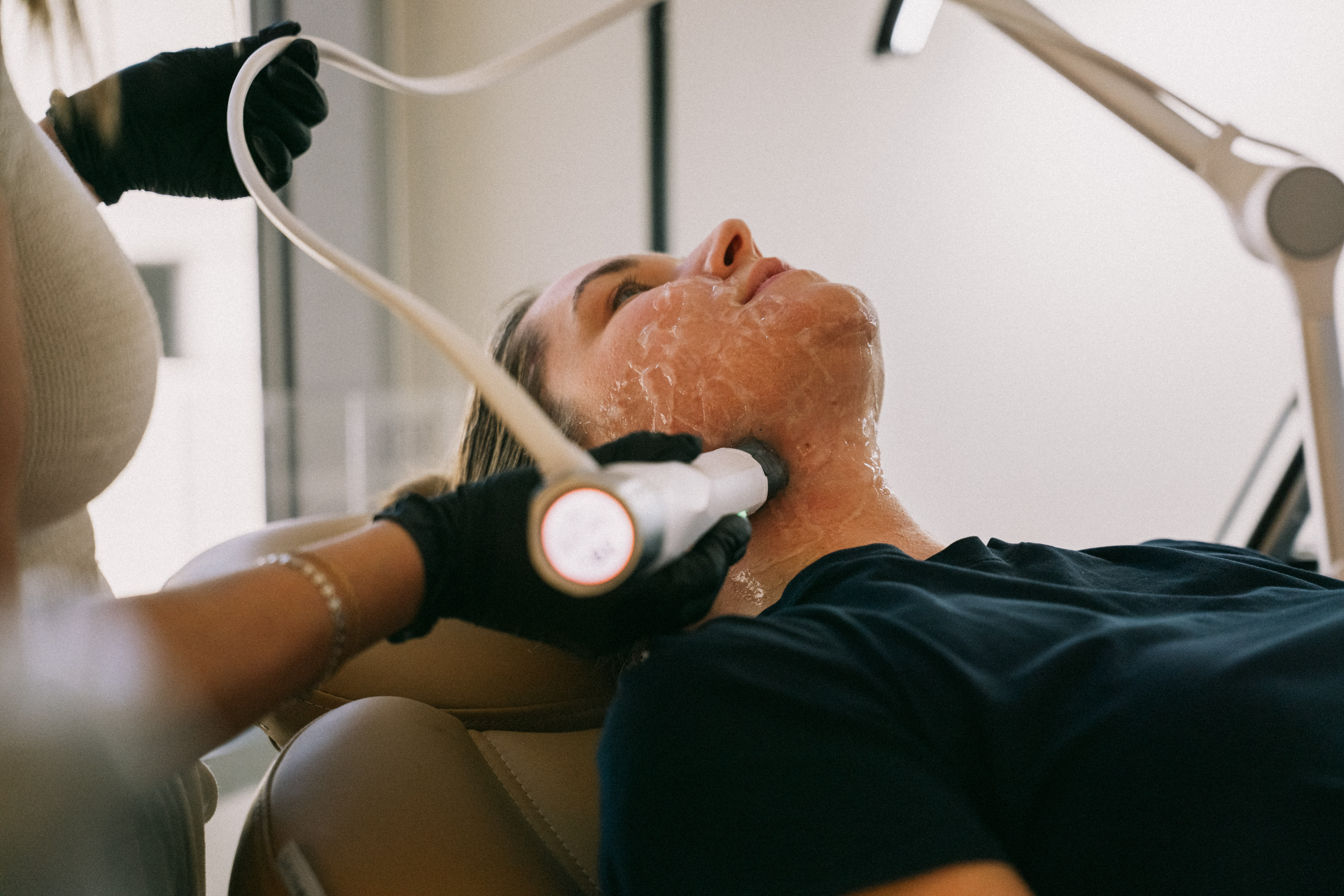
The Lutronic ULTRA — manufactured by Cynosure Lutronic — is a non-ablative fractional thulium laser operating at a wavelength of 1927 nm. It delivers fractional energy, treating a percentage of the skin surface while leaving intervening tissue intact. As a non-ablative device, it does not remove the full epidermal layer.
Its FDA-cleared indications include benign pigmented lesions such as solar lentigines (sun spots) and ephelides (freckles), actinic keratosis, and soft-tissue coagulation. For a complete technology overview, read the complete ULTRA laser guide.
MANUFACTURER
Cynosure Lutronic
WAVELENGTH
1927 nm
CLASSIFICATION
Non-ablative fractional thulium laser
CHROMOPHORE
Water
What Is Fraxel?
Fraxel is a branded family of fractional laser technologies manufactured by Solta Medical. The Fraxel brand encompasses multiple platforms and wavelengths, and the specific device determines the treatment. Saying “I had Fraxel” may not provide enough information to know exactly what treatment someone received.
The current primary platform is Fraxel Dual (also referred to as Fraxel re:store Dual), which offers two wavelengths that can be used independently or in combination. Different Fraxel systems address different concerns at different depths, which is why a meaningful ULTRA vs Fraxel comparison must identify the exact Fraxel technology being discussed.
“FRAXEL” IS A BRAND FAMILY. THE WAVELENGTH DEPENDS ON THE FRAXEL SYSTEM BEING DISCUSSED.
Why “Fraxel” Is Not a Wavelength
One of the most common errors in laser comparison is treating a brand name as if it were a wavelength. Fraxel is a brand. The wavelength depends on the Fraxel system. A device is not a setting. A wavelength is not a treatment plan.
BRAND
A commercial name that may cover multiple devices and wavelengths.
DEVICE
A specific instrument with specific delivery characteristics.
WAVELENGTH
A physical property that influences how energy interacts with tissue.
ASKING “ULTRA OR FRAXEL?” IS THE BEGINNING OF THE QUESTION. NOT THE END.
What Is Fraxel Dual?
Fraxel Dual is the current primary Fraxel platform. It offers two wavelengths — 1550 nm (erbium-doped fiber laser) and 1927 nm (thulium-doped fiber laser) — that can be used independently or in combination during a single session. The 1550 nm wavelength is generally associated with deeper dermal targets, while the 1927 nm wavelength is generally associated with more superficial, epidermal targets such as pigment and tone.
This dual-wavelength configuration means that a “Fraxel treatment” may refer to 1550 nm alone, 1927 nm alone, or both wavelengths combined. Without knowing which wavelength was used, it is difficult to compare a Fraxel experience to any other laser.
1550 NM
Erbium fiber. Generally associated with deeper dermal interaction — fine lines, scarring, deeper texture concerns.
1927 NM
Thulium fiber. Generally associated with superficial interaction — pigment, tone, epidermal quality.
Why ULTRA Is Often Compared to the 1927-nm Fraxel Wavelength
ULTRA operates at 1927 nm. The Fraxel Dual platform also offers a 1927 nm wavelength. Because both devices use the same wavelength category — 1927 nm non-ablative fractional thulium — they frequently appear in the same search. This is why the ULTRA vs Fraxel comparison is most directly relevant when discussing the 1927 nm Fraxel wavelength.
However, a similar or identical wavelength does not automatically mean the same device, the same delivery system, the same settings, the same treatment, the same downtime, or the same clinical outcome. Two devices sharing a wavelength category may still differ in pulse characteristics, energy delivery, fractional pattern, cooling, spot size, and provider technique.
SAME WAVELENGTH DOES NOT MEAN SAME TREATMENT.
Why Wavelength Matters
A wavelength is a physical property of light that helps determine how energy interacts with tissue. Different wavelengths have different relationships with water, melanin, and hemoglobin — the chromophores that absorb laser energy in the skin. The 1927 nm wavelength has a high affinity for water, which means it interacts primarily with the superficial layers of the skin where water content drives the absorption.
The 1550 nm wavelength also targets water but with a different absorption profile that generally allows deeper penetration into the dermis. This is why wavelength selection is not cosmetic — it changes what part of the skin receives the energy, and therefore what concerns the treatment may address.
Why Two Lasers With Similar Wavelengths Can Still Be Different
Even when two devices share the same wavelength, the actual treatment depends on many variables beyond wavelength alone: pulse characteristics, energy fluence, treatment density, spot or fractional pattern, delivery system, cooling method, number of passes, and provider technique. Each of these affects how the energy is delivered and how the skin responds.
This is why comparing ULTRA to a 1927 nm Fraxel treatment by wavelength alone is incomplete. The wavelength tells you the category of tissue interaction. The device, the settings, and the provider determine the actual treatment.
WAVELENGTH MATTERS. IT IS NOT THE ENTIRE TREATMENT.
What Does “Fractional” Actually Mean?
Fractional delivery means the laser treats a fraction of the skin surface — creating microscopic treatment zones — while leaving intervening tissue intact. This untreated tissue serves as a reservoir for healing, which is why fractional resurfacing generally involves less downtime than fully ablative resurfacing for a given level of treatment.
However, fractional does not automatically mean low downtime. The actual recovery depends on the device, the wavelength, the settings, the density of treatment, and the individual's skin response. Fractional is a delivery concept — not a downtime guarantee.
FRACTIONAL PATTERN
Are ULTRA and Fraxel Both Non-Ablative?
ULTRA is classified as a non-ablative fractional laser. The Fraxel Dual platform — both the 1550 nm and 1927 nm wavelengths — is also classified as non-ablative. Non-ablative means the laser does not vaporize or remove the full epidermal layer; instead, it delivers energy beneath the surface while the outer skin remains largely intact.
This is distinct from ablative resurfacing (such as CO2 or erbium ablative lasers), which removes the epidermal layer as part of the treatment. The distinction matters because ablative and non-ablative lasers generally have different recovery profiles and are selected for different clinical reasons.
ULTRA vs. Fraxel for Sun Damage
Sun damage — photodamage — may appear as brown spots, freckles, uneven tone, roughness, or fine lines. Both ULTRA and the 1927 nm Fraxel wavelength have FDA-cleared indications for benign pigmented lesions, which means both may be considered for selected sun-damage concerns.
However, neither device treats every brown lesion. A spot that is new, changing, or unusual requires medical evaluation before any cosmetic laser. The comparison depends on what the sun damage actually looks like — not on the word alone.
For the full sun-damage framework, read ULTRA for Sun Damage & Brown Spots.
ULTRA vs. Fraxel for Melasma
Melasma is a complex, patterned, often recurrent pigmentation condition influenced by UV exposure, visible light, hormonal factors, and inflammation. It is not simply "brown spots." Laser is not automatically the first or best answer for melasma, and any device — ULTRA or Fraxel — should be considered carefully within a broader management plan.
Heat and inflammation can potentially worsen melasma. This means treatment intensity, settings, and skin response all matter enormously. Neither ULTRA nor Fraxel should be positioned as a melasma cure. A consultation-led approach considers photoprotection, topical care, and whether procedural treatment is appropriate at all.
MELASMA IS NOT SIMPLY "BROWN SPOTS."
ULTRA vs. Fraxel for Skin Texture
Skin texture is a broad description — roughness, unevenness, fine surface lines, and post-acne surface changes may all be called "texture." Both ULTRA and Fraxel are fractional resurfacing devices that may improve selected textural concerns. The comparison depends on what is creating the texture and at what depth.
The 1927 nm wavelength addresses more superficial texture concerns. The 1550 nm Fraxel wavelength reaches deeper, which may be relevant for deeper textural change. ULTRA, operating at 1927 nm, addresses the superficial layer. The right choice depends on whether the texture is surface-level or deeper.
For the full texture framework, read ULTRA for Skin Texture & Pores.
ULTRA vs. Fraxel for Pores
Neither ULTRA nor Fraxel removes pores. Pores are normal skin anatomy — openings associated with hair follicles and sebaceous structures. No laser deletes or permanently erases them. What certain treatments may do is improve the appearance of pore size by improving surrounding skin quality.
The comparison between ULTRA and Fraxel for pores is not about which device "shrinks pores" — neither does. It is about which approach to surrounding skin quality may make pores appear less prominent in a given patient.
ULTRA vs. Fraxel for Fine Lines
Fine lines have different causes. Surface lines associated with skin quality and photoaging may respond to resurfacing. Dynamic expression lines — caused by muscle movement — respond to neuromodulators, not lasers. Deeper folds may require volume or structural treatment.
Neither ULTRA nor Fraxel should be framed as a replacement for Botox or filler. For surface lines, both devices may play a role depending on depth and settings. For expression lines, the conversation belongs in neuromodulators.
ULTRA vs. Fraxel for Acne Marks
Acne marks — brown or red discoloration left after a lesion heals — are different from acne scars. Brown marks may represent post-inflammatory hyperpigmentation. Red marks may represent post-inflammatory erythema. Both ULTRA and the 1927 nm Fraxel wavelength may be considered for pigment-related marks.
Red marks are a vascular concern, and a pigment-focused device may not be the correct category. The comparison depends on whether the mark is pigment, vascular, or a combination — and whether a scar is also present.
For the full post-acne framework, read ULTRA for Acne Marks & Scars.
ULTRA vs. Fraxel for Acne Scars
Acne scars involve structural change in the skin — depressions, raised areas, or altered contour. The comparison between ULTRA and Fraxel for acne scars depends on scar morphology, depth, device wavelength, and treatment intensity. Not all acne scars respond equally to the same approach.
The 1550 nm Fraxel wavelength, with its deeper dermal reach, may be relevant for certain scarring. ULTRA at 1927 nm addresses more superficial concerns. Deep or complex scarring may require scar-specific treatment planning that goes beyond any single device brand.
What About Deep Acne Scars?
Rolling scars, boxcar scars, ice-pick scars, and tethered scars each have different structural characteristics. Deep acne scars may require scar-specific treatment planning — subcision, TCA cross, filler, or combination protocols — rather than fractional resurfacing alone.
Neither the ULTRA brand name nor the Fraxel brand name alone determines the right treatment for deep scarring. The scar morphology determines the approach.
ULTRA vs. Fraxel for Crepey Skin
"Crepey" is a consumer description, not a diagnosis. It may refer to texture, dryness, skin thinning, or laxity. Each has a different cause and a different treatment. If the concern is surface texture, resurfacing may be relevant. If the concern is firmness or laxity, the conversation belongs in radiofrequency — XERF — not laser resurfacing.
ULTRA vs. Fraxel for Neck and Chest
The face, neck, and chest do not necessarily receive identical settings or recover identically. Neck and chest skin may respond differently to laser energy than facial skin. Both ULTRA and Fraxel have treatment-area considerations that should be discussed during consultation.
The comparison depends on the specific area, the concern, and how that skin tends to respond. Settings are typically adjusted by area — not copied from face to neck.
ULTRA vs. Fraxel for Hands
Both ULTRA and Fraxel have cleared treatment areas that may include the hands, depending on the indication. Hand skin differs from facial skin in thickness, sun exposure history, and healing characteristics. The comparison should be based on verified treatment-area information and individual assessment.
What If I Have a History of PIH?
If you develop dark marks after acne, irritation, scratches, or previous procedures, tell your provider before any laser treatment. A history of PIH changes the consultation. It may influence device selection, settings, treatment intensity, and pre- and post-treatment skincare.
Both ULTRA and Fraxel deliver energy that creates a controlled injury — and any controlled injury can provoke pigment in skin that tends to darken. This does not mean treatment is impossible. It means the plan must account for it. For the full PIH framework, read the ULTRA pigmentation guide.
ULTRA vs. Fraxel: Which Hurts More?
There is no universal answer. Treatment sensation depends on the device, the settings, the treatment area, the numbing protocol, any cooling used, and individual sensitivity. Both ULTRA and Fraxel are generally described as tolerable with appropriate numbing, but the experience varies by patient and protocol.
Rather than asking which hurts more, the useful question is: what will the treatment feel like with the numbing and cooling protocol planned for my skin? That answer comes from the consultation.
Which Requires Numbing?
Both ULTRA and Fraxel treatments typically involve a numbing protocol, though the specific approach depends on the provider, the treatment area, and the settings. Not every Fraxel protocol is identical, and not every ULTRA protocol is identical. Numbing is determined by the treatment plan — not by the brand name alone.
ULTRA vs. Fraxel Treatment Time
Treatment time — the period the laser is actively delivering energy — is different from total appointment time, which includes numbing, preparation, and post-treatment care. Both ULTRA and Fraxel treatment times vary by treatment area, settings, and protocol.
Do not conflate numbing time with laser time. A treatment that takes 15 minutes of active laser may involve 45 minutes of numbing. The comparison should consider the full appointment, not just the device time.
The Downtime Question Most People Actually Mean
When patients ask about downtime, they are usually asking about real life — not clinical healing stages.
Can I work?
Can I wear makeup?
Can I go to dinner?
Can I exercise?
Can I be photographed?
Can I travel?
Can I be in the sun?
Each of these questions has a different answer depending on the device, the settings, and the individual. These are not medical safety questions alone — they are lifestyle questions that should be discussed during the consultation.
ULTRA vs. Fraxel Before an Event
There is no universal “do it exactly X days before” rule for either device. Planning depends on whether it is your first treatment, the treatment intensity, your expected response, the number of sessions planned, the importance of the event, and anticipated sun exposure.
The right approach is to build the treatment calendar well before the event — not to count backward from the date and hope for the best.
ULTRA vs. Fraxel Before a Wedding
A wedding is a high-stakes visual event. The laser plan should be built months in advance, not days. Factors include whether this is your first treatment, how many sessions you may need, how your skin typically responds, and whether any sun exposure is planned between treatment and the event.
Neither ULTRA nor Fraxel should be scheduled close to a wedding without adequate recovery and result-development margin. The consultation should build a calendar — not a single appointment.
When Do ULTRA Results Appear?
ULTRA results develop over time as the skin responds to the treatment. Initial visible changes and longer-term remodeling occur on different timelines depending on the concern, the settings, and the individual. Results are not instant.
For the full timeline, read the complete ULTRA guide and the recovery guide.
When Do Fraxel Results Appear?
Fraxel results also develop over time. The timeline depends on the specific Fraxel platform, the wavelength used, the settings, and the individual. Without identifying the exact Fraxel technology, it is not possible to give a single result timeline.
As with ULTRA, the comparison should distinguish between initial visible changes and longer-term development — and should be based on the specific device, not the brand name.
How Many ULTRA Treatments Do You Need?
The number of ULTRA treatments depends on the concern, the goal, the treatment intensity, and the individual response. Pigment, sun damage, texture, and post-acne concerns may each require a different plan. JOLA's protocol is goal-dependent — not package-driven.
How Many Fraxel Treatments Do You Need?
The number of Fraxel treatments depends on the specific Fraxel platform, the wavelength, the concern, and the individual response. There is no universal Fraxel treatment count. As with ULTRA, the plan should be built around the goal — not around a fixed number.
Is One Laser “Stronger”?
“Stronger” is not a clinical endpoint. Patients often use it to mean more painful, more downtime, deeper, more aggressive, better result, or higher energy — and these are not synonymous. A treatment that feels stronger is not automatically more effective. A treatment with more downtime is not automatically better.
“STRONGER” IS NOT A CLINICAL ENDPOINT.
Is More Downtime Better?
Not necessarily. Recovery intensity does not automatically equal treatment quality. The correct amount of treatment depends on the goal — not on maximizing discomfort. A well-planned treatment delivers what the concern requires without unnecessary recovery.
Is Less Downtime Better?
Also not necessarily. There are tradeoffs. A lighter treatment may mean less recovery but may require more sessions to reach the goal. The correct amount of treatment depends on what you are treating, what your skin can handle, and what your schedule allows.
Is ULTRA a “Baby Fraxel”?
“Baby Fraxel” is social-media terminology, not a clinical classification. Describing one device as a &ldquo,baby” version of another can obscure the wavelength, delivery system, settings, indications, and clinical goals that make each device distinct. ULTRA is a specific 1927 nm non-ablative fractional thulium laser — not a lesser version of another brand.
Is ULTRA a Fraxel Alternative?
For selected concerns, patients researching Fraxel may appropriately discuss ULTRA as another fractional laser option. Both are non-ablative fractional devices, and ULTRA's 1927 nm wavelength is directly comparable to the 1927 nm Fraxel wavelength. That does not make them interchangeable — but it does make them comparable for certain conversations.
Whether ULTRA is the right alternative depends on the concern, the skin, and the treatment plan — not on the brand alone.
I Have Had Fraxel Before. Can I Have ULTRA?
Previous laser history should be reviewed during consultation. Which Fraxel device was used, when it was performed, how your skin responded, whether any complications or PIH occurred, and what your current goal is all matter. There is no universal waiting period — the decision is individualized.
I Have Had ULTRA. Can I Have Fraxel Later?
The same principle applies. Previous ULTRA history should be reviewed. The consultation considers when the treatment was performed, how the skin responded, the current concern, and whether another treatment is appropriate. No arbitrary intervals — just individualized planning.
Can ULTRA and Fraxel Be Combined?
Stacking similar fractional treatments without a clinical reason is not automatically beneficial. Treatment sequencing should be based on the target, the prior response, and the treatment plan — not on the idea that more devices equals more results. If a combination is being considered, the consultation should explain why.
What About ULTRA + XERF?
ULTRA and XERF address different categories. ULTRA is a laser — the conversation is resurfacing, pigment, tone, and texture. XERF is radiofrequency — the conversation is firmness, laxity, and structural support. For selected patients, these categories may address different concerns in a combined plan.
They are not substitutes for each other. They answer different questions. Explore XERF at JOLA Dallas for the firmness conversation.
RESURFACING AND TIGHTENING ARE NOT THE SAME JOB.
ULTRA vs. XERF vs. Fraxel
ULTRA
- Category: Laser
- Primary conversation: verified resurfacing / pigment / texture applications
- Wavelength: 1927 nm
FRAXEL
- Category: Fractional laser brand family
- Primary conversation: depends on exact platform and wavelength
- Wavelengths: 1550 nm + 1927 nm (Dual)
XERF
- Category: Radiofrequency
- Primary conversation: firmness / laxity / structural support
- Mechanism: multifrequency RF
The question each answers is different. What does the surface need? What wavelength fits the target? What does the tissue support need? These are not interchangeable questions.
What About CO2?
CO2 laser resurfacing is ablative — it removes the epidermal layer as part of the treatment. This places it in a different resurfacing category from ULTRA and Fraxel, which are non-ablative. CO2 generally involves more downtime and is selected for different clinical reasons. Neither category is universally “better” — they serve different purposes.
What About IPL / BBL?
IPL and BBL are broadband light technologies — not lasers. They deliver a spectrum of light rather than a single wavelength, which means they interact with tissue differently. Their targets, delivery, and use cases differ from fractional laser resurfacing. They are not interchangeable with ULTRA or Fraxel. For the full ULTRA laser vs. IPL/BBL comparison, read the dedicated color study.
What About Morpheus8?
Morpheus8 is RF microneedling — not a laser. It uses needles to deliver radiofrequency energy into the dermis. The mechanism, targets, and recovery profile are different from fractional laser resurfacing. Comparing Morpheus8 to ULTRA or Fraxel is a category-to-category comparison, not a device-to-device one. For the full ULTRA vs. Morpheus8 comparison, read the dedicated mechanism study.
What About Microneedling?
Microneedling creates mechanical micro-injuries in the skin using needles — not laser energy. The mechanism is different from fractional laser resurfacing, which uses light energy to create thermal treatment zones. Both may address texture, but the delivery, depth control, and tissue response differ. For the full ULTRA laser vs. microneedling comparison, read the dedicated surface/structure study.
What About Chemical Peels?
Chemical peels resurface the skin through chemical exfoliation rather than light energy. They may address pigment, texture, and tone, but the mechanism, depth control, and recovery differ from fractional laser resurfacing. There is no universal winner — the right choice depends on the concern, the skin, and the plan.
The JOLA Laser Specification
The device is selected after the specification — not before.
TARGET
What are we actually treating?
WAVELENGTH
What interaction is needed?
DEPTH
Where is the concern?
SKIN
How does this skin respond to energy and inflammation?
INTENSITY
How much treatment is appropriate?
RECOVERY
What can the patient realistically accommodate?
DEVICE
Which technology best matches the specification?
REASSESS
Did it change the intended concern?
THE DEVICE IS SELECTED AFTER THE SPECIFICATION. NOT BEFORE.
How JOLA Decides Between Lasers
JOLA's approach is consultation-led. The evaluation considers the concern, the diagnosis, skin tone, pigment history, PIH history, acne history, scarring, sun exposure, previous laser history — including previous Fraxel, ULTRA, IPL, BBL, or RF microneedling — current skincare, retinoid use, downtime tolerance, upcoming events, and treatment goals.
The device is not selected first. The specification is built first, and the device that fits the specification is recommended. Sometimes that is ULTRA. Sometimes it is another technology. Sometimes it is no treatment at all.
When JOLA May Recommend ULTRA
JOLA may recommend ULTRA when the concern aligns with its cleared indications — selected pigment concerns, sun damage, texture, and skin quality — and when the patient's skin, history, and recovery expectations fit the treatment plan. The recommendation is based on the specification, not on selling a device.
When Another Technology May Make More Sense
Sometimes the best laser consultation ends with “not this laser.” Vascular redness may require a vascular-targeted device. Deeper resurfacing may require an ablative laser. Significant laxity may require radiofrequency. Scar-specific structural issues may require subcision or filler. Active skin conditions may need to be addressed first. And sometimes the right answer is no treatment.
THE BEST LASER CONSULTATION CAN END WITH: “NOT THIS LASER.”
What If JOLA Does Not Offer the Fraxel Device I Am Comparing?
The purpose of this comparison is educational. JOLA can explain how ULTRA fits within fractional resurfacing and whether it matches your concern. If another technology is more appropriate, the consultation should say so. JOLA does not pretend to offer a device it does not offer — and the comparison is not a sales pitch.
Cost: ULTRA vs. Fraxel
Contact JOLA for current ULTRA treatment pricing. We do not publish competitor pricing or invent numbers. Cost varies by provider, market, device, treatment area, settings, and number of sessions.
Price per session is not the same as the cost of the treatment plan. A lower per-session price may require more sessions. A higher per-session price may include more comprehensive care. The comparison should consider the full plan — not the single appointment.
PRICE PER SESSION
Is not the same as
COST OF THE TREATMENT PLAN
How to Compare Two Laser Quotes
Compare the full specification — not the price alone.
Exact device
Exact wavelength
Treatment area
Provider qualifications
Number of sessions
Included post-care
Follow-up
Expected downtime
Treatment goal
Maintenance plan
25 Questions to Ask Before Choosing ULTRA or Fraxel
A saveable checklist for your consultation.
Which exact Fraxel device are we discussing?
Which wavelength will be used?
What wavelength does ULTRA use?
Why does wavelength matter for my concern?
What exactly are we treating?
Is my concern pigment or texture?
Is my pigment melanin-related?
Is redness part of my concern?
Do I have PIH history?
Does my skin tone change the plan?
Are my acne marks actually scars?
What type of scars do I have?
Is the treatment fractional?
Is it ablative or non-ablative?
How will settings be customized?
Will I need numbing?
What will treatment feel like?
What will I look like afterward?
What is the social downtime?
When can I wear makeup?
When can I exercise?
How many treatments might I need?
When should results be assessed?
Why are you recommending this device over the alternative?
Would another treatment make more sense?
ULTRA vs. Fraxel: The Bottom Line
ULTRA and Fraxel are not identical. Fraxel is a brand family — not a single laser — and the exact Fraxel device matters. ULTRA is a specific device with a specific wavelength. Both are non-ablative fractional lasers, but they differ in delivery, settings, and provider technique. Fractional is a delivery concept, not a downtime guarantee. Wavelength influences tissue interaction, but wavelength alone does not determine the treatment. Settings matter. Density matters. Provider technique matters.
Skin type matters. PIH history matters. Pigment type matters. Scar morphology matters. Downtime matters. Treatment goal matters. Sun damage and melasma are not identical. Acne marks and scars are not identical. Pores cannot be erased. Texture and laxity are different conversations. ULTRA and XERF answer different questions. CO2 is a different resurfacing category. IPL and BBL are different light technologies. Morpheus8 is RF microneedling, not a laser.
“Stronger” is not a useful clinical endpoint. More downtime is not automatically better. Less downtime is not automatically better. Price per session is not the whole treatment cost. There is no universal ULTRA vs Fraxel winner.
If you are comparing ULTRA vs. Fraxel in Dallas, do not begin by asking which brand is better. Ask: Which exact device? Which wavelength? What target? What depth? What skin type? What history? What downtime? What goal? Because the best laser is not the one with the most recognizable name. It is the technology that fits the problem being treated.
At JOLA Dallas, the comparison begins with the skin. Not the logo.
TARGET. WAVELENGTH. DEPTH. SKIN. RECOVERY. RESULT.
DON’T COMPARE THE LOGO. COMPARE THE SPECIFICATION.
COMPARE BY CONCERN — NOT JUST DEVICE
Plan Your ULTRA Treatment
NEW TO ULTRA?
Read the Complete ULTRA Guide
PIGMENT?
Explore ULTRA for Pigmentation
SUN DAMAGE?
Explore ULTRA for Sun Damage
TEXTURE + PORES?
Explore ULTRA for Skin Texture
ACNE SCARS?
Explore Post-Acne Treatment
WORRIED ABOUT DOWNTIME?
Read the ULTRA Recovery Guide
FIRMNESS?
Explore XERF
NOT SURE WHICH TECHNOLOGY?
Explore Aesthetic Consultation
ULTRA VS CO₂ LASER