
THE PIGMENT INDEX / ULTRA + PIGMENTATION
ULTRA Laser for Pigmentation: Brown Spots, Dark Marks & Uneven Skin Tone
Not all pigment is the same. Before a laser is chosen, the mark has to be understood — what it is, why it is there, and how this skin tends to respond. This is the JOLA Dallas approach to pigmentation, dark spots, PIH, acne marks, and uneven tone.
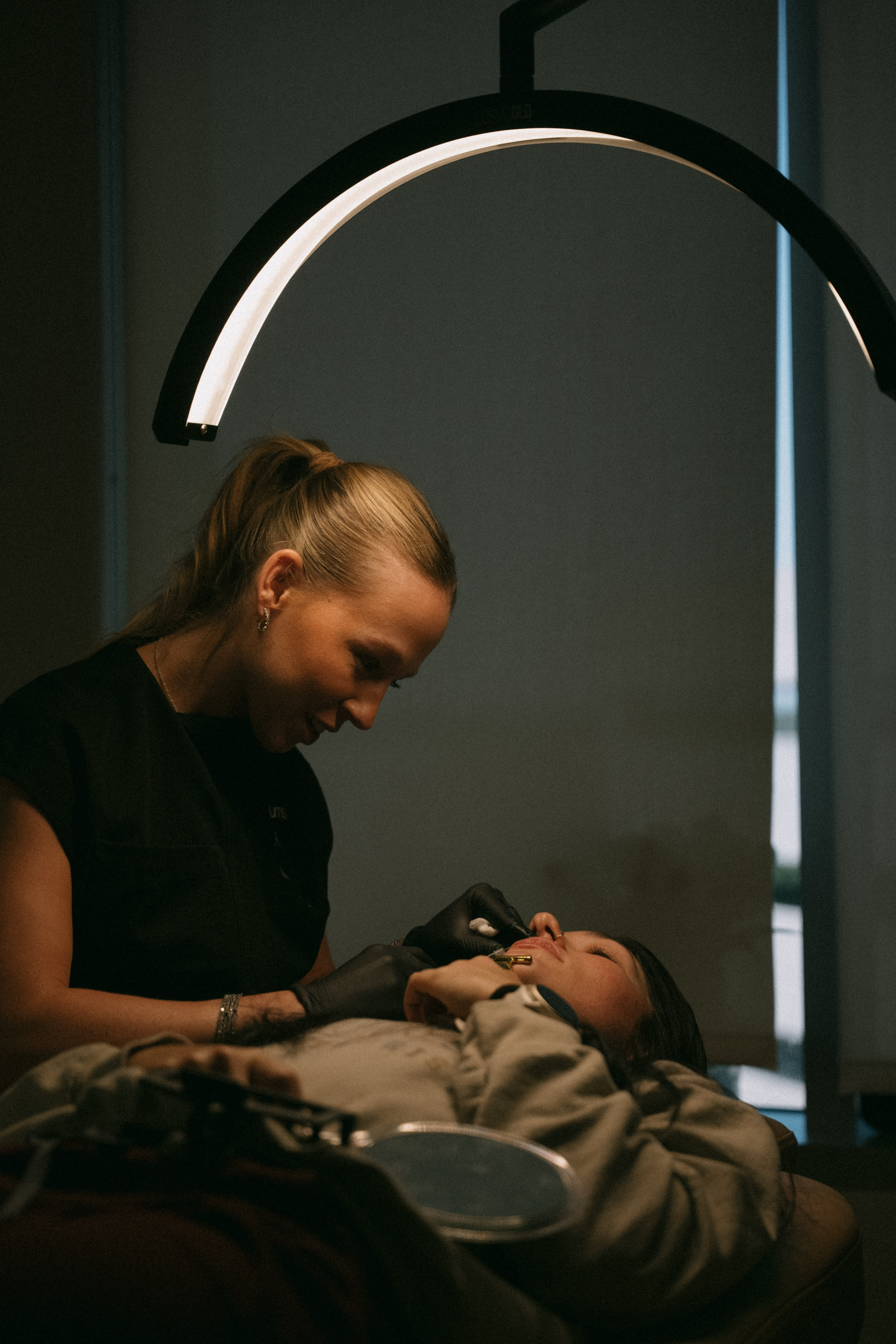
JOLA DALLAS / HIGHLAND PARK
AUG 2026
THE PIGMENT INDEX
What Is Hyperpigmentation?
Hyperpigmentation generally refers to areas of skin that appear darker than the surrounding skin because of increased pigment, or a change in how pigment is distributed. It is a descriptive term — a visible characteristic — not a single diagnosis. Two patients can both point to a dark area and be looking at two completely different processes.
Treating "hyperpigmentation" as if it were one disease is where plans go wrong. Sun-related pigment, post-inflammatory hyperpigmentation, melasma, and an acne mark are all forms of hyperpigmentation, and they behave differently. The word describes what you see; it does not explain why it is there. That explanation is the work of identification — and it comes before the laser.
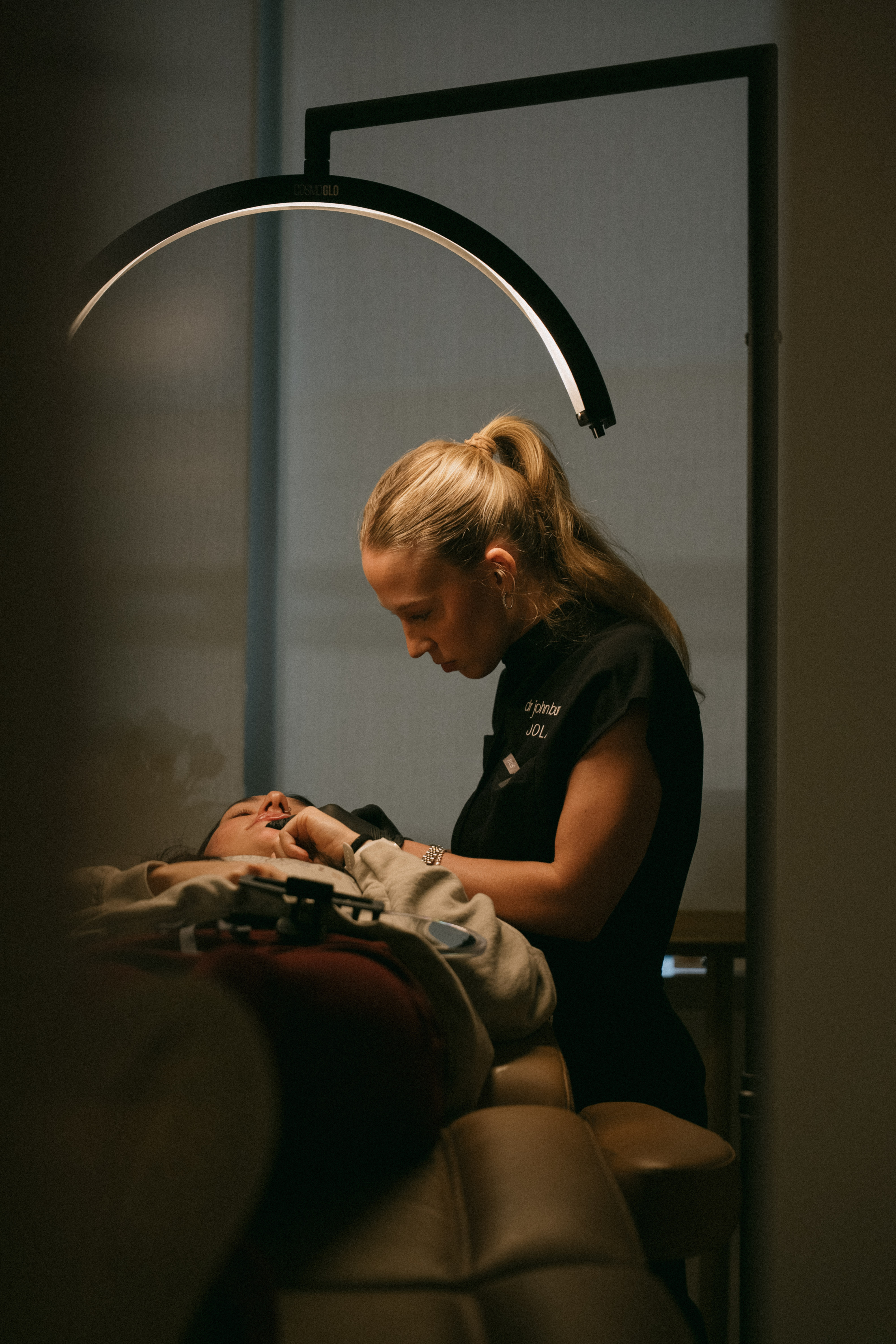
The Pigment Index
A taxonomy of the most common pigment presentations JOLA sees across Dallas, Highland Park, University Park, and the Park Cities. Each entry is a different biology wearing a similar color.
- 01Freckles (ephelides)
- 02Solar lentigines (sun spots)
Associated with cumulative UV exposure.
- 01After acne
- 02After irritation
- 03After inflammation or injury
Pigment following a skin response.
- 01Patterned, often symmetric pigment
- 02Recurrent, multifactorial
A distinct pigment disorder, not simple sun damage.
- 01Brown post-acne pigment
- 02Red post-acne marks
- 03Actual acne scarring
Color, redness, and texture are not the same.
- 01New, changing, or unusual marks
- 02Lesions requiring medical evaluation
Some pigment is a medical conversation before it is a cosmetic one.
SAME COLOR. DIFFERENT BIOLOGY.
Why Identifying the Pigment Matters
Different pigment behaves differently. A treatment that makes sense for a solar lentigo may not automatically make sense for melasma, for PIH, or for redness. A laser that softens a sun spot can, in the wrong skin or the wrong condition, worsen melasma or provoke new pigment. The same device can help or harm depending on what it is pointed at.
This is why consultation matters. Identifying the pigment — its type, its history, its relationship to this particular skin — is the step that makes treatment selection precise rather than a guess. A laser for pigmentation in Dallas is only as good as the reading of the skin that precedes it.
What Are Brown Spots?
"Brown spots," "dark spots," "pigmentation," and "hyperpigmentation" overlap heavily in everyday language. They all describe the same visible thing — an area of skin that appears darker — and they all fail to explain why. A brown spot may be a sun spot, a freckle, a post-acne mark, melasma, or a lesion that needs evaluation.
"BROWN SPOT" DESCRIBES APPEARANCE. NOT CAUSE.
This is why the question "what is the best laser for brown spots?" has no single answer. The best laser depends on what the brown spot is — and that requires looking before treating.
Acne Marks vs. Acne Scars
This is one of the most important distinctions in pigment treatment. A dark mark can sometimes fade without a scar being present — it is pigment, and pigment may improve. A scar involves structural, textural change in the skin — a depression, a raised area, or an alteration in surface quality that pigment treatment alone does not address.
Some patients have both: a dark mark sitting within a textural scar. In those cases, the plan may need to address color and texture separately, with different technologies or a sequenced approach. Assuming one treatment handles both is where expectations break down.
COLOR IS NOT TEXTURE. TEXTURE IS NOT COLOR.
Melasma vs. Hyperpigmentation
Hyperpigmentation is a broad descriptive category — any area of skin that appears darker. Melasma is a specific pigment disorder with a distinct pattern, set of triggers, and tendency to recur. All melasma is hyperpigmentation; not all hyperpigmentation is melasma.
The distinction matters because the treatments diverge. A plan that works for generic hyperpigmentation may not work for melasma — and may, in some cases, worsen it. Identifying which one is present is the step that determines the rest.
Melasma vs. Sun Spots
- Often patterned and symmetric
- Recurrent and multifactorial
- Influenced by UV, visible light, hormones
- Often localized, discrete patches
- Associated with cumulative UV exposure
- Tend to persist rather than recur in the same pattern
This is not a self-diagnosis checklist. The point is that pattern, history, and behavior differ — and a provider reads those differences before choosing a technology. For the sun-damage conversation in depth, read ULTRA Laser for Sun Damage & Brown Spots.
PIH vs. Melasma
PIH typically follows an identifiable inflammation or injury — an acne lesion, an irritation, a procedure. Melasma has different biology and triggers, often appearing without a single clear injury and tending toward pattern and recurrence. They can look similar to an untrained eye.
Treatment planning differs. A plan that helps PIH may not help melasma, and vice versa. History — what happened before the pigment appeared — is often the clearest clue to which is which.
PIH vs. Sun Spots
History is the distinguishing question. Did the mark appear after acne, after irritation, after a procedure? That points toward PIH. Did it slowly develop with years of sun exposure, in sun-exposed areas? That points toward a sun spot. The same brown mark, two different origins.
Again, this is not an invitation to diagnose yourself. It is an explanation of why a provider asks about history before recommending a laser — and why two patients with identical-looking marks may leave with different plans.
When a Dark Spot Should Not Be Treated Cosmetically First
A spot that is new, changing, unusual, growing, symptomatic, bleeding, irregular, or otherwise concerning should receive appropriate medical evaluation before any cosmetic laser treatment. This is a non-negotiable principle. Cosmetic treatment is for confirmed benign pigment; it is not a substitute for medical assessment of a changing lesion.
This is not about fear. It is about sequence. The right first step for a concerning lesion is evaluation — not a laser. Once a lesion has been appropriately evaluated and confirmed benign, the cosmetic conversation can proceed. JOLA does not treat pigment that has not been identified.
Why Wavelength Matters for Pigment
Different wavelengths interact differently with tissue. Some are absorbed more by melanin, some by water, some by hemoglobin. Laser selection should consider the target, the depth where relevant, melanin interaction, water interaction where relevant, and skin type. This is not a physics textbook — it is the reason "which laser?" is a real question and not a marketing one.
ULTRA's 1927 nm thulium wavelength targets water in the skin. That mechanism is relevant to skin quality and surface renewal, and it is part of why ULTRA is described as a skin-quality laser rather than only a spot-removal device. The wavelength is a tool; whether it is the right tool depends on the pigment.
Why "Fractional" Matters
ULTRA is a fractional laser, which means it delivers energy in a pattern of treated microzones surrounded by untreated skin. That untreated tissue supports healing and recovery, which is part of why non-ablative fractional treatment is associated with less downtime than fully ablative resurfacing.
But fractional describes how energy is delivered — it does not automatically answer whether the laser is right for your pigment. A fractional laser is still a laser, with a specific wavelength and a specific target. "Fractional" is not a synonym for "safe for everything."
FRACTIONAL DESCRIBES HOW ENERGY IS DELIVERED. IT DOES NOT AUTOMATICALLY ANSWER WHETHER THE LASER IS RIGHT FOR YOUR PIGMENT.
ULTRA for Dark Spots
Which dark spots ULTRA may be appropriate for depends on the diagnosis. Where a dark spot is a confirmed benign pigmented lesion within ULTRA's cleared indications — a solar lentigo, an ephelis — and the skin tone and history support it, ULTRA may be a reasonable technology to explore. The goal is realistic improvement, not erasure.
Where the dark spot is melasma, PIH, or a lesion needing evaluation, the conversation changes. ULTRA is not a universal dark-spot treatment, and representing it as one would be clinically misleading. It is an excellent technology in its appropriate range, and an inappropriate one outside it.
ULTRA for Post-Inflammatory Hyperpigmentation
PIH treatment can be complicated because treatment itself creates a skin response — and in skin prone to pigment, that response can produce more pigment. For selected patients, technology may play a role, but skin tone, PIH history, the cause of the pigment, the activity of any underlying inflammation, and treatment intensity all matter.
JOLA does not claim ULTRA universally treats PIH. Where the evidence and the individual support a role, that is represented precisely; where the risk is higher or the cause still active, that is stated plainly. Conservative settings, careful history, and honest expectations are the foundation.
This is one of the clearest places where the JOLA philosophy — identify first, treat second — protects the patient.
ULTRA for Acne Marks
Brown post-acne marks are a form of PIH. Whether ULTRA may address them depends on the individual — the skin tone, the PIH history, whether active acne is still producing new marks, and whether the mark is pigment or a mix of pigment and texture. ULTRA's mechanism is relevant to skin quality and surface renewal, which may play a role for selected patients.
ULTRA does not treat active acne unless supported by indication. Controlling active inflammation is a separate conversation, and it often comes first — because treating marks while new ones are still forming is a losing proposition.
ULTRA for Acne Scars
Scar morphology matters. Acne scars include rolling, boxcar, ice-pick, and other textural patterns — and they are not interchangeable. A laser that may improve surface texture does not automatically remodel a deep ice-pick scar or a rolling scar tethered to deeper tissue. Different scar types may need different approaches.
ULTRA does not treat every acne scar type, and no single laser does. A plan for acne scarring is built around the specific morphology present — sometimes combining technologies, sometimes choosing a different category entirely. The dark mark sitting within a scar is a separate conversation from the scar itself.
ULTRA for Melasma
JOLA is conservative here. Melasma is complex, recurrent, and can worsen with the wrong approach. Laser is not automatically first-line for melasma, and whether ULTRA fits at all depends on the individual, the type of melasma, the skin tone, and the history.
JOLA does not claim ULTRA cures melasma, permanently removes it, or resolves it in one treatment. Where there is evidence for a laser's role, it is represented precisely; where the evidence is limited or the risk higher, that is stated plainly. Melasma can require long-term management, photoprotection, topicals, careful procedural selection, and reassessment.
A dedicated melasma article will address this in full. Here, the principle stands: melasma is different, and treating it like a sun spot is a mistake.
ULTRA for Freckles & Sun-Related Pigment
Ephelides (freckles) and solar lentigines (sun spots) are among ULTRA's cleared pigment indications. Where identified and appropriate, ULTRA may soften their appearance. Freckles may also recur or darken with continued UV exposure, so permanent removal is not promised.
For a deeper discussion of freckles, sun spots, and photodamage — and how ULTRA fits the sun-damage conversation specifically — read ULTRA Laser for Sun Damage & Brown Spots. This article keeps that section brief to avoid repeating it.
Can ULTRA Even Out Skin Tone?
"Uneven tone" can come from brown pigment, redness, vascularity, melasma, PIH, sun spots, or combinations. Each has a different cause, and each may need a different approach. ULTRA is one option among several, and it fits some of these conversations better than others.
When uneven tone is driven by the pigment concerns ULTRA is cleared for, it may be a fit. When the unevenness is vascular, or driven by melasma, or by surface dullness alone, the conversation may point elsewhere. "Evening skin tone" may require more than one category of treatment — and identifying what "uneven" actually means for a given face is the step that makes selection precise.
What If the Mark Is Red, Not Brown?
Post-acne redness may be vascular rather than melanin-based. The persistent red mark left after an acne lesion is often a vascular response — dilated vessels and inflammation — not pigment. The treatment approach may therefore differ, and a pigment-targeting laser is not automatically the right tool.
Calling every post-acne mark PIH is a common error. A red mark and a brown mark may look like the same "spot" to a patient, but they are not necessarily the same target. This is why identification — not color alone — drives the plan.
RED AND BROWN MAY LOOK LIKE THE SAME "MARK" TO A PATIENT. THEY ARE NOT NECESSARILY THE SAME TARGET.
Can ULTRA Treat Red Pigment?
Redness is not technically "pigment" in the same sense as melanin-related brown discoloration. Visible redness and small vessels are a vascular conversation, and ULTRA is not primarily a vascular treatment. Its wavelength and mechanism are oriented toward pigment and skin quality, not toward visible vessels or diffuse redness.
Where redness is the concern, a vascular-relevant technology may be more appropriate — or a combination plan that addresses both pigment and vascularity separately. Saying so directly is part of building trust: not every device solves every concern.
Is ULTRA Safe for Darker Skin Tones?
"Safe for all skin tones" is too absolute a claim for any pigment-relevant device. What can be said is that ULTRA's non-ablative fractional mechanism and 1927 nm wavelength are considerations in how it is used across Fitzpatrick skin types, and that PIH risk is a real factor in richer skin tones. Safety depends on settings, skin type, and pigment history — not on a blanket guarantee.
In practice, this means conservative delivery, careful settings, and a thorough pigment history matter more in darker skin tones. Not that treatment is impossible, but that it requires judgment. A provider who understands melanin, PIH risk, and the difference between skin types is essential — and that judgment is part of the JOLA consultation, not an afterthought.
What Is the Fitzpatrick Scale?
The Fitzpatrick scale is a tool that classifies skin by how it responds to sun — tendency to burn and tendency to tan — across types I through VI. It is one data point in laser planning, used to estimate how skin may respond to energy and how much PIH risk may be present.
Fitzpatrick type is one tool, not a complete description of ethnicity or skin biology. Two patients with the same Fitzpatrick type can have different pigment histories, different tendencies to develop PIH, and different responses to treatment. The scale is a starting point, not a conclusion.
Why Ethnicity Is Not the Same as Skin Type
Patients within the same racial or ethnic group can have different skin tones, different tanning responses, and different pigment histories. Laser candidacy should not be assigned from ethnicity alone. A patient's skin is evaluated on its own terms — how it tans, how it burns, how it has responded to inflammation and procedures — not on a guess based on appearance.
This matters because assumptions lead to errors. Assuming darker skin is unsafe can deny a patient appropriate treatment; assuming any skin is fine can cause harm. Individual assessment is the only honest approach.
Why PIH History Matters
Someone who tends to develop dark marks after acne, scratches, irritation, peels, lasers, or inflammation should share that history. It is one of the most important predictors of how skin will respond to a pigment-relevant treatment, and it may influence device selection, settings, and the decision to treat at all.
A patient who darkens easily after minor irritation is not disqualified from treatment — but the plan will look different. Lower settings, more conservative delivery, careful aftercare, and realistic expectations all follow from that history. Telling your provider about it is one of the most useful things you can do.
Can Laser Make Pigmentation Worse?
Yes. Certain laser treatments can potentially cause or worsen pigmentation in some circumstances. PIH is a real risk with any pigment-relevant energy, and it is more relevant in richer skin tones and in patients with a history of pigment darkening. This is not fearmongering — it is the reason treatment selection and settings matter.
Incorrect treatment selection, inflammation, sun exposure, skin type, treatment intensity, aftercare, and individual response all influence whether a treatment improves pigment or provokes more. A lower, more conservative setting on the right skin may be more appropriate than an aggressive setting that risks PIH. The same device can help or harm depending on how it is used — which is why provider judgment is central.
Can ULTRA Cause PIH?
JOLA does not say ULTRA cannot cause PIH. Like any pigment-relevant laser, ULTRA carries PIH risk. Settings, skin tone, pigment history, recent sun exposure, and aftercare all influence that risk. Risk mitigation — conservative settings, careful selection, appropriate aftercare — helps manage it, but no responsible provider guarantees prevention.
The honest framing is this: ULTRA's non-ablative fractional mechanism is a consideration in how PIH risk is managed, but it does not eliminate the risk. The plan accounts for it; it does not pretend it away.
What About a Tan?
Active tanning or recent UV exposure affects the skin's melanin activity and can influence both treatment planning and PIH risk. Tanned skin is more reactive skin, and treating pigment on recently tanned skin changes the conversation.
JOLA follows current manufacturer and clinical guidance on sun exposure before treatment. Rather than invent a waiting period, the point is that recent sun exposure is part of the pre-treatment conversation — and honesty about it protects the result.
What About Self-Tanner?
Self-tanner creates a cosmetic color on the skin surface that is not the same as melanin, but it can affect how the skin reads and how treatment is planned. Patients should disclose self-tanner use before any laser treatment.
JOLA's protocol addresses self-tanner as part of pre-treatment preparation. Rather than invent a restriction, the guidance is simple: tell your provider, and follow the specific instructions given for your treatment.
What About Retinol, Tretinoin, or Acids?
Patients should disclose prescription retinoids, retinol, AHAs, BHAs, exfoliating products, pigment-correcting products, and any other actives before treatment. These can affect skin sensitivity and recovery, and they may influence pre-treatment preparation.
JOLA uses a verified pre-treatment protocol rather than generic stop dates. The specific guidance depends on the product, the skin, and the planned treatment — and it is given in consultation, not assumed. Disclose everything you use; the plan is built around it.
ULTRA vs. BBL for Pigmentation
BBL — broadband light — is, like IPL, a light-based technology, not a laser. It delivers broadband energy to target pigment and redness. ULTRA, again, is a fractional laser with a specific wavelength and a fractional delivery pattern.
Where the target is broader — pigment and redness together — a broadband light may be considered. Where the target is skin quality and specific benign pigment, a fractional laser may be more appropriate. Different targets may make one approach more appropriate than the other; neither is universally better.
ULTRA vs. Chemical Peel for Pigmentation
A chemical peel uses a chemical solution to exfoliate the skin at a controlled depth; ULTRA uses laser energy delivered fractionally. The mechanisms are different, and so are the conversations around depth, customization, PIH considerations, recovery, skin-tone considerations, and which types of pigment each addresses.
Peels can be customized by strength and depth; lasers deliver energy at a specific wavelength. For some pigment, a peel may be appropriate; for others, a laser; for some patients, a sequenced plan using both. The decision depends on the pigment type, skin tone, downtime tolerance, and goal — not on which is "stronger."
ULTRA vs. Microneedling for Pigmentation
Traditional microneedling creates physical micro-injuries to stimulate a skin response — it is primarily a texture and collagen conversation, not a pigment-targeting technology. ULTRA delivers specific wavelength energy relevant to pigment and skin quality.
If pigment is the primary concern, technology selection should reflect that. Microneedling may have a role in a broader plan, but it is not simply an alternative pigment laser — it is a different mechanism with different targets. For the full ULTRA laser vs. microneedling comparison for pigmentation, read the dedicated surface/structure study.
ULTRA vs. RF Microneedling for Pigmentation
RF microneedling combines needles with radiofrequency energy delivered into the skin. It is not a laser, and it is not simply "a stronger laser." It is a different technology with different targets — primarily texture, pores, and collagen support, with energy delivered by needle rather than light.
For pigment as the primary concern, the technology selection should reflect the target. RF microneedling and ULTRA are not interchangeable; they are different tools for different conversations. For the full ULTRA vs. Morpheus8 comparison for pigmentation, read the dedicated mechanism study.
ULTRA vs. CO2 for Pigmentation
CO2 is an ablative resurfacing laser — it removes tissue in a more aggressive, higher-recovery category. ULTRA is non-ablative fractional, associated with less downtime and a different intensity-to-recovery profile. They sit at different points on that curve.
Ablation, recovery, pigment considerations, texture, result magnitude, and skin-tone considerations all differ. CO2 may produce more dramatic change but with more recovery and, in richer skin tones, more PIH risk. ULTRA may be more conservative. They are not equivalent outcomes — and the choice depends on the pigment, the skin, and what the patient can responsibly recover from.
Comparing ULTRA with Fraxel for pigment? Fraxel is a brand family — the comparison depends on the exact Fraxel wavelength. For the full ULTRA vs. Fraxel comparison, read the dedicated specification guide.
ULTRA vs. XERF
ULTRA is a skin-surface conversation — pigmentation, texture, and skin quality according to its verified indications. XERF is a radiofrequency conversation — firmness, laxity, and structural support. They are different technologies addressing different layers of the face.
If someone has brown marks and jowling, they may actually have two separate concerns. Treating the pigment does not tighten the skin; tightening the skin does not resurface the pigment. A patient with both may need both — sequenced in a consultation-led plan.
PIGMENT DOES NOT REQUIRE VOLUME. LAXITY DOES NOT REQUIRE RESURFACING. TREAT THE RIGHT LAYER.
For the structural conversation, read XERF at JOLA Dallas.
Can ULTRA and XERF Be Part of the Same Plan?
Conceptually, yes. A patient with pigment or texture concerns and firmness or laxity concerns may use both — ULTRA for pigment and skin quality, XERF for firmness — in a consultation-led plan. Whether both are appropriate, and how they should be sequenced, is determined in consultation based on the individual's anatomy, skin, and goals.
JOLA does not invent treatment sequences or intervals. The plan is built around the patient, not around a template — and the sequence matters as much as the selection.
What About HydraFacial?
HydraFacial may support hydration, cleansing, and surface maintenance depending on the treatment. It is not equivalent to a pigment-targeting laser — it addresses surface condition and hydration rather than pigment at the level a laser does.
HydraFacial is not disparaged here; it has a role in surface maintenance and may complement a pigment plan. But a patient choosing between a facial and a laser for brown spots should understand they are different tools for different conversations.
What About Medical-Grade Skincare?
Pigmentation plans may include photoprotection, retinoids, antioxidants, pigment-modulating ingredients, or other clinician-recommended skincare. Skincare is not a substitute for a laser where a laser is appropriate, and a laser is not a substitute for the daily skin behavior that affects ongoing pigment.
JOLA does not prescribe a universal regimen. The right skincare depends on the pigment type, the skin, and the plan — and it is recommended in consultation. For the full conversation, see clinical skincare at JOLA Dallas.
Why Laser + Skincare Can Be a Better Conversation Than Laser Alone
Procedural treatment can address one part of the problem — the pigment that is present now. Daily skin behavior and topical care may affect ongoing pigmentation, inflammation, sun exposure, and maintenance. A plan that uses only a laser and ignores skincare may produce a result that does not last, because the conditions that produced the pigment continue.
This is not a claim that products prevent all recurrence. It is a recognition that pigment is often an ongoing process, and the most durable plans address both the present pigment and the conditions that create it. Laser plus skincare is, for many patients, a better conversation than laser alone.
What Does the Skin Look Like After ULTRA?
Following ULTRA, the skin may show redness, dryness, roughness, mild swelling, bronzing, or flaking as it heals, depending on settings and the individual. These are expected skin responses, not complications, and they resolve as the skin remodels.
This information is ULTRA-specific. JOLA does not borrow recovery descriptions from CO2, Fraxel, IPL, or another laser — each technology has its own recovery profile, and accuracy matters.
How Much Downtime Does ULTRA Have?
ULTRA's non-ablative fractional mechanism is associated with less downtime than ablative resurfacing, but it is not zero downtime. Visible skin response, social downtime, and the aftercare period may be different concepts — the skin may look recovered before it is fully remodeled, and the aftercare period extends beyond what is visible.
JOLA does not promise zero downtime. The honest framing is that ULTRA sits on the lower end of the resurfacing recovery curve, and the specific experience depends on settings, the area, and the individual.
When Does Pigment Start to Look Different?
Pigment and texture improve on different timelines, and the specific timing depends on the pigment type, the settings, and the individual response. Where pigment may temporarily darken before improving — a common part of the process for some pigment-relevant treatments — that is explained in consultation based on the specific plan.
JOLA uses verified treatment-response information rather than generic timelines. The honest answer is that improvement is gradual, evaluated over the weeks following treatment, and assessed against the original pigment — not against a promise.
How Many ULTRA Treatments for Pigmentation?
The number of treatments depends on the pigment type, skin type, response, intensity, goal, and protocol. JOLA does not invent a fixed number — no "three treatments," no "monthly treatments," no package recommendations. The plan is individualized within the manufacturer protocol.
A patient with a single sun spot and a patient with diffuse PIH will not have the same plan. A patient with rich skin tone and a patient with fair skin will not have the same settings. The number is a function of the variables, decided in consultation — not a number on a menu.
Do Dark Spots Come Back?
Different pigmentation behaves differently. Some pigment may recur. New pigmentation may develop. Melasma can recur. UV exposure can contribute to new sun-related pigmentation. Inflammation can create new PIH. "Permanent pigment removal" is usually too broad a promise for any responsible provider to make.
Treatment addresses what is present; protection and maintenance address what comes next. A patient who treats pigment and then continues the behaviors that created it should expect it to return. This is why the maintenance conversation is part of the plan, not an add-on.
Why the Cause of Pigment Affects Maintenance
The maintenance strategy follows the cause. Different pigment, different maintenance.
01
SUN-RELATED PIGMENT
Photoprotection matters — ongoing UV exposure drives new and recurrent pigment.
02
PIH
Reducing unnecessary inflammation may matter — controlling what triggers the pigment response.
03
MELASMA
Long-term management may matter — photoprotection, topicals, triggers, and reassessment.
04
ACNE MARKS
Controlling active acne may matter — preventing new marks while treating existing ones.
Different cause. Different maintenance strategy. A plan that ignores the cause may treat the mark and lose the result.
The Pigment Decision Tree
A full-width editorial decision tool. The device comes last. The identification comes first.
I see a dark mark.
Begin with the mark itself.
Is it new, changing, symptomatic, or concerning?
YES → Seek appropriate medical evaluation before cosmetic laser treatment.
NO / ALREADY EVALUATED → continue.
What color is it?
BROWN · RED · MIXED
What is the history?
Sun exposure? Acne? Inflammation? Patterned melasma? Unknown?
What is the pigment type?
Identified through consultation.
What is the skin type + PIH history?
Tone, tanning response, tendency to darken.
What technology fits?
Match the device to the pigment, not the other way around.
Is ULTRA appropriate?
YES → Build individualized treatment plan. NO → Select another appropriate approach.
THE DEVICE COMES LAST. THE IDENTIFICATION COMES FIRST.
The JOLA Pigment Index
The signature JOLA sequence for pigment treatment — not a checklist, but a way of thinking.
SEE
What does the patient notice?
IDENTIFY
What kind of discoloration might this represent?
HISTORY
What happened before it appeared?
SKIN
How does this skin respond to inflammation and sun?
SELECT
What treatment category fits?
TREAT
Use the appropriate technology.
PROTECT
Support the skin appropriately.
REASSESS
What actually changed?
GOOD PIGMENT TREATMENT IS NOT COLOR CORRECTION BY GUESSWORK.
The First Step in Treating Pigment Is Reading the Skin
Laser planning may account for visible pigment pattern, skin tone, tanning response, PIH history, acne history, melasma history, previous laser, previous peels, previous microneedling, current skincare, recent sun exposure, downtime tolerance, and treatment goals. That reading — not the device — is where good pigment treatment begins.

LASER SPECIALIST / JOLA DALLAS
Chey Cope
LASER SPECIALIST — ENERGY-BASED TREATMENTS
Chey's approach to pigment is built on honest candidacy evaluation: understanding who will benefit, who may not, and what realistic outcomes look like within an individual's specific anatomy and goals. Her consultation conversations around ULTRA and pigmentation are grounded in identifying the pigment before choosing the device.
@MAISON.DE.CHEYWhy JOLA May Recommend Something Other Than ULTRA
Having a device does not mean every patient needs the device. There are clinically supported reasons JOLA may recommend a different approach — and naming them is part of building trust.
- 01
The concern is vascular rather than pigmentary.
- 02
The lesion needs medical evaluation.
- 03
Another wavelength or technology is better suited.
- 04
Active inflammation should be addressed first.
- 05
Melasma management requires another strategy.
- 06
The patient’s current skin condition changes candidacy.
- 07
Skincare may be the more appropriate first step.
- 08
Treatment is not necessary.
HAVING THE DEVICE DOES NOT MEAN EVERY PATIENT NEEDS THE DEVICE.
30 Questions to Ask Before Laser for Pigmentation
A saveable checklist for your consultation. The right questions lead to the right plan.
What type of pigmentation do I have?
Is this hyperpigmentation?
Could this be PIH?
Could this be melasma?
Could this be sun-related?
Is this an acne mark or acne scar?
Is the mark brown or vascular?
Does anything need medical evaluation first?
Why are you recommending ULTRA?
What does ULTRA target?
What wavelength does ULTRA use?
Why does that wavelength make sense for my concern?
Does my skin tone change the plan?
Does my ethnicity change the plan?
Does my PIH history change the plan?
Does my melasma history change the plan?
Does active acne matter?
Does recent tanning matter?
Does self-tanner matter?
Does my current skincare matter?
Should I change any skincare before treatment?
What will treatment feel like?
What will my skin look like afterward?
What is the downtime?
When should pigment improvement be evaluated?
How many treatments might be appropriate?
Could the pigment worsen?
Could the pigment return?
Would another technology fit better?
Would skincare or no treatment be more appropriate?
ULTRA Laser for Pigmentation: The Bottom Line
Pigmentation is not one diagnosis. It is a visible characteristic with multiple possible causes — sun-related pigment, PIH, acne marks, melasma, freckling, redness, and lesions that need medical evaluation. Hyperpigmentation is a broad term; brown spots can have different causes; PIH is different from sun spots and different from melasma; acne marks are different from acne scars; red marks may be vascular rather than pigmentary; and unusual lesions should be medically evaluated before any cosmetic treatment.
ULTRA may be appropriate for selected pigment concerns where supported by its cleared indications — but wavelength matters, treatment mechanism matters, skin tone matters, and ethnicity alone does not determine skin type. PIH history matters, melasma history matters, active inflammation matters, and recent sun exposure may matter. Skincare and photoprotection matter, because pigment is often an ongoing process.
Laser can potentially worsen pigment in some circumstances, and no responsible provider should promise permanent removal of all pigment. Treatment count depends on current protocol and individual factors. ULTRA and IPL are different; ULTRA and BBL are different; ULTRA and chemical peels are different; ULTRA and microneedling are different; ULTRA and RF microneedling are different; ULTRA and CO2 are different; ULTRA and XERF treat different aesthetic questions.
JOLA uses consultation-led selection. Sometimes ULTRA is appropriate. Sometimes another technology is appropriate. Sometimes skincare is appropriate. Sometimes no procedure is appropriate. The sophistication is in knowing which — and that knowledge begins with identifying the pigment, not choosing the device.
IF YOU ARE SEARCHING FOR THE BEST LASER FOR PIGMENTATION IN DALLAS, START BEFORE THE LASER.
Ask: what kind of pigment is this? A sun spot? A post-acne mark? PIH? Melasma? Freckling? Redness? Something else? Because the most sophisticated pigment treatment does not begin with a device. It begins with identification.
ULTRA FOR ACNE MARKS & SCARS
Not everything acne leaves behind is a scar — identify the trace before the treatment.
READ THE ACNE MARKS & SCARS GUIDEULTRA VS CO₂ FOR PIGMENTATION
Ablative intensity is not automatically necessary for brown pigment.
READ THE ULTRA VS CO₂ COMPARISONTHE SURFACE STUDY
K-LUXE for Pigmentation, Texture & Pores.
Skin quality is a category, not a diagnosis. Read JOLA Dallas's guide to the ULTRA side of K-LUXE — and why not every skin concern needs both technologies.
K-LUXE FOR SKIN QUALITY →