

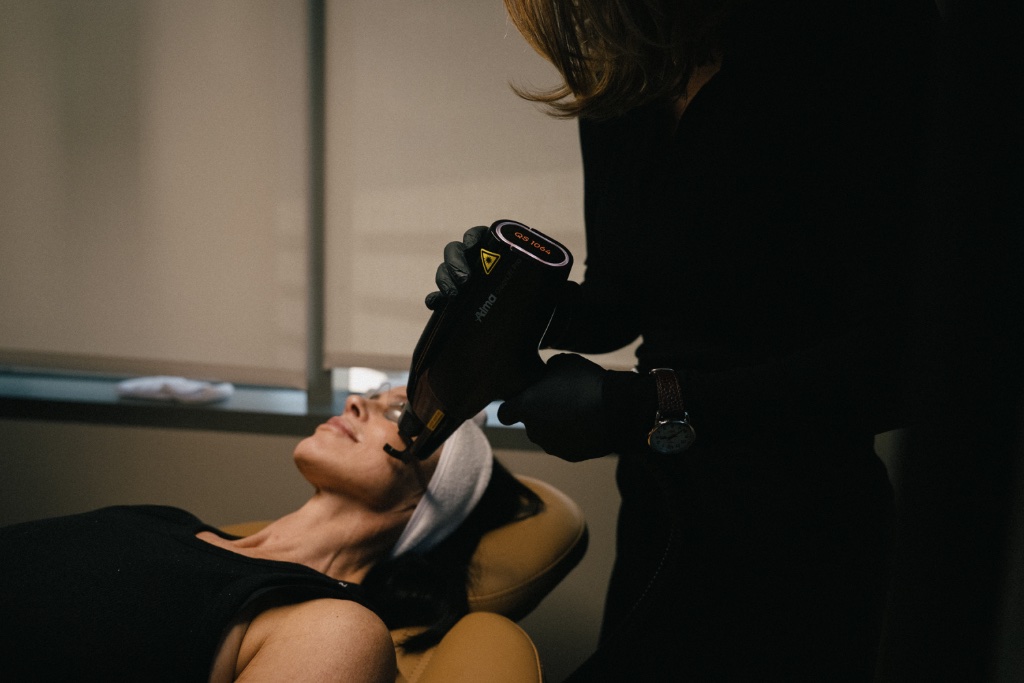
ULTRA + XERF / JOLA DALLAS
SURFACE IS
NOT STRUCTURE.
Why skin resurfacing and skin tightening may require different treatment strategies.
Can ULTRA and XERF Be Combined?
Potentially. ULTRA and XERF address different treatment categories, so a provider may consider both when a patient has both surface-quality concerns and firmness or laxity concerns. ULTRA is a fractional laser used for appropriate resurfacing-related goals, while XERF uses non-invasive radiofrequency in a skin-firming treatment category. Whether both belong in the same plan, and how they should be sequenced, depends on the patient's skin, goals, treatment intensity, recovery, and JOLA's clinical protocol.
For patients in Dallas, Highland Park, University Park, the Park Cities, and Preston Hollow, the more useful question is not whether two devices can be scheduled in the same season. It is whether the face actually contains two separate concerns worth treating. JOLA Dallas approaches ULTRA and XERF as different tools for different jobs, not as a bundled package.
ULTRA
Question:
What does the skin look like?
↓
SURFACE.
XERF
Question:
How does the skin sit?
↓
STRUCTURE.
DIFFERENT QUESTIONS. DIFFERENT TOOLS.
Why This Distinction Matters
Patients commonly use broad phrases. "My skin looks tired." "My face looks older." "My skin doesn't look as smooth." "My jawline isn't what it used to be." "I just want everything tighter."
Those statements may describe multiple anatomical and skin-quality changes at once. A single sentence can contain pigment, texture, fine lines, laxity, and volume change. Treatment begins by separating them. Skin resurfacing and skin tightening are not the same thing, and asking one device to solve every concern is how plans become imprecise.
Skin resurfacing and skin tightening are not the same thing.
The Face Is Not One Layer
Different treatments interact with different levels and mechanisms. ULTRA addresses a surface and resurfacing conversation. XERF addresses a firmness and structural conversation. Understanding the layer is what makes the plan coherent rather than random.
SURFACE
What light reveals. Pigment, texture, pores, fine lines.
SKIN QUALITY
Surface condition, tone, roughness, photodamage.
DERMAL SUPPORT
Collagen, elastin, the scaffolding beneath the surface.
SUBCUTANEOUS / STRUCTURAL CONTEXT
Fat pads, volume, how tissue drapes over structure.
FACIAL SHAPE
Projection, proportion, skeletal and volumetric architecture.
What Does "Surface" Mean?
Surface concerns are what light reveals when it moves across the skin. Pigmentation, roughness, visible pores, fine texture, photodamage, selected fine lines, and selected acne marks or scars where appropriate. These are the qualities you notice in raking light, in a mirror tilted toward a window, or in the texture of a photograph.
SURFACE IS WHAT LIGHT REVEALS.
ULTRA belongs to this conversation. As a 1927 nm non-ablative fractional thulium laser, it creates controlled micro-injury in the superficial skin to support resurfacing-related goals. Surface treatment does not tighten loose skin, and it should not be expected to.
What Does "Structure" Mean?
For this article, structure refers primarily to firmness, laxity, how skin drapes, jawline softness, jowling appearance, and neck laxity. It is about how the skin holds itself, not what it looks like in raking light.
STRUCTURE IS HOW THE SKIN HOLDS ITSELF.
XERF belongs to this conversation. It uses multifrequency monopolar radiofrequency energy to support a firmness and structural skin-tightening category. Structural treatment does not resurface pigment, and it should not be expected to.
What Is ULTRA?
ULTRA refers to the LaseMD Ultra, a 1927 nm non-ablative fractional thulium laser manufactured by Lutronic (Cynosure Lutronic). It delivers fractional laser energy to create controlled micro-channels in the skin, supporting a resurfacing and skin-quality conversation. It is FDA-cleared for dermatologic procedures including the coagulation of soft tissue and treatment of selected pigmentation concerns.
ULTRA is a laser. It is not radiofrequency. It is not a skin-tightening device. Its verified applications, depending on JOLA protocol, may include selected pigmentation, texture, pore appearance, fine lines, and acne-related surface changes.
What Is XERF?
XERF is a non-invasive structural skin-tightening system manufactured by Lutronic (Cynosure Lutronic). It uses multifrequency monopolar radiofrequency energy, combining 6.78 MHz and 2 MHz frequencies, to deliver heat to tissue in a firmness and structural tightening conversation. It does not use needles and does not use laser energy.
XERF is radiofrequency. It is not a laser. It is not a resurfacing treatment. Its verified clinical positioning, depending on JOLA protocol, relates to skin firmness, laxity, and structural support in appropriate treatment areas.
Is XERF a Laser?
No. XERF uses radiofrequency energy. ULTRA uses laser energy. They are different forms of energy delivered through different mechanisms.
Calling XERF a laser is a category error. Radiofrequency and laser light interact with tissue differently, reach different depths, and serve different treatment conversations.
XERF is radiofrequency. ULTRA is a laser. They are not interchangeable.
Is ULTRA Radiofrequency?
No. ULTRA is a 1927 nm fractional thulium laser. It delivers focused laser light to create micro-channels in the skin. Radiofrequency is a different energy form that delivers heat through electrical currents rather than light.
ULTRA and XERF use fundamentally different energy types. That is why they belong to different treatment conversations, not the same one.
ULTRA vs. XERF: The Specification
A meaningful comparison requires specification, not ranking. The table below uses APPROPRIATE, NOT PRIMARY TARGET, and DEPENDS where nuance matters rather than simplistic checks.
| Specification | ULTRA | XERF |
|---|---|---|
| Technology category | Fractional laser | Monopolar radiofrequency |
| Energy type | 1927 nm thulium laser | Multifrequency RF (6.78 MHz, 2 MHz) |
| Primary treatment conversation | Surface / resurfacing | Firmness / structural tightening |
| Surface resurfacing | PRIMARY TARGET | NOT PRIMARY TARGET |
| Pigment | APPROPRIATE (selected) | NOT A PIGMENT TREATMENT |
| Texture | APPROPRIATE | DEPENDS |
| Pores | APPEARANCE IMPROVEMENT | NOT A PORE TREATMENT |
| Fine lines | SELECTED SURFACE LINES | DEPENDS ON LINE TYPE |
| Skin firmness | NOT PRIMARY TARGET | PRIMARY TARGET |
| Laxity | NOT A LAXITY TREATMENT | APPROPRIATE (selected) |
| Jawline | NOT PRIMARY TARGET | APPROPRIATE (selected) |
| Jowls | NOT PRIMARY TARGET | APPROPRIATE (selected) |
| Neck | DEPENDS | APPROPRIATE (selected) |
| Fractional? | Yes | No (non-invasive RF delivery) |
| Needles? | No | No |
| Numbing | Topical numbing typical | Typically no numbing required |
| Visible downtime | Minimal relative to ablative | Minimal to none expected |
| Results development | Develops over weeks | Develops over weeks to months |
| Treatment series | Response-based | Response-based |
| Maintenance | Elective | Elective |
Why ULTRA and XERF Should Not Be Ranked
Asking "which is better?" without defining the concern is like asking whether a surface finish or structural reinforcement is better in architecture. They solve different problems. ULTRA and XERF do not need to compete. They have different jobs.
A tool cannot win a job it was not designed to do.
Ranking them against each other without naming the concern produces a meaningless answer. The right question is which tool fits which layer of the problem.
ULTRA vs. XERF for Pigmentation
ULTRA may belong to a selected pigmentation conversation where supported by indication and JOLA protocol. As a 1927 nm fractional laser, it interacts with superficial pigment in a resurfacing context. XERF should not be positioned as a pigmentation treatment. Radiofrequency is not a pigment-targeting energy.
If pigmentation is the primary concern, the conversation belongs to ULTRA for pigmentation, not to a combination plan by default.
ULTRA vs. XERF for Sun Damage
Sun damage can include brown spots, texture changes, fine lines, and elasticity changes. Some components belong to a resurfacing conversation. Other age-related changes may involve firmness. A patient with significant photodamage and early laxity may have two separate concerns, but a patient with photodamage alone may not.
Explore ULTRA for sun damage for the surface component.
ULTRA vs. XERF for Texture
Texture belongs primarily to a surface-quality conversation. Roughness, visible pores, and surface irregularity are what light reveals. ULTRA addresses this layer. XERF addresses how the skin sits, not how it feels to raking light.
Explore ULTRA for texture and pores.
ULTRA vs. XERF for Pores
Pores are surface anatomy. Neither treatment deletes pores. ULTRA may address the appearance of texture and pores where supported, because it belongs to the resurfacing conversation. XERF should not be sold as a pore treatment simply because it improves firmness. Firmness and pore appearance are different conversations.
ULTRA vs. XERF for Acne Marks
Acne marks are not one thing. Brown marks and red marks are different. Brown marks involve pigment and may belong to a resurfacing conversation. Red marks involve a vascular component and may require a different approach. Structural scars are a separate conversation from both.
XERF is not a substitute for pigment-specific treatment. Explore ULTRA for acne marks and scars.
ULTRA vs. XERF for Acne Scars
Scar morphology matters. A rolling scar, a boxcar scar, and an ice-pick scar are not the same plan. ULTRA may belong to selected scar and resurfacing plans where supported. XERF should not automatically be positioned as a scar resurfacing treatment, because radiofrequency firmness and surface scar remodeling are different conversations.
ULTRA vs. XERF for Fine Lines
Fine lines can arise from surface aging, photodamage, movement, volume change, or laxity. Therefore ULTRA, XERF, Botox or Dysport, Sculptra, or other treatment categories may address different components of what a patient calls "lines."
A surface fine line from photodamage is not the same as a dynamic wrinkle from movement, and neither is the same as a line created by laxity. Naming the line is what makes the plan precise.
ULTRA vs. XERF for Loose Skin
True laxity is different from roughness or pigmentation. If laxity is the primary issue, a resurfacing treatment should not automatically be expected to create the same type of result as a tightening-focused RF treatment. ULTRA addresses surface. XERF addresses firmness. Loose skin is a firmness conversation.
You cannot resurface your way out of laxity.
ULTRA vs. XERF for Jowls
"Jowls" can involve skin laxity, fat distribution, volume change, facial anatomy, and skeletal structure. XERF may belong to the firmness conversation where appropriate, because jowling is fundamentally a structural concern. ULTRA does not tighten jowls. Do not claim XERF replaces surgery, because the degree of tissue descent matters.
ULTRA vs. XERF for the Jawline
Jawline appearance is multifactorial. Possible contributors include skin quality, laxity, volume, chin projection, jaw structure, and submental fullness. A laser cannot be expected to correct every contributor. XERF may belong to the firmness and laxity component where appropriate.
Explore XERF for jawline tightening and facial balancing where anatomy is the primary concern.
ULTRA vs. XERF for the Neck
The neck may have pigmentation, crepey texture, horizontal lines, laxity, and photodamage. Different components may require different treatment categories. XERF may belong to the neck firmness conversation. ULTRA neck treatment should only be described if verified for that area in JOLA's protocol.
Explore XERF for neck tightening.
The "My Skin Looks Old" Problem
When a patient says their skin looks older, that sentence is the beginning of a diagnostic conversation, not the end of one. JOLA deconstructs the complaint before selecting a device.
MY SKIN LOOKS OLDER.
JOLA ASKS:
IS IT BROWN?
PIGMENT.
IS IT ROUGH?
TEXTURE.
IS IT LINED?
MOVEMENT / SURFACE / VOLUME.
IS IT DROOPING?
LAXITY / STRUCTURE.
IS IT HOLLOW?
VOLUME / STRUCTURE.
IS IT ALL OF THE ABOVE?
BUILD A PLAN.
THE DESCRIPTION IS THE BEGINNING. NOT THE DIAGNOSIS.
What If You Have Both Texture and Laxity?
A patient may simultaneously have surface irregularity and loss of firmness. In that situation, treating only the surface may leave the structural concern unchanged. Treating only firmness may leave pigmentation and texture unchanged. This is where combination planning may be considered.
But the combination exists because there are two concerns, not because two devices are better than one. Combination treatment should solve multiple problems, not simply use multiple devices.
Combination treatment should solve multiple problems. Not simply use multiple devices.
What If You Have Sun Damage and Jowls?
Concern A: brown spots and surface photodamage. Concern B: lower-face laxity. These should not automatically be assigned to one device. The brown spots belong to a surface and resurfacing conversation. The jowling belongs to a firmness and structural conversation.
This is a situation where ULTRA and XERF may each have a job. But the jobs must be named first.
What If You Have Pores and Loose Skin?
Pores belong to the surface. Laxity belongs to the structure. They are different layers of the same face.
PORES
↓
Surface.
LAXITY
↓
Structure.
What If You Have Acne Scars and Lower-Face Laxity?
Scar treatment and tightening should be planned separately. Do not assume ULTRA is sufficient for every scar, and do not assume XERF is a scar treatment. Scar morphology determines the scar plan. Laxity determines the firmness plan. They may coexist, but they should not be collapsed into one device.
What If You Have Fine Lines and Jowls?
Surface lines, movement, and laxity are different. A fine line from photodamage, a dynamic wrinkle from expression, and a jowl from tissue descent each belong to a different treatment category. Treatment planning may involve more than two technologies.
The plan may include ULTRA for surface, a neuromodulator for movement, and XERF for firmness. Each has a job. The number of tools should never exceed the number of problems worth treating.
Do You Need Both ULTRA and XERF?
Not necessarily. If the primary issue is surface quality, ULTRA alone may be the relevant category. If the primary issue is laxity, XERF alone may be the relevant category. If both are clinically meaningful, a combined strategy may be considered.
More treatments is not the goal. More complete diagnosis is.
Does Every ULTRA Patient Need XERF?
No. A patient whose primary concern is surface quality does not automatically need a firmness treatment. Adding XERF without a firmness indication is not a more complete plan. It is a more expensive one.
Does Every XERF Patient Need ULTRA?
No. A patient whose primary concern is firmness does not automatically need a resurfacing treatment. Adding ULTRA without a surface indication does not improve the firmness result.
Does Combining ULTRA + XERF Make Results "Better"?
A combination may create a more comprehensive plan when there are multiple appropriate treatment targets. But adding an unnecessary treatment does not automatically improve an outcome. Comprehensive does not mean more. Comprehensive means complete.
Comprehensive ≠ more. Comprehensive = complete.
Can ULTRA and XERF Be Done on the Same Day?
Whether same-day treatment is appropriate depends on treatment area, treatment intensity, skin response, recovery, and JOLA's clinical protocol. JOLA does not publish a universal same-day protocol. The sequence and spacing should be determined by the treating provider based on the patient's skin, treatment intensity, recovery, and goals.
Which Should Come First: ULTRA or XERF?
There is no universal sequence. Potential considerations include the primary concern, skin condition, treatment intensity, downtime, event schedule, and provider strategy. The sequence should have a reason.
Sequence should have a reason.
How Far Apart Should ULTRA and XERF Be?
Treatment spacing follows JOLA's clinical protocol and the patient's individual response. JOLA does not publish a universal interval, because the appropriate spacing depends on treatment intensity, area, recovery, and reassessment.
Why Treatment Timing Matters
Healing, inflammation, skin response, assessment, and patient schedule may all affect sequencing. Treating too soon may interfere with the response window. Treating without a plan may produce two treatments that do not inform each other.
Can You Alternate ULTRA and XERF?
Potentially, if that is part of an individualized treatment plan. There is no universal cadence. Alternation, like any sequence, should have a clinical rationale.
How Many ULTRA Treatments Do You Need?
ULTRA treatment count is response-based and depends on the concern, severity, skin, and goal. JOLA does not prescribe a universal number.
For the complete ULTRA treatment-count conversation, read How Many ULTRA Laser Treatments Do You Need?
How Many XERF Treatments Do You Need?
XERF treatment count follows JOLA's protocol and current device guidance. The number depends on the firmness concern, treatment area, response, and goal. JOLA does not prescribe a universal number.
Do You Need the Same Number of ULTRA and XERF Treatments?
No. There is no reason the number should automatically match, because the technologies target different concerns. Do not create package arithmetic. The ULTRA count follows the surface concern. The XERF count follows the firmness concern.
Can One ULTRA + One XERF Treatment Be Enough?
Potentially for a particular patient's limited goals, but there is no universal formula. Response-led planning means the next session is informed by the response to the last one, not by a preset count.
ULTRA + XERF Downtime
ULTRA visible recovery and XERF expected recovery are different. ULTRA, as a non-ablative fractional laser, has minimal downtime relative to ablative resurfacing. XERF, as non-invasive RF, typically has minimal to no expected visible downtime.
Combination timing may affect the patient's calendar, but the two downtime profiles should not simply be added together. How they interact depends on sequence, spacing, and protocol. Read the ULTRA downtime guide for ULTRA-specific recovery detail.
What Will I Look Like After Both?
That depends on the actual sequence and protocol. If treatments are spaced apart, the patient experiences each recovery separately. If timing varies, the experience varies. JOLA describes expected recovery based on the individual plan, not a universal combined downtime.
ULTRA + XERF Before a Wedding
Surface treatment may require visible recovery. Firmness results may develop on another timeline. Therefore wedding planning should work backward from the desired endpoint, not simply from the procedure date. There is no arbitrary universal countdown. JOLA plans event-driven treatment with enough lead time for recovery and reassessment.
ULTRA + XERF Before a Big Event
The same framework applies to any significant event. The endpoint determines the schedule. Treatment is planned backward from the date the skin should look settled, not forward from the date the patient first calls.
ULTRA + XERF Before Vacation
Sun exposure, pigment treatment, and recovery all interact. Vacation sun exposure can generate new damage, so timing and sun protection matter. JOLA does not invent restrictions, but patients should understand that treating pigment and then traveling to high UV exposure without protection undermines the result.
When Will I See Results from ULTRA + XERF?
There is not one combined result date. ULTRA has its own response timeline. XERF has its own response timeline. The patient sees one face, but the plan may contain multiple clocks.
One plan can have multiple clocks.
The Two-Clock Model
ULTRA and XERF develop on different timelines because they address different layers. The patient experiences one face, but the plan tracks two clocks.
CLOCK 01 / SURFACE
ULTRA
RECOVERY
EARLY CHANGE
DEVELOPING RESULT
CLOCK 02 / STRUCTURE
XERF
TREATMENT RESPONSE
DEVELOPING FIRMNESS
REASSESSMENT
THE PATIENT SEES ONE FACE. THE PLAN MAY CONTAIN MULTIPLE TIMELINES.
Do ULTRA + XERF Results "Stack"?
Not mathematically. They may complement one another when they address different appropriate targets. Do not create the formula ULTRA + XERF = 2X result. That is invented arithmetic.
Can ULTRA Make XERF Work Better?
The value of combination treatment may come from addressing different concerns rather than one device biologically amplifying the other. JOLA does not claim biological synergy without evidence. The safer and often more useful concept is complementary targets.
Can XERF Make ULTRA Work Better?
The same principle applies. XERF does not biologically amplify ULTRA's resurfacing effect. Each treatment does its own job. The combination is valuable when both jobs are worth doing.
What Does "Synergy" Actually Mean?
There are two possible meanings. Biologic synergy means one device biologically amplifies the other. Complementary treatment means two devices address different appropriate targets. Do not claim biologic synergy without evidence. For JOLA, the safer and often more useful concept is complementary targets.
Different jobs can create a more complete plan without claiming one device boosts the other.
ULTRA + XERF vs. Morpheus8
Morpheus8 is RF microneedling. ULTRA is a laser. XERF is non-invasive RF. Therefore ULTRA + XERF should not simply be marketed as "a better Morpheus8." Different mechanisms, different delivery, different conversations.
Read the ULTRA vs. Morpheus8 comparison.
ULTRA + XERF vs. CO2
CO2 belongs to an ablative resurfacing category. ULTRA + XERF does not become equivalent to CO2 merely because two devices are used. A non-ablative fractional laser plus non-invasive RF is not the same as ablative resurfacing, and should not be represented as such.
Read the ULTRA vs. CO2 comparison.
ULTRA + XERF vs. Fraxel
Fraxel is a fractional laser brand family, not a single wavelength. XERF addresses a different RF and tightening conversation. ULTRA + XERF should not be positioned as a replacement for a specific Fraxel device without identifying which Fraxel and why.
Read the ULTRA vs. Fraxel comparison.
ULTRA + XERF vs. IPL / BBL
IPL and BBL belong primarily to selected pigment and vascular light-treatment conversations. ULTRA + XERF should not automatically replace a color-targeting technology. If the concern is primarily vascular or a specific pigment type, a different approach may be more appropriate.
Read the ULTRA vs. IPL/BBL comparison.
ULTRA + XERF vs. Microneedling
Traditional microneedling creates mechanical micro-injury. ULTRA is laser. XERF is RF. They are different mechanisms, not variations of the same treatment. ULTRA + XERF is not a substitute for mechanical microneedling when microneedling is the indicated approach.
Read the ULTRA vs. microneedling comparison.
What About Botox / Dysport?
If the concern is dynamic expression lines, neither ULTRA nor XERF necessarily replaces neuromodulators. Movement is a separate conversation from surface and firmness.
MOVEMENT
↓NEUROMODULATOR CONVERSATION.
SURFACE
↓ULTRA CONVERSATION.
FIRMNESS
↓XERF CONVERSATION.
What About Sculptra?
Sculptra belongs to a biostimulatory injectable and volume-support conversation. It is not resurfacing. It is not the same as non-invasive RF. Sculptra addresses volume and structural support through collagen stimulation over time, which is a different layer from both surface and firmness.
Explore Sculptra at JOLA Dallas.
ULTRA + XERF + Sculptra
A patient can theoretically have surface, firmness, and volume or biostimulation as separate treatment-planning categories. But each category must have an indication. This is not a "triple treatment." It is three named problems, each with its own tool.
The number of tools should never exceed the number of problems worth treating.
Explore XERF and Sculptra at JOLA Dallas.
What About Facial Balancing?
Facial balancing addresses proportion, projection, volume, and structural relationships. ULTRA and XERF do not replace facial balancing when anatomy is the primary concern. Surface, firmness, and shape are different layers.
Explore facial balancing at JOLA Dallas.
The Four-Layer JOLA Model
Before choosing a device, JOLA asks four questions. The answers assign the layer, and the layer assigns the category.
COLOR?
Brown spots. Redness. Pigmentation.
Light / laser / other pigment strategy depending on diagnosis.
SURFACE?
Texture. Pores. Selected scarring. Fine surface lines.
Resurfacing strategy.
FIRMNESS?
Laxity. Jawline softness. Jowling. Neck firmness.
Tightening strategy.
SHAPE?
Projection. Volume. Proportion. Facial balance.
Injectable / structural planning where appropriate.
COLOR. SURFACE. FIRMNESS. SHAPE.
The JOLA Surface / Structure Method
The method moves from complaint to device in a deliberate order. Device selection is near the end, not the beginning.
NAME THE COMPLAINT.
"My skin looks older."
DECONSTRUCT IT.
Pigment? Texture? Laxity? Volume? Movement?
ASSIGN THE LAYER.
Surface? Firmness? Shape? Movement?
SELECT THE CATEGORY.
Laser? RF? Injectable? Skincare? Other?
SELECT THE DEVICE / TREATMENT.
Only now.
PLAN THE SEQUENCE.
TREAT.
REASSESS.
DEVICE SELECTION SHOULD BE NEAR THE END OF THE DECISION. NOT THE BEGINNING.
The JOLA Combination Filter
Before adding a second treatment, JOLA asks ten questions. A treatment is added only if it has a job.
Is there a second distinct concern?
Is it clinically meaningful?
Does the first treatment address it?
Does the second technology have a different appropriate target?
Is the patient an appropriate candidate?
Is the additional recovery acceptable?
Is there evidence / clinical rationale?
Is the sequence appropriate?
Is the additional cost justified by the goal?
Would doing less still satisfy the patient?
ADD THE TREATMENT ONLY IF IT HAS A JOB.
When ULTRA Alone May Make Sense
ULTRA alone may make sense when the primary concern is surface quality: texture, selected pigment, selected resurfacing goals, and related surface changes where supported by indication and JOLA protocol. This is not a remote diagnosis. It is a description of when one category is sufficient.
When XERF Alone May Make Sense
XERF alone may make sense when firmness or laxity is the dominant concern, and surface quality is not a meaningful independent target. This follows verified XERF indications and JOLA protocol.
When ULTRA + XERF May Make Sense
ULTRA + XERF may make sense when there are meaningful surface concerns and meaningful firmness or laxity concerns, and both treatments are appropriate for the patient. Both categories must have an indication. Neither is added by default.
When Neither May Be the Answer
Sometimes neither ULTRA nor XERF is the right answer. A vascular issue may require another technology. A suspicious lesion requires medical evaluation. Active skin disease, severe acne, significant structural volume loss, surgical-level laxity, unrealistic expectations, or barrier compromise may all point elsewhere. Another treatment category may be more logical.
Good combination planning includes the option: none.
Can ULTRA + XERF Replace a Facelift?
No universal claim. Non-surgical energy-based treatments should not be presented as equivalent to surgical lifting. The degree of laxity matters. For mild to moderate firmness concerns, XERF may belong to the conversation. For significant tissue descent, surgical consultation may provide information that energy-based treatment cannot.
When Surgery May Be a More Appropriate Conversation
For more significant tissue descent or laxity, surgical consultation may provide information that energy-based treatment cannot. JOLA does not discourage surgery. Surgery and energy-based treatment address different degrees of the same concern, and knowing where the line sits is part of honest planning.
The "More Is Better" Problem
Patients may encounter plans involving laser, RF, microneedling, injectables, facials, and peels all at once. More modalities do not automatically create more refined results. A plan can be complex, but it should never be random.
A sophisticated plan can be complex. It should never be random.
How JOLA Decides Whether to Combine ULTRA + XERF
JOLA considers the exact concern, surface quality, pigmentation, texture, scars, fine lines, firmness, laxity, jawline, jowling, neck, skin tone, PIH history, sun exposure, previous laser, previous ULTRA, previous XERF, previous RF microneedling, previous IPL, previous CO2, injectables, skincare, barrier health, recovery tolerance, events, travel, budget, desired endpoint, and willingness to complete a staged plan.
None of that fits on a price list. It fits in a consultation.
Chey Cope — Laser Specialist, JOLA Dallas
Chey Cope is a laser specialist at JOLA Dallas. The role demands judgment at every step: device selection, laser planning, energy-based treatment planning, recognizing surface versus firmness concerns, knowing when another modality is more appropriate, treatment sequencing, and response assessment.
The question isn't how many devices we can use. It's how many problems we actually need to solve.
Editorial concept. Not a literal attributed quote unless approved.
ULTRA + XERF Cost
The total cost depends on whether ULTRA alone, XERF alone, or a staged combination plan is actually appropriate. JOLA does not automatically bundle the treatments, and does not publish a multiplied combination price based on an invented protocol.
A combination plan should not begin with a package price. It should begin with a reason.
Is ULTRA + XERF "Worth It"?
It may offer value when both technologies address distinct concerns the patient genuinely wants to improve. It may offer little value if the second treatment has no meaningful target. Worth is not measured by the number of devices. It is measured by whether each device has a job.
How to Compare Combination-Treatment Plans
What is treatment #1 targeting?
What is treatment #2 targeting?
Are those actually different concerns?
Why these devices?
Why this sequence?
Why this spacing?
What result belongs to each treatment?
What downtime belongs to each?
What happens if we only do one?
How will results be reassessed?
What is the endpoint?
What is the total cost?
If you cannot explain the job of each treatment, the plan is not clear enough.
30 Questions to Ask Before Combining ULTRA + XERF
What exactly is my primary concern?
Is it surface or structure?
Do I actually have two separate concerns?
What is ULTRA targeting?
What is XERF targeting?
Is XERF a laser?
Is ULTRA radiofrequency?
Can ULTRA tighten loose skin?
Can XERF resurface skin?
Which treatment addresses pigmentation?
Which treatment addresses texture?
Which treatment addresses pores?
Which treatment addresses laxity?
Which treatment addresses jowls?
Which treatment addresses my neck?
Do I actually need both?
What happens if I only choose ULTRA?
What happens if I only choose XERF?
Does combining them improve each other's effect?
Is there evidence for biological synergy?
Can they be done on the same day?
Which should be done first?
How far apart should they be?
How much downtime should I expect?
When will ULTRA results appear?
When will XERF results appear?
How many of each treatment might I need?
How will we know when the plan is complete?
Could another treatment be more appropriate?
What is the total goal of the combination?
ULTRA + XERF: The Bottom Line
ULTRA and XERF are different technologies. ULTRA is a 1927 nm non-ablative fractional thulium laser manufactured by Lutronic. XERF is a multifrequency monopolar radiofrequency device manufactured by Lutronic. XERF is not a laser. ULTRA is not radiofrequency.
Resurfacing and tightening are different. Pigment and laxity are different. Texture and laxity are different. Pores and jowls are different. Acne scars and lower-face laxity are different. Surface fine lines and dynamic wrinkles are different.
"My skin looks older" is not a diagnosis. One face can contain multiple treatment targets, but one device does not need to solve every target. ULTRA does not automatically replace XERF. XERF does not automatically replace ULTRA. Not every ULTRA patient needs XERF. Not every XERF patient needs ULTRA.
Combination treatment is not inherently superior. There must be a reason for each treatment. Sequence should have a reason. Spacing should follow actual protocol. Do not invent same-day claims. Do not claim biological synergy without evidence. Complementary targets are different from biological synergy.
Treatment timelines may differ. Treatment counts may differ. Results should not be added mathematically. ULTRA + XERF does not equal CO2. ULTRA + XERF is not "better Morpheus8." Botox addresses another category. Sculptra addresses another category. Facial balancing addresses another category. Surgery may be appropriate for more significant laxity.
Some patients need one treatment. Some need a staged plan. Some need neither. JOLA should diagnose the problem before choosing the device.
If you are considering ULTRA and XERF in Dallas, do not begin with "Should I do both?" Begin with: What am I actually seeing? Is it color? Is it texture? Is it a scar? Is it laxity? Is it movement? Is it volume? Is it more than one of those?
Then give each meaningful concern a job. Surface. Structure. Movement. Shape. Only then should the treatment plan begin.
The most sophisticated combination treatment is not the plan with the most devices. It is the plan where every treatment has a reason.
WHAT LAYER ARE YOU TREATING?
Frequently Asked Questions
73 ANSWERS
Potentially. ULTRA and XERF address different treatment categories, so a provider may consider both when a patient has both surface-quality concerns and firmness or laxity concerns. Whether both belong in the same plan depends on the patient's skin, goals, and JOLA's clinical protocol.
Potentially, but whether they are performed in the same session or on different days depends on treatment area, intensity, recovery, and JOLA protocol. There is no universal same-day protocol.
ULTRA is a 1927 nm non-ablative fractional thulium laser used for resurfacing-related surface goals. XERF is a multifrequency monopolar radiofrequency device used for firmness and structural skin-tightening. ULTRA asks what the skin looks like. XERF asks how the skin sits.
No. XERF uses radiofrequency energy, not laser light. ULTRA is a laser. They are different energy forms with different mechanisms.
No. ULTRA is a 1927 nm fractional thulium laser. Radiofrequency is a different energy form. ULTRA and XERF use fundamentally different energy types.
ULTRA is a non-ablative fractional laser resurfacing treatment. It creates controlled micro-channels in the skin to support surface-quality goals like selected pigmentation, texture, and pore appearance.
XERF is a non-invasive structural skin-tightening treatment using multifrequency monopolar radiofrequency. It does not use needles or laser energy.
No. ULTRA is a resurfacing laser. It addresses surface quality, not laxity or firmness. It should not be expected to tighten loose skin.
No. XERF addresses firmness and structural tightening. It does not resurface the skin or target pigmentation.
Neither is universally better. They address different concerns. ULTRA is better for surface quality. XERF is better for firmness. Ranking them without naming the concern produces a meaningless answer.
That depends on what you are actually seeing. If the concern is surface quality, ULTRA may be relevant. If the concern is laxity, XERF may be relevant. If both are present, a combination may be considered.
Not necessarily. If only one category of concern is clinically meaningful, only one treatment may be needed. Both are added only when both have an indication.
No. A patient whose primary concern is surface quality does not automatically need a firmness treatment.
No. A patient whose primary concern is firmness does not automatically need a resurfacing treatment.
ULTRA may belong to a selected pigmentation conversation where supported by indication and JOLA protocol. It is a fractional laser that interacts with superficial pigment in a resurfacing context.
XERF is not a pigmentation treatment. Radiofrequency is not a pigment-targeting energy. Pigment concerns belong to a surface conversation.
Sun damage includes multiple components. Brown spots and texture belong to the surface conversation, where ULTRA may be relevant. Elasticity changes may involve firmness, where XERF may be relevant.
Brown spots are a pigment concern. ULTRA may address selected pigmentation in a resurfacing context. XERF is not a pigment treatment.
Texture belongs primarily to the surface conversation. ULTRA addresses this layer. XERF addresses firmness, not surface texture.
Pores are surface anatomy. ULTRA may address the appearance of texture and pores. XERF should not be sold as a pore treatment.
ULTRA may improve the appearance of pores as surface texture refines, but pores cannot be removed. The honest framing is appearance improvement, not pore removal.
No. XERF addresses firmness, not pore appearance. Pores are surface anatomy and belong to a resurfacing conversation.
Brown acne marks may belong to a resurfacing conversation where ULTRA is relevant. Red marks involve a vascular component. XERF is not a substitute for pigment-specific treatment.
Scar morphology matters. ULTRA may belong to selected scar plans where supported. XERF should not automatically be positioned as a scar resurfacing treatment.
Fine lines have multiple causes. Surface lines from photodamage may belong to ULTRA. Dynamic wrinkles from movement belong to neuromodulators. Lines from laxity may involve XERF. Naming the line determines the treatment.
It depends on the wrinkle type. Surface wrinkles, dynamic wrinkles, and laxity-related lines are different conversations that may involve ULTRA, Botox, or XERF respectively.
Loose skin is a firmness conversation. XERF may belong to this category. ULTRA addresses surface and should not be expected to tighten loose skin.
Jowls involve laxity and structural change. XERF may belong to the firmness conversation. ULTRA does not tighten jowls. The degree of tissue descent matters.
Jawline appearance is multifactorial. XERF may address the firmness component. ULTRA addresses surface quality. If anatomy is the primary concern, facial balancing may be more relevant.
The neck may have pigmentation, texture, and laxity. XERF may belong to the neck firmness conversation. ULTRA neck treatment depends on verified protocol for that area.
No. ULTRA is a resurfacing laser. It addresses surface quality, not laxity. Jowls are a firmness conversation.
No. XERF is a radiofrequency firmness treatment. It does not resurface the skin or target pigment. Resurfacing belongs to a laser conversation.
Potentially, when both concerns are clinically meaningful. ULTRA may address texture and XERF may address laxity, but each must have an indication.
Potentially. Sun damage is a surface conversation and jowls are a firmness conversation. ULTRA and XERF may each have a job, but the jobs must be named first.
Potentially. Pores belong to the surface and loose skin belongs to the structure. They are different layers that may require different tools.
Potentially, but scar treatment and tightening should be planned separately. Scar morphology determines the scar plan. Laxity determines the firmness plan.
A combination may create a more comprehensive plan when there are multiple appropriate targets. Adding an unnecessary treatment does not automatically improve an outcome. Comprehensive means complete, not more.
JOLA does not claim biological synergy without evidence. The safer and more useful concept is complementary targets: two devices addressing different appropriate concerns, not one amplifying the other.
The value of combination treatment may come from addressing different concerns, not from one device biologically amplifying the other. JOLA does not claim ULTRA makes XERF work better.
No biological synergy is claimed. XERF does not biologically amplify ULTRA's resurfacing effect. Each treatment does its own job.
Whether same-day treatment is appropriate depends on treatment area, intensity, skin response, recovery, and JOLA protocol. There is no universal same-day protocol.
There is no universal sequence. The order depends on the primary concern, skin condition, treatment intensity, downtime, event schedule, and provider strategy. The sequence should have a reason.
Treatment spacing follows JOLA's clinical protocol and the patient's individual response. JOLA does not publish a universal interval.
Potentially, if that is part of an individualized treatment plan. There is no universal cadence. Alternation should have a clinical rationale.
ULTRA treatment count is response-based and depends on the concern, severity, skin, and goal. There is no universal number. Read the complete ULTRA treatment-count guide for detail.
XERF treatment count follows JOLA protocol and current device guidance. The number depends on the firmness concern, area, response, and goal. There is no universal number.
No. The technologies target different concerns, so there is no reason the counts should automatically match. Do not create package arithmetic.
Potentially for a particular patient's limited goals, but there is no universal formula. Response-led planning means the next session is informed by the response to the last one.
ULTRA has minimal downtime relative to ablative resurfacing. XERF typically has minimal to no expected visible downtime. The two profiles should not simply be added together. How they interact depends on sequence and protocol.
That depends on the actual sequence and protocol. If treatments are spaced apart, the patient experiences each recovery separately. JOLA describes expected recovery based on the individual plan.
ULTRA results develop over weeks as the skin remodels. Some superficial change may appear earlier, but the developing result unfolds over time.
XERF results develop over weeks to months as firmness develops. There is no single universal result date.
There is not one combined result date. ULTRA and XERF develop on different timelines because they address different layers. One plan can have multiple clocks.
Potentially, with appropriate timing. Surface treatment may require visible recovery and firmness results may develop on another timeline. Wedding planning should work backward from the desired endpoint.
Potentially, with attention to sun exposure. Vacation sun exposure can generate new damage, so timing and sun protection matter.
ULTRA + XERF should not be marketed as a better Morpheus8. Morpheus8 is RF microneedling, ULTRA is a laser, and XERF is non-invasive RF. They are different mechanisms for different conversations.
No. CO2 is ablative resurfacing. ULTRA is non-ablative fractional and XERF is non-invasive RF. Two devices do not become equivalent to CO2 merely because both are used.
Fraxel is a fractional laser brand family. XERF addresses a different RF tightening conversation. ULTRA + XERF is not a replacement for a specific Fraxel device without identifying which Fraxel and why.
IPL and BBL belong primarily to selected pigment and vascular light-treatment conversations. ULTRA + XERF should not automatically replace a color-targeting technology.
No. If the concern is dynamic expression lines, neither ULTRA nor XERF replaces neuromodulators. Movement is a separate conversation from surface and firmness.
No. Sculptra is a biostimulatory injectable addressing volume and structural support. It is a different layer from both surface and firmness.
No. Filler addresses volume and structural support. ULTRA and XERF address surface and firmness, not volume.
No universal claim. Non-surgical energy-based treatments should not be presented as equivalent to surgical lifting. The degree of laxity matters.
If texture is the only meaningful concern, ULTRA alone may be the relevant category. XERF is not needed without a firmness indication.
If laxity is the only meaningful concern, XERF alone may be the relevant category. ULTRA is not needed without a surface indication.
When both are clinically meaningful, a combined strategy may be considered. ULTRA may address texture and XERF may address laxity, but each must have a job.
Then the plan may involve multiple categories. Pigment and texture belong to the surface conversation. Laxity belongs to the firmness conversation. Each concern is named and assigned a layer before a device is chosen.
The total cost depends on whether ULTRA alone, XERF alone, or a staged combination is appropriate. JOLA does not automatically bundle the treatments. Pricing is reviewed at consultation.
It may offer value when both technologies address distinct concerns the patient genuinely wants to improve. It may offer little value if the second treatment has no meaningful target.
Through consultation-led assessment of the exact concern, surface quality, firmness, skin tone, history, goals, and response. The decision follows the diagnosis, not a preset package.
Chey Cope is a laser specialist at JOLA Dallas, involved in device selection, laser planning, and energy-based treatment planning.
JOLA Dallas offers the LaseMD Ultra 1927 nm non-ablative fractional thulium laser. Book a consultation to build a response-based ULTRA plan.
JOLA Dallas offers XERF multifrequency monopolar radiofrequency for structural skin-tightening. Book a consultation to determine whether XERF is appropriate for your firmness concerns.
SURFACE OR STRUCTURE? START WITH THE CONCERN.
Explore ULTRA + XERF at JOLA Dallas.
EXPLORE ULTRA + XERFNOT SURE IF YOU NEED ONE TREATMENT OR TWO? START WITH A PLAN.
Explore Aesthetic Consultation.
EXPLORE AESTHETIC CONSULTATIONXERF + ULTRA HAS A NAME: K-LUXE
Cynosure Lutronic K-LUXE, Explained.
Cynosure Lutronic now calls the coordinated XERF + ULTRA pairing K-LUXE. Read JOLA Dallas's complete guide to the new K-LUXE treatment: what it is, who makes it, what it may address, and who actually needs both technologies.
READ ABOUT K-LUXE AT JOLA DALLAS →SURFACE AND STRUCTURE, OVER TIME
XERF + ULTRA Results.
K-LUXE is the new Cynosure Lutronic treatment concept pairing XERF radiofrequency for structure with ULTRA fractional laser for surface. Read JOLA Dallas’s complete guide to what K-LUXE is, what it may address, and who may need both technologies.
XERF + ULTRA RESULTS →THE DAYS AFTER
Recovery After XERF + ULTRA.
K-LUXE is the new Cynosure Lutronic treatment concept pairing XERF radiofrequency for structure with ULTRA fractional laser for surface. Read JOLA Dallas’s complete guide to what K-LUXE is, what it may address, and who may need both technologies.
RECOVERY AFTER XERF + ULTRA →