
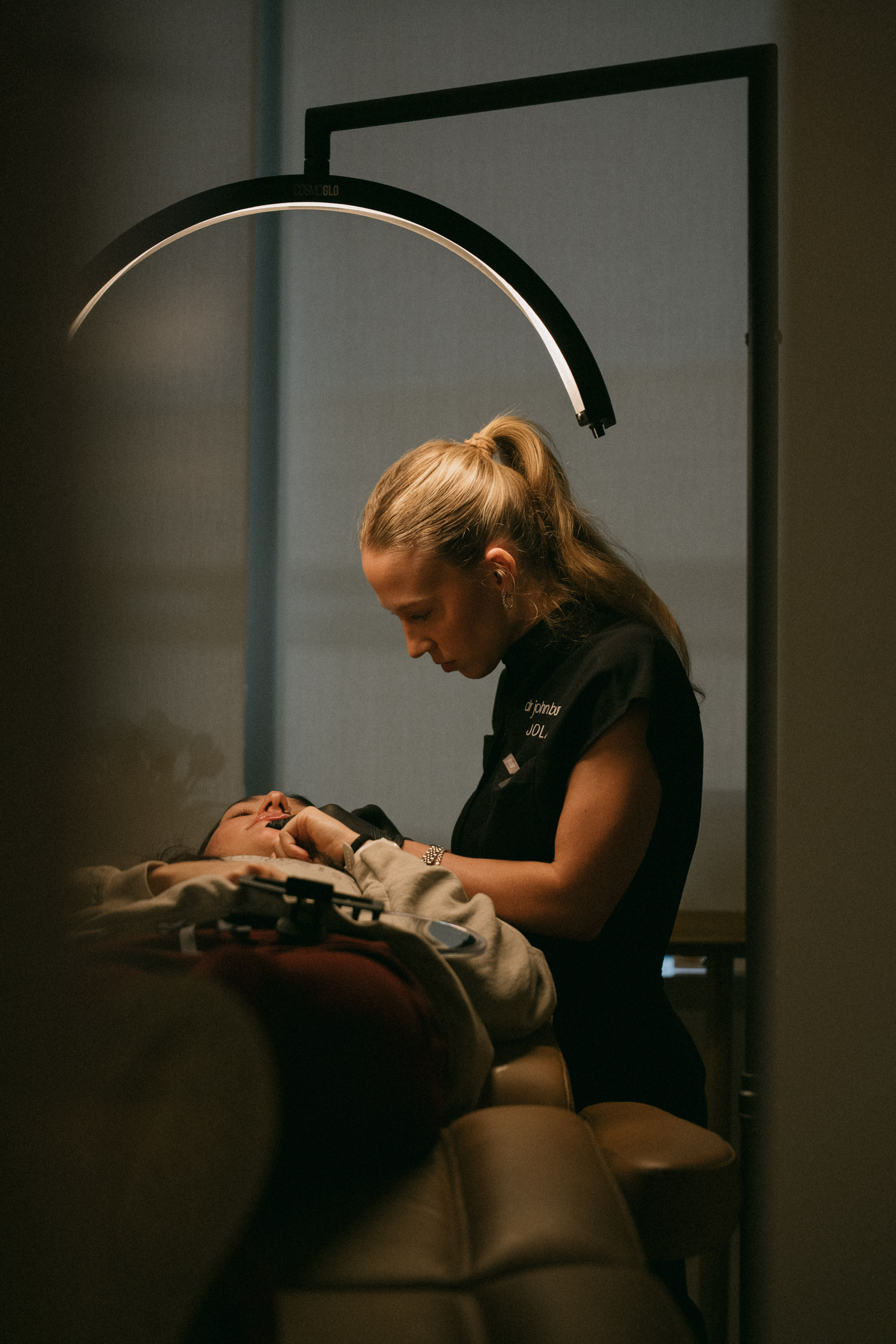
DECISION GUIDE / EYE AREA
THE EYE IS NOT ONE AREA
XERF + THE EYE AREA
Before choosing a treatment, understand what is actually creating the heaviness. Brow. Lid. Movement. Volume. Skin.
JOLA DALLAS / AUGUST 2026
18 MIN READ
The 30-Second Answer: Can XERF Help Hooded Eyes?
In Dallas and Highland Park, patients frequently arrive at consultation asking whether XERF can help hooded eyes. The honest answer is: not automatically, and not as a single category. "Hooded eyes" is an appearance, not a diagnosis. The heaviness a patient perceives may involve upper-eyelid skin, brow position, orbital anatomy, volume, muscle movement, pigment, texture, fat compartments, or a combination. XERF is a radiofrequency skin-tightening treatment, and it should only be discussed for treatment areas supported by current manufacturer guidance and JOLA clinical protocol. Direct treatment of the eyelids should not be assumed.
WHAT THE PATIENT SEES
"My eyes look hooded."
WHAT JOLA NEEDS TO DETERMINE
Is it eyelid skin? Brow position? Orbital anatomy? Volume? Muscle movement? Or a combination of several?
HOODED EYES ARE AN APPEARANCE. NOT A TREATMENT CATEGORY.
What Does “Hooded Eyes” Actually Mean?
"Hooded eyes" is commonly used to describe visible skin folding over the upper-eyelid crease. But appearances vary significantly. Some patients have always had this eye shape. For others, the fold has become more pronounced over time. The term collapses together natural anatomy, genetics, brow position, upper-eyelid skin, age-related tissue changes, and orbital structure into one phrase — and that imprecision is exactly where unhelpful treatment decisions begin.
Importantly, hooded eyes are not inherently undesirable. Many of the most striking faces in art and fashion have hooded eyelid anatomy. The question is never whether an eyelid fold exists — it is whether something has changed, whether that change bothers the patient, and which anatomical factor is responsible.
Some People Have Always Had Hooded Eyes
Hooded eyelid anatomy may simply be a natural facial feature. In patients across University Park, Preston Hollow, and the Park Cities, consultations sometimes reveal that the "heaviness" a patient notices has been present since their twenties — or since childhood. In those cases, treatment should not be recommended simply because the eye shape fits an internet beauty term.
A FACIAL FEATURE IS NOT AUTOMATICALLY A PROBLEM.
This is a question of restraint: distinguishing a natural feature from a change, and then deciding — with the patient — whether any intervention is warranted at all. For more on how JOLA approaches this philosophy, see JOLA's treatment philosophy.
Why Eyes Can Look Heavier Over Time
When the appearance is a change rather than a lifelong feature, several contributors may be involved. Upper-eyelid skin may lose some of its firmness. Brow position may shift. Facial volume may change, altering the relationship between the brow, the lid, and the cheek. Tissue support may soften. Skin texture may become more crepey. Muscle movement may create dynamic lines that contribute to a tired or heavy impression. None of these is diagnosed from a mirror — they are evaluated in consultation.
The key point: "heavier" is a description of how the eye looks. It is not a diagnosis of what is causing it. Treatment that begins with the description rather than the cause often misses the target entirely.
The Six-Layer Eye Question
MY EYES LOOK HEAVIER. WHY?
BROW POSITION
Has the brow shifted lower or changed shape?
UPPER-EYELID SKIN
Is there excess or less-firm skin on the lid?
MUSCLE MOVEMENT
Are dynamic lines or expression contributing?
ORBITAL STRUCTURE
Is the bony framework a factor?
VOLUME
Has fat or volume changed around the eye?
SKIN QUALITY
Is texture, crepiness, or pigment involved?
ONE VISUAL CONCERN. MULTIPLE POSSIBLE CAUSES.
The value of this framework is that it slows the conversation down. Before asking what treats hooded eyes, it asks what is actually creating the hooded appearance. For a deeper structural perspective, see facial balancing at JOLA Dallas and treatment planning.
"HOODED" DOESN'T TELL YOU WHAT TO TREAT.
EXPLORE AESTHETIC CONSULTATIONWhere XERF Actually Fits
XERF is a multifrequency monopolar radiofrequency treatment designed to deliver controlled heat into deeper tissue layers to support collagen and skin firmness. What it can and cannot address depends on the verified treatment areas for the specific device — not on the general phrase "RF skin tightening." Patients should not blur the forehead, temple, brow, orbital rim, upper eyelid, and lower eyelid into a single interchangeable "eye area." These are anatomically and clinically distinct zones.
The only responsible way to determine whether XERF fits a given concern is through a consultation that verifies the exact treatment zone against current manufacturer guidance and JOLA protocol. For the foundational treatment overview, see XERF at JOLA Dallas and what XERF is.
Can XERF Be Used on the Upper Eyelids?
Direct treatment of the upper eyelid should not be assumed without current manufacturer and regulatory guidance. The upper eyelid is one of the most delicate structures on the face — thin skin, minimal subcutaneous tissue, and proximity to the globe. It is anatomically distinct from the forehead, the temple, and the brow region above it. If upper-eyelid skin is the primary concern, the honest conversation may point toward a different category entirely, including whether surgical evaluation is the more appropriate path.
The phrase "xerf eyelids" appears frequently in search, but a search term is not a treatment indication. The question is whether the device is cleared and appropriate for that exact zone — and that answer comes from verified guidance, not marketing.
Can XERF Be Used Under the Eyes?
The lower eyelid, the infraorbital region, the cheek, and the orbital rim are not interchangeable. Each has different anatomy, skin thickness, and safety considerations. Whether XERF is appropriate in any zone close to the eye depends on verified treatment-area guidance. Under-eye concerns — hollowing, pigment, puffiness, texture — often belong to different treatment categories than skin tightening.
For the dedicated lower-eye conversation, see our existing under-eye skin-tightening guide and under-eye hollows. This article focuses on the decision framework: what is causing the heaviness, and which category fits.
Can XERF Lift the Brows?
XERF should not be marketed as a brow lift. The phrase "xerf brow lift" appears in search, but a search term does not create a clinical indication. Brow position is influenced by anatomy, muscular balance, tissue support, and volume. A patient may perceive that the eye "looks more open" after a skin-firmness treatment in an appropriate adjacent zone — but "looks more open" and "the brow was lifted" are not automatically the same claim.
"LOOKS MORE OPEN" AND "THE BROW WAS LIFTED" ARE NOT AUTOMATICALLY THE SAME CLAIM.
Distinguishing skin firmness from structural brow positioning is essential. The former is a tissue-quality conversation; the latter is a structural and muscular conversation. They require different treatment categories.
Can XERF Tighten Crepey Eyelid Skin?
Crepey eyelid skin is a skin-quality concern. Whether XERF is appropriate for skin near the eyelid depends on verified treatment-area guidance. If direct eyelid treatment is not supported, other categories may be more relevant — including appropriate laser modalities, skin-health programs, and medical-grade skin care. The right answer follows the anatomy and the verified treatment zone, not a desire to use a specific device.
Upper-Eyelid Skin vs Brow Position
THE LID
A patient may perceive "hooding" because upper-eyelid skin has changed. This is a skin and tissue conversation. The relevant question is whether the concern is significant enough to warrant a skin-quality treatment, an energy-based treatment in a verified zone, or surgical evaluation.
THE BROW
A patient may perceive "hooding" because the brow has shifted. This is a structural and muscular conversation. The relevant question is whether brow position is influenced by anatomy, muscle balance, or volume — and whether a neuromodulator, a structural plan, or nothing is appropriate.
Both can present as "hooding." The treatment categories may be completely different. This is why the consultation begins with what is actually seen — not with a device.
The Brow Position Question
Brow position is influenced by anatomy and muscular activity. The forehead elevators and the depressor muscles around the eye create a balance that shapes where the brow sits. For some patients, a conversation about neuromodulators may be relevant for selected brow-position goals. For others, structural or tissue considerations dominate. And for many, brow position is simply natural anatomy that does not require intervention.
It is important not to imply that Botox produces a surgical brow lift. Neuromodulators influence muscle balance; they do not reposition tissue surgically. For more, see can people tell if you've had Botox and Botox vs Dysport.
XERF vs Botox for Hooded Eyes
XERF
An energy-based skin-firmness category — considered only where the treatment area is supported by verified guidance.
BOTOX / DYSPORT
A neuromodulator category that influences muscle movement — relevant for dynamic lines and, in selected patients, brow positioning.
They are not substitutes. They address different mechanisms. Which — if either — fits depends entirely on what is causing the heaviness. A patient whose concern is dynamic crow's feet and brow position is in a different conversation than a patient whose concern is upper-eyelid skin.
Can Botox Lift the Brows?
Neuromodulators may influence the balance of muscles affecting brow position in selected patients. By modulating the depressors that pull the brow down, the elevators may have a relatively greater effect — and the brow may appear slightly lifted. Results depend on anatomy and injection strategy. No specific lift measurement should be promised, and neuromodulators do not produce a surgical brow lift.
For patients exploring this, what age to start Botox and prejuvenation offer broader context.
When Botox Can Make Eyelid Heaviness the Wrong Conversation
If excess upper-eyelid skin or another anatomical factor is primarily responsible for the heaviness, changing muscle movement may not address the main concern — and in some cases can create a sense of lid heaviness depending on placement. Neuromodulators have potential effects that require appropriate assessment. This is why a consultation that identifies the cause before recommending a category matters so much. Starting with "Can Botox fix this?" before "What is causing this?" can lead to the wrong treatment.
The Under-Eye Is Another Question Entirely
UPPER LID ≠ LOWER LID.
Patients frequently combine multiple concerns into "my eyes." But lower-eye concerns are anatomically and clinically distinct from upper-lid concerns. Lower-eye changes can include hollowing, pigmentation, visible vessels, skin texture, fine lines, puffiness, fat pads, edema, and the cheek transition. Each requires different thinking — and often a different treatment category.
For the dedicated lower-eye conversation, see XERF under the eyes.
Under-Eye Hollowing
Hollowing is not primarily the same thing as loose skin. Skin tightening does not create missing volume. The under-eye hollow is usually a volume and structure question, which belongs in a facial-balancing or structural-planning conversation. Under-eye PRF or under-eye hollow treatments may be relevant, but filler is not automatically the answer.
Under-Eye Puffiness
Puffiness may have different causes — fluid, fat pads, allergy, or other factors. Neither XERF, nor filler, nor laser automatically solves it. Persistent or unusual swelling may warrant medical evaluation rather than a cosmetic device. Assuming "puffy eyes" is a tightening problem is one of the most common errors in eye-area treatment planning.
Under-Eye Pigment
Pigmentation is a different category from laxity. Dark circles are often pigment, vascular, or shadow — not a skin-firmness problem. XERF should not be assumed to treat pigmentation unless specifically indicated. The relevant conversation may point toward laser treatments, skin-health programs, or medical-grade skin care.
Under-Eye Texture
Fine texture and crepiness may lead to discussion of appropriate laser modalities, skin treatments, energy-based treatments where supported, and skin care. Do not recommend direct periocular procedures without confirming candidacy and verified treatment-area safety. See laser treatments in Dallas.
Crow’s Feet
Crow's feet are strongly influenced by expression and the orbicularis muscle. This is a different mechanism from skin laxity, upper-lid hooding, and under-eye hollowing. The category most commonly discussed for dynamic crow's feet is neuromodulators — not skin tightening.
XERF vs Laser Around the Eyes
XERF / RF
A firmness conversation — considered only where the treatment area is supported by verified guidance.
LASER
May address specific skin-quality concerns — texture, pigment, resurfacing — depending on modality and treatment area.
Neither is universally better. Not all lasers are interchangeable, and eyelid treatment requires specific safety considerations. The choice follows the anatomy and the verified treatment zone. See laser treatments in Dallas.
XERF vs Filler for the Eye Area
Skin tightening and volume / structural support are different categories. Under-eye filler is not universally appropriate and requires careful anatomical assessment of product, location, skin thickness, and goal. Filler is one possible category within a facial-balancing or structural plan — not an automatic recommendation for every hollow.
For a related structural comparison, see XERF vs Sculptra.
XERF vs PRF / PRP for Under Eyes
PRF and PRP are regenerative categories that work through biological mechanisms rather than energy-based firmness. They are a different conversation from XERF. For a careful comparison, see PRF vs PRP. Regenerative claims should not be overstated.
XERF vs Skin Boosters for the Eye Area
Skin boosters address hydration and skin quality, while XERF addresses energy-based firmness where supported. They are complementary, not interchangeable. See what is a skin booster.
Can XERF Replace Blepharoplasty?
No. XERF and blepharoplasty represent different magnitudes and categories of intervention. No non-surgical energy-based treatment should be positioned as equivalent to surgical removal or repositioning of tissue. This does not mean every patient with hooding needs surgery — many do not. It means the two are not interchangeable, and patients with significant upper-eyelid tissue concerns may be better served by surgical consultation.
What Is Blepharoplasty?
Blepharoplasty is a surgical procedure that removes or repositions tissue around the eyelids. It is performed by an appropriately qualified surgical specialist. Patients with more significant upper-eyelid tissue concerns — where the desired magnitude of change exceeds what non-surgical treatment can realistically deliver — may choose to consult such a specialist. JOLA does not perform blepharoplasty; the role of this section is to clarify when surgical evaluation may be the more honest conversation.
What Does “Non-Surgical Blepharoplasty” Mean?
This phrase is used loosely in aesthetic marketing. A non-surgical treatment does not literally perform a blepharoplasty. It does not remove or reposition tissue surgically. Calling a skin treatment a "non-surgical blepharoplasty" borrows the authority of surgery for a treatment that operates by a completely different mechanism and produces a different magnitude of change.
NON-SURGICAL EYE REJUVENATION IS NOT THE SAME PROCEDURE WITH THE SCALPEL REMOVED.
When Surgical Evaluation May Be the More Honest Conversation
If the desired result requires significant tissue removal or repositioning, non-surgical treatment may not create the magnitude of change expected. In those cases, presenting a device as the solution sets up the patient for disappointment and erodes trust. Additionally, visual-field concerns or functional eyelid symptoms should be evaluated medically — not treated as a cosmetic device question.
An honest consultation sometimes means saying: the change you want is larger than what this category can deliver. For a related conversation, see XERF vs facelift and XERF before a facelift.
The “My Eyes Look Tired” Problem
"Tired" is one of the most common words patients use, and it can mean almost anything: heavy upper lids, a low brow, under-eye hollow, darkness, puffiness, fine lines, skin quality, or facial-volume relationships. It is a feeling, not a diagnosis — and it rarely points to a single treatment.
"TIRED" IS ONE WORD. THE ANATOMY UNDER IT CAN BE COMPLETELY DIFFERENT.
For patients navigating this, what to do first if you want to look refreshed is a useful starting point.
The Eye-Area Decision Map
EDUCATIONAL ONLY — NOT A CANDIDACY TOOL.
MY UPPER LIDS LOOK HEAVIER
↓ Upper-Eyelid Anatomy · Aesthetic Consultation
MY BROWS LOOK LOWER
↓ Neuromodulators · Aesthetic Consultation
MY UNDER EYES LOOK HOLLOW
↓ Facial Balancing · Aesthetic Consultation
MY UNDER EYES LOOK DARK
↓ Skin Health · Laser Consultation
MY UNDER EYES LOOK PUFFY
↓ Aesthetic Consultation
I HAVE FINE LINES WHEN I SMILE
↓ Neuromodulators
MY SKIN LOOKS CREPEY
↓ Laser Treatments · Skin Rejuvenation
I WANT A BIG CHANGE IN UPPER-LID HOODING
↓ Consultation + whether surgical evaluation is appropriate
I'M NOT SURE
↓ Start with an Aesthetic Consultation
The JOLA Eye-Area Framework
DON'T ASK: "WHAT TREATS HOODED EYES?" ASK:
Is this my natural anatomy?
What actually changed?
Is it the brow?
Is it eyelid skin?
Is it muscle movement?
Is it volume?
Is it skin quality?
Is the concern functional or cosmetic?
What magnitude of change do I want?
Which category fits?
THE EYE AREA IS SMALL. THE DECISION IS NOT.
XERF for Eyes in Your 30s
In your 30s, some patients naturally have hooded eyes, some notice early texture changes, some have dynamic lines, and some need nothing. Treatment selection should follow anatomy and concern, not age. Not every eyelid fold in your 30s requires intervention. See XERF for prejuvenation.
XERF for Eyes in Your 40s
In your 40s, concerns may overlap — skin quality, brow position, movement, upper-lid appearance, under-eye changes, and volume relationships. These are different anatomical conversations. Age does not determine the treatment; the anatomy does.
XERF for Eyes in Your 50s and Beyond
In your 50s and beyond, treatment selection should still follow anatomy rather than age. Expectations become especially important when comparing non-surgical and surgical options, and some patients may benefit from surgical evaluation. See what is the best age to start aesthetic treatments.
What If You Already Have Botox?
Existing neuromodulator treatment should be considered when evaluating brow and eyelid appearance, because Botox can affect brow position and the perceived openness of the eye. Your provider should review your treatment history during consultation.
What If You Already Have Under-Eye Filler?
Previous filler matters. Assessment should consider product if known, location, timing, current anatomy, swelling, and treatment goal. Do not assume a universal interval; treatment planning should be individualized.
What If You Have Had Blepharoplasty?
Prior eyelid surgery must be disclosed. Treatment planning should consider healing status and surgeon or provider guidance. There is no universal XERF waiting interval after blepharoplasty — the decision is clinical and individualized.
What If You Have Had Laser Around the Eyes?
Previous laser treatment around the eyes matters. The relevance depends on the laser type, timing, skin condition, and area treated. No invented intervals — the decision is based on clinical assessment of current skin condition and treatment history.
Is XERF Safe Around the Eyes?
The eye area requires more restraint than almost any other facial zone. Safety depends on the specific device, the exact treatment zone, eye-protection requirements where applicable, skin thickness, and clinical protocol. Do not generalize from one radiofrequency device to another — RF devices differ substantially, and their periocular safety profiles are not identical. Safety information should come from current manufacturer documentation and your provider, not from internet generalizations.
For the broader safety conversation, see XERF side effects, risks & safety.
Why the Eye Area Requires More Restraint
Small anatomical changes around the eyes can have large visual effects. Overcorrection can alter expression, proportion, light reflection, brow position, and the eye-cheek transition. A treatment that is slightly too aggressive in the lower face may be tolerable; the same error around the eye can be conspicuous. This is why precision matters more here than anywhere else on the face.
THE SMALLER THE AREA, THE MORE PRECISION MATTERS.
What XERF Will Not Do
- —Change natural eye shape dramatically
- —Remove substantial excess eyelid skin
- —Create a surgical blepharoplasty result
- —Correct every under-eye hollow
- —Erase pigmentation unless specifically indicated
- —Eliminate every crow’s foot
- —Reposition substantial tissue
- —Solve every form of "tired eyes"
If direct eyelid treatment is not supported by verified guidance, that should be stated clearly here as well. For more on what XERF can and cannot realistically deliver, see is XERF worth it, does XERF melt facial fat, and how many XERF treatments do you need.
When XERF May Enter the Conversation
XERF may become relevant when an appropriate skin-firmness concern exists in a supported treatment zone and the desired magnitude of change aligns with non-invasive radiofrequency treatment. The indication should not be stretched. For related context, see XERF + facial balancing, XERF + Sculptra, and when will you see XERF results.
When Another Treatment May Make More Sense
CONCERN
Dynamic crow’s feet
CATEGORY TO DISCUSS
Neuromodulator
CONCERN
Pigment / sun damage
CATEGORY TO DISCUSS
Appropriate laser / skin treatment
CONCERN
Under-eye hollowing
CATEGORY TO DISCUSS
Facial / structural evaluation
CONCERN
Upper-lid tissue excess
CATEGORY TO DISCUSS
Determine whether surgical evaluation is appropriate
CONCERN
Brow position
CATEGORY TO DISCUSS
Anatomical / movement assessment
CONCERN
Skin firmness in a verified XERF area
CATEGORY TO DISCUSS
XERF may enter the discussion
When “Do Nothing” Is Appropriate
Natural hooded-eye anatomy does not require treatment. Mild asymmetry does not automatically require correction. Treatment should be driven by patient concern and appropriate indication — not by internet beauty standards or the existence of an eyelid fold. Some of the most confident consultations at JOLA end with the recommendation to do nothing, or to wait.
NOT EVERY EYELID FOLD NEEDS TO BE ERASED.
The Energy + Skin Perspective
CHEY COPE / LASER SPECIALIST / JOLA DALLAS
Thoughtful energy-based treatment planning requires understanding the treatment zone, skin quality, skin thickness, previous laser, previous RF treatment, existing filler, neuromodulator history, facial volume, patient goals, device-specific safety considerations, and whether an energy-based treatment is actually appropriate. At JOLA Dallas, Chey Cope approaches XERF and laser / energy-based treatment planning with this framework — the device never precedes the anatomy.
For the broader treatment philosophy, see clinical fluency at JOLA Dallas.
How JOLA Evaluates “My Eyes Look Heavy”
The consultation begins with the concern, not the device. Questions may include: What looks different? Upper lid or lower lid? At rest or when smiling? Has this always been your eye shape? Has the brow changed? Is there hollowing? Darkness? Puffiness? Texture? What previous Botox have you had? Any filler? Any laser? Any eyelid surgery? What magnitude of change do you want? From those answers — and a full assessment — the treatment category is determined. See treatment planning at JOLA Dallas and what happens at a JOLA consultation.
Questions to Ask Before Treating the Eye Area
- 01What is actually causing the hooded appearance?
- 02Is this my natural anatomy or a change?
- 03Is my brow position contributing?
- 04Is upper-eyelid skin contributing?
- 05Is muscle movement contributing?
- 06Is facial volume contributing?
- 07Is the concern actually under the eye?
- 08Is the problem skin texture?
- 09Is pigmentation contributing?
- 10Is puffiness contributing?
- 11Is XERF cleared / appropriate for the exact area I want treated?
- 12Which part of the eye area would actually be treated?
- 13What would XERF realistically change?
- 14What would XERF not change?
- 15Would Botox address a different component?
- 16Would laser address a different component?
- 17Would facial balancing address a different component?
- 18Does previous filler affect the plan?
- 19Does previous Botox affect the plan?
- 20Does previous laser affect the plan?
- 21Does previous eyelid surgery affect the plan?
- 22What safety precautions are required near the eye?
- 23Is my desired result realistic without surgery?
- 24Would doing nothing also be reasonable?
Can XERF Help Hooded Eyes? The Bottom Line
"Hooded eyes" describes an appearance, not one anatomical problem. Some hooding is natural anatomy and requires no treatment. Upper-eyelid skin and brow position are different structures; lower-eye concerns are different again. XERF uses radiofrequency, and it should only be discussed for treatment areas supported by current guidance and JOLA protocol — do not assume XERF can be applied directly to the eyelid.
Skin firmness is different from brow position. Brow position is different from volume. Volume is different from dynamic wrinkles. Pigmentation is different from laxity. Botox and XERF are not substitutes; laser and XERF are not substitutes; filler and XERF are not substitutes. Non-surgical treatment is not equivalent to blepharoplasty or facelift surgery. Some patients benefit from a different category; some warrant surgical consultation; some need no treatment at all. Eye-area work requires restraint.
If your eyes look heavier, do not begin with "Can XERF lift my eyelids?" Begin with: what is actually creating the heaviness? The brow? The lid? Movement? Volume? Skin quality? Once that is clear, the treatment conversation becomes much more precise.