

JOLA / THE CROW’S FEET STUDY / 010
Crow’s Feet: What Causes Them and What Actually Softens Them
CROW’S FEET
ARE A SMILE
THE SKIN
DECIDED
TO KEEP.
Crow’s feet, eye-corner lines and crepey skin, and why Botox answers only one of the questions.
MOVEMENTSKINCREPECHEEKBROWLIGHTSUPPORT
STAGE 1 / 4 · THE EYE
01THE EYE
02THE SMILE
03THE MEMORY
04THE NEIGHBORS
YOU SEARCHED
FOR BOTOX.WHAT YOU ARE LOOKING AT
IS A SMILE, AND THE
SKIN THAT KEPT IT.
THE 60-SECOND ANSWER
What is the best treatment for crow's feet?
There is no single best treatment for crow's feet, because a crow's foot is not one problem. Crow's feet are lines that fan out from the outer corners of the eyes. They are written by the orbicularis oculi, the circular muscle that closes the eye and creates the smile that reaches the eyes, and they are kept by skin that has thinned through sun, squinting, genetics and age. The cheek rising during a smile and a lower lateral brow can deepen them. More than one layer is usually involved, so no single tool addresses all of it.
Each layer points somewhere different. A neuromodulator softens the movement that writes dynamic crow’s feet, and it is the only category that does. Resurfacing with eCO2 3D or ULTRA addresses etched lines, thin skin and texture. Energy-based tightening with XERF, or K-LUXE where surface quality also matters, addresses crepe and mild laxity rather than movement. Skin boosters and clinical skincare improve skin quality over time, and support in the temple or lateral cheek can change how the outer eye reads in selected faces.
Two things deserve more credit than they usually get. Daily broad-spectrum sun protection on the outer eye and the lids, and sunglasses that reduce both UV exposure and the squint that comes with bright light, address the layer with the longest horizon. Texas sun makes both relevant for most of the year, and neither erases a line that already exists while both change what the next decade looks like.
Softer is realistic. A smile that no longer reaches the eyes is not the goal. The face keeps moving after any treatment, and the most useful thing to understand before choosing one is which layer you are actually looking at: movement, skin, cheek, brow or light.
Botox in Dallas: cost and results →CROW'S FEETARE A SMILETHE SKINDECIDEDTO KEEP.
CHAPTER
01
WHAT ARE CROW'S FEET,AND WHY DOTHEY FORM?
Crow's feet are the fine lines that fan outward from the outer corner of each eye. Clinically they are called lateral canthal lines. They form where the outer ring of the orbicularis oculi, the muscle that closes the eye, gathers the skin with every smile, laugh and squint. They become visible at rest as that skin thins and loses collagen and elasticity.
The muscle is the reason the lines fan. The orbicularis oculi is a circular muscle that surrounds the eye like a purse string. Its outer portion gathers the skin at the lateral canthus, the outer corner, and folds it into a radiating pattern. Every contraction returns the skin to the same few positions, and repeating a fold is how a fold becomes a line.
The repetitions are ordinary expression, which is why the pattern is fixed rather than random. Smiling, laughing, squinting into light, and the small squints of concentrating on a screen all contract the same muscle. A face that smiles thousands of times a year writes the same fan thousands of times a year, and the fan always starts from one point.
What turns a fold into a permanent line is the skin it happens in. The skin at the outer eye is among the thinnest on the face and among the most exposed. Sun exposure, genetics, smoking and age reduce collagen and elastin, and skin that has lost resilience stops springing back to flat after a smile and begins to hold the shape it was given. This is the most useful distinction in this study: movement writes the fan, and the skin decides whether it stays.
Contributors are usually layered rather than singular. Bright light produces both UV exposure and the squint that goes with it. Genetics set how thin the skin starts and how quickly it changes. The cheek rising during a smile pushes skin upward into the same corner, and a lower lateral brow crowds the area from above. Both change how the lines read without changing the lines themselves.
One distinction is worth holding from the beginning. A dynamic line appears when you smile and settles when your face is still. A static line is etched at rest. Dynamic lines point at movement, static lines point at skin, and most faces that have had lines for years have both at once. That is why the chapters that follow are organized by layer rather than by product.
THE LINE IS NOTTHE PROBLEM.THE KEEPING IS.
CO2 for wrinkles and crepey skin →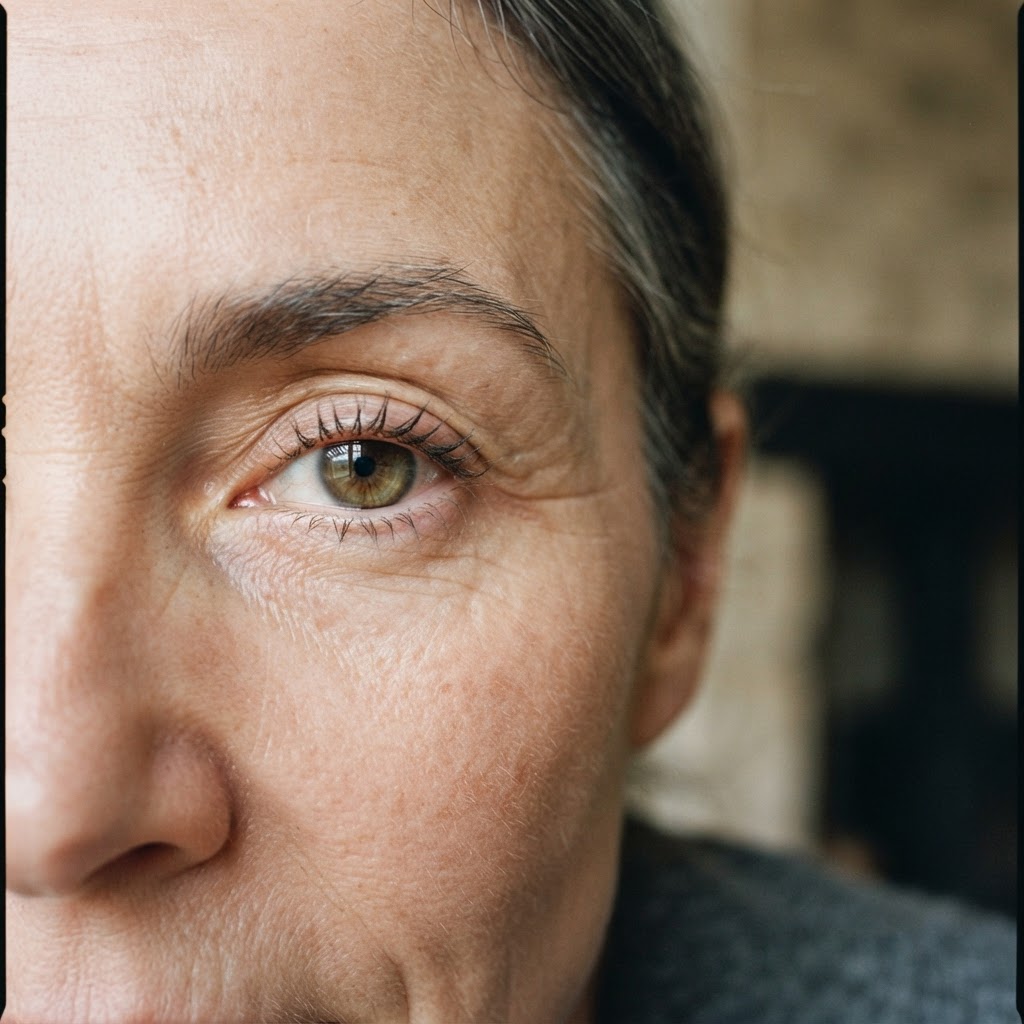
CHAPTER 02 / THE CROW’S FEET MAP
ONE POINT.
SEVEN
LAYERS.
The Crow’s Feet Map is JOLA’s editorial framework for reading lines at the outer eye. A line that has become more visible may involve any of these seven layers, and most faces involve several. Not every layer can be changed. Not every layer should be treated.
01
MOVEMENT
WHAT IT IS
The outer orbicularis oculi gathering the skin with every smile and squint.
WHY IT CHANGES THE LINE
The orbicularis oculi is the circular muscle that closes the eye. Its outer portion gathers the skin at the lateral canthus each time you smile, laugh or squint, folding it into the same radiating pattern thousands of times a year. Those folds are the lines that fan outward.
WHAT CONVERSATION IT OPENS
A neuromodulator conversation, where the movement is genuinely part of the finding.
WHAT IT IS CONFUSED WITH
A skin problem. Movement writes the line; the skin decides whether it stays.
02
SKIN
WHAT IT IS
Thin outer-eye skin, collagen loss and etching.
WHY IT CHANGES THE LINE
The skin at the outer eye is among the thinnest on the face and among the most exposed. Sun, genetics and age reduce collagen and elastin, and skin that has lost resilience stops springing back to flat after a smile and begins to hold the shape it was given.
WHAT CONVERSATION IT OPENS
A resurfacing and skin-quality conversation, which may include fractional laser.
WHAT IT IS CONFUSED WITH
Movement. A line etched at rest is a skin conversation even when movement made it.
03
CREPE
WHAT IT IS
Fine surface wrinkling, thin skin and mild laxity around the eye.
WHY IT CHANGES THE LINE
Crepe is a change in the skin surface itself: a fine, crinkled texture that can extend from the outer eye toward the under-eye area and the upper cheek. It is read as a quality of the skin rather than as a single line.
WHAT CONVERSATION IT OPENS
A tightening and surface conversation, which may include energy-based treatment.
WHAT IT IS CONFUSED WITH
Crow's feet themselves. A line is a line. Crepe is the surface between the lines.
04
CHEEK
WHAT IT IS
The cheek rising into the outer eye during a smile.
WHY IT CHANGES THE LINE
When the cheek elevates, it pushes skin upward toward the outer eye, creating folds that run upward from the cheek rather than outward from the muscle. These lines are produced by a neighbor, not by the eye itself, and a neuromodulator does not fully address them.
WHAT CONVERSATION IT OPENS
An expectations conversation about what relaxing the muscle can and cannot change.
WHAT IT IS CONFUSED WITH
Eye-muscle lines. Cheek-pushed lines rise; crow’s feet fan.
05
BROW
WHAT IT IS
A lower lateral brow crowding the outer eye.
WHY IT CHANGES THE LINE
When the outer brow sits lower, the skin above the eye crowds inward and the outer eye reads heavier, which can make surface lines look deeper than they are. Brow position also changes how the upper lid drapes.
WHAT CONVERSATION IT OPENS
A brow and hooding conversation, which may involve a different treatment category entirely.
WHAT IT IS CONFUSED WITH
Lines. Brow position is not a line problem, and no resurfacing changes it.
06
LIGHT
WHAT IT IS
Sun exposure and squinting.
WHY IT CHANGES THE LINE
Texas sun is bright for most of the year, and squinting is the muscle’s own reaction to it. That combination adds both UV exposure on thin skin and additional movement repetitions, which is why the two prevention habits that matter most here are sun protection and sunglasses.
WHAT CONVERSATION IT OPENS
A prevention conversation, which has the longest horizon of any option on this map.
WHAT IT IS CONFUSED WITH
Genetics. Sun exposure adds to what inheritance already set.
07
SUPPORT
WHAT IT IS
Temple and lateral cheek support framing the outer eye.
WHY IT CHANGES THE LINE
The outer eye sits on a frame of temple and lateral cheek support. When that support changes, the eye area can read flatter or more hollowed, and the outer corner can appear to change position even when the skin and muscle have not.
WHAT CONVERSATION IT OPENS
A support and balancing conversation in selected faces, considered as part of the whole face.
WHAT IT IS CONFUSED WITH
Filling the lines. Support changes the frame; it does not fill a crease.
CHAPTER
03
NOT EVERY LINEAT THE EYECOMES FROMTHE EYE
Four different findings share the outer eye, and only one of them belongs to the eye muscle. Dynamic crow's feet are written by movement. Etched lines are kept by skin. Crepe is a change in the skin surface itself. Lines pushed up by the cheek belong to a neighbor. Telling them apart is most of the assessment.
Dynamic crow's feet are the ones that appear when you smile and soften when you stop. They radiate from a single point at the outer corner and they deepen with a laugh. This is the finding a neuromodulator addresses, and it is the finding most people are describing when they search for a treatment.
Etched lines are visible when the face is completely still. They sit in the skin rather than in the muscle, they are often finer and shorter, and they behave like etched lines anywhere else on the face. They are a skin-quality conversation, which is why a movement treatment does not resolve them and skin treatment does not stop the movement that deepened them.
Crepe is not a line at all. It is a fine, crinkled surface that can extend from the outer corner toward the under-eye area and the upper cheek, and it reads as a quality of the skin rather than as a crease. Because crepe often extends further than crow’s feet do, it is frequently the finding that patients describe as the skin looking thin. Concerns beneath the eye itself belong to the Eye Area Study rather than to this one.
Cheek-pushed lines are the ones a smile creates from below. When the cheek elevates, it drives skin upward toward the outer eye, producing folds that run upward rather than outward. They are produced by a neighbor, and relaxing the eye muscle does not fully address them. A lower lateral brow does something similar from above, crowding the corner and making every surface line read deeper than it is.
Separating these four matters because they open different conversations. Movement points to a neuromodulator conversation. Etching and crepe point to resurfacing, tightening and skin quality. The cheek points to expectations and, in selected faces, to support. The brow points to a brow conversation entirely. Most assessments find two or three present at once, in a proportion only an examination can define.
NOT EVERY LINEAT THE EYECOMES FROMTHE EYE.
The Eye Area Study →CHAPTER 04 / THE SMILE STUDY
ONE SMILE.
TWO SOURCES
OF LINES.
Move the face from neutral to smile to laugh and watch what changes. Lines appear from one point at the outer corner, and at the same time the cheek pushes skin upward into the same small area. This is an educational schematic of a mechanism, not a simulation of a clinical outcome.
AT REST
SMILING
The expression
The eye is open and the muscle is quiet. The outer corner is smooth, and the skin that has kept its elasticity shows very little.
Lines that are visible here are etched rather than written. They belong to the skin, and relaxing a muscle does not change them.
ONE SMILE.
TWO SOURCES
OF LINES.
THE EYE WRITESTHE FAN.THE CHEEKADDS TO IT.
CHAPTER
05
CAN BOTOX TREATCROW'S FEET?
Yes, for the layer it belongs to. A neuromodulator placed in the outer ring of the orbicularis oculi by an experienced injector softens the movement that writes dynamic crow's feet, and it is one of the most established neuromodulator uses on the face. It relaxes movement. It does not repair skin, and it does not remove lines that are already etched.
The mechanism is straightforward. If the outer muscle cannot contract as fully, it gathers the skin less completely, and the fan that appears with a smile is shallower. What changes is the movement. What does not change is the skin the movement has been writing into, which is why an etched line can remain visible in a face that has been treated carefully.
Labeling is worth stating precisely. Botox Cosmetic carries FDA approval for the temporary improvement of moderate to severe lateral canthal lines in adults, which is the clinical name for crow’s feet. Other neuromodulators used at the outer eye, including Dysport in the United States, are selected by the clinician for this area rather than approved for it, and that distinction is discussed at consultation rather than left implied.
The limits matter as much as the effect. A neuromodulator softens movement lines and does very little for crepe, which is a surface change. It does not fully address lines pushed up by the cheek during a smile. And it does not lift a brow that sits lower than it used to, because brow position is not a muscle-activity problem in the same way.
Over-treatment is the risk that is easiest to avoid and easiest to recognize afterward. Too much relaxation at the outer eye can flatten the smile, change how the cheek moves and, in some patients, affect the lower lid. A lighter dose that leaves expression intact is usually the better result, and it is easier to add than to remove. Your own history matters here: how a previous treatment changed your smile is one of the most useful things you can bring to a consultation.
RELAXING THE SQUINTIS NOTREPAIRING THE SKIN.
Botox in Dallas: cost and results →CHAPTER
06
CAN RESURFACINGSOFTEN CROW'S FEET?
Yes, for the skin layer. Fractional resurfacing with eCO2 3D or ULTRA addresses etched lines, thin skin and texture at the outer eye and stimulates collagen remodeling over the months that follow. It changes the skin the lines live in. It does not stop the muscle that writes them, so movement lines continue to appear unless movement is addressed separately.
Fractional treatment works by creating controlled columns of injury in the skin and leaving the surrounding skin intact, which is what allows the area to heal and rebuild. Over time the etched lines read softer, the surface looks less thin, and fine crepe improves. The change develops gradually, which is one reason results are assessed over months rather than days.
The outer eye requires respect for reasons that have nothing to do with the device. The skin is thin, it sits a few millimeters from the eye itself, and protective eye shielding is part of any responsible treatment here. An experienced provider, eye protection and an honest assessment of candidacy are the three things that matter most in this area, more than which device is used.
Candidacy includes skin type. Resurfacing carries a risk of pigment change after treatment, and that risk is higher in some skin tones than others. This is a genuine consideration rather than a formality, and it is one of the reasons an eye-area plan is decided in person. If pigment risk is a concern, a provider may recommend a treatment with a different profile, or a staged approach.
What resurfacing will not do is worth stating plainly. It does not lift a brow that has descended, it does not tighten skin that has become lax, and it does not stop a muscle from contracting. Those are three other conversations, and a plan that names them is more useful than one that implies a single treatment can cover all of them.
SURFACEIS NOTMOVEMENT.
CO2 for wrinkles and crepey skin →CHAPTER
07
DOES SKIN TIGHTENINGHELP CROW'S FEET?
When crepe and mild laxity around the outer eye are part of the picture, energy-based tightening such as XERF, or K-LUXE where surface quality also matters, may improve firmness and texture in the area. It is a skin conversation. It does not stop the movement that writes the fan, and it does not lift a brow that has dropped.
Tightening addresses the firmness of the skin itself. Where the outer eye looks thin and finely wrinkled rather than lined, a firming treatment can change how the surface reads, and because radiofrequency also stimulates collagen over time, the change continues after the appointment. This is a different mechanism from resurfacing, and in some faces the two are discussed together.
XERF and K-LUXE are not the same conversation. XERF is a radiofrequency approach to firmness. K-LUXE pairs radiofrequency with a fractional laser where surface quality, pigment and texture also need addressing. Which of them, if either, belongs in an eye-area plan depends on what the assessment finds, and the detail belongs on those treatments’ own pages rather than here.
The limits are worth naming because tightening is the category most often over-promised. It does not relax the muscle, so a dynamic fan remains dynamic. It does not reposition a brow, so a crowded upper corner remains crowded. And it does not erase an etched line, because a line is a line and firmness is firmness. Where those three things are the main finding, tightening is supporting rather than primary.
Where it fits best is the face whose complaint is not really a line at all. A patient may describe crow’s feet when what concerns them is that the skin around the eye looks thin, crepey or tired. That is a firmness and surface conversation, and it is more likely to be answered by a skin treatment than by a movement one.
TIGHTENINGIS NOTLIFTING.
XERF around the eyes →
THE SUN WRITESHERE TOO.
CHAPTER 08 / THE LAYER STUDY
FOUR LAYERS.
FOUR DIFFERENT
CONVERSATIONS.
Every line in this small area is drawn by more than one of these. Add them one at a time and the same eye explains why a single treatment so rarely answers the whole question. This is an educational schematic of a mechanism, not a simulation of a clinical outcome.
1 OF 4 · MOVEMENT
Add a layer
MOVEMENTThe outer ring of the orbicularis gathers the skin into a fan every time you smile or squint. This is the layer a neuromodulator addresses, and the only layer it addresses.
FOUR LAYERS.
FOUR DIFFERENT
CONVERSATIONS.
ONE POINTAT THE EYE.SEVERALDRAWERS.
CHAPTER
09
DO SKIN BOOSTERS, PRFOR FILLER HELPCROW'S FEET?
They help with different parts of the question. Skin boosters and PRF aim at the quality and hydration of the skin around the eye, usually over a series rather than a single appointment. Filler is rarely placed in crow's feet directly, because the skin there is thin and moves constantly, though support in the temple or lateral cheek can change how the outer eye reads in selected faces.
Skin boosters are a skin-quality category rather than a wrinkle treatment. They aim at hydration, elasticity and the general appearance of the skin, and the change is gradual and cumulative. Because the eye area is delicate, whether a booster is appropriate for this specific region is a candidacy question, and JOLA will confirm what is offered for which areas before recommending it.
PRF works from your own blood rather than from a manufactured product, and it is used in regenerative conversations for skin quality and for support. In the eye area it is most often discussed beneath the eye rather than at the outer corner, which places a good deal of that conversation in the Eye Area Study rather than here. Where it is used at the outer eye, the goal is skin quality rather than line removal.
Direct filling of crow’s feet is rarely appropriate. The skin is thin, the area moves more than almost any other part of the face, and placing volume into a constantly moving crease tends to look and feel wrong. It also carries the recognized risk of vascular compromise that applies to filler anywhere on the face, and that risk is discussed explicitly at consultation rather than treated as a footnote.
Support is the more defensible use of volume in this region. When the temple or the lateral cheek has lost support, the outer eye can read flatter or more hollowed, and the corner can appear to have changed position even when the skin and muscle have not. Restoring support in the frame rather than in the lines is a facial balancing conversation, and in the right face it changes how the whole eye area reads.
SUPPORT IS NOTFILLING A LINE.
What is a skin booster →CHAPTER
10
WHAT CAN SKINCARE,SPF ANDSUNGLASSES DO?
They address the layer with the longest horizon, and they cost the least. Daily broad-spectrum sun protection on the outer eye and the lids, sunglasses that reduce both UV exposure and the squint that goes with bright light, a retinoid the eye-area skin tolerates, and consistent moisturization all support skin quality and slow the formation of new lines. None of them erases an etched line.
Sun protection is the single most useful habit in this study. The outer eye and the upper eyelid are among the areas most often missed in a routine, and they are among the most exposed. A broad-spectrum product applied to the eye area daily changes what the next decade of skin looks like, even though it changes nothing about a line that already exists.
Sunglasses do two things at once. They reduce UV exposure on thin skin, and they reduce squinting, which is the muscle’s own response to brightness. Texas sun is bright for most of the year, which makes this the most relevant prevention habit in Dallas and the one with the clearest mechanism. It is not an accessory in this conversation. It is the mechanism.
Skincare beyond sun protection is about barrier support and cell turnover. A retinoid, introduced gradually and tolerated by the skin around the eye, can improve surface quality over months, and consistent moisturization supports the barrier that keeps thin skin looking less fragile. These are categories rather than instructions: which product suits a particular eye area is decided with the skin in front of you, and the lid margin is an area to approach gently.
Expectations matter here more than anywhere else in this study. Skincare slows the formation of lines and improves the surface they sit in. It does not remove an etched line, it does not relax a muscle, and it does not firm skin that has become lax. What it does is change the direction of travel, which is why it belongs in every plan in this study regardless of what else is in it.
THE MOST EFFECTIVETREATMENTIS OFTENTHE CHEAPEST.
Clinical skincare →
CHAPTER
11
WHY COMBINATIONPLANS ARE COMMONAT THE OUTER EYE
Because crow's feet are rarely one layer. Movement, skin and the neighbors above and below usually contribute at once, so a plan often pairs a neuromodulator for the movement that writes the lines with resurfacing or tightening for the skin that keeps them. The pairing follows the layers found in the assessment, and it is timed by a clinician rather than prescribed in advance.
The logic is additive because the mechanisms are separate. Relaxing the outer muscle changes how deeply the skin is gathered. Resurfacing changes the skin the gathering happens in. Firming treatment changes how the surface reads when it is at rest. None of the three undoes another, and none of them substitutes for the others, which is exactly why they are discussed together.
Timing is a clinical decision rather than a rule. Skin treatments and movement treatments do not work against each other, but the order and spacing depend on what the skin needs to recover from, what a patient has coming up in their calendar, and whether the plan is being staged deliberately to assess response. A provider may choose to separate categories so that each change can be read on its own.
Combination is not accumulation, and the distinction is worth holding onto. Adding another treatment is only useful if it addresses a layer that is actually present. A plan that stacks categories without a target is not a more complete plan, it is a more expensive one, and around the eye it is also a plan with more opportunity for something to look overdone.
This is why the plan is written down and reviewed. A patient should be able to say which layer each part of their plan addresses and what it is expected to change. Where that cannot be said, the treatment probably does not belong in the plan yet, and that includes treatments a patient arrived asking for by name.
COMBINATIONIS NOTACCUMULATION.
Treatment planning →CHAPTER
12
CROW'S FEET VSUNDER-EYE LINESVS HOODING
Three findings sit within a few centimeters of each other and behave differently. Crow's feet fan from the outer corner and are led by movement. Under-eye lines sit beneath the eye and are often textural or static. Hooding is not a line at all but a change in brow position and upper-lid skin. Different locations, different mechanisms, different conversations.
Under-eye lines and crepe belong to the Eye Area Study, which covers skin quality and crepe beneath the eye, along with the hollows, color and bags that live in the same area. Reading them as crow’s feet tends to lead to a movement treatment for a skin problem, which is one of the more common mismatches in this region.
Hooding is about where the outer brow sits and how the upper lid drapes over the eye. It is often attributed to the eye area generally, but brow position is its own conversation and has its own treatment categories. A lower lateral brow also crowds the outer corner, so the two findings can appear together while remaining separate questions.
The naming matters because a patient searching for eye wrinkles may be describing any of the three, and the treatments do not transfer between them. Describing where the line is, whether it is there at rest, and whether the brow or the cheek is involved is more useful to a provider than any treatment named in advance.
ONE EYE.THREECONVERSATIONS.
Hooding and brow position →CHAPTER
13
DOES AGE, SEXOR SKIN TYPE CHANGETHE CONVERSATION?
All three change it, but not in the way a decade-by-decade rule would suggest. What changes with age is which layers are present, not which treatment is due. Sex influences muscle activity and the result that looks right. Skin type influences candidacy for resurfacing and the pigment risk that comes with it. Anatomy decides, and the birthday does not.
In the twenties and thirties, the finding is usually dynamic. Lines appear with a smile and disappear when the face is still, and the skin is still resilient enough that almost nothing is etched. That makes it a prevention conversation as much as a treatment one, with sun protection, sunglasses and skin quality doing the long work and a neuromodulator discussed selectively rather than automatically.
Through the forties and fifties, the two layers begin to separate. Movement lines remain, and etched lines and crepe start to be visible at rest, particularly in a face with significant sun exposure behind it. This is the stage where combination plans become common, because the movement layer and the skin layer have both arrived and neither is sufficient alone.
In the sixties and beyond, thin skin and brow descent often join the picture, and the honest ceiling of non-surgical treatment becomes part of the conversation. A plan may still be worthwhile and quite satisfying, but it is built around firmness, surface and support rather than around the removal of lines that have been present for decades. Saying that clearly at the start is more useful than discovering it after a series.
Sex matters in a narrower way than it is often framed. Male faces frequently show stronger orbicularis activity, and the goal is usually softening rather than a smooth surface, since a frozen outer eye reads as more incongruous on a man than on a woman. The mechanism is identical; the target is not.
Skin type is a practical variable rather than a detail. Resurfacing candidacy and pigment risk vary with skin tone, and any plan that includes a laser near the eye should account for that openly. Weight change belongs here too: significant or rapid loss, including loss associated with GLP-1 medications, changes facial volume and can make the outer eye read flatter or more hollowed without any change in the lines themselves.
THERE IS NO BEST AGE.THERE ISA BEST REASON.
GLP-1 and your face →
CHAPTER
14
WHAT ARETHE RISKS?
Every category in this study carries its own, and the eye area concentrates them because the skin is thin and the structures beneath it matter. None of these risks is rare enough to treat as theoretical, and none of them is a reason to avoid treatment altogether. They are the reason the assessment and the injector matter as much as the tool.
A neuromodulator at the outer eye can cause bruising, temporary heaviness or a change in how the smile and cheek move. When product spreads beyond the intended area, lower-lid and eyelid effects are possible, and they are the reason this region is treated conservatively. Most such effects resolve, and they are the most common reason a lighter dose is the better starting point.
Resurfacing near the eye can produce redness and swelling during recovery, and pigment change is a recognized possibility, which is why skin type is part of candidacy. Scarring is rare and eye protection is essential: the cornea is close to the treatment area, and protective shielding is not optional. Any treatment in this region should be performed by a provider experienced in periorbital work.
Radiofrequency tightening can cause temporary redness and swelling, and burns or textural change are rare but recognized possibilities. Because the treatment is delivered through the skin rather than into it, correct technique and appropriate settings matter more than maximum energy. More energy is not a clinical goal.
Skin boosters and PRF carry the risks of injections: bruising, swelling and the possibility of lumps or nodules. Filler in or near the lines carries those risks plus vascular compromise, which is the most serious concern associated with filler anywhere on the face and is discussed explicitly before consent. Any provider who does not raise it is not describing the treatment completely.
What does not appear in this chapter is a number. Complication rates vary by provider, technique and patient, and a figure quoted without that context is not information. The useful version of this chapter is a conversation about your own anatomy and history, which is a consultation rather than a page.
EVERY TREATMENT HASA NON-ZERORISK.
Provider judgment →CHAPTER
15
HOW LONG DO RESULTS LAST,AND WHAT DOESMAINTENANCE LOOK LIKE?
Longevity is easier to reason about by category than by number. Neuromodulator effects fade as muscle activity returns. Resurfacing results develop over months and are influenced by sun and habits. Tightening results continue to develop and then settle. And because people keep smiling, maintenance is part of the plan rather than evidence that something went wrong.
Movement treatment is the most predictable of the three. The muscle resumes its activity as the effect wears off, which is why the fan returns and why maintenance is expected rather than disappointing. The useful question is not how long the last one lasted but whether the dose let you smile normally for the whole of it.
Skin results behave differently. Resurfacing produces change gradually and that change is partly the skin’s response, which continues to develop after the appointment. How long it reads is influenced by sun exposure, skincare and the habits around them, which is why the same treatment can look different on two people with different routines. There is no fixed duration that applies to a face.
Tightening sits between the two. Firming improves and collagen remodeling continues afterward, then the skin keeps aging from that new baseline. Reassessment follows what the skin is doing rather than a calendar, and a maintenance appointment should be justified by a change in the skin rather than by the passage of time.
The one continuous layer is prevention. Sun protection and sunglasses are the only interventions in this study that are not an appointment, and they are the only ones that change the direction the skin is heading. Every other category on this page is a correction. Prevention is the only thing that reduces how much correction is needed later.
THE MUSCLE WILL RESUME.THE SUNWILL RETURN.
Natural-looking results →CHAPTER
16
WHAT DO CROW'SFEET TREATMENTSCOST IN DALLAS?
JOLA does not publish prices for these treatments, because a price attached to a category rather than to an assessment is not useful. What a plan costs depends on which layers are present, which categories address them, how many sessions the skin needs, and how maintenance is planned over time. Those are answered at consultation rather than on a page.
The factors that actually move cost are consistent. The category chosen matters most, because resurfacing, tightening and injectable treatment differ in what they involve. The number of sessions matters, since skin treatments are usually assessed as a series rather than as one appointment. Whether categories are combined matters. And the maintenance horizon matters, because a plan that lasts a year is not priced like a single visit.
There is a reason this page does not list figures. A patient who arrives asking for a price for crow’s feet is often describing a finding that turns out to be crepe, or a brow position, or a support question, each of which opens a different category with a different cost structure. A quote given before an assessment is a quote for a treatment that may not be the right one.
Comparing quotes from different providers is worthwhile, and the useful questions are not about the price of a session. Ask who will be performing the treatment, which layer they are treating and how they know, what is included in the plan, what happens if the response is less than expected, and how the plan will be reviewed before anything is repeated. Those answers determine value more than the number does.
The assessment itself is the first step and the one that makes the rest of the plan accountable. It is where a provider should be willing to say that a lighter dose is enough, that a skin treatment belongs before anything else, or that sunglasses and sun protection are the most useful recommendation in the room.
A PRICEIS NOTA PLAN.
Treatment planning →THE CROW’S FEET DECISION MAP
WHAT ARE YOU
NOTICING?
This is not a diagnostic tool and it does not prescribe a treatment. It helps you name what you see so the conversation can begin in the right place.
WHAT YOU SEEIS THE BEGINNINGOF THECONVERSATION.NOT THETREATMENTPLAN.
THE JOLA TREATMENT MATRIX
Which tool belongs to which finding?
No yes or no, no best or worst. Each cell describes the general relationship between a treatment category and a finding at the outer eye. It is editorial education, not a treatment recommendation, and an individual assessment can change any cell.
| FINDING | NEUROMODULATOR | eCO2 3D | ULTRA | XERF | K-LUXE | SKIN BOOSTER / PRF | TEMPLE / CHEEK SUPPORT | SKINCARE + SPF | BROW / HOODING EVAL |
|---|---|---|---|---|---|---|---|---|---|
| DYNAMIC LINES (ONLY WHEN SMILING) | P | N | N | N | N | N | N | S | N |
| ETCHED LINES AT REST | S | P | P | S | S | S | N | S | N |
| CREPEY OUTER-EYE SKIN | N | S | S | P | P | S | N | S | N |
| CHEEK-PUSHED LINES WHEN SMILING | A | N | N | N | N | N | S | N | N |
| LOWER LATERAL BROW | S | N | N | S | S | N | S | N | A |
| SUN-DAMAGED, THIN SKIN | N | P | P | S | S | S | N | P | N |
| TEMPLE / LATERAL SUPPORT LOSS | N | N | N | N | N | S | P | N | N |
| EARLY LINES, PREVENTION | S | N | S | N | N | S | N | P | N |
| MIXED CONCERNS | A | A | A | A | A | A | A | A | A |
PPRIMARY CONVERSATION
SPOSSIBLE SUPPORTING ROLE
DDIFFERENT TARGET
NNOT THE PRIMARY MECHANISM
XSURGICAL EVALUATION MAY BE MORE RELEVANT
ADEPENDS ON ASSESSMENT
Educational framework. Not a treatment plan.
NATURAL RESULTS
A natural outer-eye result still laughs
A natural result at the outer eye is not an eye without lines. It is a face in which the smile still reaches the eyes, the lines read softer at rest and gentler in motion, and the cheek and lid move the way they always did.
Frozen outer eyes are among the most recognizable signs of overdone work, and they are recognizable for functional reasons before aesthetic ones. A smile that stops at the mouth, an eye area that does not move when something is genuinely funny, a cheek that no longer elevates: these read as treatment rather than as a person, and they are more noticeable at the eye than almost anywhere else on the face.
A result that looks natural is legible only in comparison. Nobody notices that the lines are gentler; they notice that the face looks rested and that the expression still works. That is a quieter outcome than a visible correction, and at the outer eye it is also the one that ages better, because a face that cannot move draws attention to the fact that it is not moving.
What makes a result look expensive →A SMILE THAT STILLREACHES THE EYESIS NOTA FAILED RESULT.
PHOTOGRAPHY INTEGRITY
How an eye area should be photographed
The outer eye is unusually sensitive to lighting direction and expression. Overhead light deepens every fine line, frontal light flattens them, a slightly squinting face multiplies them and a relaxed face removes them. A meaningful comparison controls all of it, and a comparison that does not is a comparison of lighting rather than of skin.
Credible images require the same camera, distance, lighting direction, head position and expression, with no deliberate relaxation in the after photograph and no change in light angle to erase lines. No digital smoothing of texture. No AI-altered before and after imagery, and JOLA does not use it.
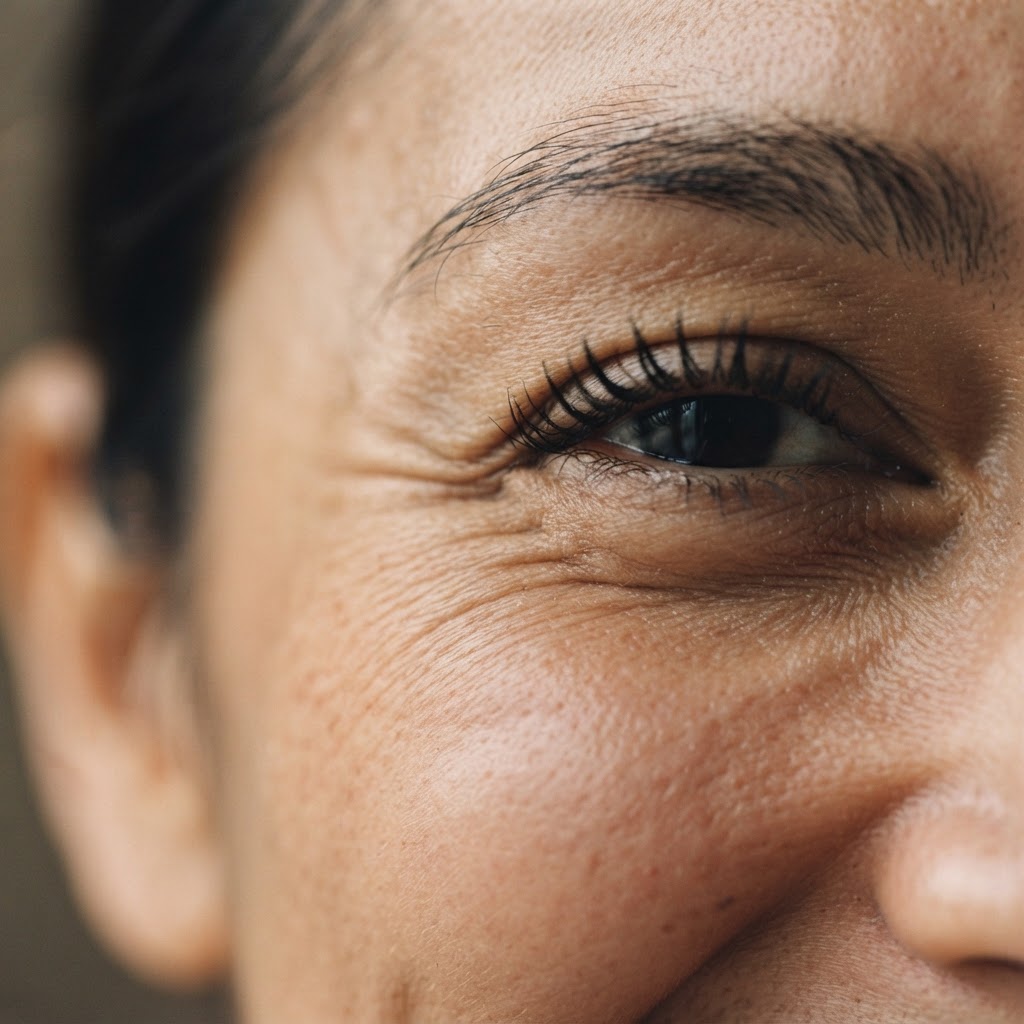
The photographs in this study are editorial images made for illustration. They are not patient photographs, they do not show treatment results, and no image on this page is presented as a before and after. Everything here that is not a photograph is an educational diagram of a mechanism rather than a simulation of an outcome.
CHANGE THE LIGHT.CHANGE THE EYE.DOCUMENTTHE RESULT.DON'TMANUFACTUREIT.
THE MYTH INDEX / 18
Eighteen things people believe about crow’s feet
MYTH 01
CROW'S FEET MEAN YOU ARE AGING BADLY.
REALITY
They are the signature of a face that smiles. Movement made them and repetition kept them.
MYTH 02
BOTOX FIXES ALL CROW'S FEET.
REALITY
It softens movement. Etched lines and crepe need a skin conversation.
MYTH 03
MORE BOTOX MEANS SMOOTHER EYES.
REALITY
Too much flattens the smile and can affect the cheek and lower lid.
MYTH 04
CROW'S FEET AND UNDER-EYE WRINKLES ARE THE SAME.
REALITY
Different location, different mechanisms, different study.
MYTH 05
ALL LINES AT THE EYE COME FROM THE EYE MUSCLE.
REALITY
Some are pushed up by the cheek when you smile.
MYTH 06
FILLER IS THE ANSWER FOR DEEP CROW'S FEET.
REALITY
Thin, mobile skin makes direct filling rarely appropriate.
MYTH 07
EYE CREAM ERASES CROW'S FEET.
REALITY
Skincare supports quality. It does not erase etched lines.
MYTH 08
SKIN TIGHTENING STOPS CROW'S FEET.
REALITY
Tightening addresses crepe and laxity, not movement.
MYTH 09
YOU SHOULD SMILE LESS.
REALITY
No. The goal is softer lines, not less expression.
MYTH 10
STARTING BOTOX YOUNG PREVENTS ALL LINES.
REALITY
Prevention is a conversation, not a guarantee.
MYTH 11
LASER AROUND THE EYES IS UNSAFE.
REALITY
With eye protection and an experienced provider, it is a well-established conversation.
MYTH 12
SUNGLASSES ARE JUST AN ACCESSORY.
REALITY
They reduce squinting and UV exposure at the outer eye.
MYTH 13
MEN DON'T GET TREATED FOR CROW'S FEET.
REALITY
Many do. The goal is softening, not a frozen look.
MYTH 14
A HOODED EYE IS A CROW'S FEET PROBLEM.
REALITY
Brow position is a separate conversation.
MYTH 15
ONE TREATMENT LASTS FOREVER.
REALITY
People keep smiling. Maintenance is part of the plan.
MYTH 16
EVERYONE WITH CROW'S FEET NEEDS TREATMENT.
REALITY
Sometimes the most valuable outcome of a consultation is clarity.
MYTH 17
FROZEN IS THE GOAL.
REALITY
A smile should still reach the eyes.
MYTH 18
THE SEARCH TERM CHOOSES THE TREATMENT.
REALITY
The anatomy does.
THE JOLA PHILOSOPHY
JOLA does not treat a search term.
A patient who arrives asking for Botox for crow’s feet may need a skin conversation, a brow conversation, sunglasses, or simply a lighter dose. The treatment named in a search bar is a starting point, not a conclusion, and at the outer eye the difference between those answers is visible to everyone.
The philosophy behind this study is anatomy before treatment, diagnosis before device, skin quality before filters, and precision before aggression. Refinement is not erasure. Around the eye those principles carry more weight than they do almost anywhere else, because the skin is thin, the structures beneath it are unforgiving, and the margin between a refined result and a visible one is measured in millimeters.
It also means accepting the ceiling and saying so early. A fan written by years of expression and kept by thin skin will not be removed by any non-surgical tool, and the most useful thing a provider can do is explain the layers before recommending anything rather than after several appointments. Sometimes the plan is sun protection, skincare, sunglasses and a decision to reassess.
None of that is a reason to do nothing. It is a reason to do the right thing in the right order, and to judge a result by whether the face still looks like the patient rather than by whether a line can still be found in a photograph taken under directional light.
Provider judgment →THECONSULTATIONIS WHERETHE SEARCHTERMBECOMESA PLAN.
DALLAS
Crow's feet assessment and treatment in Dallas
JOLA is a Dallas aesthetic practice offering an anatomy-led approach to the eye area, with care led by a doctorate-trained nurse practitioner and oversight from an on-site, board-certified plastic surgeon. Patients come from Highland Park, University Park and the Park Cities, Preston Hollow, and across DFW.
Texas sun is part of the reason this conversation matters here. Bright light for most of the year produces both cumulative UV exposure on thin skin and a habitual squint, and the outer eye is one of the areas most often left out of a sun protection routine. That combination is the one contributor in this study a patient can change immediately, without an appointment.
Assessment begins with the layer question rather than the product question: is the line there at rest, does it fan from the eye or rise from the cheek, is the skin crepey, and has the brow dropped at the outer edge. From there a plan is sequenced and discussed rather than prescribed, and treatment planning is shared with the patient in writing.
Treatment planning →THE OUTER EYEIS WHEREMOVEMENT MEETSTHE THINNESTSKIN.

THE BOTTOM LINE
Crow’s Feet: The Bottom Line
CROW'S FEET AREA SMILE THE SKINDECIDED TO KEEP.
Crow's feet are a smile the skin decided to keep. Everything in this study follows from those two halves. The outer ring of the orbicularis oculi gathers the skin at one point with every smile, laugh and squint, and the skin, thinned by sun, squinting, genetics and age, stops springing back to flat. Neither half of that mechanism is optional, and no single treatment addresses both.
The distinctions are worth restating because they are where most plans go wrong. Movement is not skin. A line visible only when you smile is a different finding from a line that is there at rest, and relaxing the muscle that writes a line is not the same as repairing the skin that keeps it. Tightening is not lifting, so firming the surface will not reposition a brow. And not every line at the eye comes from the eye: the cheek pushes some of them up from below, and the brow crowds them from above.
THE LINE IS THE SHAPETHE SKIN KEEPS.NOT THE SHAPEIT NEEDS.
Softer is realistic and frozen is not the goal. A good result at the outer eye means lines that read less heavily in ordinary light, a surface that looks less thin, and a smile that still reaches the eyes. An eye area that no longer moves when something is funny is not a better outcome, it is a different problem, and it is one of the more recognizable signs of overdone work.
This is also why assessment comes before treatment here more emphatically than in most areas. A patient who arrives asking for Botox for crow’s feet may need a skin conversation, a brow conversation, a support conversation, or a lighter dose than they expected. The eye area is thin, mobile and close to structures that matter, and the tools that suit a cheek do not transfer automatically to a region this delicate.
JOLA may recommend sun protection and skincare before it recommends a device, and it may say that a line is anatomy rather than a defect. Broad-spectrum SPF on the outer eye and the lids, sunglasses that reduce both UV exposure and squinting, and a retinoid the skin tolerates address the layer with the longest horizon, and they cost less than any treatment in this study. Where a treatment is appropriate, the plan is sequenced by layer, discussed in writing, and reviewed as the skin responds rather than repeated on a schedule.
THE SEARCH TERMDOES NOT CHOOSETHE TREATMENT.THE ANATOMYDOES.
- CROW'S FEET ARE A SMILE THE SKIN DECIDED TO KEEP.
- THE LINE IS NOT THE PROBLEM. THE KEEPING IS.
- NOT EVERY LINE AT THE EYE COMES FROM THE EYE.
- RELAXING IS NOT REPAIRING.
- TIGHTENING IS NOT LIFTING.
- THE SUN WRITES HERE TOO.
- A SMILE SHOULD STILL REACH THE EYES.
- SOFTER IS REALISTIC.
- THE SEARCH TERM DOES NOT CHOOSE THE TREATMENT.
- THE ANATOMY DOES.
- LUXURY IN THE DETAILS.
THE ARCHIVE / 69 QUESTIONS
Crow’s feet and outer-eye lines: frequently asked questions
69 matching questions
001What causes crow's feet?
They are written by movement and kept by skin. The outer ring of the orbicularis oculi, the muscle that closes the eye, gathers the skin at the outer corner into a fan every time you smile, laugh or squint. Once that skin has thinned and lost collagen through sun exposure, genetics, smoking and age, it stops springing back to flat and begins to hold the shape movement gives it.
002Why do I have crow's feet in my 20s?
Because movement writes them long before age does. A face in its twenties smiles and squints thousands of times a year, so the fan is already being drawn. At that stage the lines usually appear only with expression and disappear when the face is still, which means the skin is still springing back. What they are not is a sign that your skin is aging badly.
003Does squinting cause crow's feet?
Squinting is the same muscle movement as smiling, so it writes the same folds, and it adds repetitions rather than replacing them. Bright light, uncorrected vision and long stretches of concentrated screen use can each produce it. Squinting is a contributing layer rather than the sole cause, but it is one of the two most useful things to reduce, alongside sun exposure.
004Does the sun cause crow's feet?
Sun does not write the line, but it decides whether the line stays. The outer eye and the lid are among the most exposed and least protected areas of the face, and cumulative UV exposure thins the skin and reduces its elasticity. In a place as bright as Dallas for most of the year, that combination is a genuine contributor rather than a theoretical one.
005Are crow's feet genetic?
Partly. Skin thickness, collagen behavior, the size and activity of the orbicularis oculi, and how the brow and cheek sit are all inherited to a meaningful degree. That is why two people of the same age with similar sun exposure can have very different amounts of line. Genetics set the starting point, not the only variable.
006Does smoking cause crow's feet?
Smoking is associated with skin changes that accelerate collagen loss, and repeated squinting around smoke adds movement on top of it. It is one contributor among several rather than a cause on its own, and it is one of the few contributors a patient controls completely. Stopping will not erase an existing line, and it changes what the next decade looks like.
007Why is one side deeper than the other?
Faces are not symmetrical, and neither is the way they move. Most people favor one side when they smile, sleep on one side, and have slightly different brow and cheek position on each side. Sun exposure from driving or working near a window can also be uneven. Treating the two sides identically is usually the wrong answer; matching them is the goal.
008Can crow's feet be prevented?
They can be slowed, which is not the same thing. Daily broad-spectrum sun protection on the outer eye and the lids, sunglasses that reduce both UV exposure and squinting, and skincare that supports the skin around the eye all change the direction of travel. None of them prevents expression, and expression is what draws the fan in the first place.
009What is the orbicularis oculi?
It is the circular muscle that surrounds the eye and closes it. The inner portion controls blinking and lid closure; the outer portion, near the corner of the eye, gathers the skin into the radiating folds known as crow's feet when you smile, laugh or squint. It is the muscle responsible for what people describe as a smile that reaches the eyes.
010What are lateral canthal lines?
Lateral canthal lines is the clinical name for crow's feet. The lateral canthus is the outer corner of the eye, where the upper and lower lids meet, so lateral canthal lines are simply the lines that radiate from that point. The term is used in labeling and in clinical descriptions of treatments for the area.
011What is the difference between dynamic and static crow's feet?
Dynamic lines appear when you smile and soften when your face is still, which makes them a movement finding. Static lines are visible at rest, which makes them a skin finding. Most faces that have had lines for years have both at once, which is why assessment usually finds more than one layer present.
012Why does the cheek push lines up when I smile?
Because the cheek elevates during a smile and drives skin upward toward the outer eye. Those folds run upward from below rather than outward from the corner, and they are produced by a muscle in the cheek rather than by the eye itself. Relaxing the eye muscle does not fully address them, which is why expectations matter.
013How does the brow affect the outer eye?
When the outer brow sits lower than it used to, it crowds the area above the eye and changes how the upper lid drapes. A crowded corner makes surface lines read deeper than they are without changing the lines themselves. Brow position is its own conversation with its own treatment categories, and no resurfacing changes it.
014What is crepe around the eye?
Crepe is a change in the surface of the skin rather than a single crease. It looks finely crinkled and thin, and it often extends from the outer corner toward the under-eye area and upper cheek. Because it spreads beyond the fan itself, patients frequently describe it as the skin looking fragile rather than as a line.
015Is a crow's foot the same as a wrinkle?
Not exactly, and the difference matters. A crow's foot is a fold created by movement at the outer corner, so it has a direction and an origin. A wrinkle is a broader term that includes etched static lines, crepe and textural change. Two findings can sit in the same square centimeter and behave completely differently.
016What is the best treatment for crow's feet?
There is no single best treatment, because there is more than one layer. A neuromodulator softens the movement that writes dynamic lines. Resurfacing addresses etched lines and skin quality. Energy-based tightening addresses crepe and mild laxity. Skin boosters and clinical skincare improve skin quality over time. Which combination fits depends on what the assessment finds.
017Does Botox work for crow's feet?
Yes, for the movement layer. Placed in the outer ring of the orbicularis oculi by an experienced injector, it reduces how completely the muscle gathers the skin, so the fan that appears with a smile is shallower. It does not repair skin that has been thinned, and it does not remove a line that is visible at rest.
018Is Botox FDA-approved for crow's feet?
Botox Cosmetic carries FDA approval for the temporary improvement of moderate to severe lateral canthal lines in adults, which is the clinical term for crow's feet. Other neuromodulators used in this area are selected by the clinician rather than approved for this specific indication, and that distinction is discussed at consultation.
019Botox vs Dysport for crow's feet?
Both are neuromodulators and both reduce muscle activity at the outer eye. In the United States, Botox Cosmetic carries approval for lateral canthal lines, while Dysport's cosmetic approval covers the lines between the brows, which makes its use for crow's feet a clinician-selected one. Which product and dose suit a particular face is a clinical decision, not a brand preference.
020Can laser treat crow's feet?
Fractional laser resurfacing addresses the skin layer rather than the movement layer. It can soften etched lines, improve thin skin and refine texture at the outer eye, and it stimulates collagen remodeling over the months that follow. It does not stop the muscle, so the dynamic fan continues to appear unless movement is addressed as well.
021Can CO2 be used around the eyes?
Fractional CO2 resurfacing is used in the periorbital area by experienced providers, with protective eye shielding and an assessment of skin type and pigment risk beforehand. The skin is thin and the area sits close to the eye, which is why candidacy and technique matter more here than device selection. Any provider offering it in this region should be able to explain the safety plan.
022Does ULTRA help crow's feet?
ULTRA is a fractional laser used for skin quality, texture and pigment, and it can be part of an eye-area plan where etched lines and surface quality are the finding. Like other resurfacing, it changes the skin rather than the muscle, so it is usually described as one part of a plan rather than as a treatment for crow’s feet in isolation.
023Does XERF help crow's feet?
XERF is radiofrequency tightening, so its role at the outer eye is firmness and skin quality rather than movement. Where the finding is crepe and mild laxity, it may improve how the surface reads. It does not stop the muscle from gathering the skin, and it does not lift a brow that has descended.
024Does K-LUXE help?
K-LUXE pairs radiofrequency with a fractional laser, so it addresses firmness and surface together. At the outer eye it belongs in the skin conversation: crepe, texture and surface quality. The movement that writes crow’s feet is not part of its mechanism, which is why it is often discussed alongside rather than instead of a neuromodulator.
025Do skin boosters help crow's feet?
Skin boosters aim at the quality and hydration of the skin rather than at a specific line, and the change is gradual and cumulative over a series. Around the eye they may improve how thin skin reads. Whether they are appropriate for this particular region is a candidacy question, and JOLA will confirm what is offered for which areas before recommending anything.
026Does PRF help
PRF uses your own blood and is most often discussed in the eye area for skin quality and support beneath the eye rather than at the outer corner. Where it is used near the outer eye, the goal is the skin rather than the line. Concerns beneath the eye belong to the Eye Area Study, which covers that region in more detail.
027Can filler help crow's feet?
Filler is rarely placed directly in crow's feet. The skin there is among the thinnest on the face and moves constantly, which makes it a poor host for volume, and filler carries the recognized risk of vascular compromise anywhere on the face. Support placed in the temple or lateral cheek is a different conversation and can change how the outer eye reads in selected faces.
028Do eye creams work?
They work on the layer they can reach. A well-formulated eye-area product can support the skin barrier, improve hydration and, if it contains a retinoid the skin tolerates, contribute to surface quality over months. It does not erase an etched line, relax a muscle or firm lax skin. Expectation is most of the value in the eye-cream aisle.
029Does tretinoin help around the eyes?
A retinoid can improve surface quality and support the skin around the eye over time, and the eye area is one of the places where tolerance is lowest. It is usually introduced gradually and kept away from the lid margin, and it is a category rather than a prescription: which product and how often are decided with the skin in front of you.
030What can sunglasses actually do?
Two things, and both are relevant. They reduce UV exposure on thin, exposed skin, and they reduce the squint that bright light produces, which is the muscle movement that writes the fan. In a bright climate they are simultaneously a sun-protection habit and a movement intervention, which makes them the most useful prevention step in this study.
031How effective is SPF around the eyes?
Sun protection is the layer with the longest horizon. Applied daily to the outer eye and the lids, broad-spectrum SPF reduces the cumulative thinning and pigment change that make lines permanent rather than temporary. The outer eye and lids are among the most commonly skipped areas in a routine, which is why this is the habit most worth correcting first.
032Is retinol or laser better for crow's feet?
They address different degrees of the same layer. Skincare supports surface quality and barrier over months, while resurfacing produces a more substantial change to etched lines and thin skin with recovery attached. In an eye area with mostly dynamic lines, neither is the primary answer, because the primary answer belongs to movement.
033Can anything remove crow's feet completely?
No non-surgical treatment removes a line that years of expression and thinning have written, and any plan that promises completeness is describing something other than what these treatments do. What is realistic is a softer fan, a less fragile surface and a face that still moves. Deciding whether that is worth treating is a legitimate part of the consultation.
034Botox vs laser for crow's feet?
They work on different layers and are often complementary. A neuromodulator reduces the muscle movement that writes dynamic lines. Resurfacing changes the skin that has kept them, improving etched lines and texture. Neither substitutes for the other, and a face with both movement and etched lines is usually the face where both are discussed.
035Laser vs RF for the outer eye?
Resurfacing addresses the surface: etched lines, texture and thin skin, with recovery attached. Radiofrequency tightening addresses firmness and crepe by delivering energy through the skin, with less surface disruption. Where the finding is etching, resurfacing is closer. Where it is crepe and laxity, tightening is. Where both are present, the assessment decides which comes first.
036Crow's feet vs under-eye wrinkles?
Location separates them immediately. Crow's feet radiate from the outer corner and are led by movement. Under-eye lines and crepe sit beneath the eye and are often textural or static, and they belong to the Eye Area Study along with hollows, color and bags. Reading one as the other tends to point treatment at the wrong layer.
037Crow's feet vs hooded eyes?
Hooding is not a line but a change in brow position and upper-lid skin, and it is a separate conversation with different treatment categories. A lower lateral brow can crowd the outer eye at the same time, which makes the two easy to conflate and worth separating during assessment.
038Crepe vs crow's feet?
Crepe is a surface change, like finely crinkled, thin skin that can spread well beyond the corner of the eye. Crow's feet are individual folds radiating from a single point. They often appear together, and they respond to different treatments, which is why the distinction survives the first question of a consultation.
039Movement lines vs static lines?
A movement line is present only when the face moves, so relaxing muscle activity can soften it. A static line is visible at rest, so it is a skin finding and movement treatment does not remove it. Most faces have both, and the proportion between them is what shapes a plan rather than either one alone.
040Cheek-pushed lines vs eye-muscle lines?
Eye-muscle lines fan outward from the canthus and deepen with a smile. Cheek-pushed lines rise from below, created by the cheek elevating into the outer eye. A neuromodulator does not fully address the second kind, which is why some patients see a softening of the fan but not of everything they noticed in the mirror.
041Should I treat movement or skin first?
It depends on which is dominant, and that is an assessment question rather than a rule. Where lines appear only with expression, movement is the primary conversation. Where they are etched at rest, skin is. Where both are present, the sequencing is decided by a clinician and may be staged deliberately so that the response to each part can be read.
042Am I a candidate for crow's feet treatment?
There is no single threshold, because candidacy depends on which layer is present rather than on the line itself. Dynamic lines point to a movement conversation. Etched lines and crepe point to skin treatments. A lower brow or a full cheek may mean that part of what you see is not going to change with an eye-area treatment at all. That is what assessment is for.
043Am I too young for treatment?
Age alone does not decide. A patient in their twenties with lines that appear only when they smile is in a prevention and movement conversation, and a patient in their twenties with no lines visible at rest may not need treatment at all yet. What a provider should resist is treating a face because of a birthday rather than because of a finding.
044Can men treat crow's feet?
Yes, and many do. Male faces frequently show stronger orbicularis activity, and the goal is usually softening rather than a smooth surface, because a completely frozen outer eye reads differently on a man than on a woman. The mechanism is identical; the target and the dose are not necessarily the same.
045Can darker skin tones have eye-area resurfacing?
Resurfacing is possible across a range of skin tones, and candidacy and pigment risk vary with tone and with individual history. Post-inflammatory pigment change is a recognized consideration after laser treatment, which is why the assessment includes skin type rather than treating it as a formality. A provider may recommend a different category or a staged approach depending on what they find.
046What if I wear contacts?
Contacts are manageable around a treatment appointment rather than a barrier to one. Bring them to the consultation so they can be discussed, and expect the provider to give you specific instructions about what to wear on the day and afterward based on what is actually being treated. Any of that guidance is given for your own eyes rather than stated here as a general rule.
047Can I have treatment with sensitive eyes?
Sensitive eyes affect which categories are comfortable and which need extra care, particularly any treatment near the lid margin. It is a conversation to have at assessment rather than a reason to rule out treatment. Bringing up a history of dryness, irritation or a previous reaction at the start of the appointment is more useful than mentioning it at the end.
048Does a history of Botox change my options?
It informs them. How a previous neuromodulator treatment changed your smile, your cheek movement and how long the effect lasted is one of the most useful pieces of information you can bring, because it tells a provider how your particular muscle responds. That is a better basis for a dose than a default figure.
049Is there anything that rules out treatment?
Yes, and they are discussed individually rather than listed as a page of conditions. Active skin infection near the area, certain medical histories, pregnancy and other circumstances all change what is appropriate, and none of them should be discovered after a consent form is signed. A consultation exists to find them.
050Will I still be able to smile normally?
That is the goal, not a side effect. A well-judged movement treatment softens how deeply the muscle gathers the skin while leaving expression intact, so you smile the same way with a gentler fan. A result in which the smile looks different or the cheek no longer elevates is over-treatment rather than success, which is why the starting point is usually conservative.
051Can crow's feet go away completely?
No. A line written by years of expression and kept by thinned skin will not be removed by any non-surgical treatment. What is realistic is lines that read softer at rest and gentler in motion, and a surface that looks less fragile. Any plan that promises completeness is describing something other than what these treatments do.
052How soon will I see change?
It depends on the layer. Movement treatment begins to show within days and continues to develop for a short period afterward. Resurfacing results develop gradually as the skin responds and rebuilds, which is why they are judged over months rather than days. Tightening continues to develop after the appointment as well. Your provider will tell you what to expect for your specific plan.
053Will people be able to tell?
The result people notice is usually that you look rested rather than that you had something done. Treatment becomes noticeable when it changes how the face moves, which is why the eye area is treated conservatively, and why a face that still expresses normally tends to read as simply looking well rather than as treated.
054Can treatment make my eyes look worse?
It can, and knowing how is part of an informed decision. Over-relaxing the outer muscle can flatten the smile or alter how the cheek moves, and in some patients the lower lid is affected. That is why a conservative starting point, an experienced injector and a willingness to add rather than remove are the safeguards for this area.
055What are the risks of Botox around the eyes?
Bruising, temporary heaviness and a change in how the smile or cheek moves are the most common possibilities. If product spreads beyond the intended area, lower-lid or eyelid effects are possible, which is why the region is treated conservatively and why a provider experienced in periorbital work matters. Most such effects resolve. No complication rate is quoted here, because rates vary by provider and technique.
056Can Botox affect my eyelid?
It can, and that is a recognized possibility when product spreads beyond the intended area near the eye. The muscle that supports the lower lid is part of why treatment in this region is approached carefully and conservatively. It is one of the reasons a patient’s history with previous treatments is worth discussing before a dose is chosen.
057Is laser near the eyes safe?
Fractional resurfacing in the periorbital area is established practice when it is performed with protective eye shielding by a provider experienced in this region. Eye protection is essential rather than optional, candidacy includes skin type and pigment risk, and the skin is thin. Those three facts are the safety plan, and any provider offering the treatment should be able to explain them.
058What are the risks of RF around the eyes?
Temporary redness and swelling are expected after radiofrequency tightening. Burns and textural change are rare but recognized possibilities, which is why correct technique and appropriate settings matter more than maximum energy. More energy is not a clinical objective, and a provider who frames it as one is describing a different approach to the treatment.
059Is PRF or a skin booster safe around the eye?
They carry the risks that come with any injection, including bruising, swelling and the possibility of lumps. Whether a particular product is appropriate for this specific area is a candidacy question rather than a general one, and JOLA will confirm what is offered for which regions before recommending anything.
060Is filler near the eye risky?
Filler carries the recognized risk of vascular compromise anywhere on the face, and that risk is discussed explicitly before consent rather than treated as a footnote. The outer eye is a poor host for direct filling because the skin is thin and moves constantly, which is why support is usually discussed in the temple or lateral cheek instead.
061How long do results last?
It depends on the category rather than on the treatment name. Movement treatment fades as muscle activity returns. Resurfacing results develop over months and are influenced by sun exposure and routine. Tightening improves and then the skin continues aging from that new baseline. A maintenance appointment should follow what the skin is doing rather than the passage of time.
062How often do I need maintenance?
There is no schedule that applies to every face, and a calendar is not an indication. Maintenance is justified by a change in the skin or in the lines rather than by an interval, and the plan should be reassessed before anything is repeated. That is also the point at which a provider can tell you whether the previous plan is still the right one.
063How do I prevent crow's feet from getting worse?
Sun protection on the outer eye and the lids, sunglasses that reduce both UV exposure and squinting, and skincare that supports the skin around the eye are the habits with the longest horizon. They slow the formation of new lines and the thinning that makes existing ones permanent. They are also the cheapest part of any plan in this study.
064What affects the cost of crow's feet treatment?
Which categories are involved, how many sessions the skin needs, whether treatments are combined, and how maintenance is planned over a year rather than over a single visit. A figure quoted before an assessment is a price for a category rather than for a plan, which is why the two cannot be separated meaningfully.
065Why does JOLA not list prices online?
Because a plan follows an assessment. A patient asking about the cost of crow’s feet may turn out to have crepe, a brow position change or a support question, each of which opens a different category with a different cost structure. Publishing a number before that conversation is answered would be publishing a number for something that may not be the right treatment.
066What happens at a JOLA consultation for crow's feet?
It begins with what you see rather than what you want treated. Whether the lines are present at rest, whether they fan from the eye or rise from the cheek, whether the skin is crepey and whether the outer brow has dropped are all established first. Then the layers are named, the realistic options are discussed and a plan is put in writing for review as the skin responds.
067How do I book a JOLA consultation?
Consultations are scheduled through JOLA’s online booking, and the team will confirm what to bring and how the appointment will run. If you are unsure whether your concern is crow’s feet or something beneath the eye, mention it when you book so the appointment is planned around the right assessment.
068Do you see patients from Highland Park and University Park?
Yes. JOLA sees patients from Highland Park, University Park and the Park Cities, Preston Hollow, and across DFW. The bright Texas sun is part of why the eye-area conversation matters here, since squinting and UV exposure work on the same thin skin for most of the year.
069What should I bring to a consultation?
Bring your current skincare, any history of previous treatments and how you responded to them, your contact lens habits if you wear lenses, and any dates you are working toward. Photographs of yourself smiling are genuinely useful, because they show the movement layer that a still face does not.
Editorial imagery for illustration. Not patient photographs.