

JOLA / THE MOUTH CORNER STUDY / 006
Marionette Lines: Filler, Sculptra, Skin Tightening, or Something Else?
THE CORNER
OF THE MOUTH
DOES NOT FALL
ON ITS OWN.
Marionette lines, downturned corners, and why “filler or Sculptra” is the wrong first question.
MUSCLESUPPORTSKINDESCENTEXPRESSIONPROPORTIONANATOMY
STAGE 1 / 4 · THE LINE
01THE LINE
02WHAT PULLS
03WHAT NO LONGER HOLDS
04WHAT DRAPES
YOU SEARCHED
FOR A LINE.WHAT YOU ARE
LOOKING AT
IS A DIRECTION.
THE 60-SECOND ANSWER
What is the best treatment for marionette lines?
There is no single best treatment, because marionette lines are produced by several forces at once: the depressor muscles that pull the corners down, the loss of support in the chin, the pre-jowl region and the midface that used to hold the corners up, the downward shift of soft tissue over time, and the skin draping over all of it.
A neuromodulator used off-label in the depressor anguli oris by clinician judgment may soften active downward pull. Filler may restore support beside the corner and in the pre-jowl sulcus. Sculptra may build gradual structural support. Energy-based tightening such as XERF may address the firmness component. When descent is significant, the honest conversation is surgical. Most faces involve more than one of these, and the combination is never a menu item.
Assessment, not product, is the first step. A line that runs downhill tells you the corner has moved relative to something. It does not tell you whether the muscle is pulling, whether the shelf of support has thinned, whether the skin has lost firmness, or whether the whole lower face has shifted. Those are four different findings with four different answers, and in some faces the correct answer is that nothing needs to be done.
Sculptra vs filler →YOU SEARCHEDFOR A LINE.WHAT YOU ARELOOKING ATIS ADIRECTION.
CHAPTER
01
WHAT AREMARIONETTELINES, AND WHYDO THE CORNERSOF THE MOUTHTURN DOWN?
A marionette line is the crease that runs from the corner of the mouth downward toward the chin. It takes its name from the hinged jaw of a marionette puppet, where the mouth opens around a fixed point. It is not the same as a nasolabial fold, which runs from the nose to the mouth, or a jowl, which forms along the jawline, though all three frequently appear together. It forms when a depressor muscle pulls the corner down while the support beside and below the corner thins, tissue shifts downward, and the skin loses firmness.
The first thing to separate is a line from a direction. A marionette line is not primarily a crease of a certain depth. It is the visible edge of a mouth corner that sits lower than it used to relative to the chin beside it. Two faces can have creases of identical depth where one reads as a soft smile line and the other reads as a downturn, because the difference is where the corner sits, not how deep the fold runs.
That is why the name matters less than the mechanism. The crease is the shadow of a corner that has moved. Something moved it, and the candidates are few and distinct: the depressor anguli oris pulling downward, the shelf of support under the corner losing projection, the skin over the corner losing firmness, or the whole lower face shifting position as a unit.
It is worth separating the terms that get used interchangeably in conversation. A line is a visible crease. A fold is a crease produced by skin folding over a structural boundary. A downturned corner is a position finding, and it can exist with almost no crease at all. A shadow is an area that reads darker because of light rather than pigment, which is why a marionette line photographed under overhead light can look twice as deep as it does in a mirror at eye level.
The muscle contribution comes from the depressor anguli oris, a small triangular muscle that draws the corner of the mouth down and slightly outward. In some faces it is overactive, and the corner sits low even in a completely neutral moment. In others the muscle is unremarkable and the corner has simply lost the structure that used to hold it up. The two look similar in a photograph and require opposite conversations.
The support contribution is less intuitive. The mouth corner rests on a shelf built from the chin in front, the pre-jowl region immediately beside it, and the cheek above. When the chin loses projection, or the pre-jowl area hollows, or the cheek loses volume and sits lower, the corner goes with it. Nothing about the muscle has changed. The floor moved.
Age is a poor predictor here. Some people have downturned corners at twenty-five because of the muscle pattern and structure they were born with, and it stays stable for decades. In others the change appears in the forties or fifties and is clearly different from photographs taken ten years earlier. The useful question is not how old the face is but whether the corner has changed.
Two claims this study does not make. Marionette lines are not caused by frowning or by being unhappy, and reducing how often someone frowns will not remove them, because the resting position of the corner is not a habit. Nor can marionette lines be permanently removed. A corner that participates in speech and expression will always have some crease beside it, and the realistic goal is a softer line and a more neutral direction rather than its disappearance.
A MARIONETTE LINEIS A DIRECTION,NOTA DEPTH.
The Smile Line Study →CHAPTER
02
THEMOUTH CORNERMAP.
The Mouth Corner Map is JOLA's editorial framework for reading a marionette line. A corner that reads low may involve any of seven components: muscle, support, skin, descent, expression, proportion and anatomy. Not every patient has all seven, not every component can be changed non-surgically, and not every component should be treated.
The first component is muscle. The depressor anguli oris pulls the corner down. Where it is overactive, the corner sits lower at rest, and the face reads stern or sad in a neutral moment. This is the one component on the map that is genuinely muscular, and it is the reason a neuromodulator conversation sometimes belongs at the start rather than at the end.
The second is support. The chin, the pre-jowl sulcus and the midface form the shelf the corner rests on. Support loss is the most common reason a corner appears to drop without anything happening to the muscle, and it is the component most often mistaken for the crease itself.
The third is skin. Firmness, elasticity and surface quality determine how sharply the line reads and how much it creases when the mouth moves. Thinner, less elastic skin folds differently, and cumulative sun exposure changes the surface. This is a firmness conversation, not a volume conversation.
The fourth is descent. Over years, soft tissue can shift position. Descent is a movement problem rather than a deflation problem, and it changes the corner, the pre-jowl region and the jawline together rather than one crease alone. Where descent is significant, it is the component that decides the conversation.
The fifth is expression. Resting muscle pattern and the read that follows from it. This component does not describe a flaw. It describes how a face is built, and it sets the expectations for what a result can reasonably look like.
The sixth is proportion. How the corner reads relative to chin projection, lip volume and the jaw. A corner that reads low may be a relationship question that has very little to do with the corner itself.
The seventh is anatomy. Some faces have downturned corners from the beginning, unchanged for twenty years. That is structure, not aging, and the correct conversation may be no treatment at all.
Reading a corner means identifying which of these are present and which matter most. The map is not a menu, and it is not a scoring system. It is a way of deciding what the line you see is actually made of, so that whatever follows is aimed at a mechanism rather than at a shadow.
ONE CORNER.SEVENPOSSIBLEFORCES.
CHAPTER 02 / THE MOUTH CORNER MAP
ONE CORNER.
SEVEN
POSSIBLE
FORCES.
The Mouth Corner Map is JOLA’s editorial framework for reading a marionette line. A corner that reads low may involve any of these seven components. Not every patient has all seven. Not every component can be changed non-surgically. Not every component should be treated.
01
MUSCLE
WHAT IT IS
The depressor anguli oris and its downward pull on the corner.
WHY IT CHANGES THE CORNER
This small muscle draws the mouth corner down and outward. Where it is overactive, the corner sits lower at rest, and the face can read as stern or sad even in a neutral moment.
WHAT CONVERSATION IT OPENS
A neuromodulator conversation, where the mechanism is muscular rather than structural.
WHAT IT IS CONFUSED WITH
Tissue descent. A muscle pulling down is a different problem from tissue that has moved down.
02
SUPPORT
WHAT IT IS
Chin, pre-jowl sulcus and midface structure that holds the corner up.
WHY IT CHANGES THE CORNER
The mouth corner rests on a shelf: the chin in front, the pre-jowl region beside it, the cheek above. When that shelf thins, the corner sits lower even with no change in muscle activity.
WHAT CONVERSATION IT OPENS
A support and volume conversation, which may include filler or a biostimulator placed beside and below the corner.
WHAT IT IS CONFUSED WITH
The line itself. Support sits around the corner, not in the crease.
03
SKIN
WHAT IT IS
Firmness, elasticity and surface quality draping over the corner.
WHY IT CHANGES THE CORNER
Thinner, less elastic skin folds differently over a moving corner. Sun exposure, genetics and time change the surface, which can deepen how the line reads without changing anything structural beneath it.
WHAT CONVERSATION IT OPENS
A firmness and surface conversation, which may include energy-based tightening, resurfacing or clinical skincare.
WHAT IT IS CONFUSED WITH
Volume loss. Skin firmness is not volume, and tightening does not fill a crease.
04
DESCENT
WHAT IT IS
Soft-tissue position over time; the lower face moving as a unit.
WHY IT CHANGES THE CORNER
Over years, soft tissue can shift downward. The result is not deflation but movement, and it changes the mouth corner, the pre-jowl region and the jawline together.
WHAT CONVERSATION IT OPENS
An honest boundary conversation, which may include surgical evaluation for significant change.
WHAT IT IS CONFUSED WITH
Something filler can lift. Filler adds volume; it does not reposition descended tissue.
05
EXPRESSION
WHAT IT IS
Resting muscle pattern and the "sad" or "stern" read.
WHY IT CHANGES THE CORNER
Resting expression is built from anatomy and muscle pattern. It is not a mood, and it is frequently misread as one by the person looking in the mirror and by everyone else.
WHAT CONVERSATION IT OPENS
An expectations conversation. Neutral is the goal, not upturned.
WHAT IT IS CONFUSED WITH
Mood. A downturned corner at rest says nothing about how someone feels.
06
PROPORTION
WHAT IT IS
How the corner reads relative to chin projection, lip and jaw.
WHY IT CHANGES THE CORNER
Facial balance is about relationships. A corner that reads low may be a proportion question involving the chin or the jaw rather than a corner question at all.
WHAT CONVERSATION IT OPENS
A facial-balancing conversation that considers the whole lower face rather than one crease.
WHAT IT IS CONFUSED WITH
A single-area fix. Changing one part changes the whole, in both directions.
07
ANATOMY
WHAT IT IS
Natural variation; some faces have downturned corners at 25.
WHY IT CHANGES THE CORNER
Some mouths turn down at the corners from the beginning. That is structure, not aging, and it is not a problem unless it is one to the person living in the face.
WHAT CONVERSATION IT OPENS
A "do nothing" conversation. Sometimes the most valuable outcome of a consultation is clarity.
WHAT IT IS CONFUSED WITH
Aging. Anatomy is not the same as change.
CHAPTER
03
IS ITTHE MUSCLE?THE DEPRESSORANGULI ORISEXPLAINED.
The depressor anguli oris is a small triangular muscle running from the lower jaw up to the corner of the mouth. Its job is to pull that corner down. In some faces it is overactive, and a neuromodulator placed into it by an experienced injector may soften that pull so the corners rest more neutrally. This is an off-label, clinician-selected use. It does not fill a line or add support.
The muscle is one of the few components on the mouth corner map that can be influenced directly and in a single visit. Where an overactive depressor is genuinely the dominant finding, softening its pull changes how the corner sits at rest, and the difference can be visible without any product being placed in the crease.
It is worth being precise about what that does and does not mean. Relaxing a depressor changes the direction of pull on the corner. It does not add volume, it does not restore a shelf of support that has thinned, and it does not lift tissue that has descended. A line that is deep because the cheek has lowered will still be deep after the muscle is softened, and the corner will simply be pulled down by something other than muscle.
This is also the component where imprecision carries the most visible cost. The muscles around the mouth are small, they sit close together, and they do different things. Placement that reaches beyond the depressor can affect the muscles that elevate the corner, which changes how a smile reads or how the lower lip moves. Those changes are temporary, but they are noticeable, and they are the reason this particular injection is a judgment call rather than a formula.
Because of that, the useful question is not whether a neuromodulator can be placed in the depressor. It can, in selected faces. The useful question is whether the depressor is the finding that actually explains the corner, which is answered by watching the face at rest and in motion rather than by looking at a photograph.
Some faces need this conversation and nothing else. A young patient with a downturned corner built from muscle pattern, with good support and firm skin, may have exactly one finding on the map and a very small intervention available. The same patient may also be best served by being told that the corner is simply how the face is built, and that nothing about it needs correcting.
This is the clearest example in the whole study of why the search term and the treatment do not always match. Somebody searching for marionette line filler may be looking at a muscular finding, where filler is not the answer, and somebody searching for a corner lift may be looking at a support finding, where a neuromodulator is not the answer. The mechanism decides.
WHAT PULLS DOWNAND WHATNO LONGER HOLDS UPARE DIFFERENTPROBLEMS.
Botox vs Dysport at JOLA →CHAPTER
04
IS ITSUPPORT? CHIN,PRE-JOWLAND MIDFACE.
The mouth corner sits on a shelf of support: the chin in front, the pre-jowl sulcus beside it, and the cheek above. When that shelf thins, the corner reads lower even if nothing has changed about the muscle. Filler placed beside the corner and in the pre-jowl sulcus, or support added to the chin, may restore the shelf. Filling the line itself is usually the wrong target.
Support is the component most often missed, because the thing a patient notices is the crease. The crease sits on top of a change in the structures around it, and adding product to the crease addresses the shadow rather than the shelf. Where the shelf is the finding, restoring it changes the corner indirectly, without the line being touched at all.
The pre-jowl sulcus deserves particular attention. It is the shallow hollow that sits between the corner of the mouth and the front of the jaw, immediately in front of where a jowl forms. When it deepens, the corner loses the small platform beside it and the marionette line appears to lengthen. Patients frequently describe this as the line getting deeper when what has happened is that the ground beside it has dropped.
Chin support works the same way from a different direction. A chin that has lost projection no longer holds the lower lip and corner forward, so the whole mouth region sits back and the corners read lower relative to the profile. Adding projection at the chin changes the corner without going near it, which is why a chin conversation can be part of a marionette line plan and why that can sound surprising at first.
This raises the central distinction of the study. Filling the line does not change the direction of the corner. Product placed along a crease softens a shadow and adds weight to tissue that has already moved. Product placed to restore support changes where the corner sits, because it is aimed at what moved rather than at what the movement produced.
The assessment question that decides this is specific: has the shelf lost projection, or is it still adequate? A corner with an intact shelf, good chin projection and strong skin is a different case from a corner whose support has visibly thinned, and the two can look similar in a photograph taken from the front. Where support is intact, adding more around the corner produces heaviness rather than improvement.
Anatomy adds one further consideration. The mouth corner sits close to the facial artery, and the region is vascular. This is not a reason for alarm, and it is a reason that injector experience and a working knowledge of the local anatomy matter more here than in many other areas of the face. Product selection, placement and quantity are clinical decisions made at consultation, not specifications that belong in an article.
None of this makes corner filler wrong. It makes it specific. In the right face, placed conservatively beside and below the corner, it does something useful that nothing else does as directly. In the wrong face, it adds volume to a region that has already descended, and the result reads as heavier rather than softer.
FILLINGTHE LINEDOES NOTCHANGETHE DIRECTION.
Facial Balancing at JOLA →CHAPTER
05
IS SCULPTRAA BETTER OPTIONFOR MARIONETTELINES?
Sometimes. Sculptra is poly-L-lactic acid, a biostimulator that builds gradual collagen-based support in the cheek, the pre-jowl region and the chin. It is not placed in the line, and it is not immediate. It suits a face where the finding is broad support loss and where the patient prefers change that arrives over months rather than in a week.
The mechanism is the reason to consider it. A biostimulator works by stimulating the skin and the tissue beneath it to build collagen over time, which gradually restores structural support in the regions where it is placed. In the context of a marionette line, that means the cheek, the pre-jowl region and the chin rather than the crease itself. The crease softens as a consequence of the shelf being rebuilt around it.
It is not placed in the line. This is the point patients most often arrive with backwards. A biostimulator is not a crease filler, and injecting it along a marionette line would be treating the shadow rather than the shelf. Where a clinician places it, it is to rebuild support beside and below the corner.
The fit is specific. Sculptra is well suited to a face whose primary finding is broad, diffuse support loss, where the cheek has lost projection and the pre-jowl region has hollowed, and where a gradual, cumulative change is desirable rather than a visible one. It is a poor fit where the primary finding is an overactive depressor muscle, because building support does not change a muscle pull, and where the primary finding is skin laxity, because collagen support in the deeper tissue is not the same thing as firmness in the skin.
It is also a poor fit for someone who wants to see a result before an event next month. A biostimulator builds over time and the change is gradual by design. That is a feature for the patient who wants to look slightly different in six months and identical next week, and a frustration for the patient who books two weeks before a wedding.
There is a second reason clinicians reach for it here. A mouth corner region that has been repeatedly filled directly, and that has accumulated product in tissue which has already shifted, is often better served by a change of strategy than by more of the same. Rebuilding support in the regions that surround the corner can soften the line while the crease itself goes untouched.
What it cannot do should be stated as plainly as what it can. It does not relax a muscle. It does not tighten skin. It does not reposition tissue that has descended significantly. Where any of those is the dominant finding, a biostimulator is not the primary answer, and choosing it because it sounds more sophisticated than filler is not a mechanism-based decision.
FILLERREPLACES.SCULPTRAREBUILDS.
Sculptra vs filler →CHAPTER
06
IS IT THESKIN? DOES SKINTIGHTENING HELPMARIONETTE LINES?
It can contribute, and it cannot do the whole job. Where a marionette line is deepened by reduced skin firmness and mild laxity draping over the corner, energy-based tightening may address the firmness component. It does not add support, it does not relax muscle pull, and it does not reposition tissue that has descended significantly.
The skin component is a firmness finding. Thinner, less elastic skin creases more readily, holds a crease longer, and in this region begins to crepe over the corner rather than folding cleanly. Sun exposure accelerates that change, which is why a patient who has spent decades outdoors may show it here earlier and more visibly than elsewhere on the face.
Where that is the mechanism, tightening has a genuine role. Energy-based treatments deliver controlled heat into the deeper layers to stimulate collagen remodeling over the following months, which improves firmness and, with it, how the skin behaves over a moving corner. At JOLA that is a conversation about XERF multifrequency radiofrequency, or about K-LUXE where surface quality is also part of the concern and the plan pairs tightening with resurfacing.
The limits are what make this useful rather than misleading. Tightening does not add support, so it will not change where the corner sits if the shelf beneath it has thinned. It does not relax muscle pull, so it will not change an overactive depressor. It does not lift, which is the distinction that matters most in this study, because the word lift is a surgical word and using it for a non-surgical treatment sets an expectation the treatment cannot meet.
This is why tightening is often a supporting role rather than a primary one. A face with mild laxity over an otherwise well-supported corner may see a meaningful improvement in how the line reads from tightening alone. A face with significant support loss and a low corner will not, because the problem is not the quality of the skin.
There is also an honest scheduling point. Collagen remodeling takes time, and the visible change from tightening accumulates across weeks to months rather than arriving at once. A patient comparing it to filler, which shows its effect within days, will misread a perfectly normal result as no result. That is an expectation problem rather than a treatment problem, and it is worth naming before treatment rather than after.
Where the skin finding and the surface finding appear together, as they often do in a face that has had a lot of sun, the useful conversation is about sequencing rather than about choosing. Firmness and surface are separate targets, and a plan that addresses one while ignoring the other tends to leave the region looking half-treated.
LIFTIS A SURGICALWORD.SUPPORTIS NOT.
Skin tightening, filler or both →CHAPTER
07
IS IT DESCENT?WHEN MARIONETTELINES ARE REALLYA LOWER-FACECONVERSATION.
Often. Marionette lines, pre-jowl hollowing and jowls frequently share one cause: soft tissue moving downward over time. When the whole lower face has shifted, treating the marionette line in isolation disappoints, and the honest answer may be that this is a surgical conversation rather than a non-surgical one.
Descent is a movement problem, not a deflation problem, and that distinction decides everything that follows. Volume loss means the tissue is where it was but thinner, and it can sometimes be restored. Descent means the tissue is somewhere else, and no filler repositions it. Product added to tissue that has moved adds weight to a region that has already changed position, which is one of the most reliable ways to make a lower face look heavier.
This is why the marionette line so rarely appears alone once descent is involved. The same shift that lowers the mouth corner also deepens the pre-jowl sulcus, creates or worsens a jowl, and changes how the jawline reads. Where a patient reports all three, the finding is not three problems, it is one process with three visible consequences.
The surgical boundary should be described plainly. Where there has been significant descent of the soft tissue of the lower face, the treatment that addresses position is a surgical one, and a lower face or facelift conversation is the appropriate referral. Saying so is part of good care rather than a failure of non-surgical options, and a practice that cannot say it is not in a position to advise honestly on the lower face.
There is a middle ground, and it is worth naming without overselling. In a face with mild descent and good skin, non-surgical treatment can soften an impression: support beside the corner, firmness in the skin, and conservatively placed volume can each contribute to a region that reads better without its position having been restored. That is a legitimate result as long as it is described as softening rather than lifting.
The mistake to avoid is the sequence most likely to disappoint: a course of treatment aimed at the crease in a face whose real change is position, followed by more of the same when the crease returns. The line coming back is not a sign that the treatment failed. It is a sign that the treatment was aimed at the wrong finding, and repeating it produces a heavier lower face rather than a softer line.
For the patient, the practical question is straightforward. If the change they notice is that the whole lower face looks lower than it did, including the jawline and the area in front of the jaw, they are describing descent, and the useful consultation is one that can discuss surgical evaluation as one of the available answers. If the change is a line that has deepened while everything else has stayed put, they are describing something else.
DESCENTIS NOTDEFLATION.AND NOTHINGNON-SURGICALREPOSITIONSDESCENDEDTISSUE.
The Lower Face Study →CHAPTER 08 / THE VECTOR STUDY
THE SAME
LINE. FOUR
DIFFERENT
CONVERSATIONS.
Switch each force on and off and watch what happens to the corner. Muscle changes what is pulling on it. Support changes what is holding it. Skin changes how it drapes. Descent changes where the whole region sits. This is an educational schematic of four mechanisms, not a simulation of a clinical outcome.
NO FORCE SWITCHED ON · THE CORNER AT ITS BASELINE
Nothing is switched on. The corner sits at its baseline, and the line beside it is simply a crease. Switch on a force to see which conversation it opens.
THE SAME LINE.
FOUR DIFFERENT
CONVERSATIONS.
FOUR FORCES.ONE CORNER.FOURDIFFERENTANSWERS.
CHAPTER
09
MARIONETTELINES VSNASOLABIAL FOLDSVS JOWLS: HOWTO TELL THEMAPART.
The three are told apart by location and direction. A nasolabial fold runs from the side of the nose to the corner of the mouth. A marionette line runs from the corner of the mouth down toward the chin. A jowl is a soft-tissue bulge along the jawline, felt and seen below and outside the corner rather than as a crease. They coexist frequently, and each opens a different conversation.
Location is the first handle. Trace the line. If it begins beside the nose and ends at the corner of the mouth, it is a nasolabial fold, the boundary between the mobile upper lip and the relatively fixed cheek. If it begins at the corner and travels downhill, separating the lower cheek from the chin, it is a marionette line. If there is no line at all and the finding is a fullness below the jawline, that is a jowl.
Direction is the second handle. A nasolabial fold runs diagonally toward the mouth corner from above. A marionette line runs diagonally away from the corner toward the chin, at roughly the opposite angle. A jowl does not run anywhere; it is a mass, and it reads most clearly in profile and in three-quarter view rather than in a straight-on photograph.
Mechanism is the third handle. Nasolabial folds are primarily structural, a boundary that all moving faces have and that deepens with support, fat and skin changes above and beside it. Marionette lines carry a genuine muscle component in some faces through the depressor anguli oris, which is why a neuromodulator enters that conversation and not the nasolabial one. Jowls are almost purely about position, since the finding is tissue that has moved.
The reason the distinction matters clinically is that the conversations run in different directions. A nasolabial fold conversation is usually about what is above the fold. A marionette line conversation may be about what is pulling from below, what has thinned beside it, or what the skin is doing over it. A jowl conversation is often the one where the surgical boundary is closest, because position is the issue.
Coexistence is the rule rather than the exception. A face with significant descent typically shows all three, and they may appear in the same photograph as one impression of overall heaviness rather than as three separate findings. Separating them is part of what an assessment does, because a plan that treats one while ignoring the others in the same process tends to produce a face that reads as partly addressed.
What the three share is a principle that runs through this series. In each case the crease is the least informative thing about the problem, because the crease is where the face moves rather than where anything changed. What matters is what has changed on either side of it, and that is why each of these regions has its own study rather than a paragraph in somebody else's.
DIFFERENTLOCATION.DIFFERENTFORCES.DIFFERENTCONVERSATION.
The Weight of the Face →CHAPTER
10
WHAT ABOUTRESURFACINGAND SKINCARE?
Resurfacing and clinical skincare improve surface quality and soften fine etched lines within the marionette region. They do not change the direction of the corner, add support, or relax a muscle pull. In this study they are treated as support rather than as a solution, and support is still worth having.
The surface of the region is a real finding. Years of sun exposure and movement leave fine lines etched across the lower cheek and beside the corner, and those lines sit on top of whatever structural change is happening underneath. Resurfacing, whether fractional CO2 such as eCO2 3D or a fractionated laser approach such as ULTRA, improves texture and tone and softens those etched lines. The area looks better. It does not sit higher.
This distinction is the same one that runs through the rest of the study. Resurfacing changes the quality of skin. Support changes where the corner sits. Muscle relaxation changes what is pulling on it. Three different targets, three different tools, and a plan that mistakes one for another produces a result the patient did not ask for.
Clinical skincare operates on the same principle over a longer horizon. A structured regimen with appropriate active ingredients improves skin quality continuously, which changes how the whole region reads without any intervention aimed at the line. It also protects whatever else has been done, which is why it belongs in almost every plan and is so often left out of the conversation.
Where surface quality is the dominant concern, the useful conversation is about resurfacing and skincare rather than about the corner. Where it is one of several concerns, the useful conversation is about sequencing, because resurfacing carries recovery and support treatment does not. Getting the order right matters more than getting either one perfect.
There is also a version of this conversation that is mostly about restraint. A face whose only finding is fine surface lines beside a well-supported corner does not need volume, and telling that patient so is more useful than adding product to a region that does not require it. The most common over-treatment in this area is not the wrong product. It is a product applied to a finding that was not there.
SURFACEIS NOTSTRUCTURE.
Clinical skincare →CHAPTER
11
WHO IS ACANDIDATE, ANDWHO IS NOT?
Candidates for non-surgical approaches generally have mild to moderate lines driven by one identifiable mechanism: an overactive depressor, a modest loss of support beside the corner, or reduced skin firmness. Significant descent, heavy jowling, or a deep long-standing static fold may be better served by a surgical conversation. Non-surgical treatment is not equivalent to surgery.
A good candidate is identified by mechanism rather than by wanting a treatment. A corner that reads low because the depressor is overactive, in a face with good support and firm skin, is a clear case with a small, well-aimed intervention available. A corner that reads low because the shelf of support beside it has thinned, in a face with reasonable skin, is a different clear case with a different plan.
Descent is the honest boundary, and it is worth repeating in the candidacy section because this is where it matters most. Filler adds volume and does not reposition descended tissue. Energy-based tightening improves skin quality and does not lift a face. Where the lower face has moved significantly as a unit, non-surgical treatment can soften an impression but cannot restore position, and a patient whose primary goal is a change in position deserves to hear that clearly before committing to a series.
The same honesty applies to a face that has already accumulated product in the region. Tissue that has been filled repeatedly and has also descended will not improve with more volume in the same place. That is not a reason for more of the same; it is a reason for a different assessment, and often for a different conversation entirely.
There is a candidacy question that has nothing to do with anatomy. A patient whose downturned corners are their natural structure, present since their twenties and unchanged, is not automatically a candidate for anything. A corner that has not changed is not a problem to be solved, and the most valuable outcome of that consultation may be clarity rather than treatment.
Age alone does not decide candidacy in either direction. A thirty-year-old with an overactive depressor and a genuinely low corner may be an excellent candidate for one small intervention. A thirty-year-old with a corner that is simply how their face is built is not a candidate for anything, and the two can be difficult to tell apart in a photograph because both involve a corner that sits low.
Where a non-surgical plan is appropriate, it is usually staged. Muscle, support, skin and surface may each have a place, and they do not all need to happen at once, or at all. Where it is not appropriate, the conclusion is a referral, a later reassessment, or nothing, and each of those is a legitimate result of a good consultation rather than an admission that none was needed.
SOMETIMESTHE HONESTANSWERIS SURGERY.
Why good medicine sometimes means no →CHAPTER
12
WHAT ARETHE RISKS?
Every treatment in this region carries risks worth knowing before treatment rather than after. Filler can cause bruising, swelling, asymmetry, lumps or heaviness, and there is a recognised risk of vascular compromise near the facial artery. A depressor neuromodulator can affect the smile or lower lip when placement is imprecise. Radiofrequency tightening can cause temporary redness and, rarely, burns or textural change.
Filler in and around the mouth corner produces the ordinary consequences of any injection: bruising, swelling and tenderness, usually settling within days. Less common but more important are asymmetry, visible or palpable lumps, and heaviness in a region that already reads full. Because this area moves constantly in speech, product placed here is asked to hold a shape while the face works against it all day.
The vascular risk deserves specific mention. The mouth corner sits close to the facial artery, and the region is vascular. Accidental injection into or around a vessel can compromise blood supply to the skin, which is a recognised complication of facial filler and the reason this area is treated with particular care. This is not a reason for alarm. It is a reason that injector training and a working knowledge of local anatomy matter more here than in many other areas.
For a depressor neuromodulator, the risks are different and relate to spread. The muscles around the mouth are small and close together, and placement that reaches beyond the depressor can affect the muscles that elevate the corner or control the lower lip. The result can be an asymmetric smile or lower-lip weakness, which is temporary but noticeable, and it is the reason this injection is a judgment call rather than a formula.
For energy-based tightening, the common effects are temporary redness and warmth in the treated area, with swelling that settles over hours. Uncommon risks include burns and textural change, which is why device selection and operator experience matter, and why a treatment that is appropriate in one face is not automatically appropriate in another. No treatment in this study is risk-free, and any practice presenting one as such is not describing it accurately.
There is one more risk that belongs in a list like this, and it is not medical. Treatment aimed at the wrong finding produces a result that is worse than no treatment, because the region becomes heavier or the expression changes without the line improving. That risk is managed at the assessment stage rather than at the treatment stage, which is why the assessment is the part of the visit that carries the most weight.
A consultation covers the specific risks for the specific plan, including the alternatives and what happens if the result is not what either party expected. Hyaluronic acid filler can be dissolved, which is one reason it remains a common starting point in a region where reversibility has value. Biostimulators and tightening do not offer that option, which is worth knowing before choosing between them.
KNOW THE RISKBEFOREYOU KNOWTHE RESULT.
Who is injecting your face →CHAPTER
13
HOW LONG DORESULTS LAST,AND WHAT DOESMAINTENANCELOOK LIKE?
Longevity depends entirely on which category of treatment is used, and the categories differ more than most people expect. A neuromodulator effect softens over months. Hyaluronic acid filler tends to hold for months to over a year, depending on the product and the individual. Biostimulators build gradually and last longer. Tightening is progressive and maintained. Skincare is continuous.
The reason the ranges are broad rather than precise is that metabolism, movement and anatomy vary between people. A face with strong muscle activity in the region will process a neuromodulator effect differently from one with less, and a product placed in a highly mobile area is asked to do more than the same product placed in a static one. Quoting a number of months as a fact would be a disservice for that reason.
What matters more than the number is what the number means. A neuromodulator effect fading is not the treatment failing; it is the muscle returning to its previous activity, and the corner gradually returning to where it sat. Filler being absorbed is not a loss; it is the product leaving while whatever structural change the face would have made continues independently.
Biostimulators behave differently in a way that is worth understanding before choosing them. The change arrives gradually as collagen is built, and it then persists longer than a filler result because the support is the patient's own tissue rather than a product that will be absorbed. That is the trade: patience in exchange for durability.
Tightening is progressive and maintained rather than replaced. Collagen remodeling continues for months after treatment, and the firmness gained is retained while the skin continues to age. Maintenance is therefore a question of reassessment rather than of topping up on a calendar. Skincare is the only category with no endpoint at all, because it works while it is used and stops when it stops.
Maintenance planning is best understood as a schedule of reassessment rather than a schedule of appointments. What changes over time is not the treatment but the face, and a plan that is reviewed against the patient's own photographs is more useful than one that is reviewed against an interval. This is also what makes stopping a legitimate option: if the reassessment shows the finding has not changed, nothing needs to be done.
The useful question for a patient is therefore not how long a result lasts but what will have changed when it does. If the answer is that the same finding will return, the treatment is addressing a stable problem and repeating it makes sense. If the answer is that a different finding will have developed underneath, that is a signal to reassess rather than to repeat, and the plan should say so from the beginning.
REASSESSMENTIS NOTTHE SAME ASREPETITION.
Treatment planning →CHAPTER 14 / THE DIRECTION STUDY
NEUTRAL.
OR
DOWN.
NOT SAD.
A corner that sits low at rest is not a mood. It is where anatomy and muscle pattern have left the mouth when nothing is happening. This is why people with downturned corners are so often asked whether something is wrong.
It is also why the goal of treatment here is neutral rather than upturned. A corner that has been turned upward reads as a permanent expression, and the face stops looking like a face at rest. The direction is what a treatment can influence. The mood was never the problem.
DOWNTURNED AT REST
The corners sit lower than the middle of the lip and the marionette lines run on from them. Nothing is being felt here. This is simply where the face rests, which is why it is so often misread as sadness.
THE EXPRESSIONIS NOTTHE MOOD.
CHAPTER
15
DOES AGE ORWEIGHT CHANGETHE CONVERSATION?
Age changes which component dominates, and weight changes the support beneath the corner. In the twenties and thirties the finding is often muscle pattern and natural anatomy. In the forties and fifties support and skin dominate. From the sixties onward, descent and the surgical boundary become the central question. Significant weight loss hollows the pre-jowl and chin region and deepens the line.
In the twenties and thirties, a downturned corner is usually structural and stable rather than a change. The muscle pattern and the shape of the mouth were there before, and they will be there after. That makes treatment frequently unnecessary, and where the depressor is genuinely overactive, the conversation is a narrow one about muscle rather than a broad one about the lower face.
In the forties and fifties, two things tend to happen at once. Support begins to thin in the pre-jowl region and at the chin, so the shelf under the corner loses projection, and skin firmness declines so the line creases more readily and holds the crease longer. This is the decade where the most useful assessment happens, because more than one component is usually present and the sequencing of a plan matters.
From the sixties onward, the dominant change is often position rather than volume or quality. Tissue has had longer to shift, and the jawline, the pre-jowl region and the corner change together. Here the honest answer becomes more likely to involve surgical evaluation, and a practice that cannot say so is not in a position to advise honestly about the lower face.
Weight behaves like a separate variable that can be introduced at any age. Substantial weight loss reduces facial volume, and the pre-jowl region and chin are places where it shows early. A corner that had adequate support from the tissue around it loses that support, and a line that was soft becomes defined. Nothing about the corner itself has changed; the ground around it has.
That pattern is worth naming specifically because it has become more common. Loss on GLP-1 medications is often rapid, and facial volume reduces faster than the skin adapts to the change beneath it. The result can be a lower face that reads hollow at the pre-jowl region with a newly defined marionette line, in a patient who had none of this two years earlier. It is a deflation finding, which makes it a different conversation from a descent finding, even though the two can look similar.
What all of this points to is that age and weight do not determine the treatment. They determine which component of the map is likely to dominate, which is the finding that decides the conversation. A fifty-year-old with excellent support and an overactive depressor is closer to a thirty-year-old's case than to most fifty-year-olds', and treating by decade rather than by anatomy is how plans end up aimed at the wrong thing.
TREAT THEFINDING.NOT THEBIRTHDAY.
GLP-1 and your face →CHAPTER
16
WHAT DOMARIONETTE LINETREATMENTS COSTIN DALLAS?
Marionette line treatment is priced by what the plan actually involves rather than by the line itself, which is why a single figure is not a useful answer. A plan can be a narrow intervention aimed at one mechanism, or a staged plan addressing support, skin and surface over several visits, and the two sit at very different price points.
The factors that determine cost are the category of treatment, the amount of product if product is involved, and the number of regions treated. A corner plan is rarely one region. It may involve the mouth corner, the pre-jowl sulcus, the chin and the cheek, and each of those changes what the plan requires. Two patients with the same line can have plans that differ by a factor rather than by a margin.
Combination approaches cost more than single treatments and often accomplish more than a series of single treatments, which is a genuine consideration rather than an upsell. Support, firmness and surface are different targets, and addressing them deliberately tends to produce a better result than treating the crease repeatedly. That said, not every face needs all three, and a plan that recommends all of them without distinguishing between them is not a considered plan.
Maintenance cadence is the other half of the cost picture. A treatment that is repeated several times a year costs more over three years than one that builds gradually and holds, even if the initial visit is more expensive. The useful comparison is therefore not between two treatments but between two plans measured over the length of time the patient intends to maintain the result.
JOLA does not publish prices for these treatments, and that is a deliberate position rather than an omission. A price list encourages a patient to choose a treatment before an assessment has established what the finding is, and in this region the wrong treatment costs more than the right one regardless of the figure attached to either. Quoting a number before examining the corner would be quoting a number for a plan that may not be the plan.
The practical answer to the question is therefore the consultation. A JOLA consultation establishes which component of the mouth corner map is dominant, what the appropriate plan is, what that plan costs, and what the alternatives are, including the alternative of doing nothing. Patients who want a figure before that conversation can be given one, but they should know they are being given a figure for an assumption rather than for their face.
THE PRICEFOLLOWSTHE PLAN.NOT THESEARCH TERM.
The JOLA consultation →THE MOUTH CORNER DECISION MAP
WHAT ARE YOU
NOTICING?
This is not a diagnostic tool and it does not prescribe a treatment. It helps you name what you see so the conversation can begin in the right place.
WHAT YOU SEEIS THE BEGINNINGOF THECONVERSATION.NOT THETREATMENTPLAN.
THE JOLA TREATMENT MATRIX
Which tool belongs to which force?
No yes or no, no best or worst. Each cell describes the general relationship between a treatment category and a force acting on the mouth corner. It is editorial education, not a treatment recommendation, and an individual assessment can change any cell.
| COMPONENT | DAO NEUROMODULATOR | PRE-JOWL / CORNER FILLER | CHIN SUPPORT | SCULPTRA | XERF | K-LUXE | RESURFACING | SKINCARE | SURGICAL EVAL |
|---|---|---|---|---|---|---|---|---|---|
| ACTIVE DOWNWARD MUSCLE PULL | P | N | N | N | N | N | N | N | N |
| PRE-JOWL SUPPORT LOSS | S | P | S | P | S | S | N | N | N |
| WEAK CHIN SUPPORT | N | S | P | S | N | N | N | N | A |
| SKIN LAXITY OVER THE CORNER | N | N | N | S | P | P | S | S | N |
| SURFACE TEXTURE / ETCHED LINES | N | N | N | N | S | S | P | P | N |
| STATIC LINE, GOOD SUPPORT | S | P | S | S | S | S | N | N | N |
| SIGNIFICANT DESCENT | S | S | S | S | S | S | N | N | X |
| NATURAL ANATOMY, YOUNG FACE | A | N | N | N | N | N | N | S | N |
| MIXED CONCERNS | A | A | A | A | A | A | A | A | A |
PPRIMARY CONVERSATION
SPOSSIBLE SUPPORTING ROLE
DDIFFERENT TARGET
NNOT THE PRIMARY MECHANISM
XSURGICAL EVALUATION MAY BE MORE RELEVANT
ADEPENDS ON ASSESSMENT
Educational framework. Not a treatment plan.
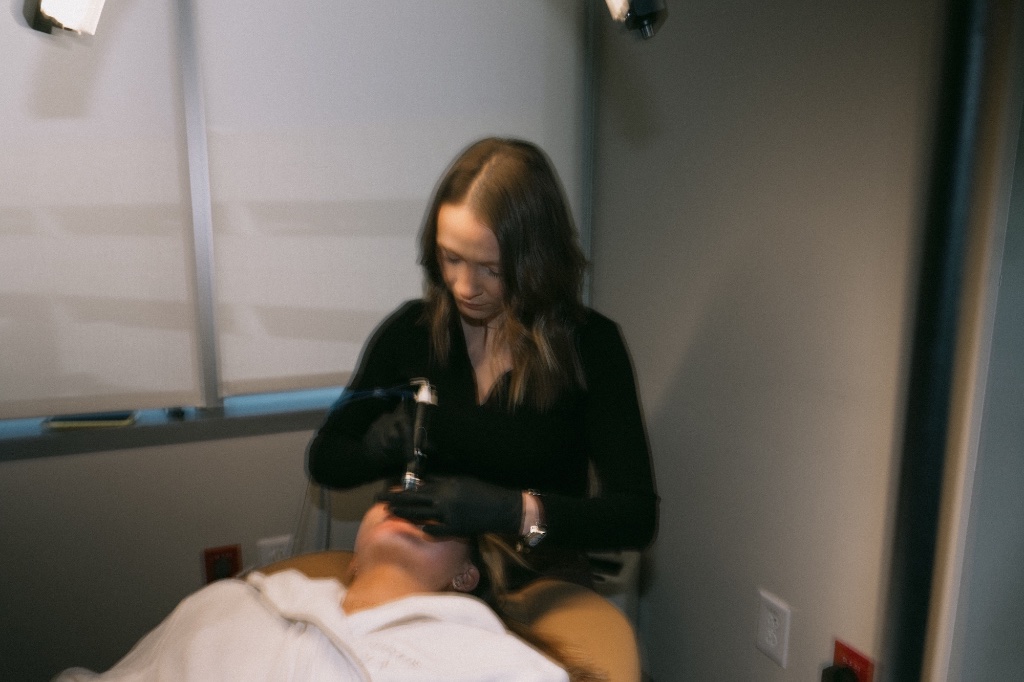
NATURAL RESULTS
A natural result here is a neutral corner, not an upturned one.
The mouth still moves in speech and in expression. The line softens, and the direction changes slightly. At rest the corners sit where the face would hold them, rather than where someone propped them.
Over-filled marionette regions are among the most recognizable signs of overdone work, because this is one of the transitions a face is read most closely around. A corner that has been pushed up and out looks cheerful in a still photograph and wrong the moment its owner stops talking.
A result that looks natural is not a result with no change. It is a result where the corner still participates in expression, where the pre-jowl region does not look inflated, and where the person still looks like themselves in motion and at rest.
What makes a result look expensive →NEUTRALIS THEGOAL.NOTUPTURNED.
BEFORE AND AFTER INTEGRITY
How photographs of this region should be taken
The mouth corner is unusually sensitive to camera distance, lens choice, head position, lighting direction and expression. A slight change in chin angle or a shift in light direction changes how deep a marionette line reads without anything about the line changing.
Credible comparisons require the same camera, lens, distance, lighting, chin angle and expression. No deliberate smile in the after image. No lighting change to deepen or erase a shadow. No digital smoothing of the line. No AI-altered imagery. JOLA does not use AI-generated before and after images.
CHANGETHELIGHT.CHANGETHELINE.DOCUMENTTHERESULT.DON'TMANUFACTUREIT.
THE MYTH INDEX / 18
Eighteen things people believe about marionette lines
MYTH 01
MARIONETTE LINES MEAN YOU FROWN TOO MUCH.
REALITY
Muscle pattern, support, skin and descent produce them. Frowning less will not remove them.
MYTH 02
FILLER IN THE LINE IS THE OBVIOUS FIX.
REALITY
The line is a direction, not a depth. Filling it adds weight where tissue has moved.
MYTH 03
BOTOX LIFTS THE CORNERS OF THE MOUTH.
REALITY
A neuromodulator can soften downward pull. It does not lift, fill or support.
MYTH 04
MARIONETTE LINES CAN BE ERASED.
REALITY
Softer and more neutral is realistic. Erased is not.
MYTH 05
SCULPTRA IS INJECTED INTO THE LINE.
REALITY
Biostimulators build support beside and below the corner over time.
MYTH 06
SKIN TIGHTENING LIFTS THE MOUTH CORNER.
REALITY
Tightening addresses firmness. Lift is a surgical word.
MYTH 07
CHIN FILLER IS FOR THE CHIN ONLY.
REALITY
Chin support changes how the entire mouth corner reads.
MYTH 08
A DOWNTURNED MOUTH MEANS YOU ARE AGING FAST.
REALITY
Many 25-year-olds have downturned corners. That is anatomy.
MYTH 09
MARIONETTE LINES AND JOWLS ARE THE SAME PROBLEM.
REALITY
Related, often coexisting, but different conversations.
MYTH 10
MARIONETTE LINES AND NASOLABIAL FOLDS ARE THE SAME.
REALITY
Different location, different direction, different study.
MYTH 11
MORE FILLER MEANS MORE LIFT.
REALITY
More volume in a descended region often means more heaviness.
MYTH 12
IF THE LINE IS DEEP, SURGERY IS INEVITABLE.
REALITY
Surgery is one honest option for significant descent. It is not the default.
MYTH 13
RESURFACING REMOVES MARIONETTE LINES.
REALITY
Resurfacing improves surface. It does not change direction or support.
MYTH 14
WEIGHT LOSS FIXES A HEAVY LOWER FACE.
REALITY
Loss can hollow the pre-jowl region and deepen the line.
MYTH 15
EVERYONE WITH MARIONETTE LINES NEEDS TREATMENT.
REALITY
Sometimes the most valuable outcome of a consultation is clarity.
MYTH 16
THE GOAL IS AN UPTURNED MOUTH.
REALITY
The goal is neutral. Upturned at rest looks treated.
MYTH 17
ONE SYRINGE IS A PLAN.
REALITY
A syringe is a quantity. A plan starts with assessment.
MYTH 18
THE SEARCH TERM CHOOSES THE TREATMENT.
REALITY
The anatomy does.
THE JOLA PHILOSOPHY
JOLA doesn't treat a search term.
A patient who arrives asking about marionette line filler may need a muscle conversation, a chin conversation, a surgical conversation, or none at all. The treatment named in a search bar is a starting point, not a conclusion.
The philosophy behind this study is: anatomy before treatment. Diagnosis before device. Proportion before volume. Skin quality before filters. Refinement is not erasure.
Filling is not supporting. Relaxing is not lifting. Tightening is not lifting. When those distinctions stay clear, the plan that follows is smaller, better aimed and easier to live with than the plan that begins with a product name.
Provider judgment →THECONSULTATIONIS WHERETHE SEARCHTERMBECOMESA PLAN.
DALLAS
Marionette line assessment and treatment in Dallas
JOLA is a Dallas aesthetic practice offering an anatomy-first approach to the lower face. Patients from Highland Park, University Park, the Park Cities, Preston Hollow and across DFW come to JOLA when they want to understand what changed at the mouth corner before deciding what to do about it.
A plan for the corner may draw on neuromodulators, dermal fillers, Sculptra, facial balancing, XERF, K-LUXE, eCO2 3D, ULTRA, clinical skincare, or on none of them. When a goal is surgical, JOLA says so and recommends evaluation with an appropriately qualified surgical specialist.
Consultations begin with assessment rather than with a product recommendation, and treatment planning is staged so that each step has a reason to be there.
The JOLA consultation →THE BOTTOM LINE
Marionette Lines: The Bottom Line
THE CORNEROF THE MOUTHDOES NOTFALL ONITS OWN.
Two people can describe the same line in the same words. One has a corner that sits low because a depressor muscle pulls it down. Another has a corner that has dropped because the support beside it thinned. Another has skin that has lost firmness and creases over a corner that has not moved at all. Another has fine etched surface lines beside a corner that is structurally fine. Another has a lower face that has shifted as a unit. Another has lost weight recently and is looking at a hollow where there used to be a shelf. Another has simply always had downward corners, unchanged since their twenties.
SAMEOBSERVATION.DIFFERENTANATOMY.
That is the central idea of this study. The crease is the least informative thing about the problem, because the crease is the visible edge of a corner that has moved relative to something else. What moved, or what stopped holding, is the finding that decides the plan.
THE CORNER OF THE MOUTHDOES NOT FALLON ITS OWN.
Four distinctions carry most of the weight here. What pulls and what no longer holds are different problems. A muscle drawing the corner down and a shelf of support losing projection both produce a corner that sits lower, and they require different treatments. Softening a depressor does not restore a shelf, and restoring a shelf does not change a muscle.
WHAT PULLSAND WHAT HOLDSARE DIFFERENTPROBLEMS.
Filling is not supporting. Product placed along the crease softens a shadow and adds weight to tissue that has already moved. Product placed to restore support beside and below the corner changes where the corner sits. One addresses what the movement produced. The other addresses what moved.
FILLINGIS NOTSUPPORTING.
Relaxing is not lifting, and tightening is not lifting. A neuromodulator changes what is pulling on the corner. Energy-based treatment changes the quality of the skin over it. Neither changes position, and lift is a surgical word for a reason. Where a face has genuinely descended, the honest conversation is surgical, and saying so is part of good care rather than a failure of non-surgical options.
RELAXINGIS NOTLIFTING.TIGHTENINGIS NOTLIFTING.
The last distinction is about expectations. A marionette line can be softened. A corner can be supported. The direction can change slightly. What cannot happen is that the line is erased or the corner is turned upward. A corner that has been propped up looks cheerful in a still photograph and wrong the moment its owner stops talking, because the mouth is one of the transitions a face is read most closely around.
NEUTRALIS THEGOAL.NOTUPTURNED.
This is also why assessment matters more here than in almost any other region. The same search term describes several different anatomies, and two of them require opposite approaches. A clinician reading the corner asks what is pulling on it, what is holding it, what the skin is doing over it, and whether the whole lower face has moved. Only then does a plan make sense, and sometimes the plan is smaller than the patient expected.
JOLA may recommend less than was searched for. Where the corner is anatomy, the recommendation may be nothing. Where the cause is support, the recommendation may be a shelf rather than a crease. Where the position has changed significantly, the recommendation may be a referral. Each of those is a real answer, and each is a better one than a treatment aimed at a line that was only ever a direction.
THE SEARCH TERMDOES NOTCHOOSETHE TREATMENT.THE ANATOMYDOES.
LUXURYIN THEDETAILS.
- THE CORNER OF THE MOUTH DOES NOT FALL ON ITS OWN.
- A LINE IS A DIRECTION, NOT A DEPTH.
- WHAT PULLS AND WHAT HOLDS ARE DIFFERENT PROBLEMS.
- FILLING IS NOT SUPPORTING.
- RELAXING IS NOT LIFTING.
- TIGHTENING IS NOT LIFTING.
- LIFT IS A SURGICAL WORD.
- NEUTRAL IS THE GOAL. NOT UPTURNED.
- THE EXPRESSION IS NOT THE MOOD.
- THE SEARCH TERM DOES NOT CHOOSE THE TREATMENT.
- THE ANATOMY DOES.
- LUXURY IN THE DETAILS.
A provider reads muscle, support, skin, descent, expression, proportion and anatomy before naming any tool. The plan may be one treatment, a staged combination, no treatment, or a surgical referral.
THE ARCHIVE / 75 QUESTIONS
Marionette lines and downturned mouth corners: frequently asked questions
75 matching questions
001What causes marionette lines?
A marionette line is the crease running from the corner of the mouth down toward the chin. It forms from a combination of forces: the depressor anguli oris pulling the corner down, loss of support in the chin, the pre-jowl sulcus and the midface that used to hold the corner up, downward shift of soft tissue over time, and skin that has lost firmness draping over the corner. Most faces involve more than one.
002Why do the corners of my mouth turn down?
Either something is pulling them down or nothing is holding them up. An overactive depressor anguli oris pulls the corner downward. Loss of support in the chin, the pre-jowl region or the midface lets the corner sit lower without any change in muscle activity. Soft tissue that has shifted downward changes position again. The three are separate findings.
003Are marionette lines genetic?
Structure and muscle pattern have a strong inherited component, which is why some people have downturned corners in their twenties while others do not show them until their fifties. Inherited factors also shape chin projection and the depth of the pre-jowl region, both of which change how the mouth corner reads. Aging adds to what was inherited rather than replacing it.
004Can weight loss cause marionette lines?
Yes. Substantial weight loss reduces facial volume, and the pre-jowl region and the chin are places where it shows early. A corner that had support from the tissue around it loses that support, and a soft line becomes defined. Nothing about the corner itself has changed. This pattern is common with rapid loss, including loss on GLP-1 medications.
005Why is one side worse than the other?
Facial asymmetry is normal. Most faces differ between sides in structure, fat distribution, muscle activity and skin quality. Sleep position and side preference can contribute gradually over years, as can sun exposure that has been heavier on one side. A difference between sides is a finding an assessment notes rather than a sign that something is wrong.
006Do marionette lines come from frowning?
No. The resting position of the mouth corner is not a habit, and a facial expression repeated over years does not create the downward direction. A person can hold a neutral or cheerful expression all day and still have downturned corners, because the direction comes from muscle pattern and structural support rather than from mood or habit.
007Why do I have marionette lines in my twenties?
Because downturned corners are frequently anatomical. Some faces are built with a depressor pattern and a mouth shape that leaves the corners low at rest from the beginning. At that age the line is usually not accompanied by support loss, skin laxity or descent, which means the conversation is narrow and often ends with the conclusion that nothing needs treatment.
008Does sleeping on my side matter?
Sleep position and pillow contact can contribute to creases over many years, particularly on the side a person favors, and this is one reason asymmetry sometimes has a history behind it. The contribution is gradual and modest compared with support, muscle and skin changes. It is worth noting at an assessment rather than treating as a primary cause.
009Does sun damage deepen marionette lines?
Sun exposure does not change the depth of the crease, but it changes the skin over and beside it. Cumulative photoaging reduces elasticity and creates fine etched lines across the lower cheek and around the corner, which makes the whole region read as older and the line as more pronounced. This is a firmness and surface finding rather than a structural one.
010What is the depressor anguli oris?
The depressor anguli oris is a small triangular muscle that runs from the lower jaw up to the corner of the mouth. Its function is to draw that corner downward and slightly outward. Where it is overactive, the corner sits lower at rest and the face can read as stern or sad in a neutral moment. It is one of the few components of the mouth corner that can be influenced directly.
011What is the pre-jowl sulcus?
The pre-jowl sulcus is the shallow hollow between the corner of the mouth and the front of the jaw, immediately in front of where a jowl forms. It provides part of the shelf the mouth corner rests on. When it deepens, the corner loses the small platform beside it, and a marionette line appears to lengthen even if the crease itself has not changed.
012What is tissue descent?
Tissue descent is the downward shift of soft tissue that can happen over time. It is different from volume loss. Volume loss is deflation, where tissue stays where it is but thins. Descent is movement, where tissue changes position. Filler can add volume but does not reposition tissue that has shifted, which is why significant descent may be a surgical conversation.
013What is the difference between a line, a fold and a downturned corner?
A line is a visible crease. A fold is a crease produced by skin folding over a structural boundary. A downturned corner is a position finding, and it can exist with almost no crease at all. A shadow is an area that reads darker because of light rather than pigment. Separating these four matters because each one points at a different cause.
014How does the chin affect the mouth corners?
The chin is part of the shelf that holds the corner forward and up. When chin projection is reduced, the lower lip and mouth corner sit further back, and the corners read lower relative to the profile. This is why a chin conversation can be part of a marionette line plan, and why restoring projection at the chin can change the corner without the line being treated at all.
015Are marionette lines muscle or skin?
They can be either, and often both. An overactive depressor anguli oris is a genuine muscle finding that can be softened. Reduced skin firmness draping over the corner is a firmness finding that responds to a different kind of treatment. Loss of support in the chin and pre-jowl region is a structural finding that responds to a third. The assessment decides which one is dominant.
016What is the difference between static and dynamic lines?
A dynamic line appears with movement and softens when the face is still. A static line is visible at rest, which means it has depth. In this region the distinction is particularly useful, because a corner that turns down only while speaking or smiling is an expression finding, whereas a line that remains visible with the face still is a structural one.
017What is the best treatment for marionette lines?
There is no single best treatment, because marionette lines are produced by more than one force. A neuromodulator may soften active downward pull from the depressor muscle. Filler may restore support beside the corner and in the pre-jowl sulcus. A biostimulator may build gradual structural support. Energy-based tightening may address the firmness component. When descent is significant, the honest conversation is surgical. Assessment decides which applies.
018Can Botox treat marionette lines?
A neuromodulator can soften an overactive depressor anguli oris where that is the dominant finding, which changes the direction of pull on the corner. It does not fill a line, add support, or lift tissue that has descended. It is also used off-label in this muscle by clinician judgment, which is a distinction worth understanding before booking.
019What is DAO Botox?
DAO Botox is the common shorthand for placing a neuromodulator in the depressor anguli oris to reduce downward pull on the mouth corner. It is an off-label, clinician-selected use rather than an approved indication. The muscles around the mouth are small and close together, so placement that reaches beyond the target can affect the smile or the lower lip. This is why it is a judgment call rather than a formula.
020Can filler fix marionette lines?
Filler can soften the appearance of a marionette line, but where it is placed matters more than how much is used. Product placed along the crease adds weight to tissue that has already moved. Product placed to restore support beside and below the corner changes where the corner sits. The second approach is usually the more useful one, and the first is often the reason a region looks heavier afterward.
021Where is filler placed for marionette lines?
Conceptually, beside and below the corner rather than in the crease. The targets are the pre-jowl sulcus, which provides the shelf beside the corner, and the chin, which provides projection in front of it. Midface support may also be part of the conversation. Placement, product selection and quantity are clinical decisions made at consultation and are not specifications that belong in an article.
022Does Sculptra help marionette lines?
It can, where the dominant finding is broad support loss. Sculptra is poly-L-lactic acid, a biostimulator that builds gradual collagen-based support in the cheek, pre-jowl region and chin. It is not placed in the line and it is not immediate. It is a poor fit where the primary finding is an overactive muscle or skin laxity, because it does not change either.
023Does XERF help marionette lines?
XERF can contribute where reduced skin firmness is deepening how the line reads. Energy-based tightening stimulates collagen remodeling over the following months, which improves the quality of the skin over a moving corner. It does not add support, relax muscle pull, or reposition descended tissue, so it is usually a supporting role rather than a primary one.
024Does K-LUXE help marionette lines?
K-LUXE pairs energy-based tightening with resurfacing, which makes it relevant where firmness and surface quality are both part of the concern. The tightening component addresses how the skin behaves over the corner, and the resurfacing component addresses fine etched lines across the region. Neither changes support or muscle pull, so it addresses part of the picture rather than all of it.
025Can lasers help marionette lines?
Lasers improve surface quality, tone and texture, and they soften fine etched lines within the marionette region. They do not change the direction of the corner, add support, or affect muscle pull. In a face whose only finding is surface, that can be a meaningful result. In a face whose finding is structural, resurfacing leaves the structure untouched.
026Does skincare help marionette lines?
Clinical skincare improves skin quality continuously, which changes how the whole region reads without any intervention aimed at the line itself. Retinoids, antioxidants, barrier support and daily sun protection all contribute to firmness and surface quality over time. Skincare does not change the direction of the corner, and it protects the results of whatever else has been done.
027Do facial exercises help marionette lines?
There is no reliable evidence that facial exercises change the direction of a mouth corner or the depth of a structural line, and working the muscles around the mouth more can increase activity in a depressor that is already pulling the corner down. Where the finding is muscle, the conversation is about reducing pull rather than increasing work.
028Do mouth taping or devices help marionette lines?
Taping and at-home devices do not change structural support, muscle pull, tissue position, or skin quality in any lasting way. They may produce a temporary visual smoothing while in place. They are not a substitute for assessment, and they do not address any of the mechanisms that produce a marionette line.
029Is filler or Sculptra better for marionette lines?
They do different things. Filler restores volume directly and shows its effect within days, and hyaluronic acid filler has the advantage of being dissolvable. Sculptra builds collagen-based support gradually and persists longer, because the support becomes the patient's own tissue. Which is appropriate depends on whether the finding is a defined support gap or a broader diffuse loss.
030Can marionette lines be treated without filler?
Yes, depending on the finding. Where an overactive depressor is the mechanism, a neuromodulator is the treatment and no volume is involved. Where reduced skin firmness is the mechanism, energy-based tightening is the relevant conversation. Where surface quality is the concern, resurfacing and skincare address it. Filler is one of several options rather than the default.
031Botox vs filler for marionette lines, which is right?
They answer different questions. A neuromodulator addresses an overactive depressor muscle, which changes what is pulling on the corner. Filler addresses support, which changes what is holding it. Where the muscle is the finding, filler does not help. Where support is the finding, a neuromodulator does not help. Where both are present, the order in which they are approached is a clinical decision.
032Sculptra vs filler for the mouth corner?
Filler places volume that is present immediately and is absorbed over time. Sculptra stimulates collagen so that the support becomes the patient's own tissue, and the change arrives gradually over months. Filler is reversible if the product is hyaluronic acid. Sculptra is not. The choice usually turns on whether the finding is a specific gap or a broader loss.
033Filler vs skin tightening for marionette lines?
Filler changes what is holding the corner, and tightening changes the quality of the skin over it. Where support has thinned, tightening will not restore it. Where skin firmness is the mechanism, filler does not improve it. The two are often complementary rather than alternatives, and which comes first depends on which finding dominates.
034XERF vs filler for marionette lines?
XERF is energy-based tightening, which improves skin firmness and surface quality progressively and is maintained rather than absorbed. Filler adds volume, which restores support and shows its effect within days. XERF does not add support and filler does not improve firmness. In a face with both findings, a plan may include both with the sequence determined at assessment.
035Non-surgical vs facelift for marionette lines?
The distinction is position. Non-surgical treatment can soften an impression, restore support locally, and improve skin quality. It cannot reposition tissue that has descended significantly. Where the lower face has shifted as a unit and the goal is a change in position, a surgical consultation is the appropriate referral, and saying so is part of good care.
036Marionette lines vs nasolabial folds, what is the difference?
Location and direction. A nasolabial fold runs from the side of the nose to the corner of the mouth. A marionette line runs from the corner down toward the chin. Nasolabial folds are primarily structural, deepening with support and skin changes above them. Marionette lines carry a genuine muscle component in some faces. They are covered by separate studies for that reason.
037Marionette lines vs jowls, are they the same problem?
Related, often coexisting, but different conversations. A marionette line is a crease. A jowl is a soft-tissue bulge along the jawline, and it is a position finding. Both can be produced by the same downward shift of soft tissue, which is why they frequently appear together, and why the presence of one changes how the other is assessed.
038Who should not get filler at the mouth corner?
A patient whose lower face has descended significantly, a patient whose finding is an overactive muscle or skin laxity rather than support, and a patient whose corners are simply their natural anatomy are all poorly served by filler here. A region that has already accumulated product and has also descended will not improve with more volume in the same place.
039Am I too young for marionette line treatment?
Age is not the test. The useful question is whether the corner has changed. A downturned corner that has been present and stable since the twenties is anatomy, and it usually needs no treatment. A corner that has genuinely changed, or a depressor that is clearly overactive, can be discussed at any age. Some young faces have one finding and a small intervention available.
040Can marionette lines be treated after a facelift?
Yes, and the conversation is often easier afterward, because position has already been addressed. Support, skin quality and surface can all be considered once the surgical result has settled, and the timing is decided with the surgeon. What a facelift does not address is an overactive depressor muscle or the quality of the skin, so those remain separate findings.
041What if I already have jowls?
Then the assessment has more to consider, because jowls indicate that tissue position is part of the picture. Mild jowling with good support still leaves room for a non-surgical plan aimed at softening. Heavier jowling with visible descent often means the honest conversation is surgical. Treating the marionette line while ignoring the position of the lower face tends to produce a partly addressed result.
042Can men treat marionette lines?
Yes. The anatomy is the same, though male faces often carry more skin thickness and a different hair-bearing pattern on the lower face, which affects how treatments are planned rather than whether they are appropriate. The same principle applies: mechanism decides, and an overactive depressor, support loss and skin firmness are read the same way.
043What if my corners are just built this way?
Then that is the answer, and it is a real one. A corner that has been unchanged for a decade or more, in a face with good support and firm skin, is structure rather than aging. The most valuable outcome of a consultation like that is clarity, and a practice that recommends treatment for a finding that has not changed is not assessing accurately.
044Will my smile change?
It should not, and preserving it is a stated goal of treatment in this region. Filler placed to restore support sits away from the muscles that elevate the corner. A neuromodulator placed in the depressor is intended to soften downward pull without affecting the elevators. Precision matters, which is why imprecise placement in this area can change how a smile reads.
045Will I look happier?
A softer line and a more neutral corner can change how a resting expression reads, and patients often describe exactly that. The caveat is that a corner deliberately turned upward looks like a permanent expression, and it reads as treated the moment the face stops moving. The goal is neutral, not cheerful, and neutral is what looks like the person rather than the work.
046Can results look natural?
Yes, and in this region naturalness is largely a matter of restraint. A natural result leaves the mouth moving normally, keeps the transition between the lip and the cheek intact, and does not fill the region to the point where it reads as padded. Over-filled marionette areas are among the most recognizable signs of overdone work, because this transition is read closely.
047How soon will I see a change?
A neuromodulator effect develops over the days following treatment. Hyaluronic acid filler shows its effect within days, once initial swelling settles. A biostimulator builds gradually over months. Energy-based tightening is progressive, with collagen remodeling continuing for months after the visit. Because the timelines differ so much, comparing one category against another can make a normal result look like no result.
048Can marionette lines go away completely?
No. A mouth that speaks and expresses will always have a crease beside it, and a corner participating in a smile will always return toward its resting position. Softer, better supported and more neutral are achievable. Erased is not, and a face whose corner region has been erased no longer moves the way a face moves.
049How will I know if the result is right?
Look at the face in motion, not in a still photograph. The right result is one where the line is softer, the direction is closer to neutral, and speech, smiling and laughing all still look like the patient. A region that photographs well and moves strangely has not been treated well. Assessment, review and honest conversation about what is still visible are part of the process.
050Can I get a second treatment if I want more?
Sometimes, and the useful question is whether the same finding is still the one being treated. Adding more volume to a region that has descended, or repeating a treatment aimed at a crease that is really a support problem, will not improve the result and can make the lower face heavier. A review visit answers that with the face in front of both parties rather than by assuming.
051What is the downtime after filler at the mouth corner?
Bruising, swelling and tenderness are the ordinary consequences and usually settle within days. The region moves constantly in speech and expression, so minor swelling may be more noticeable than in a less mobile area. Most patients return to normal activity immediately and describe the area as slightly tender rather than painful.
052What is the downtime after a neuromodulator in the depressor?
There is no meaningful downtime. A neuromodulator is delivered by injection and patients return to normal activity the same day. The effect develops over the following days. Swelling or a small bruise at the site is possible. The relevant limitation is not recovery but the fact that any change in how the smile reads, if it occurs, is temporary.
053What is the downtime after Sculptra?
Expect swelling in the treated area for a few days, and occasionally bruising. Patients typically return to normal activity immediately. The structural change then builds gradually over months rather than appearing in the first week, which is important to understand before treatment so the early days are not misread as a result that has not worked.
054What is the downtime after XERF?
Redness and warmth in the treated area for a short period, with mild swelling that settles over hours. Most patients resume normal activity the same day and wear makeup as advised. Collagen remodeling then continues for months, so the visible improvement is progressive rather than immediate. Individual recovery varies, and the plan covers what to expect.
055Can I have treatment before an event?
For neuromodulators and hyaluronic acid filler, timing depends on how much bruising risk the individual carries and how close the event is. For a biostimulator, the change is gradual by design and an event in the near future is the wrong reason to choose it. For tightening, results accumulate over months. Timing is part of the plan, not an afterthought after booking.
056Is there downtime after resurfacing?
Yes, and it is the largest of any treatment discussed in this study. Resurfacing involves a recovery period during which the skin heals, and the length and nature of that recovery depend on the treatment and the individual. It is planned around the patient's calendar rather than booked on impulse.
057What are the risks of filler at the mouth corner?
Bruising, swelling, tenderness, asymmetry, lumps and heaviness are the ordinary and uncommon consequences. There is also a recognised risk of vascular compromise, because the mouth corner sits close to the facial artery and the region is vascular. This is not a reason for alarm, and it is a reason that injector experience and knowledge of local anatomy matter more here than in many areas.
058What is vascular occlusion?
Vascular occlusion is when filler compromises blood supply to an area of skin by entering or compressing a vessel. It is a recognised complication of facial filler and the reason certain regions are treated with particular care. It is rare, it is treatable when recognised promptly, and it is the main reason patients should choose an injector with the training and experience to manage it.
059Can filler at the mouth corner be dissolved?
Hyaluronic acid filler can be dissolved, which is one reason it remains a common starting point in a region where reversibility has value. Biostimulators and energy-based treatments do not offer that option. This is a legitimate factor in choosing between categories, and it is worth discussing before treatment rather than after.
060What are the risks of a DAO neuromodulator?
The main risk relates to spread. The muscles around the mouth are small and close together, and placement that reaches beyond the depressor can affect the muscles that elevate the corner or control the lower lip. The result can be an asymmetric smile or lower-lip weakness. It is temporary, and it is the reason this injection is a judgment call rather than a formula.
061What is lower-lip weakness?
Lower-lip weakness is reduced function in the muscle that pulls the lower lip downward and outward, which can follow neuromodulator placement that affects more than the intended muscle. It may make the lower lip feel less controlled or change how the smile looks, and it resolves as the effect fades. It is uncommon and it is one of the specific risks discussed at consultation.
062What are the risks of RF tightening?
Temporary redness and warmth in the treated area are expected, with swelling that settles over hours. Uncommon risks include burns and textural change, which is why device selection and operator experience matter, and why a treatment appropriate in one face is not automatically appropriate in another. No treatment in this study is risk-free.
063Is there a risk of looking overdone?
Yes, and it is the risk this region manages least well. Because the transition between the lip and the cheek is read closely, and because the area moves all day, excessive volume here reads as heaviness rather than improvement. The most common cause is treatment aimed at the crease instead of the support, repeated when the crease returns.
064How long do neuromodulator results last in the depressor?
The effect softens over months rather than ending on a fixed date, and the range between individuals is wide because muscle activity, metabolism and anatomy all vary. A muscle returning to its previous activity is not the treatment failing; it is the corner gradually returning to where it sat. Review visits are more useful than calendar intervals.
065How long does filler last at the mouth corner?
Hyaluronic acid filler tends to hold for months to over a year, depending on the product and the individual. A highly mobile region is asked more of a product than a static one, because the face works against it in speech and expression all day. Product being absorbed over time is normal rather than a loss.
066How long do Sculptra and tightening results last?
A biostimulator builds gradually and then persists longer than a filler result, because the support becomes the patient's own tissue rather than a product that will be absorbed. Energy-based tightening is progressive and maintained: collagen remodeling continues for months, and the firmness gained is retained while the skin continues to age. Neither is replaced on a schedule.
067What happens if I stop treatment?
The face returns to being what it would have been, which is not the same as reverting to a worse state. A neuromodulator effect fades and the muscle resumes its previous activity. Filler is absorbed and the support gap gradually returns. A biostimulator result fades more slowly because the tissue built is the patient's own. Skincare stops working when it stops being used.
068What affects the cost of marionette line treatment?
The category of treatment, the amount of product if product is involved, and the number of regions treated. A corner plan is rarely one region: it may involve the mouth corner, the pre-jowl sulcus, the chin and the cheek. Two patients with a similar line can have plans that differ substantially, because the plan follows the mechanism rather than the appearance.
069Is support more expensive than line filler?
It can be, because a plan that addresses support usually treats more than one region and may use more product than a small volume placed along a crease. That comparison is misleading on its own, however, because the two plans do different things. Cost is better compared between plans measured over the length of time the result is intended to be maintained.
070Why does JOLA not list prices online?
Because a price list invites a patient to choose a treatment before an assessment has established what the finding is, and in this region the wrong treatment costs more than the right one regardless of the figure attached to either. A figure quoted before the corner has been examined is a figure for an assumption rather than for a face.
071How do I get a price for my plan?
The consultation is where that happens. A JOLA consultation establishes which component of the mouth corner map is dominant, what the appropriate plan is, what it costs, and what the alternatives are, including the alternative of doing nothing. Patients who want a number before that conversation can be given one, with the caveat that it is an estimate for an assumption.
072What happens at a JOLA consultation for marionette lines?
A provider assesses the mouth corner at rest and in motion, looks at chin projection, the pre-jowl region and support, examines skin firmness and surface, and asks about weight change and history. The goal is to identify which forces are acting on the corner. Only then is a plan discussed, and the plan may be no treatment at all.
073How do I book with JOLA?
Booking is online through the JOLA scheduler, linked at the top and bottom of this study. Consultation availability is set by the practice. If a surgical conversation is the appropriate next step, JOLA says so and recommends evaluation with an appropriately qualified surgical specialist rather than booking a non-surgical plan that cannot deliver the goal.
074Do you see patients from Highland Park, University Park and Preston Hollow?
Yes. JOLA is a Dallas practice and sees patients from Highland Park, University Park, the Park Cities, Preston Hollow and across DFW. Patients travel from elsewhere in the metroplex as well, usually when they want an assessment-led approach rather than a treatment chosen before the face has been read.
075What should I bring to a consultation?
Photographs at different points in time are the most useful thing a patient can bring, because a corner that has changed is a different finding from one that has always been the same shape. A list of what has been done before, including products and approximate dates, is also useful. Sun protection history and general skin concerns are worth mentioning as well.