

JOLA / THE PERIORAL STUDY / 009
Lip Lines: What Causes Them and What Actually Softens Them
LIP LINES
ARE WRITTEN
BY MOVEMENT.
THEY ARE KEPT
BY SKIN.
Lip lines, smoker’s lines and lipstick lines, and why lip filler is rarely the first answer.
MOVEMENTSKINBORDERSUPPORTLIGHTHABITPROPORTION
STAGE 1 / 4 · THE BORDER
01THE BORDER
02THE PURSE
03THE MEMORY
04THE BLEED
YOU SEARCHED
FOR A LIP TREATMENT.WHAT YOU ARE
LOOKING AT IS SKIN.
THE 60-SECOND ANSWER
What is the best treatment for lip lines?
There is no single best treatment for lip lines, because a lip line is not one problem. Lip lines are fine vertical lines in the skin around the mouth, mostly above the upper lip. They are written by the orbicularis oris, the circular muscle that purses the lips thousands of times a day, and they are kept by skin that has thinned and lost collagen. No single tool addresses both layers.
Four layers are usually involved to some degree. Movement writes the lines. Skin keeps them, through sun exposure, smoking or vaping, genetics and age. Support, meaning lip volume and the dental and bony structure behind the mouth, changes how the region sits. And a softening lip border changes how color behaves, which is why lipstick bleeding is often the first thing a patient notices rather than the lines themselves.
Each layer points somewhere different. Fractional resurfacing with eCO2 3D or ULTRA addresses the etched lines and the skin quality that holds them. A very small amount of neuromodulator, used selectively by an experienced injector, can soften the purse that writes dynamic lines, though it does nothing for lines already etched at rest. Skin boosters and collagen-induction approaches such as microneedling and peels improve skin quality and can make fine lines read softer. Soft, conservative filler can restore border definition or support in selected faces, and does not remove lines in the skin above the lip.
Two things matter more here than almost anywhere else on the face. Daily broad-spectrum sun protection on the upper lip skin and on the lips themselves addresses the contributor with the longest horizon. Stopping smoking or vaping removes both the repeated pursing and the effect on the skin. Neither erases a line that already exists, and both change what the next decade looks like.
Softer is realistic. A mouth that no longer creases is not. The mouth keeps moving after any treatment, which is the single most useful thing to understand before choosing one.
CO2 for wrinkles and crepey skin →LIP LINESARE WRITTENBY MOVEMENT.THEY ARE KEPTBY SKIN.
CHAPTER
01
WHAT ARELIP LINES, ANDWHY DOTHEY FORM?
Lip lines are fine vertical lines in the skin around the mouth, most often above the upper lip and sometimes below the lower lip. They are also called perioral lines, smoker's lines, lipstick lines and barcode lines. They form where the ring of muscle around the mouth gathers the skin with every purse, sip, whistle, kiss and word, and they become permanent as that skin thins and loses collagen and elasticity.
The muscle is the reason the lines run vertically. The orbicularis oris is a circular muscle that surrounds the mouth like a drawstring. When it contracts, it pulls the skin inward toward the center of the lips, and the skin above the border has nowhere to go except into folds. They are always vertical and always clustered above the lip, because that is the direction the muscle gathers them.
The mechanism is ordinary movement, which is why the number of repetitions matters more than any single habit. Pursing the lips happens constantly: drinking through a straw, sipping, whistling, speaking certain sounds, applying lipstick, kissing. A mouth that purses thousands of times a day writes the same fine folds thousands of times a day, and skin that keeps returning to a folded position eventually holds it.
What turns a fold into a line is the skin itself. Perioral skin is thin, and it thins further with sun exposure, with smoking or vaping, with genetics and with age, while collagen and elastin decline. Skin that has lost resilience stops springing back to flat after a purse and begins to keep the shape it was given. This is the single most useful distinction in this study: movement writes the line, skin decides whether it stays.
Contributors are usually layered rather than singular. Repetitive pursing supplies the motion. Sun exposure on the upper lip and lips supplies cumulative damage on a surface that is rarely protected. Smoking and vaping combine the pursing repetitions with an effect on the skin itself. Genetics decide how thin the skin starts and how it ages. Loss of lip volume and of dental or bony support behind the mouth changes how the whole region sits, and can make lines that were always there read more heavily.
One distinction is worth holding onto from the beginning. A dynamic line appears when you purse and settles when you relax. A static line is etched at rest. Dynamic lines point at movement, static lines point at skin, and most mouths that have had lines for years have both at once. That is why the treatment conversations in the chapters that follow are described by layer rather than by brand.
YOU DO NOT HAVETO SMOKE TO HAVESMOKER'S LINES.
CO2 for wrinkles and crepey skin →CHAPTER 02 / THE PERIORAL MAP
ONE LINE.
SEVEN
LAYERS.
The Perioral Map is JOLA’s editorial framework for reading lines around the mouth. A line that has become more visible may involve any of these seven layers. Not every mouth has all seven. Not every layer can be changed. Not every layer should be treated.
01
MOVEMENT
WHAT IT IS
The orbicularis oris gathering the skin with every purse.
WHY IT CHANGES THE LINE
The orbicularis oris is a ring of muscle around the mouth. Each time it contracts, to purse, sip, speak, whistle or kiss, it gathers the skin above the border into the same fine vertical folds. Repeated thousands of times a day, the folds become a pattern the skin returns to.
WHAT CONVERSATION IT OPENS
A precise, selective neuromodulator conversation, where the movement is genuinely part of the finding.
WHAT IT IS CONFUSED WITH
A volume problem. Movement writes the line; volume is a separate question.
02
SKIN
WHAT IT IS
Thinning, collagen loss and etching of perioral skin.
WHY IT CHANGES THE LINE
The skin around the mouth is thin and constantly mobile. Sun exposure, smoking or vaping, genetics and age thin it and reduce its collagen, and skin that has lost resilience keeps the shape movement gives it instead of springing back.
WHAT CONVERSATION IT OPENS
A resurfacing and skin-quality conversation, which may include laser, microneedling or a peel.
WHAT IT IS CONFUSED WITH
The lip itself. The line lives in the skin above the lip, not in the lip.
03
BORDER
WHAT IT IS
The vermilion border that holds lip color in place.
WHY IT CHANGES THE LINE
The vermilion border is the edge where the colored part of the lip meets the skin. When that edge softens or loses definition, lipstick and lip liner have less to hold onto and color feathers along the fine lines.
WHAT CONVERSATION IT OPENS
A definition conversation, which may include a conservative amount of soft filler at the border.
WHAT IT IS CONFUSED WITH
Lip size. A defined border is not a fuller lip.
04
SUPPORT
WHAT IT IS
Lip volume and dental and bony support behind the mouth.
WHY IT CHANGES THE LINE
The lips sit on a framework of teeth and bone. Changes in lip volume, in dental structure or in the bone beneath the mouth change how the lips sit, and less support can make fine lines and folds read more heavily.
WHAT CONVERSATION IT OPENS
A support conversation, which may involve the lip, the midface or a dental referral.
WHAT IT IS CONFUSED WITH
Bigger lips. Support is about how the mouth sits, not how large it looks.
05
LIGHT
WHAT IT IS
Sun exposure on the upper lip and the lips themselves.
WHY IT CHANGES THE LINE
The upper lip and the lips are among the most exposed and least protected surfaces on the face. Cumulative sun exposure contributes to thinning, texture change and pigment change, and it is one of the few contributors a patient can change tomorrow.
WHAT CONVERSATION IT OPENS
A prevention conversation, which has the longest horizon of any option on this map.
WHAT IT IS CONFUSED WITH
Genetics. Sun exposure adds to what inheritance already set.
06
HABIT
WHAT IT IS
Smoking, vaping, straws and repetitive pursing.
WHY IT CHANGES THE LINE
Smoking and vaping combine repetitive pursing with an effect on the skin itself. Straws, water bottles and some speech patterns add pursing repetitions without that effect. The habit layer is worth naming because it is the one layer a patient controls entirely.
WHAT CONVERSATION IT OPENS
A habits conversation, which is often the first recommendation and the least expensive one.
WHAT IT IS CONFUSED WITH
The only cause. Most people with lip lines have never smoked.
07
PROPORTION
WHAT IT IS
How the mouth relates to the nose, chin and lower face.
WHY IT CHANGES THE LINE
The mouth is read against the nose above it, the chin below it and the lower face around it. A mouth that looks compressed, or lines that look prominent, can be a proportion question involving more than the mouth itself.
WHAT CONVERSATION IT OPENS
A facial-balancing conversation that considers the whole face rather than one region in isolation.
WHAT IT IS CONFUSED WITH
A single-area fix. Changing one part of a face changes the whole.
CHAPTER
03
IS IT THELINES, THE LIPOR THE BORDER?
Three different changes are usually all called lip lines. Vertical lines in the skin above the lip are this study. Loss of lip volume is a lip conversation. A softening vermilion border that no longer holds lipstick is a border conversation. Each opens a different treatment conversation, and most mouths have some of each at the same time.
The skin lines are the ones the mirror shows at rest. They sit above the border, in the skin rather than on the lip, and they behave like fine creases anywhere else: they deepen with sun and thinning, and they soften with treatments that act on the skin. Nothing that changes the lip itself changes them, because they are not in the lip.
Volume loss is a different observation. Lips thin with age, with volume changes and with dental or bony change, and a thinner lip changes how the whole region reads. A mouth with less lip volume can look as though it has more lines, because there is less lip for the eye to rest on. That is a real finding and it is worth treating as its own question rather than through the lens of lines.
The border is the third and the most commonly misread. The vermilion border is the crisp edge where the colored part of the lip meets the skin. When that edge loses definition, lipstick, lip liner and tint have less to hold onto, and color feathers outward along the vertical lines. Patients often describe this as lines appearing, when what has changed is the edge that used to contain the color.
Separating the three matters because they respond to different things. Resurfacing works on the skin lines and not on the border. A conservative amount of soft filler at the border can restore an edge without adding visible volume to the lip body. Filler in the lip body changes volume, and does not remove the lines in the skin above it. Most assessments find all three present to some degree, in a proportion that only an examination can define.
A LIP LINEIS NOT ALIP PROBLEM.
Natural-looking lip filler →CHAPTER 04 / THE PURSE STUDY
THE SAME MOVEMENT.
DIFFERENT SKIN.
DIFFERENT LINES.
Two mouths, the same muscle, the same daily movement. The difference is the skin it happens in. This is an educational schematic of a mechanism, not a simulation of a clinical outcome.
RELAXED · THICK SKIN
The movement
The skin
The ring is at rest. The skin above the border sits flat, and nothing has been recorded yet.
In thick, resilient skin, the same pleats form while the mouth moves and largely settle when it relaxes, because the skin returns to the shape it had.
THE SAME MOVEMENT.
DIFFERENT SKIN.
DIFFERENT LINES.
MOVEMENT WRITESTHE LINE.SKIN DECIDESWHETHER IT STAYS.
CHAPTER
05
CAN RESURFACINGTREAT LIP LINES?
For etched static lip lines, fractional resurfacing is often the primary conversation, because it treats the layer that keeps the lines. eCO2 3D and ULTRA both address the skin itself and support collagen remodeling over time. Resurfacing around the mouth has specific considerations that do not apply to a cheek or a forehead, and candidacy is decided at a consultation rather than from an article.
The logic follows from the mechanism. If a line has become permanent because the skin stopped springing back, then the tool that changes the skin is the one with the best chance of changing how the line reads. Fractional resurfacing creates controlled, microscopic injury in a pattern that leaves surrounding skin intact, and the repair response that follows is what improves texture, softens etched edges and can make a line shallower.
eCO2 3D and ULTRA are not interchangeable, and choosing between them is a clinical decision rather than a patient preference. Different technologies reach the skin differently, and the depth of the concern, the condition of the skin, the history and the time available for recovery all influence which is more appropriate. Both have their own studies, and the honest position is that around the mouth the choice matters more than it does in some other areas.
One consideration is genuinely specific to this region. Resurfacing near the mouth can trigger a cold sore outbreak in someone with a history of herpes simplex, so that history needs to be discussed in advance rather than discovered afterward, and a clinician may recommend antiviral prevention before the treatment. This is one of the few questions in aesthetics where a patient's memory of a childhood cold sore is directly relevant to planning.
The region is also mobile and functional in a way few treatment areas are. Eating, drinking, oral hygiene and speaking all involve the area being treated, and all of them continue during recovery. That means area-specific instructions are given at consultation and are followed carefully, and it means the practical experience of healing here is different from a cheek in ways a patient should understand before scheduling. Because the mouth moves constantly, recovery planning is as much a part of the treatment as the treatment itself.
Chemical peels occupy a different position on the spectrum. For milder lines and for skin quality rather than depth, a peel series may be part of the conversation, either on its own or alongside other approaches. For deeply etched lines, a peel is unlikely to be the primary tool, and any suggestion that it is deserves skepticism. Skin type and pigment risk shape candidacy for resurfacing here as they do elsewhere, and this is not a region where assumptions about tolerance are safe.
THE MOVEMENT WRITESTHE LINE.THE SKIN DECIDESWHETHER IT STAYS.
CO2 for wrinkles and crepey skin →CHAPTER
06
CAN NEUROMODULATORSOFTEN LIP LINES?
A very small amount of neuromodulator placed in the ring of muscle around the mouth by an experienced injector may soften the pursing that writes dynamic lip lines. It is the same muscle used for what is commonly called a lip flip. It is a precise, low-dose, clinician-selected use rather than a standard one, and it does nothing for lines already etched into thin skin.
The reasoning is straightforward. If the muscle gathers the skin, reducing how hard and how often it gathers should reduce how much the skin is folded. On a mouth whose lines appear only when pursing, that logic can hold, and patients sometimes report that the mouth feels less creased at the end of a day. On a mouth with lines etched into the skin at rest, reducing movement does not remove what the skin has already kept.
It is also the least forgiving area on the face for this kind of treatment. The muscle around the mouth is responsible for functions patients rarely think about until they change: drinking through a straw, whistling, pronouncing certain sounds clearly, keeping the lips closed comfortably, and smiling in a way that still reads as their own smile. Over-treatment here does not look like a cosmetic error so much as a functional one, and that is a meaningfully different risk profile.
This is why the conversation in this region is about restraint rather than correction. A clinician working here is choosing a small dose in a specific place for a specific reason, and is accepting that a soft improvement is the goal. A patient who wants the lines erased should be told plainly that this is not the tool that does that, because the alternative is a series of increasing doses that eventually compromise how the mouth works.
It is also worth being accurate about labels. Perioral use of neuromodulators for the lines around the mouth is an off-label application, meaning it sits outside the approved indication of the product. Off-label is not a synonym for inappropriate, and much of aesthetic practice works this way, but a patient should know the status of what they are receiving before they consent to it rather than learning it afterward.
The relationship to lip flip deserves one clarification. A lip flip and the treatment of dynamic lip lines use the same muscle, but they are different objectives. A lip flip aims at how the upper lip sits and how much of the lip shows. Softening dynamic perioral lines aims at movement. A patient asking for a lip flip has not automatically asked for the other, and a clinician may decline one while recommending the other.
THE MOUTHMUST STILL MOVE.
Botox vs Dysport at JOLA →CHAPTER
07
CAN FILLER FIXLIP LINES?
Soft hyaluronic acid filler can help in selected faces in two specific ways: restoring definition at the vermilion border so lip color no longer bleeds, and, in very small superficial amounts, softening individual deeper lines. Adding volume to the lip body does not remove lines in the skin above it, and stretching lines out with volume is one of the most recognizable signs of overdone work.
The border use is the better understood of the two. When the vermilion border softens, color feathers into the fine lines and the mouth looks less crisp than it did. Placing a small amount of soft product precisely at that edge can restore the line that holds lipstick, and it often changes how the whole mouth reads without adding obvious fullness. This is definition rather than volume, and the distinction is worth stating explicitly.
The second use is narrower and more demanding. Some clinicians place very small amounts of soft product superficially along an individual deep line, aiming to soften that line specifically. It is a technique-sensitive approach in thin skin, where visible product, an irregular surface or a bluish cast under the skin are real possibilities, and it is not a default treatment for a field of fine lines. Where it is used, it is usually for one or two stubborn lines rather than for the whole upper lip.
The third use is the one that goes wrong. Adding volume to the lip body to stretch the surrounding lines away is a recognizable strategy and a recognizable error. The lip gains projection, the profile changes, and the lines in the skin above remain, because they were never in the lip. Patients who describe their goal as wanting the lines pulled out are describing a mechanism that does not exist, and the honest response involves explaining why.
The region is vascular, and that is not a minor footnote. The lips and the area around them have a rich blood supply with connections that matter, and the perioral region carries a recognized risk of vascular compromise, which is the interruption of blood flow to tissue. That risk is the reason this area rewards expertise over enthusiasm, and it is a central reason to choose who performs the treatment carefully rather than by convenience or price.
The realistic summary is that filler answers the border question well, answers individual deep lines in a limited way, and does not answer the question of fine lines across the skin above the lip. A patient whose main concern is those fine lines is usually better served by a resurfacing and skin-quality conversation, with filler reserved for border definition if the border has genuinely lost definition.
MORE LIPIS NOTLESS LINE.
How much filler is too much →CHAPTER 08 / THE BORDER STUDY
THE BORDER HOLDS
THE COLOR.
THE LINE
BREAKS IT.
Move the border from defined to softened and watch what happens to the color. The lines do not change. The edge that was holding the color does. This is an educational schematic of a mechanism, not a simulation of a clinical outcome.
DEFINED BORDER
The border is crisp and the color stops at the edge. Lipstick and lip liner have something to hold, which is why a defined border reads as a crisp mouth even when fine lines are present.
THE BORDER HOLDS THE COLOR.
THE LINE BREAKS IT.
THE BORDERHOLDS THE COLOR.THE LINEBREAKS IT.
CHAPTER
09
DO SKIN BOOSTERS,MICRONEEDLING ORPEELS HELP?
They can improve the skin that keeps the lines, and they are not substitutes for resurfacing where lines are deeply etched. Hydration-focused injectable skin boosters, and collagen-induction approaches such as microneedling with or without PRF or PRP, aim at skin quality around the mouth over a series rather than at a single crease.
A hydration-focused injectable skin booster works on the tissue rather than on a line. Rather than adding volume or filling a crease, it aims to improve hydration and skin quality across a region, and the perioral area is a natural fit for that approach because the concern there is distributed rather than concentrated in one place. Change builds over a series rather than appearing after one appointment.
Microneedling works through a different mechanism and a similar aim. Controlled microscopic injury prompts a repair response, and over a series the skin can look better hydrated, more even and less finely creased. Where PRF or PRP is added, the patient's own concentrated platelets are part of the same approach. None of this changes the anatomy of the muscle, the thickness of the skin or the border.
Chemical peels sit on a spectrum from mild surface work to deeper resurfacing, and the milder end is where they belong in most perioral plans. A peel series can improve skin quality and soften fine lines, and it can be useful for a patient who is not a candidate for, or not ready for, fractional laser. For lines that are genuinely etched, a peel is unlikely to be the primary answer, and a plan built around one should be examined closely.
The category-level honesty matters here, because this is the part of the market with the most enthusiastic claims. Boosters, microneedling and peels all improve skin. None of them removes the underlying pattern of a line written by movement and kept by thin skin, and a patient who expects erasure from a skin-quality treatment will be disappointed for reasons that were explained in advance if anyone took the time.
Which specific booster preparations, microneedling services and PRF options are appropriate is a clinical decision, and in this article the categories are described generically rather than by product. That is deliberate. Naming a product in an article is not the same as offering it, and a patient is better served by a consultation that confirms what the practice actually provides than by a list assembled from a web page.
SKIN QUALITYIS NOTERASURE.
What is a skin booster →CHAPTER
10
WHY COMBINATIONPLANS ARE COMMONAROUND THE MOUTH
Because lip lines involve movement, skin and support at once, a perioral plan often sequences two or three approaches rather than choosing one. Support and border definition, then skin, then a very small amount for movement is one common order. It is not a prescription, and the order and the spacing between steps are individualized.
Single-treatment thinking assumes one cause. The mouth does not work that way. A patient can have fine etched lines in thin skin, a border that no longer holds color, a lip that has lost some volume and a muscle that purses all day. Each of those is a different layer, and a plan that addresses only one of them produces a result that looks incomplete for reasons the patient can sense but not name.
The sequencing logic usually follows reversibility and risk. A small, low-risk step that changes how the region reads is often worth doing first, because it clarifies how much of the concern was structural and how much was skin. Resurfacing involves a recovery period and a candidacy assessment, so it is rarely the first thing scheduled for a patient who is still forming a picture of the problem.
Spacing matters as much as order. The skin needs time between interventions, and a clinician plans around how the tissue responds rather than around a calendar. Combining treatments into one appointment to save time is not automatically better, and in this region in particular the argument for letting the skin settle between steps is stronger than the argument for efficiency.
What a combination plan is not is accumulation. Adding a fourth and fifth modality to a face that has not responded is not a more complete plan, it is an unfocused one. Around the mouth the useful question is which layer is still unaddressed, and the correct answer is sometimes that no further layer should be addressed at all.
COMBINATIONIS NOTACCUMULATION.
Full facial balancing at JOLA →CHAPTER
11
WHAT CAN SKINCARE,SPF ANDHABITS DO?
More than the upper lip usually gets, and less than people hope. Daily broad-spectrum sun protection including the upper lip skin and the lips themselves, a retinoid the perioral skin tolerates, consistent moisturization, and stopping smoking or vaping all support the skin and slow the formation of lines. None of them removes lines already etched.
Sun protection is the highest-value habit in this study, for a mundane reason. The upper lip and the lips are among the most exposed surfaces on the face and among the least protected, and they are frequently missed by a facial sunscreen applied in a hurry. Broad-spectrum protection, including a lip product with SPF, addresses the contributor with the longest horizon and the lowest cost.
Stopping smoking or vaping removes two contributors at once: the repetitive pursing that writes the folds, and the effect on the skin itself. This is not a moral point and it is not a lecture. It is a statement that in this region, one habit sits on two layers of the map, which makes it unusually efficient to change.
A retinoid can support perioral skin over time, with one caveat. The skin around the mouth is more reactive than the skin on the forehead, and it often needs a gentler starting point and a slower build than a patient is used to from facial products. Started too aggressively, it produces redness and flaking that make the area look worse for weeks, which is a poor trade for a gradual improvement.
Moisturization is unglamorous and genuinely useful. Dry, thin skin folds more visibly than adequately hydrated skin, and a mouth that is comfortable and well moisturized behaves the way healthy skin always does. It is maintenance rather than treatment, and in this region maintenance is doing more work than most patients expect.
There is one habit worth naming that is not about skincare at all. Repetitive pursing has less to do with straws than with how many times a day the mouth closes into that position, and being aware of it is free. The realistic claim is that reducing unnecessary repetitions reduces the number of folds the skin is asked to hold. Exercising the mouth, by contrast, adds the repetitions rather than removing them.
PREVENTIONIS NOTERASURE.IT IS STILLTHE BEST RETURN.
Clinical skincare →CHAPTER
12
LIP LINES VSNASOLABIAL FOLDSVS MARIONETTE LINES
Three mouth-region concerns, three mechanisms, three studies. Lip lines are fine vertical lines in the skin around the mouth, written by the ring of muscle that purses the lips. Nasolabial folds run from the side of the nose to the mouth corner and are driven by support, fat and descent. Marionette lines run from the mouth corner down toward the chin and are driven by muscle, support and descent.
They are frequently confused because all three sit near the mouth and all three are described by patients in the same general language. The separation is not academic. A vertical skin line responds to skin and movement. A fold responds to structure. A downward line from the corner responds to muscle and support. Treating one with the tool that belongs to another is the most common way a plan goes sideways.
There is a second reason to separate them. A patient who comes in asking about lip lines may actually be describing the beginning of a marionette line, or a nasolabial fold that has deepened. The mirror does not label anything, and what looks like one concern is often another once the face is examined in motion.
Each of the other two has its own study in this series, and neither is treated here. The Smile Line Study covers the fold from the nose to the mouth corner. The Mouth Corner Study covers the line from the corner toward the chin. This study stays with the vertical lines in the skin around the mouth, and where a patient has more than one finding, the assessment names all of them rather than treating the first thing named.
THREE LINES.THREE MECHANISMS.ONE MOUTH.
The Smile Line Study →CHAPTER
13
DOES AGE, SKIN TYPEOR SEX CHANGETHE CONVERSATION?
Yes, in ways that are specific. In the thirties, lines are often dynamic and the skin still has resilience, so prevention and skin quality come first. In the forties and fifties, lines become static, the border softens and lip volume changes. After sixty, thinner skin and changes in dental and bony support alter how the whole region sits. Skin type affects resurfacing candidacy and pigment risk, and men develop the same lines, often masked by facial hair.
In the thirties, the most common finding is a line that appears when the lips purse and fades when they relax, in skin that is still capable of recovering. This is the decade where the intervention with the best return is not a procedure. Daily broad-spectrum protection on the upper lip and the lips, a tolerated retinoid and a habit review do more over ten years than a treatment does over one, and they cost less in every sense.
In the forties and fifties the pattern changes in three places at once. Lines begin to be visible at rest because the skin has kept the fold. The vermilion border softens, which is what makes lipstick bleed and what patients often notice first. And lip volume begins to change, which alters how the whole mouth reads. A plan that addresses only the lines will leave the border and the volume unaddressed, and the result will look incomplete rather than incorrect.
After sixty, the structural context matters more. Thinner skin responds differently to resurfacing and heals more conservatively. Dental and bony support behind the mouth may have changed, which changes how the lips sit and how the region reads, and that is a finding no injectable corrects. In some mouths, the honest recommendation is a combination of conservative skin work, border definition and a note that the support question belongs with a dentist rather than with an aesthetic practitioner.
Skin type belongs in the conversation because it changes candidacy rather than preference. Around the mouth, as elsewhere, the risk of post-inflammatory pigment change after resurfacing varies by skin type and by individual history, and darker skin tones are not excluded from these treatments so much as assessed differently for them. Anyone who answers this question with a blanket statement about who can be treated has answered it wrongly.
Sex changes the conversation less in biology than in visibility. Lip lines occur in men as well as women, and facial hair often conceals them, so they are discussed less often and noticed later. The mechanism is identical, the treatment logic is identical, and the differences are practical: shaving, hair growth and the way makeup or concealer is used all change how a result is assessed in the mirror. Weight change belongs here too, since a rapid change in facial volume alters how the perioral region sits and can make lines that were stable suddenly more prominent.
THE LAYERDOES NOT CHANGEWITH BIRTHDAYS.
GLP-1 and your face →CHAPTER
14
WHAT ARETHE RISKS?
Every option here carries risk, and the honest version of this chapter names them rather than ranking them. Resurfacing can reactivate cold sores, and can involve prolonged redness and pigment change. Neuromodulators around the mouth can affect drinking, whistling, speech and smile, and can compromise how the lips close. Filler can cause bruising, swelling, lumps, visible product and, rarely, vascular compromise. Boosters and microneedling carry bruising, swelling and temporary irregularity.
The resurfacing risks are the most predictable. In someone with a history of herpes simplex, treatment near the mouth can trigger an outbreak, which is why a clinician may recommend antiviral prevention in advance. Redness that lasts longer than expected is common enough to be planned for rather than treated as a surprise. Pigment change, either darker or lighter, is a recognized risk that varies with skin type and history, and it is one of the reasons candidacy here is a real decision rather than a formality.
The neuromodulator risks are functional rather than cosmetic. Difficulty drinking through a straw, difficulty whistling, altered pronunciation of certain sounds, an asymmetric smile and lips that no longer close comfortably are all consequences of over-treating the muscle around the mouth. They are dose-dependent rather than random, and they are the reason this region is treated conservatively by anyone experienced in it. In most cases these effects resolve as the treatment wears off, which is a reason for patience rather than for trying to correct them with more product.
The filler risks are the most consequential. Bruising and swelling are ordinary. Lumps, visible product and an overfilled profile are the recognized aesthetic risks of placing too much too superficially. Vascular compromise, in which blood flow to tissue is interrupted, is the risk that makes this region worth treating with genuine care, and it is a reason to choose an injector on the basis of training and experience rather than on price or proximity.
The skin-quality options have the mildest profile, which is not the same as none. Boosters and microneedling can produce bruising, swelling and temporary irregularity of the surface, and with any treatment that breaks the skin there is a small risk of infection or a reaction. These are the risks of a low-drama category, and they should still be stated rather than assumed away because the treatment sounds gentle.
No complication rate belongs in a patient-facing article, and none appears here. Rates depend on the specific procedure, the specific patient and the specific clinician, and a number quoted without those is a number that misleads. What a patient should ask for instead is a plain description of the risks that apply to them, and what the plan is if something happens. A practice that can answer that question specifically is the one worth choosing.
A SMALL DOSEIS A SAFETYFEATURE.NOTA COMPROMISE.
How to choose an injector →CHAPTER
15
HOW LONG DO RESULTSLAST, AND WHAT DOESMAINTENANCE LOOK LIKE?
Longevity depends on the layer rather than on the calendar. Movement-based results fade as movement continues, which starts the day after treatment. Skin-quality results build over a series and then gently decline with further sun exposure and age. Border definition and volume change over time. The mouth keeps moving throughout, which is why maintenance in this region is about habits and timing rather than about a fixed interval.
The one honest generalization is that this region is unforgiving of time. The muscle that writes the lines is active during every conversation, meal and expression, so the folding that created the lines continues after any treatment. A result that looks good at eight weeks will not look identical at eighteen months, not because something failed, but because the mechanism that produced the concern never stopped operating.
Skin-quality results behave differently. Resurfacing, boosters, microneedling and peels build change over a series and then decline gradually, with sun exposure and further aging taking back part of what was gained. This is why a maintenance rhythm exists at all, and why the rhythm is based on how the skin looks rather than on a scheduled number of months.
Volume and border changes tend to be the longest lasting of the options discussed here, and they are also the ones where the temptation to over-correct is strongest, because a good result invites more. That is a maintenance problem of a particular kind: the risk is not that the result fades, but that it accumulates. Reassessing rather than repeating is the discipline this region rewards.
Maintenance is not only treatment. Sun protection on the upper lip and lips, a retinoid the skin tolerates, moisturization and the absence of smoking or vaping all act continuously between appointments, and they are the part of the plan a patient owns outright. Where a patient wants to know how often they will need something done, the more useful answer is what they can do that does not need scheduling at all.
THE MOUTHKEEPS MOVING.THE PLANHAS TO ASSUME IT.
Clinical skincare →CHAPTER
16
WHAT DO LIP LINETREATMENTS COSTIN DALLAS?
Cost in this region is not one number, because the plan is not one treatment. What drives it is the category of treatment, how many sessions a series requires, whether two or three layers are being addressed, and what maintenance looks like afterward. No figure is quoted here, and a plan assembled from a price list rather than from an assessment is usually the wrong plan at the right price.
Four variables explain most of the variation. The category sets a range, since resurfacing, a small neuromodulator treatment, border definition, a booster series, microneedling and skincare sit at very different price points. The number of sessions follows from the category and from how the skin responds. Combinations change the total because they address more than one layer. And maintenance extends the cost across time rather than concentrating it, which is the variable patients most often overlook when comparing plans.
JOLA does not publish per-treatment pricing for the perioral region, and the reason is that the honest answer depends on the mouth being treated. A patient with early dynamic lines and good skin is not buying what a patient with etched static lines, a softened border and a change in lip volume is buying, and presenting both with the same number would misrepresent one of them.
The practical answer is that cost is discussed at consultation, after the assessment has identified which layers are involved and in what order they would be addressed. That conversation includes what can be deferred, what can be replaced by skincare and habits, and what is not worth doing at all. A patient who leaves a consultation with a clear picture of the sequence and the reasoning behind it can then decide whether the plan is worth its price, which is the only version of this question that has a useful answer.
A PRICE LISTIS NOTA TREATMENTPLAN.
The JOLA consultation →THE PERIORAL DECISION MAP
WHAT ARE YOU
NOTICING?
This is not a diagnostic tool and it does not prescribe a treatment. It helps you name what you see so the conversation can begin in the right place.
WHAT YOU SEEIS THE BEGINNINGOF THECONVERSATION.NOT THETREATMENTPLAN.
THE JOLA TREATMENT MATRIX
Which tool belongs to which finding?
No yes or no, no best or worst. Each cell describes the general relationship between a treatment category and a finding around the mouth. It is editorial education, not a treatment recommendation, and an individual assessment can change any cell.
| FINDING | eCO2 3D | ULTRA | NEUROMODULATOR | BORDER FILLER | LIP FILLER | SKIN BOOSTER | MICRONEEDLING / PEEL | SKINCARE + SPF | FACIAL BALANCING |
|---|---|---|---|---|---|---|---|---|---|
| DYNAMIC LINES (ONLY WHEN PURSING) | N | S | P | N | N | N | N | S | N |
| ETCHED STATIC LINES | P | P | S | S | N | S | S | S | N |
| LIPSTICK BLEED / SOFT BORDER | S | S | N | P | S | N | N | N | S |
| LIP VOLUME LOSS | N | N | N | S | P | N | N | N | S |
| THIN, SUN-DAMAGED PERIORAL SKIN | P | P | N | N | N | S | S | P | N |
| DEEP SINGLE LINES | S | S | S | A | N | N | S | N | N |
| EARLY LINES, PREVENTION | N | S | S | N | N | S | S | P | N |
| LOWER-FACE SUPPORT / PROPORTION | N | N | N | S | S | N | N | N | P |
| MIXED CONCERNS | A | A | A | A | A | A | A | A | A |
PPRIMARY CONVERSATION
SPOSSIBLE SUPPORTING ROLE
DDIFFERENT TARGET
NNOT THE PRIMARY MECHANISM
XSURGICAL EVALUATION MAY BE MORE RELEVANT
ADEPENDS ON ASSESSMENT
Educational framework. Not a treatment plan.
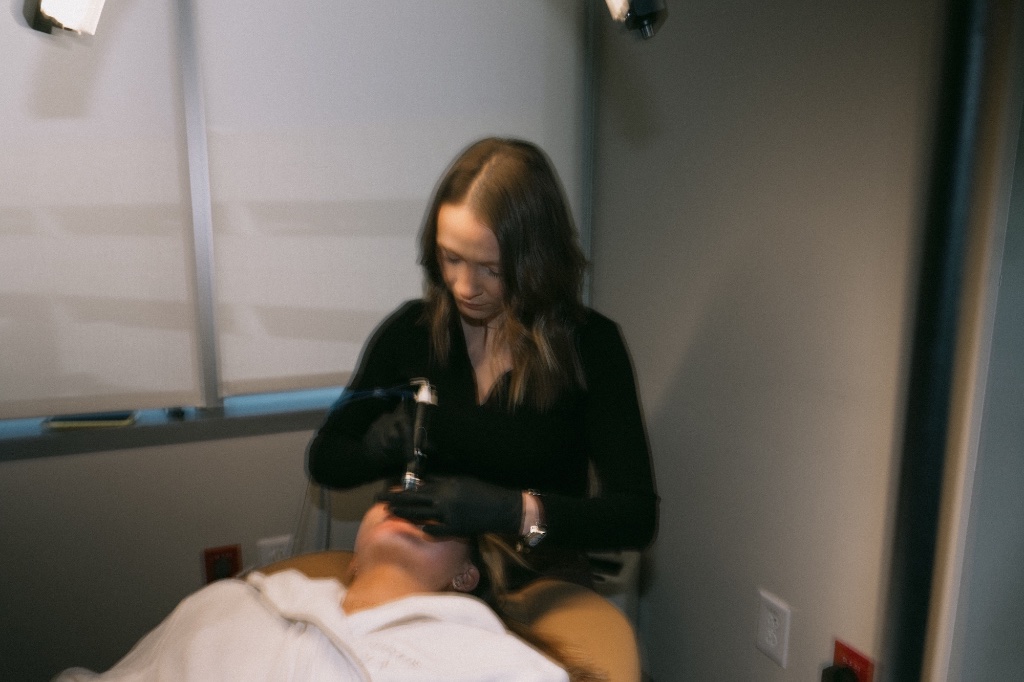
NATURAL RESULTS
A natural result still speaks, sips and smiles
A natural perioral result is not a mouth without lines. It is a mouth that still speaks, sips, smiles and kisses normally, in which the lines read softer in ordinary light and the border holds color again, and where the lips still look like the patient's own.
Overdone mouths are among the most recognizable signs of overdone work, and they are recognizable for functional reasons before aesthetic ones. An upper lip that no longer moves freely, a smile that has changed shape, a mouth that loses competence when drinking from a straw, lips that have gained projection the rest of the face did not gain: these read as work rather than as a person.
A result that looks natural is a change that is legible only in comparison, not one that announces itself in conversation. That is a quieter outcome than a visible correction, and around the mouth it is also a safer one, because the region's function is what most easily gives a treatment away.
What makes a result look expensive →A MOUTH THAT STILLMOVESIS NOTA FAILED RESULT.
BEFORE AND AFTER INTEGRITY
How photographs of the mouth should be taken
The perioral region is unusually sensitive to lighting direction, lip posture and camera height. Overhead light deepens every fine line, frontal light flattens them, a mouth held slightly pursed multiplies them, and a relaxed mouth removes them. A meaningful comparison controls all of it.
Credible images require the same camera, lens, distance, lighting, head position and lip posture, with no deliberate relaxation in the after photograph and no change in lighting direction to deepen or erase lines. No digital smoothing of perioral texture. No AI-altered imagery. JOLA does not use AI-generated before and after images.
CHANGETHE LIGHT.CHANGETHE MOUTH.DOCUMENTTHE RESULT.DON'TMANUFACTUREIT.
THE MYTH INDEX / 18
Eighteen things people believe about lip lines
MYTH 01
ONLY SMOKERS GET SMOKER'S LINES.
REALITY
Pursing, sun, genetics and skin thickness create them in non-smokers too.
MYTH 02
LIP LINES MEAN YOU NEED LIP FILLER.
REALITY
Lines live in the skin above the lip. Volume in the lip body does not remove them.
MYTH 03
BIGGER LIPS STRETCH LINES AWAY.
REALITY
Over-volumizing changes the profile before it changes the lines.
MYTH 04
BOTOX ERASES LIP LINES.
REALITY
A small dose can soften the purse. It does not erase etched lines in thin skin.
MYTH 05
A LIP FLIP AND LIP LINE TREATMENT ARE THE SAME.
REALITY
Same muscle, different goals. Lines are mostly a skin conversation.
MYTH 06
ONE LASER SESSION REMOVES LIP LINES.
REALITY
Resurfacing improves etched lines over time; candidacy and recovery matter.
MYTH 07
RESURFACING AROUND THE MOUTH IS LIKE ANYWHERE ELSE.
REALITY
Cold sore history, eating and movement require specific planning.
MYTH 08
STRAWS ALONE CAUSE LIP LINES.
REALITY
Repetitive pursing contributes; skin quality decides whether lines stay.
MYTH 09
LIP LINES ONLY AFFECT WOMEN.
REALITY
Men get them too; facial hair often hides them.
MYTH 10
LIPSTICK BLEED MEANS YOUR LIPS ARE TOO THIN.
REALITY
It usually means the border has softened or lines have formed.
MYTH 11
LIP BALM IS ENOUGH SUN PROTECTION.
REALITY
Only if it contains broad-spectrum SPF and covers the upper lip skin too.
MYTH 12
LIP LINES CAN'T BE PREVENTED.
REALITY
SPF, not smoking or vaping and skin care slow their formation.
MYTH 13
MORE NEUROMODULATOR MEANS SMOOTHER LIPS.
REALITY
Too much affects speech, straws and smile.
MYTH 14
FACIAL EXERCISES SMOOTH LIP LINES.
REALITY
More pursing is the opposite of what the skin needs.
MYTH 15
LIP LINES ARE THE SAME AS MARIONETTE LINES.
REALITY
Different location, different mechanism, different study.
MYTH 16
EVERYONE WITH LIP LINES NEEDS TREATMENT.
REALITY
Sometimes the most valuable outcome of a consultation is clarity.
MYTH 17
ERASED IS THE GOAL.
REALITY
Softer is realistic. A mouth that does not move is not.
MYTH 18
THE SEARCH TERM CHOOSES THE TREATMENT.
REALITY
The anatomy does.
THE JOLA PHILOSOPHY
JOLA does not treat a search term.
A patient who arrives asking for lip filler for lip lines may need a resurfacing conversation, a border conversation, a very small movement conversation, or simply sun protection and a candid explanation that nothing here erases what is already there. The treatment named in a search bar is a starting point, not a conclusion.
The philosophy behind this study is anatomy before treatment, diagnosis before device, skin quality before filters, and precision before aggression. Refinement is not erasure. Around the mouth those principles carry more weight than they do almost anywhere else, because the region is thin, vascular and functional, and because the margin between a refined result and a visible one is narrower here than on the cheek or the forehead.
It also means accepting the ceiling and saying so early. A line written by thousands of daily movements and kept by thin skin will not be removed by any non-surgical tool, and the most useful thing a provider can do is explain the layer structure before recommending anything rather than after several appointments. Sometimes the plan is SPF, skincare, a habit change and a decision to reassess.
Provider judgment →THECONSULTATIONIS WHERETHE SEARCHTERMBECOMESA PLAN.
DALLAS
Lip line assessment and treatment in Dallas
JOLA is a Dallas aesthetic practice offering an anatomy-led approach to the mouth region, with care led by a doctorate-trained nurse practitioner and oversight from an on-site, board-certified plastic surgeon. Patients come from Highland Park, University Park and the Park Cities, Preston Hollow, and across DFW.
Texas sun is part of the reason the perioral conversation matters here. The upper lip and the lips are exposed year-round in a way that most of the face is not, and they are the areas most often left out of a sun protection routine. That combination produces cumulative change on a surface that is already thin, and it is the one contributor a patient can change immediately.
Assessment begins with the layer question rather than the product question: are these lines in the skin, is the border holding color, has volume changed, and how much does the mouth purse in a day. From there, a plan is sequenced and discussed rather than prescribed, and treatment planning is shared with the patient in writing.
Treatment planning →THE UPPER LIPIS THEMOST SKIPPEDAREA INTHE ROUTINE.
THE BOTTOM LINE
Lip Lines: The Bottom Line
LIP LINES AREWRITTEN BY MOVEMENT.THEY ARE KEPTBY SKIN.
Lip lines are written by movement, and they are kept by skin. Everything in this study follows from that one sentence. The orbicularis oris gathers the skin above the lip into fine vertical pleats thousands of times a day, and the skin that has thinned and lost collagen stops springing back to flat. Neither half of that mechanism is optional, and no single treatment addresses both.
The distinctions are worth restating because they are where most plans go wrong. Lines live in the skin above the lip, not in the lip. The border is the edge that holds color, not a measure of lip size. Movement is not the same as skin, and relaxing the muscle that writes a line is not the same as resurfacing the skin that keeps it. Volume is not definition, and definition is not volume.
THE LINEIS THE SHAPETHE SKIN KEEPS.NOT THE SHAPEIT NEEDS.
Softer is realistic and stiffer is not. A good result around the mouth means lines that read less heavily in ordinary light, a border that holds lipstick again, and a mouth that still speaks, sips, smiles and kisses normally. A mouth that no longer creases naturally is not a better outcome, it is a different problem, and it is one of the more recognizable signs of overdone work.
This is also why assessment comes before treatment here more emphatically than in most areas. A patient who arrives asking for filler for lip lines may need a resurfacing conversation, a border conversation, a very small movement conversation, or none of the above. The mouth is thin, vascular and functional, and the tools that suit a cheek do not transfer automatically to a region this mobile.
JOLA may recommend skin and prevention before it recommends filler, and it may say that a line is anatomy rather than a defect. Sun protection on the upper lip and the lips, a retinoid the skin tolerates, and an end to smoking or vaping address the layer with the longest horizon, and they cost less than any treatment in this study. Where a treatment is appropriate, the plan is sequenced by layer, discussed in writing, and reviewed as the skin responds rather than repeated on a schedule.
THE SEARCH TERMDOES NOT CHOOSETHE TREATMENT.THE ANATOMYDOES.
- LIP LINES ARE WRITTEN BY MOVEMENT.
- THEY ARE KEPT BY SKIN.
- A LIP LINE IS NOT A LIP PROBLEM.
- YOU DO NOT HAVE TO SMOKE TO HAVE SMOKER'S LINES.
- MORE LIP IS NOT LESS LINE.
- THE BORDER HOLDS THE COLOR.
- RELAXING IS NOT RESURFACING.
- THE MOUTH MUST STILL MOVE.
- SOFTER IS REALISTIC.
- THE SEARCH TERM DOES NOT CHOOSE THE TREATMENT.
- THE ANATOMY DOES.
- LUXURY IN THE DETAILS.
THE ARCHIVE / 69 QUESTIONS
Lip lines and perioral lines: frequently asked questions
69 matching questions
001What causes lip lines?
They are written by movement and kept by skin. The ring of muscle around the mouth, the orbicularis oris, gathers the skin above the upper lip into fine vertical folds every time the lips purse, sip, speak, whistle or kiss. Once the skin above the lip has thinned and lost collagen through sun exposure, smoking or vaping, genetics and age, it stops springing back to flat and begins to hold the shape movement gives it.
002Why do I have lip lines if I have never smoked?
Because smoking is one contributor among several rather than the cause. A non-smoker purses their lips thousands of times a day through ordinary speech, drinking and expression, and the skin above the upper lip is thin and rarely protected from the sun. Genetics set how thin that skin starts. The term smoker's lines describes the pattern, not the person.
003Do straws cause lip lines?
Straws add pursing repetitions, and repetitions are what the muscle uses to gather the skin into folds. What straws do not do is decide whether those folds stay, because that depends on the skin. A straw habit on resilient skin is unlikely to produce permanent lines on its own, and a mouth with thin, sun-exposed skin may develop them without a straw in sight.
004Does vaping cause lip lines?
It involves the same pursing as smoking, so it adds the same repetitions. Whether it carries the additional effect on the skin itself that smoking does is a clinical question rather than an established equivalence, and a clinician may frame it more cautiously. What is not in question is that the pursing pattern sits in the same layer of the map as smoking does.
005Are lip lines genetic?
Partly. Skin thickness, collagen behaviour, the size and activity of the muscle around the mouth, and how the lips and the dental structure sit are all inherited to a meaningful degree. That is why two people of the same age with the same sun exposure and the same habits can have very different amounts of perioral line. Genetics set the starting point, not the only variable.
006Does sun cause lip lines?
Sun does not write the line, but it decides whether the line stays. The upper lip and the lips are among the most exposed surfaces on the face and among the least protected, and cumulative exposure thins the skin, reduces its elasticity and adds pigment and texture change. It is the contributor with the longest horizon and the one a patient can change immediately.
007Why do lines appear above the lip but not below?
Because that is where the muscle gathers the skin. The ring of muscle pulls the skin inward toward the mouth, and the upper lip has a longer span of thin skin above it before the nose begins. Below the lower lip, that span is shorter and reinforced differently. Some patients do develop lines below the lower lip, and those are usually shallower and fewer.
008Does weight loss cause lip lines?
It can change how they read. Losing facial volume alters how the perioral region sits, and less support around the mouth can make lines that were stable more visible. This is a common conversation in current practice with GLP-1-related weight loss. It does not create the line, but it removes some of the tissue that was softening the way the surrounding skin looked.
009What is the orbicularis oris?
It is a ring of muscle that surrounds the mouth, and it is the muscle behind lip lines. When it contracts, the lips purse and the skin around the mouth is pulled inward toward the center. It is responsible for closing the lips, shaping speech, whistling, sipping and kissing. Because it is circular, the folds it produces in the surrounding skin are vertical rather than horizontal.
010What is the vermilion border?
It is the edge where the colored part of the lip meets the skin around it. It is not a structure you can feel as a separate layer, but it is visible as a line of definition, and it is what holds lipstick, liner and tint in place. When that edge softens or loses definition, color has less to hold onto and feathers into the fine vertical lines above the lip.
011What are static versus dynamic lip lines?
A dynamic line appears only when the lips purse or move and settles when the mouth relaxes. A static line is visible at rest. Dynamic lines point at movement, static lines point at skin quality, and most mouths that have had lines for years have both at once. That distinction is the reason a single treatment rarely addresses everything a patient sees.
012Why does lipstick bleed?
Because the border has softened or lines have formed, or both. Color travels outward along the same vertical pleats the muscle has gathered into the skin. A patient often interprets bleeding as a sign that the lips are too thin and assumes filler, when what has usually changed is the crispness of the edge that used to stop the color.
013Why is the skin above the upper lip prone to lines?
It is thin, it is constantly in motion, and it is exposed to the sun year-round with the least protection of any facial area. Thin skin has less collagen to resist folding, motion supplies the folds, and sun exposure removes resilience over time. That combination is why this small area shows change earlier than most of the face.
014What is the philtrum, and does it matter here?
The philtrum is the vertical groove between the nose and the upper lip. It is not a line produced by movement, and it is not part of this study. It is mentioned because patients sometimes describe a change in the area between the nose and the lip and attribute it to lip lines, when what has changed is the contour of the region rather than the skin pattern.
015What is the best treatment for lip lines?
There is no single best one, because a lip line is not one problem. It has a movement component written by the muscle around the mouth and a skin component created by thinning and collagen loss. Resurfacing addresses the skin, a small selective neuromodulator dose may soften the movement, skin quality treatments improve the tissue, and border definition answers a different question again.
016Can CO2 laser treat lip lines?
Fractional CO2 resurfacing such as eCO2 3D is often the primary conversation for lines that are etched into the skin at rest, because it treats the layer that keeps them and supports collagen remodeling over time. It has specific considerations around the mouth, including cold sore history, movement during recovery and pigment risk. Candidacy is a clinical decision.
017Can ULTRA treat lip lines?
ULTRA is a resurfacing option and belongs in the same conversation as fractional CO2 for etched static lines. The two are not interchangeable, and choosing between them depends on the depth of the concern, the condition and history of the skin, and the time available for recovery. That decision belongs to a clinician examining the area rather than to a preference stated in advance.
018Can Botox treat lip lines?
It may soften dynamic lines, and it does not erase etched ones. A very small amount placed in the ring of muscle around the mouth by an experienced injector can reduce the pursing that writes new folds, and the effect fades as the treatment wears off. Perioral use for lines is off-label, and over-treatment can affect drinking, whistling, speech and smile.
019What is a lip flip?
A lip flip is a small amount of neuromodulator placed in the muscle above the upper lip to change how the lip sits and how much of it shows. It uses the same muscle as the treatment of dynamic lip lines, but it is a different objective. A patient asking about a lip flip has not automatically asked about their lines, and the two are discussed separately.
020Can filler treat lip lines?
In two specific ways, both narrow. A small amount of soft filler at the vermilion border can restore an edge that has softened so color stops bleeding. Very small superficial amounts can soften an individual deep line, though this is technique-sensitive and limited in scope. Filler placed in the lip body does not remove lines in the skin above it.
021What is border definition?
It is the use of a conservative amount of soft filler to restore crispness at the edge where the colored lip meets the skin. It is a definition treatment rather than a volume treatment, and patients often describe the result as lipstick sitting properly again rather than as fuller lips. It is one of the more reliable uses of filler in this region.
022Why is the perioral region considered higher risk for filler?
Because it is vascular. The lips and the area around them have a rich blood supply with connections that matter, and the region carries a recognized risk of vascular compromise, which is the interruption of blood flow to tissue. That risk is manageable in experienced hands and is a central reason to choose who performs the treatment carefully.
023Do skin boosters help lip lines?
They can improve the skin the lines live in. A hydration-focused injectable skin booster treats a region rather than a single crease, aiming at hydration and skin quality, and the perioral area suits that approach because the concern there is distributed rather than concentrated. Change builds over a series. A booster does not erase a line that is already etched.
024Does microneedling help lip lines?
It can improve skin quality over a series. Microneedling creates controlled microscopic injury that prompts a repair response, and around the mouth the aim is better hydrated, more even skin that reads less finely creased. Where PRF or PRP is added, the patient's own concentrated platelets are part of the same approach. It does not change the muscle, the border or the thickness of the skin.
025Do chemical peels help lip lines?
Milder peels can improve skin quality and soften fine lines, and a series may suit a patient who is not a candidate for, or not ready for, fractional laser. For deeply etched lines a peel is unlikely to be the primary answer, and a plan built around one deserves scrutiny. Depth, skin type and pigment risk shape what is appropriate.
026Do lip line creams work?
They support the skin and they do not remove lines. A well-formulated product can improve hydration and surface quality, which makes fine lines read softer, and that is a real if modest contribution. The claim that a cream erases etched lines is the clearest example of a category being oversold, because a topical product cannot restore collagen structure that has already changed.
027Does tretinoin help lip lines?
A retinoid can support perioral skin over time by encouraging turnover and supporting collagen, and it is one of the few topical categories with a genuine long-term role here. The caveat is tolerance. Skin around the mouth is more reactive than the forehead, and it usually needs a gentler starting point and a slower build, or it produces weeks of redness and flaking.
028Do lip plumpers help lip lines?
They work cosmetically and temporarily. Plumping products typically create a short-lived sensation of fullness through irritation or hydration rather than changing the skin the lines live in, so the effect lasts hours at most and does nothing to the underlying pattern. They are a makeup decision rather than a treatment one.
029Are there treatments that remove lip lines completely?
No non-surgical treatment removes a line that has been written by movement and kept by thin skin, because the mechanism that created it continues after any course of treatment. What is realistic is lines that read softer in ordinary light, skin that looks better hydrated and more even, and a border that holds color again. Softer is a real outcome; erased is not.
030How do I decide between skin and movement treatments?
By asking whether the lines are visible at rest. Lines that appear only when the lips purse are a movement finding, and lines visible at rest are a skin finding. Most mouths have both, which is why plans frequently sequence two approaches rather than choosing one. The sequence is decided at an examination, not from a description.
031Laser versus Botox for lip lines: which is right?
They are not competitors; they act on different layers. Laser resurfacing treats the skin that keeps the lines and is the relevant conversation for lines visible at rest. A small neuromodulator dose reduces the movement that writes new folds and is relevant when lines appear mainly on pursing. A mouth with both findings may have both discussions, in an order set by a clinician.
032Filler versus laser for lip lines?
Laser changes the skin above the lip. Filler changes the border or the lip, and does not change the skin above it. A patient whose concern is fine lines will usually find laser or another skin-quality approach more relevant, while a patient whose concern is lipstick bleeding into those lines may benefit from border definition. Most plans that include filler do so for definition rather than for the lines.
033Lip flip versus lip filler?
A lip flip uses a small amount of neuromodulator in the muscle above the upper lip to change how the lip sits and how much shows. Lip filler adds volume or definition to the lip itself. They answer different questions, they can be combined, and neither is a treatment for lines in the skin above the lip, which is why patients seeking that are usually directed elsewhere.
034CO2 versus ULTRA around the mouth?
Both are resurfacing options for etched static lines, and both act on the skin rather than on movement. They differ in technology, in how they interact with the skin, and in the recovery they involve. Which is appropriate depends on the depth of the lines, the condition and history of the skin, and the time available. That is a clinical decision made on the area being treated.
035Lip lines versus nasolabial folds versus marionette lines?
Lip lines are fine vertical lines in the skin around the mouth, written by the ring of muscle that purses the lips. Nasolabial folds run from the side of the nose to the mouth corner and are driven by support, fat and descent. Marionette lines run from the mouth corner toward the chin and are driven by muscle, support and descent. Three locations, three mechanisms, three studies.
036Resurfacing versus skin boosters for perioral skin?
Resurfacing creates a controlled injury and a repair response, and it is the more substantial of the two for etched lines, with a candidacy assessment and recovery attached. Boosters aim at hydration and skin quality over a series with little downtime. They can be complementary, and neither substitutes for daily sun protection, which addresses the contributor with the longest horizon.
037Am I a candidate for lip line treatment?
That depends on which layer is producing what you see. Fine lines in thin skin point at a skin-quality conversation. Lines that appear only on pursing point at movement. A border that no longer holds color points at definition. A candidate for one is not automatically a candidate for another, which is why the assessment comes before any recommendation.
038Am I too young to treat lip lines?
Being young is not a contraindication, but it does change the plan. In the thirties the most common finding is dynamic lines in skin that still has resilience, and the highest-return recommendations are usually daily sun protection on the upper lip and lips, a tolerated retinoid and a review of habits. A procedure is not automatically the next step, and often it is not the right one.
039Can I have perioral resurfacing if I get cold sores?
A history of herpes simplex does not automatically exclude you, but it must be discussed in advance rather than discovered afterward, because resurfacing near the mouth can trigger an outbreak. A clinician may recommend antiviral prevention before treatment. This is one of the few questions in aesthetics where a patient's memory of a childhood cold sore directly changes the plan.
040Can darker skin tones have perioral resurfacing?
Yes, with a different assessment rather than a blanket exclusion. The risk of post-inflammatory pigment change after resurfacing varies by skin type and individual history, so candidacy is considered more carefully and in some cases a different approach is chosen. Anyone who answers this question with a general statement about who can be treated has answered it wrongly.
041Can men treat lip lines?
Yes, and the mechanism is identical. Lip lines occur in men as well as women, and facial hair often conceals them, so they are noticed later and discussed less often. The practical differences are around shaving, hair growth and how a result is assessed in the mirror rather than around biology, treatment logic or candidacy.
042Who is not a good candidate for these treatments?
Someone expecting a line to be erased is not a good candidate for any of them, because no non-surgical option removes a line whose mechanism continues. Someone with an active infection or an untreated skin condition near the mouth needs that addressed first. And a patient whose perioral change is driven by dental or bony support may be better served by a different referral rather than an aesthetic treatment.
043Can lip lines go away completely?
No. A line written by thousands of daily movements and kept by skin that has lost collagen will not be removed by any non-surgical treatment, because the movement continues after the treatment ends. What is realistic is that lines read softer in ordinary light, that the surrounding skin looks better hydrated and more even, and that a softened border holds color again.
044Will my mouth look different?
It should still look like your mouth. A good result is legible in comparison rather than in conversation: softer lines, better skin quality, a border that holds lipstick. A mouth that no longer moves freely, has changed smile shape or has gained projection the rest of the face did not gain reads as work rather than as a person, and that is the outcome to avoid.
045Will I still be able to drink through a straw?
If a neuromodulator is part of the plan, this is precisely the function a clinician is protecting. Difficulty with a straw is one of the recognized consequences of over-treating the muscle around the mouth, along with whistling, pronouncing certain sounds and closing the lips comfortably. It is dose-dependent rather than random, which is why restraint rather than correction is the rule here.
046How soon will I see change?
It depends on the layer. Change after a neuromodulator typically appears over days to a couple of weeks, as the muscle activity reduces. Resurfacing produces visible surface change as the skin heals and then continues to improve gradually as collagen remodels, which is measured over months rather than weeks. Skin-quality treatments build across a series, and border definition is visible quickly.
047Will I look like I have had work done?
The result you want is one that does not announce itself. Over-treated mouths are recognizable for functional reasons first: an upper lip that no longer moves freely, a changed smile, a mouth that loses competence when drinking. Around the mouth, restraint is not a stylistic preference; it is what keeps a result from reading as a treatment.
048What is recovery like after perioral laser?
It involves visible surface healing around the mouth, and the area continues to be used for eating, drinking, speaking and oral hygiene throughout. Because of that, area-specific instructions are given at consultation and followed carefully, and the practical experience here differs from a cheek or a forehead. Plan the calendar around the treatment rather than the treatment around the calendar.
049Is there downtime after a neuromodulator around the mouth?
Social downtime is minimal and functional change is the more relevant consideration. The area may feel different as the muscle activity reduces, and the specific things to watch, drinking through a straw and pronouncing certain sounds among them, are discussed before rather than after. Any effect is temporary and wears off as the treatment does.
050Is there downtime after border or lip filler?
Expect swelling and possible bruising around the lips for several days, with a smaller amount of product in a border definition treatment than in a volume treatment. Bruising is common in this vascular region. Most patients are comfortable in social settings within a short period, and a consultation will describe what is typical for the specific plan.
051Can I have treatment before an event?
The general principle is to leave room. Filler bruising and swelling, and the visible healing phase after resurfacing, both resolve on their own timeline rather than on the calendar of an event. A neuromodulator needs time to take effect as well. Booking close to a wedding, a shoot or a trip trades a better result for a worse week, and it is the most common scheduling mistake in this region.
052What can I do during recovery?
Follow the instructions given at consultation, which are specific to the treatment and to the area. The general principles are to keep the treated skin protected from sun, to avoid anything that irritates or traumatizes it while it heals, and to keep the mouth clean and comfortable. Recovery instructions are not interchangeable between treatments, which is why they are given in person.
053What are the risks of perioral laser resurfacing?
Reactivation of cold sores in someone with a herpes simplex history is the most predictable risk, and it is why that history is discussed in advance. Prolonged redness is common enough to be planned for. Pigment change, either darker or lighter, is a recognized risk that varies with skin type and history. Scarring is rare and is among the reasons candidacy is assessed rather than assumed.
054What are the risks of Botox around the mouth?
They are functional rather than cosmetic. Difficulty drinking through a straw, difficulty whistling, altered pronunciation of certain sounds, an asymmetric smile and lips that no longer close comfortably are all consequences of over-treating the muscle around the mouth. They are dose-dependent, they typically resolve as the treatment wears off, and they are the reason this region is treated conservatively.
055What are the risks of lip filler?
Bruising and swelling are ordinary. Lumps, visible product and an overfilled profile are the recognized aesthetic risks of placing too much too superficially in thin tissue. Vascular compromise, in which blood flow to tissue is interrupted, is the risk that makes this region worth treating with genuine care, and it is why training and experience matter more here than price or convenience.
056What is vascular occlusion?
It is the interruption of blood flow to tissue, and in filler treatment it occurs when product enters or compresses a vessel. The lips and the area around them have a rich blood supply with connections that matter, which is why the perioral region is among the areas where this risk is discussed most seriously. It is uncommon, and it is the reason practitioners managing this region work accurately and conservatively.
057Can filler be dissolved?
Hyaluronic acid filler can be dissolved with an enzyme, which is one reason it is often chosen in a region like this where precision matters and reversibility has value. This is a clinical procedure in its own right rather than a simple undo, and it is performed by the practitioner managing the area. Fillers that are not hyaluronic acid based do not have the same reversibility.
058Are skin boosters and microneedling safe around the mouth?
They carry the mildest risk profile of the options discussed here, which is not the same as no risk. Bruising, swelling and temporary surface irregularity are possible, and any treatment that breaks the skin carries a small risk of infection or reaction. These are the risks of a low-drama category, and they are still stated rather than assumed away because the treatment sounds gentle.
059How can I prevent lip lines?
Daily broad-spectrum sun protection that includes the upper lip skin and the lips themselves, a retinoid your skin tolerates, consistent moisturization and not smoking or vaping are the interventions with the longest horizon. They do not erase lines that already exist. What they do is slow the formation of new ones and protect the skin quality a treatment is trying to build.
060How long do lip line treatment results last?
It depends on the layer rather than on a calendar. Movement-based results fade as movement continues, which begins the day after treatment. Skin-quality results build over a series and then decline gradually with further sun exposure and age. Border definition and volume change over time. No figure here should be treated as a schedule, because the mouth keeps moving throughout.
061How often will I need maintenance?
There is no fixed interval, and this region is a poor candidate for one. Because the muscle that writes the lines is active during every conversation and meal, the mechanism never stops, and the useful rhythm is based on how the skin actually looks rather than on a set number of months. Where a practitioner quotes a fixed interval before examining you, the plan is being sold rather than designed.
062Does stopping smoking or vaping really change anything?
It removes two contributors at once. Smoking and vaping involve the same repetitive pursing that writes the folds, and smoking carries an additional effect on the skin itself. That makes it unusually efficient as a change, because one habit sits on two layers of the perioral map. It does not remove lines already etched, and it does change what the next decade looks like.
063What affects the cost of lip line treatment in Dallas?
Four variables explain most of it. The category of treatment sets a range, since resurfacing, a small neuromodulator treatment, border definition, a booster series, microneedling and skincare sit at very different price points. The number of sessions follows from the category and from how the skin responds. Combinations address more than one layer. And maintenance spreads the cost across time rather than concentrating it.
064Why does JOLA not list lip line treatment prices online?
Because the honest answer depends on the mouth being treated. A patient with early dynamic lines and good skin is not buying what a patient with etched static lines, a softened border and a change in lip volume is buying, and giving both the same number would misrepresent one of them. Cost is discussed at consultation, once the assessment has identified which layers are involved.
065What happens at a JOLA consultation for lip lines?
The assessment begins with the layer question rather than the product question. Are the lines visible at rest or only on pursing. Is the border holding color. Has lip volume or support changed. How much does the mouth purse in a day, and how much sun protection does the upper lip get. From there, a plan is sequenced by layer and discussed with you, including what can be deferred and what is not worth doing.
066How do I book a consultation?
Appointments are booked online through the JOLA scheduling link. If you are unsure whether your concern is a line, a border change or a volume change, that is exactly what the consultation is for, and you do not need to arrive with a treatment in mind. The assessment is what determines the plan.
067Do you see patients from Highland Park, University Park and Preston Hollow?
Yes. JOLA is a Dallas practice and patients come from Highland Park, University Park and the Park Cities, Preston Hollow, and across DFW. The practice location and contact details are on the contact page, and consultations are booked through the online scheduling link.
068What should I bring to a lip line consultation?
Bring your medication history, including any antiviral medication, and tell us about cold sore history, previous filler or neuromodulator treatment around the mouth, and any dental work or changes in dental structure. Photographs of yourself at an earlier age are genuinely useful for assessing what has changed. If you use lip products that bleed, bring them, since that is a practical finding.
069Does the consultation include a facial assessment beyond the mouth?
Yes, at least in the sense that the mouth is read in relation to the face around it. The nose above it, the chin below it and the lower-face proportions all change how the perioral region reads, and a finding that looks like a line problem is occasionally a proportion observation. That is why the assessment is anatomical rather than regional.