
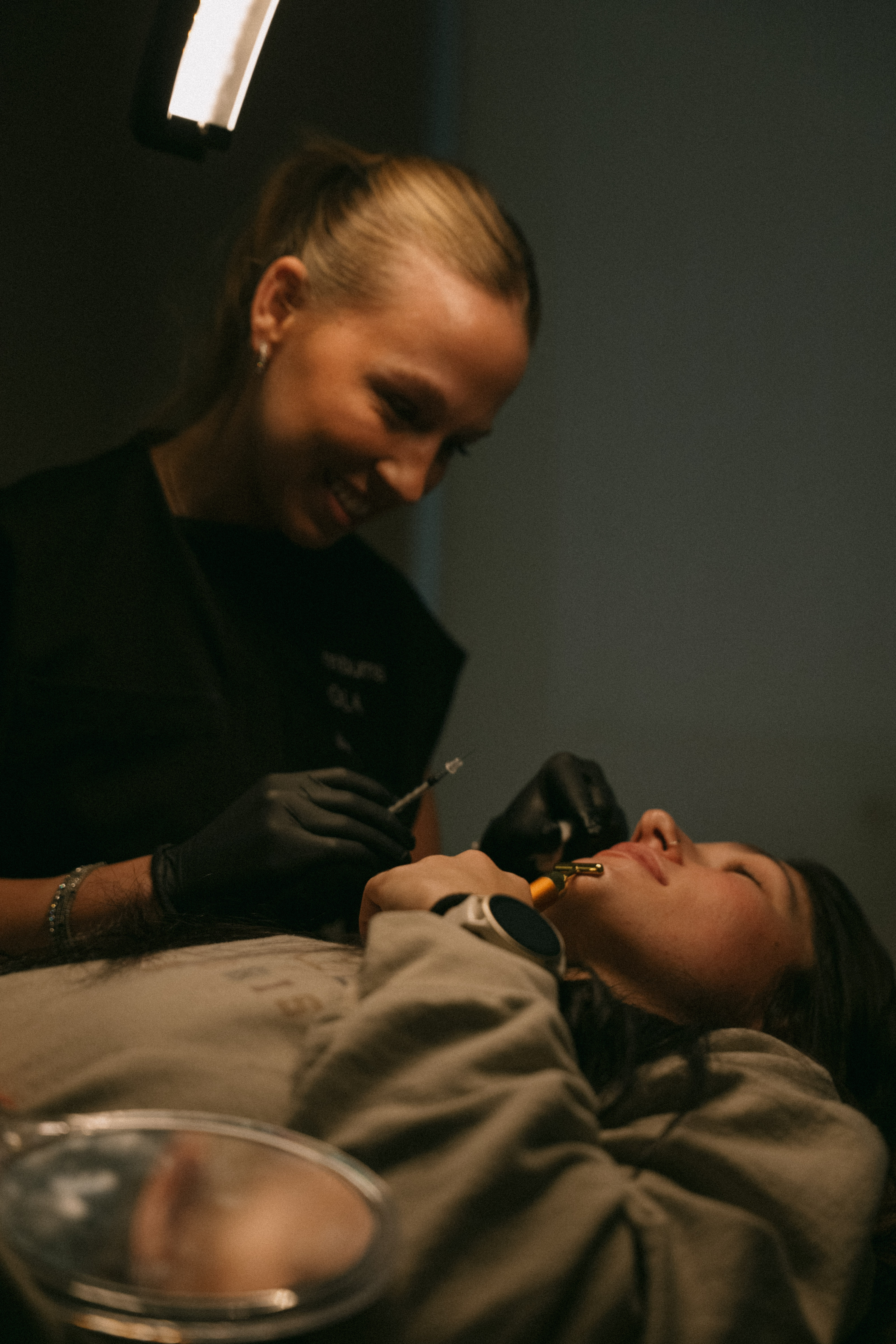
JOLA / THE HORIZONTAL LINE STUDY / 008
Horizontal Neck Lines: What Causes Them and What Actually Helps?
THE NECK
BENDS.
THE SKIN
REMEMBERS.
Horizontal neck lines, tech neck and necklace lines, and why the neck’s most visible line is often its most misunderstood.
ANCHORMOTIONSURFACEQUALITYLAXITYLIGHTANATOMY
STAGE 1 / 4 · THE COLUMN
01THE COLUMN
02THE BEND
03THE MEMORY
04THE RECORD
YOU SEARCHED
FOR A WRINKLE.WHAT YOU ARE
LOOKING AT IS A FOLD
THE SKIN HAS LEARNED.
THE 60-SECOND ANSWER
What actually helps horizontal neck lines?
Horizontal neck lines are folds. They form where the skin across the front of the neck creases as the neck bends, at the points where that skin is anchored to the tissue beneath it. Because the line is anchored rather than simply loose, no single treatment erases it.
They are partly anatomical. Many people have faint rings from a young age because of how their skin attaches and how their neck moves, which is why a twenty-five-year-old and a fifty-five-year-old can have a similar line for entirely different reasons. Repeated forward flexion, thinner and drier skin, sun exposure the neck rarely gets protected from, and laxity in later decades all deepen what is already there.
Options that may soften the appearance work on different layers. Resurfacing with eCO2 3D or ULTRA addresses surface quality and the fine etching around a line. Hydration-focused injectable skin boosters and microneedling-based collagen work aim at the skin itself. Energy-based tightening with XERF, or K-LUXE where surface quality is also part of the picture, helps where laxity is amplifying how deep the folds read. In selected deep static creases, a clinician may consider very small superficial microdroplet techniques. Daily skincare, sun protection on the neck yourself and attention to how long your chin stays down matter more here than on almost any other area.
Softer is realistic. Erased is not. The neck keeps bending after any treatment, which is the single most useful thing to understand before choosing one.
The Neck Study →SOFTERIS REALISTIC.ERASEDIS NOT.
CHAPTER
01
WHAT AREHORIZONTALNECK LINES,AND WHY DOTHEY FORM?
Horizontal neck lines are transverse creases that run across the front of the neck, often in a series. They are also called neck rings or necklace lines. They form where the skin folds as the neck flexes, and they persist because the skin is held to the tissue beneath it at those points. That tethering is why they can appear early, and why they behave differently from laxity.
Start with the mechanics. The front of the neck is a column of thin skin over muscle, fat and airway. When the chin drops, the column has to accommodate the bend somewhere, and it does so by folding. The skin does not fold evenly along its length. It creases at the points where it is attached more firmly to the structure beneath, which is why rings tend to sit at fairly consistent heights from person to person rather than appearing at random.
The attachment is the part usually missed. A crease that appears because skin is loose can be improved by addressing firmness. A crease that appears because the skin is held down at a point and folds above it behaves differently: the fold is a fixed consequence of that attachment plus the motion. This is the difference between a line that is loose and a line that is anchored, and it is the reason the same treatment can help one neck and disappoint another.
Several contributors deepen what the anatomy already set up. Repeated flexion along the same lines is the most constant one, because it happens thousands of times a day without anyone deciding to do it. Skin that is thinner, drier and lower in collagen folds more visibly than skin that is not. Sun exposure accumulates on a part of the body that is almost never protected. In later decades, laxity around the lines changes how they read. Changes in weight change how the skin sits over the neck.
It is also worth separating two findings that look identical in a photograph. A dynamic fold is visible only when the chin drops and disappears when the neck is extended. A static line is etched at rest. A neck can have either, or both, and the distinction changes the conversation, because dynamic folds point at motion while static lines point at surface and skin quality.
What this chapter deliberately does not claim is a settled fine mechanism. The broad explanation, that skin folds at points of attachment and is deepened by movement, skin quality and sun, is well established. The finer anatomy of exactly which structures tether where varies between individuals and between sources, and anything more specific than that belongs in an assessment rather than in an article. What follows from the broad version is enough to work with.
THE LINEIS ANCHORED,NOTLOOSE.
The Neck Study covers neck aging in full →CHAPTER 02 / THE HORIZONTAL LINE MAP
ONE LINE.
SEVEN
COMPONENTS.
The Horizontal Line Map is JOLA’s editorial framework for reading neck rings. A line that has become more visible may involve any of these seven components. Not every neck has all seven. Not every component can be changed without surgery. Not every component should be treated.
01
ANCHOR
WHAT IT IS
Where the skin is tethered to the tissue beneath, setting where the fold forms.
WHY IT CHANGES THE LINE
The front of the neck does not fold evenly. It creases at the points where the skin is held more firmly to the structure underneath, which is why rings sit at fairly consistent heights rather than appearing at random.
WHAT CONVERSATION IT OPENS
An expectations conversation. The anchor is anatomy, and it is the reason the fold is not simply a looseness problem.
WHAT IT IS CONFUSED WITH
Loose skin. A tethered fold and a lax surface are different findings.
02
MOTION
WHAT IT IS
Repeated forward flexion that folds the skin along the same lines.
WHY IT CHANGES THE LINE
Looking down folds the front of the neck. Doing it for hours a day for years folds the same skin along the same lines far more often than a neck that stays extended.
WHAT CONVERSATION IT OPENS
A habits conversation, about screens, posture and how long the chin spends down.
WHAT IT IS CONFUSED WITH
A muscle problem. Folding skin is not the same as contracting a muscle.
03
SURFACE
WHAT IT IS
Thinning, dryness and fine etching of neck skin.
WHY IT CHANGES THE LINE
Neck skin is thin and rarely moisturized or protected. Surface quality changes how a line reads by deepening its edges and adding fine texture around it.
WHAT CONVERSATION IT OPENS
A resurfacing and skin-quality conversation, which may include laser or skincare.
WHAT IT IS CONFUSED WITH
A deep crease. Surface etching is the layer around the fold, not the fold itself.
04
QUALITY
WHAT IT IS
Collagen, hydration and elasticity across the region.
WHY IT CHANGES THE LINE
Skin quality across the whole front of the neck changes how the folds read, because a hydrated, resilient surface holds light differently from a dry, thinned one.
WHAT CONVERSATION IT OPENS
A booster or collagen-induction conversation, which is regional rather than line-specific.
WHAT IT IS CONFUSED WITH
Volume. Skin quality and volume are different properties with different tools.
05
LAXITY
WHAT IT IS
Loosening skin around the lines in later decades.
WHY IT CHANGES THE LINE
When the skin drapes, the valleys between folds look deeper than they are, even though the folds themselves have not changed.
WHAT CONVERSATION IT OPENS
A tightening conversation, where supported and where laxity is genuinely present.
WHAT IT IS CONFUSED WITH
The line itself. The line is the fold; laxity is the way the surface around it behaves.
06
LIGHT
WHAT IT IS
Sun exposure the neck rarely gets protected from.
WHY IT CHANGES THE LINE
The front of the neck is exposed most of the year and almost never receives the sun protection a face does, so cumulative exposure contributes to texture and pigment change.
WHAT CONVERSATION IT OPENS
A prevention conversation, which is the one with the longest horizon.
WHAT IT IS CONFUSED WITH
Genetics. Sun exposure adds to what inheritance already set.
07
ANATOMY
WHAT IT IS
Natural variation. Many people have rings from a young age.
WHY IT CHANGES THE LINE
How the skin attaches, how thick it is and how the neck is shaped vary by individual. Some necks show rings in their twenties and change very little for decades.
WHAT CONVERSATION IT OPENS
A "do nothing yet" conversation, which is a legitimate clinical answer.
WHAT IT IS CONFUSED WITH
Aging. A ring in a young neck is usually anatomy rather than a marker of early aging.
CHAPTER
03
HORIZONTAL LINESVS BANDS VSCREPE VS LAXITY:WHICH ONE IS IT?
Four different findings share the phrase neck lines. Horizontal lines are folds that run across the neck. Platysmal bands are vertical muscle edges. Crepey texture is fine surface wrinkling. Laxity is skin that has lost firmness. Each opens a different conversation, and treating one does not address another.
Horizontal lines run across. They are folds in skin, produced by the column bending and by the skin being held at points along it. When someone looks down and sees rings appear, they are watching a fold form, not a muscle contract.
Vertical bands run up and down. They are the visible edges of the platysma, a thin sheet of muscle covering much of the front of the neck. Bands appear or sharpen with expression and neck tension, and they belong to a muscle-activity conversation. Bands and horizontal lines coexist in many necks, which is why the same person can be told two entirely different things by two different providers.
Crepe is texture. Crepey skin describes fine, dense surface wrinkling with a thin, less resilient feel, closer to the way very fine paper behaves than to the way a fold behaves. It is a skin-quality finding rather than a structural one. Between two horizontal rings, a neck can be perfectly smooth or visibly crepey.
Laxity is firmness. Loose skin drapes and folds rather than holding a surface. Where laxity accompanies horizontal lines, it changes how deep the lines read without changing the lines at all, which is why the two are so easily conflated. The Neck Study covers bands, crepe and laxity in depth. This study goes deep on the horizontal layer only and links back for everything else.
The practical value of the distinction is that each finding has its own mechanism and its own realistic outcome. Muscle responds to muscle-directed treatment. Texture responds to skin-directed treatment. Laxity responds to firmness-directed treatment. A fold is its own category, and it is the least responsive of the four to any single tool.
A HORIZONTAL LINEIS NOTA BAND.
XERF for neck tightening →CHAPTER 04 / THE FINDING STUDY
FOUR FINDINGS.
ONE WORD.
Most people arrive describing everything on this neck as lines. Select each finding in turn and see what changes, because the same word covers a fold, a muscle edge, a texture and a firmness problem, and only one of them belongs to this study. This is an educational schematic, not a diagnosis.
LINES · THIS STUDY
LINES
Folds that run across the neck, formed where the skin is anchored to the tissue beneath and the column bends. This study. A surface, skin quality and habits conversation.
A LINE IS NOT
A BAND.
A FOLD IS NOT
A TEXTURE.
A LINE IS NOT A BAND.A FOLD IS NOTA TEXTURE.
CHAPTER
05
IS IT REALLYTECH NECK?
Forward flexion while looking down at a phone or a laptop folds the skin along the same lines, repeatedly, which can deepen creases that already exist. But many people with prominent rings spend very little time on screens, and many heavy screen users have almost none. Anatomy and skin quality decide where the lines are. Posture can make them read deeper.
The useful version of the idea is mechanical rather than moral. Looking down folds the front of the neck. Doing it for hours a day for years means folding the same skin along the same lines far more often than a neck that stays extended. Folding is not the same as damaging, but repetition is exactly what turns a faint line into a more established one.
The reason the label overreaches is that lines usually arrive before the habit does. Children and teenagers have faint horizontal rings, and so do people who have never owned a smartphone. The rings in those necks reflect how the skin is attached and how the neck is shaped, which makes the habit a modifier rather than a cause on its own.
The practical habits are unremarkable and worth stating plainly. Raising a screen to eye level costs nothing and reduces how often the neck spends its day folded forward. Being aware of a persistently dropped chin matters more than any exercise. Sun protection on the neck, which is routinely skipped, addresses a contributor that habits cannot.
It is also worth being honest about how small the cosmetic return on posture work usually is. Someone who corrects their setup often notices the neck feeling better, and sometimes notices the lines reading slightly softer when the column is held extended, but nobody should expect an established etched line to disappear because a laptop was raised. Posture is a supporting habit, not a treatment.
A caution about the exercises and devices that circulate online. Neck movements and stretching devices are marketed as line erasers, and there is no meaningful evidence that either releases a tethered fold or rebuilds collagen in the skin. Some movements feel good and are harmless. The claim is where the problem sits.
TECH NECKIS A POSTURE,NOT ADIAGNOSIS.
Clinical skincare at JOLA →CHAPTER 06 / THE FLEX STUDY
THE NECK BENDS.
THE SKIN
REMEMBERS.
Move the column through four positions, from upright to chin down, and watch where the folds appear. The fold points are fixed, which is why the same rings return in the same places. This is an educational schematic of a mechanism, not a simulation of a clinical outcome.
UPRIGHT · NOTHING RECORDED YET
The column is upright and smooth. Nothing has been recorded yet. Move the slider toward chin down to fold the front of the neck.
THE NECK BENDS.
THE SKIN
REMEMBERS.
THE NECK BENDS.THE SKINREMEMBERS.
CHAPTER
07
CAN RESURFACINGSOFTEN HORIZONTALNECK LINES?
Fractional resurfacing with eCO2 3D or ULTRA can improve surface quality, soften the fine etching that runs within and around horizontal lines, and support collagen remodeling over time. Neck skin is thinner than facial skin and heals differently, so treatment is deliberately conservative and candidacy matters. Resurfacing does not release the attachment that creates the fold.
The layer resurfacing addresses is the surface. A horizontal line has two visible parts: the fold itself, created by attachment and motion, and the fine etched texture that develops along and around it as skin ages. Resurfacing works on the second part. It refines the quality of the skin around the line, which changes how the line reads without changing the mechanism that produced it.
The neck is treated differently from the face because its skin is thinner, has fewer supporting structures to draw on during healing, and moves constantly. That combination means a protocol written for a cheek does not transfer directly. Fractional approaches are used rather than fully ablative ones, candidacy is assessed more carefully, and conservative treatment is the norm rather than a limitation of technique.
Candidacy is where most of the useful conversation happens. Skin type and pigment risk matter, because inflammation in the wrong skin can leave marks more troublesome than the lines. Sun exposure history matters. So does whether the skin is healthy and intact, and whether expectations are realistic about how much surface change a neck will show compared with a face.
What resurfacing cannot do is worth stating as clearly as what it can. It does not release the attachment, so it does not remove the fold. It does not tighten laxity. It does not replace a surgical evaluation where skin excess is significant. A neck that has been resurfaced often looks better in surface quality while keeping the horizontal geometry it started with.
This is an area where the honest answer is category-level and the details belong in a consultation. Settings, number of sessions, intervals and recovery expectations are decisions that follow from examining the skin in front of the clinician, not from an article. What can be said is that improvement builds rather than arrives, and that the goal is refinement.
CO2 laser for wrinkles and crepey skin →CHAPTER
08
DO SKIN BOOSTERSAND MICRONEEDLINGHELP NECK LINES?
Hydration-focused injectable skin boosters and collagen-induction approaches such as microneedling, with or without PRF or PRP, both aim at skin quality across a region rather than at a single crease. Either may improve hydration, fine texture and how lines read. Neither fills a fold or releases the attachment that creates one.
Skin boosters take a regional approach. Rather than placing volume to change a contour, they deliver a hydrating, non-volumizing preparation across an area with the aim of improving the skin itself. On a neck the appeal is obvious: the concern is distributed across a region rather than concentrated in one place, and a regional tool matches that.
Microneedling and PRF-based approaches work differently, through controlled injury and, in the case of PRF or PRP, the addition of the patient's own concentrated platelets. The intent is collagen induction and improved skin quality over a series rather than an immediate visible change. Both approaches are about the skin as tissue, not about the crease as a line.
Both categories share the same ceiling, and it is a low one for a deep static crease. Neither fills, and neither releases. Where the line is shallow and the concern is really about the quality of the skin between and around the rings, either can be a reasonable part of a plan. Where an etched line sits across a tethered band of skin, no amount of skin quality work will flatten it.
Which specific booster preparations and which microneedling or PRF services are currently offered at JOLA is a practice question rather than an editorial one, and it is answered at a consultation rather than here. This study describes the categories deliberately, because naming a product implies an availability and a set of indications that should come from the practice itself.
One framing point matters for expectations. A skin-quality series is usually a commitment over time rather than a single appointment, and its result is a neck whose skin looks healthier in a way that is often easier to see in person than in a photograph. That is a genuine result. It is simply not the same result as erasing a line.
What a skin booster is, and when it makes sense →CHAPTER
09
CAN FILLER ORBOTOX TREATHORIZONTALNECK LINES?
Occasionally, and selectively. Some clinicians use very small amounts of soft hyaluronic acid filler placed superficially along a deep static crease, an off-label use in a region where the skin is thin and the margin for error is small. Neuromodulators relax muscle, and horizontal lines are mostly skin folds rather than muscle driven, so their role here is limited. Neither is a default.
Filler in the neck is not the same proposition as filler in the face. Neck skin is thin, the crease is superficial, and the tissue beneath is unforgiving. Placing product to soften a line means placing it very close to the surface, where the risk of visible product, a bluish cast under the skin, lumps and irregularity is more substantial than in the deeper planes where facial filling usually happens. It is a technique that depends almost entirely on the judgment and experience of the person doing it.
It is also off-label, which is not a synonym for inappropriate but is a fact a patient should know before consenting. Many widely used aesthetic treatments are off-label, and the standard of care is set by training and experience rather than by a label. What is different here is the margin for error, because the consequences of product sitting where it should not are more visible in a thin neck than in most of the face.
Neuromodulators occupy a smaller role than most people searching for Botox for neck lines expect. They reduce the activity of the muscle they reach. Horizontal lines are produced by folding skin rather than by contracting a muscle, so relaxing the platysma changes the vertical bands rather than the horizontal rings. Where a neuromodulator is used on the neck it is usually for a band pattern, and it is a clinician-selected decision rather than a standard one.
The honest summary is that a deep static horizontal crease is the hardest thing on this map to change, and the tools available for it are the most demanding. That argues for a conservative plan and for a practitioner who will say no, not for a more aggressive one. In many necks the better answer is a skin-quality and surface strategy alongside acceptance of the geometry.
No article should describe how any of this is done. Technique, product choice, placement and volume are clinical decisions made in the room, on an individual neck, by the person responsible for the outcome. What a patient can reasonably ask for is an honest statement of whether the crease in question is one of the small subset this approach can help.
How JOLA chooses a neuromodulator →CHAPTER
10
DOES SKINTIGHTENING HELPHORIZONTALNECK LINES?
Sometimes, and only when laxity is part of the picture. Energy-based tightening with XERF, or K-LUXE where surface quality is also being addressed, can help the skin around the lines hold more firmly, which changes how deep the folds read. Tightening does not release the attachment itself. A young neck with lines but no laxity is rarely a tightening candidate.
The relationship between laxity and horizontal lines is indirect. Lax skin drapes, and when the surface drapes, the valleys between folds look deeper than they are. Firming the skin does not remove the fold, but it can change the way light and shadow behave across it, which is why a person who has had tightening sometimes reports that their lines look softer without anything having happened to the lines.
XERF is a radiofrequency treatment directed at firmness, and K-LUXE combines XERF with ULTRA light-based resurfacing where surface quality is also part of the concern. Both have their own studies and their own candidacy conversations. In this one they belong to a single question: is the way these lines read being amplified by laxity? If the answer is no, tightening is solving a problem the neck does not have.
The candidacy point is the one most worth repeating. A twenty-eight-year-old with clear horizontal rings and firm skin has an anchored fold and no laxity, and tightening addresses neither. A fifty-eight-year-old with the same rings plus visible draping has two findings, and only one of them responds to energy-based treatment. The assessment is what separates them.
Expectations here should be framed around the surrounding skin rather than the line. The realistic outcome is a neck that behaves more firmly, with folds that read less heavily because the tissue around them holds better. It is not a neck without lines, and any plan promising that has stopped describing what these devices do.
Because the neck is thin, mobile and close to structures that matter, energy-based treatment there is not simply a facial protocol moved downward. Candidacy, selection and conservatism carry more weight on the neck than on almost any other treatment area, which is why the practice that offers it should be the one that assesses it.
Skin tightening, filler, or both →CHAPTER
11
WHAT CANSKINCARE AND SUNPROTECTION DOFOR THE NECK?
More than the neck usually gets, and less than people hope. Consistent broad-spectrum sun protection, a retinoid the neck skin tolerates, and moisturization support skin quality over years and can make lines read softer. Skincare does not erase established creases, and it does not release an anchored fold.
The neck is the most reliably skipped area in a skincare routine, and sun protection is the most reliably skipped step on it. That matters because the front of the neck is exposed for most of the year, receives light at an angle facial application often misses, and almost never gets the reapplication a face does.
A retinoid is the other category worth naming, with the caveat that neck skin is more reactive than facial skin and often needs a gentler starting point and a slower build. Used consistently and tolerated well, it supports the skin over time. Used the way a face product is used, it can leave a neck red and uncomfortable for weeks.
Moisturization is unglamorous and genuinely useful. Dry, thin skin folds more visibly than skin that is adequately hydrated, and a neck that is comfortable and well moisturized looks better in the way healthy skin always does. It is a maintenance contribution rather than a treatment.
The limit of skincare is a limit of mechanism. A cream can improve the quality of the skin. It cannot detach a fold from its attachment, and it cannot replace firmness that has been lost or reverse significant sun damage in the deeper layers. The claim that a neck cream removes neck lines is the clearest example of a category being oversold.
Clinical skincare, and what belongs on the neck →CHAPTER
12
DOES A NECK LIFTREMOVE HORIZONTALNECK LINES?
It may not fully address them. A neck lift addresses laxity, excess skin and muscle banding, and it can change a neck dramatically. Horizontal creases can persist afterward because their cause is partly the way the skin is attached rather than only looseness, so a neck can be significantly tighter and still show its original rings. This statement requires clinician review before it is put to a patient.
What surgery does well is reposition and remove. It addresses tissue that has descended, skin that has become excessive, and the banding that comes from muscle. Those are the findings no non-surgical tool genuinely corrects, and where they dominate, a surgical consultation is a more respectful recommendation than a long series of treatments aimed at a goal they cannot reach.
Horizontal rings are a different kind of finding. If a line exists because the skin is anchored at a point and folds above it, removing skin and tightening the neck changes the setting without necessarily changing the attachment. Some patients find their rings are far less visible afterward because the surrounding tissue behaves differently. Others find the rings are still there, on a neck that otherwise looks considerably younger.
That is why the honest framing is may not fully address rather than will not fix. It is a distinction patients deserve before consenting to anything, surgical or otherwise, because expectation is the most common source of disappointment in this area. A clinician should confirm how this is described in the practice's own language before it is published.
The boundary worth stating plainly: where there is significant excess skin, non-surgical tightening and resurfacing do not remove it, and continuing to add treatments in that situation spends time and money without changing the ceiling. A surgical evaluation is the better next conversation, and raising it early is not a failure of the consultation.
XERF versus a facelift →CHAPTER
13
WHY DO I HAVENECK LINES INMY 20s OR 30s?
Because horizontal rings are common in young necks, and because they usually reflect anatomy rather than aging. Skin attaches where it attaches, and a neck that bends will fold at those points from early adulthood onward. Early lines typically call for skincare, sun protection and a posture habit rather than treatment, and often for reassurance.
The question behind the search is usually not a dermatological one. Someone in their twenties notices rings in a photograph, sees them described online as an aging concern, and concludes something has started early. In most of those necks nothing has started. The rings are anatomy, present for years, noticed for the first time because of a particular camera angle or a lowered chin.
Weight change is one of the few things that genuinely alters how lines read in a younger neck, in either direction. Volume loss can make skin sit differently over the same structure and reveal folds that were being carried. GLP-1-related weight loss is a common version of this in current practice, and it opens a skin and support conversation rather than a line-erasing one.
Sun exposure is the other contributor worth taking seriously at this age, precisely because it is the one with a long horizon. The front of the neck accumulates exposure for decades before much is visible, and the interventions that make a difference later are the unglamorous ones started now.
The reasonable first conversation for a young neck is therefore not a treatment menu. It is sun protection on the neck, a retinoid if the skin tolerates one, moisturizer, awareness of how long the chin spends down, and a decision to reassess in a few years rather than react now. That is a plan, and it is often the whole plan.
YOUNG NECKSHAVE LINESTOO.
GLP-1 and your face →CHAPTER
14
WHAT ARETHE RISKS?
Every category carries its own. Resurfacing on thin neck skin can produce prolonged redness, pigment change and, rarely, scarring. Injectable skin-quality work and microdroplet filler can produce bruising, lumps, visible product and irregularity. Neuromodulators used inappropriately on the neck can affect muscle function beyond the intended area. Energy-based tightening can cause temporary redness and, rarely, burns or textural change. This article publishes no complication rates.
Resurfacing risks are shaped by the fact that neck skin heals differently from facial skin. Prolonged redness is expected rather than unusual. Pigment change is the risk candidacy assessment is largely designed to reduce, which is why skin type and history are discussed before any settings are chosen. Scarring is uncommon and is the reason conservative parameters are the norm on the neck.
Injectable risks cluster around the thinness of the tissue. Bruising is common and predictable. Lumps, visible product and a bluish cast under the skin are the risks specific to placing material superficially in a thin region, and they are why this technique is described here as selective rather than routine.
Neuromodulator risk on the neck is different in kind. The muscles of the neck are involved in more than appearance, and a treatment that reaches the wrong fibers can alter function rather than only aesthetics. This is stated conceptually and deliberately without technique, and it is one of the statements a JOLA clinician must verify before publication, because the correct wording is clinical rather than editorial.
Energy-based tightening risks are usually limited to temporary redness and sensitivity, with burns and textural change occurring rarely and relating to technique and candidacy. On a thin, mobile neck, conservatism is a safety parameter rather than a stylistic preference.
Two general points belong with all of the above. Risk is individual, and the same treatment carries different weight in different necks, which is why nothing here is framed as safe or unsafe in general. And this article deliberately publishes no complication rates, because a figure without the population and the technique behind it is not information a patient can use.
CHAPTER
15
HOW LONG DO RESULTSLAST, AND WHAT DOESMAINTENANCE LOOK LIKE?
Longevity depends on the category, and maintenance matters more on the neck than almost anywhere else because the neck keeps bending. Surface quality from resurfacing and skin quality from boosters or microneedling change gradually and continue to evolve with the skin's own behavior. Firmness from energy-based treatment follows a similarly slow curve. This article gives no month counts.
The reason the neck is a maintenance area is mechanical. A treated neck continues to flex forward thousands of times a day, so the mechanics that produced the lines are still operating afterward. Whatever improvement was achieved sits inside a system that keeps moving, which is why a maintenance conversation is part of the plan rather than a sign that something failed.
Each category has its own curve. Resurfacing and skin-quality work change surface texture over weeks and months, and the skin then continues to age. Firmness from energy-based tightening develops gradually and behaves the same way. Deep crease work, where it is done at all, is the most likely to be judged temporary, because the mechanism is unchanged.
Maintenance in practice looks unremarkable. It means sun protection every day on a part of the body that has usually never had it, a skincare routine that includes the neck, attention to posture and screen habits, and reassessment at intervals that follow what the clinician sees rather than a calendar printed in advance.
CHAPTER
16
WHAT DO NECK LINETREATMENTS COSTIN DALLAS?
Cost depends on which category the assessment points toward, how many sessions a plan requires, whether treatments are combined, and what maintenance looks like over time. A single figure is not meaningful without the plan it belongs to, and JOLA does not publish pricing for treatments that depend on an individual assessment.
The factors are straightforward even when the number is not. A surface strategy and a skin-quality strategy have different structures: one may involve a small number of more intensive sessions, the other a series over months. Where a plan combines categories, the sequencing affects both the total and the timeline. Maintenance adds a long-term dimension a single-session price does not capture.
A quote given before an assessment is a number for an undefined treatment. Two necks with the same rings can require different plans because one is anchored and firm while the other has laxity and pigment risk. The honest way to price that is to look first, which is why this article contains no figures.
The practical alternative is a consultation, where the assessment, the recommended plan, the sequence and the cost are discussed together. It is a more useful conversation than a price list, and it is the one that allows the answer to be no treatment at all, or skincare and sun protection, or a surgical referral.
How treatment planning works at JOLA →THE HORIZONTAL LINE DECISION MAP
WHAT ARE YOU
NOTICING?
This is not a diagnostic tool and it does not prescribe a treatment. It helps you name what you see so the conversation can begin in the right place.
WHAT YOU SEEIS THE BEGINNINGOF THECONVERSATION.NOT THETREATMENTPLAN.
THE JOLA TREATMENT MATRIX
Which tool belongs to which finding?
No yes or no, no best or worst. Each cell describes the general relationship between a treatment category and a cause of horizontal neck lines. It is editorial education, not a treatment recommendation, and an individual assessment can change any cell.
| FINDING | SKIN BOOSTER | MICRODROPLET FILLER | NEUROMODULATOR | XERF | K-LUXE | eCO2 3D / ULTRA | MICRONEEDLING / PRF | SKINCARE + SPF | SURGICAL EVAL |
|---|---|---|---|---|---|---|---|---|---|
| FINE ETCHED LINES | S | N | N | S | S | P | S | P | N |
| DEEP STATIC CREASES | S | A | N | S | S | S | S | N | N |
| TECH NECK / POSTURE-RELATED FOLDS | S | N | N | N | N | S | S | P | N |
| CREPEY TEXTURE BETWEEN LINES | S | N | N | S | P | P | S | P | N |
| MILD LAXITY AROUND THE LINES | N | N | N | P | P | S | S | S | N |
| VERTICAL BANDS (NOT THIS STUDY) | N | N | P | N | N | N | N | N | D |
| SIGNIFICANT SKIN EXCESS | N | N | N | S | S | N | N | N | X |
| EARLY LINES, YOUNG NECK | S | A | N | N | N | S | S | P | N |
| MIXED CONCERNS | A | A | A | A | A | A | A | A | A |
PPRIMARY CONVERSATION
SPOSSIBLE SUPPORTING ROLE
DDIFFERENT TARGET
NNOT THE PRIMARY MECHANISM
XSURGICAL EVALUATION MAY BE MORE RELEVANT
ADEPENDS ON ASSESSMENT
Educational framework. Not a treatment plan.
NATURAL RESULTS
A natural neck result still moves and still folds
The neck does not become a smooth column. It moves when you speak, swallow and turn your head, and it folds when the chin drops. A good result is a neck whose skin looks healthier between the lines, whose lines read softer in ordinary light, and whose surface no longer draws the eye first.
Over-treated necks are recognizable in specific ways. Product placed too superficially in thin skin can read as fullness or a bluish tone rather than as a softened crease. Resurfacing pushed past what neck skin tolerates can leave a surface that looks altered next to the face above it. A neck that no longer matches the face it belongs to is its own kind of tell.
A result that looks natural is not a result with no change. It is a change that reads as healthy skin rather than as work, and it is measured by whether the person still looks like themselves with their head turned and their chin down. That is a quieter outcome than a visible correction, and it is the one worth aiming at.
What makes a result look expensive →A NECK THAT STILLMOVESIS NOTA FAILED RESULT.
BEFORE AND AFTER INTEGRITY
How photographs of a neck should be taken
The front of the neck is unusually sensitive to lighting direction, chin position and camera height. A chin held slightly down multiplies the appearance of horizontal rings, a chin lifted removes them, overhead light deepens every fold and frontal light flattens them. A meaningful comparison controls all of it.
Credible images require the same camera, lens, distance, lighting, head position and expression, with no deliberate chin lift in the after photograph and no change in lighting direction to deepen or erase folds. No digital smoothing of neck texture. No AI-altered imagery. JOLA does not use AI-generated before and after images.
CHANGETHE LIGHT.CHANGETHE NECK.DOCUMENTTHE RESULT.DON'TMANUFACTUREIT.
THE MYTH INDEX / 18
Eighteen things people believe about neck lines
MYTH 01
NECK LINES ARE CAUSED BY PHONES.
REALITY
Screens can deepen folds. Anatomy and skin quality set where they form.
MYTH 02
NECK LINES MEAN YOU ARE AGING FAST.
REALITY
Many people have rings in their twenties. That is anatomy.
MYTH 03
HORIZONTAL LINES AND NECK BANDS ARE THE SAME.
REALITY
Lines run across and are skin folds. Bands run vertically and are muscle.
MYTH 04
BOTOX FIXES HORIZONTAL NECK LINES.
REALITY
Neuromodulators relax muscle. Horizontal lines are mostly skin folds.
MYTH 05
FILLER IS THE OBVIOUS ANSWER FOR DEEP NECK LINES.
REALITY
Neck skin is thin. Injectable work here is off-label, selective and technique-sensitive.
MYTH 06
SKIN TIGHTENING ERASES NECK LINES.
REALITY
Tightening helps the laxity around the lines. It does not release the fold.
MYTH 07
A NECK LIFT REMOVES NECK LINES.
REALITY
Surgery addresses laxity and excess skin. Creases can persist.
MYTH 08
ONE LASER SESSION WILL SMOOTH THE NECK.
REALITY
Neck skin is treated conservatively, and change builds over time.
MYTH 09
NECK CREAM CAN REMOVE NECK LINES.
REALITY
Skincare supports quality. It does not erase established creases.
MYTH 10
SLEEPING ON YOUR BACK PREVENTS NECK LINES.
REALITY
Sleep position is minor next to anatomy, motion and skin quality.
MYTH 11
CREPEY SKIN AND NECK LINES ARE THE SAME.
REALITY
Crepe is surface texture. Lines are folds. Different conversations.
MYTH 12
THE FACE ROUTINE IS ENOUGH FOR THE NECK.
REALITY
The neck is usually skipped, especially for SPF.
MYTH 13
NECK EXERCISES SMOOTH THE LINES.
REALITY
Exercises do not release folds or rebuild skin quality.
MYTH 14
IF YOU HAVE LINES YOUNG, YOU NEED TREATMENT YOUNG.
REALITY
Often the first step is habits, skincare and sun protection.
MYTH 15
THE MOST AGGRESSIVE TREATMENT GIVES THE BEST NECK.
REALITY
Thin neck skin rewards precision over aggression.
MYTH 16
EVERYONE WITH NECK LINES NEEDS TREATMENT.
REALITY
Sometimes the most valuable outcome of a consultation is clarity.
MYTH 17
ERASED IS THE GOAL.
REALITY
Softer is realistic. Erased is not.
MYTH 18
THE SEARCH TERM CHOOSES THE TREATMENT.
REALITY
The anatomy does.
THE JOLA PHILOSOPHY
JOLA does not treat a search term.
A patient who arrives asking about Botox for neck lines may need a skin-quality conversation, a habits conversation, a resurfacing conversation, or simply reassurance that their neck is normal. The treatment named in a search bar is a starting point, not a conclusion.
The philosophy behind this study is anatomy before treatment, diagnosis before device, skin quality before filters, and precision before aggression. Refinement is not erasure. On a thin, mobile neck those principles carry more weight than they do almost anywhere else, because the distance between a refined result and a visible one is shorter here than on the face.
It also means accepting the ceiling. A horizontal line that exists because skin is anchored and a neck bends will not be removed by any tool in a non-surgical practice, and the most useful thing a provider can do is say that early rather than after three appointments. Sometimes the plan is skincare, sun protection, a raised monitor and a decision to reassess.
Provider judgment →THECONSULTATIONIS WHERETHE SEARCHTERMBECOMESA PLAN.
DALLAS
Neck line assessment and treatment in Dallas
JOLA is a Dallas aesthetic practice offering an anatomy-led approach to the neck. Patients from Highland Park, University Park, the Park Cities, Preston Hollow and across DFW come to JOLA when they want to understand why the lines formed before deciding whether to do anything about them.
Texas sun is a relevant part of the context rather than a generic aside. The front of the neck is exposed for most of the year in this climate and is almost never protected, which makes sun protection on the neck a genuinely useful conversation for a Dallas patient.
A plan for horizontal neck lines in Dallas may draw on eCO2 3D or ULTRA resurfacing, hydration-focused skin boosters, microneedling-based collagen work, XERF or K-LUXE where firmness is part of the picture, clinical skincare, or on none of them. Where the honest answer is surgical, JOLA says so and recommends evaluation with an appropriately qualified surgical specialist.
Consultations begin with assessment rather than with a product recommendation, and treatment planning is staged so that each step has a reason to be there.
The JOLA consultation →THE BOTTOM LINE
Horizontal Neck Lines: The Bottom Line
THE NECKBENDS.THE SKINREMEMBERS.
Two people can describe the same neck in the same words and have two different things. One has faint rings that have been there since their twenties, on skin that is firm and healthy, with no laxity at all. Another has the same rings on skin that has thinned and is draping, so the valleys between them read deeper than they are. Another has rings that are barely visible at rest and unmistakable when the chin drops. Another has surface texture and fine etching around lines that are themselves shallow. Another has muscle banding running the other way, and has been treating it as lines. Another has significant skin excess, where the rings are the least of what has changed.
THE NECK BENDS.THE SKIN REMEMBERS.
That is the central idea of this study. A horizontal neck line is a record of something repeated: a column that bends forward thousands of times a day, and skin that keeps the trace of it. Because the line is partly a matter of where the skin is anchored rather than only how loose it is, treatment changes how it reads far more reliably than it removes it.
A LINE IS NOTA BAND.
Four distinctions carry most of the weight here. A horizontal line and a vertical band are different findings in different tissues, and confusing them sends a patient toward the wrong treatment. A fold and a lax surface are different, and only the second responds to tightening. Surface quality and the crease itself are different layers, and resurfacing works on one of them. And a habit is not a diagnosis, which matters because so much of what is written about tech neck presents posture as a cause rather than as a modifier.
THE LINE IS ANCHORED,NOT LOOSE.
What follows from that is a set of expectations that are deliberately modest. A realistic result is a neck whose skin looks healthier between the lines, whose lines read softer in ordinary light, and whose overall surface no longer draws the eye first. Nobody should book a treatment expecting the rings to be gone, and a practice that promises that has stopped describing what its tools do.
RESURFACINGIS NOTRELEASING.TIGHTENINGIS NOTERASING.
This is also why assessment matters more here than the search term suggests. A young neck with firm skin and no laxity has an anchored fold, and the useful answer may be skincare, sun protection and a raised monitor rather than a device. A neck with genuine laxity has a second finding that changes what is worth doing. A neck with pigment risk needs a different conversation about resurfacing. A neck with significant skin excess needs an honest surgical conversation rather than a longer series of non-surgical appointments aimed at a goal they cannot reach.
TECH NECK IS A POSTURE,NOT A DIAGNOSIS.
It is reasonable to find all of this unsatisfying. Horizontal neck lines are one of the few concerns in aesthetic medicine where the honest answer is that the best tools are modest and the best habits are free. Sun protection on a part of the body that has never had it, a skincare routine that includes the neck, a monitor at eye level, and precision in whatever treatment is chosen will do more for most necks than any single appointment.
YOUNG NECKSHAVE LINES TOO.
So be measured about the goal. A neck that has been treated well still folds when you look down, because that is what a neck does. What changes is how much the folds announce themselves, and how healthy the skin around them looks. That is a real outcome, it is achievable, and it is a better target than a smooth column that no living neck has ever been.
THE SEARCH TERMDOES NOTCHOOSETHE TREATMENT.THE ANATOMYDOES.
LUXURYIN THEDETAILS.
- THE NECK BENDS.
- THE SKIN REMEMBERS.
- A LINE IS NOT A BAND.
- THE LINE IS ANCHORED, NOT LOOSE.
- TECH NECK IS A POSTURE, NOT A DIAGNOSIS.
- RESURFACING IS NOT RELEASING.
- TIGHTENING IS NOT ERASING.
- YOUNG NECKS HAVE LINES TOO.
- SOFTER IS REALISTIC. ERASED IS NOT.
- THE SEARCH TERM DOES NOT CHOOSE THE TREATMENT.
- THE ANATOMY DOES.
- LUXURY IN THE DETAILS.
A provider reads where the skin is attached, surface quality, laxity, banding, pigment risk and how much of the day your chin spends down before naming any tool. The plan may be one treatment, a staged combination, skincare and sun protection alone, no treatment, or a surgical referral.
THE ARCHIVE / 62 QUESTIONS
Horizontal neck lines and neck rings: frequently asked questions
62 matching questions
001What causes horizontal neck lines?
They are folds. The front of the neck is a thin column of skin that has to accommodate a bend every time the chin drops, and it creases at the points where the skin is attached more firmly to the tissue beneath. That is why they can appear early and why they sit at fairly consistent heights. Movement deepens them over time, and skin quality, sun exposure and laxity change how visible they are.
002Why do I have neck lines at 25?
Most likely because you have had them for years without noticing. Rings in a young neck usually reflect how the skin attaches and how the neck is shaped rather than aging, and a photograph taken with the chin lowered or light arriving from above can make them obvious for the first time. Nothing has necessarily started. It is anatomy being seen.
003Is tech neck real?
Forward flexion is real and it does fold the skin of the front of the neck repeatedly, which can deepen creases that already exist. What is not accurate is the implication that screens cause the lines. Many people with prominent rings spend little time looking down, and many heavy screen users have almost none. Posture is a modifier. Anatomy sets where the lines sit.
004Are horizontal neck lines genetic?
Substantially. Skin thickness, how the skin attaches to the tissue beneath, the shape of the neck and how much the neck moves are all inherited to a meaningful degree. That is why some people show rings in their twenties that change very little for decades, and why the useful question is not how old the neck is but whether anything about it has actually changed.
005Can weight loss cause neck lines?
It can change how they read. Losing volume makes the skin sit differently over the same structure and can reveal folds that were being carried, and this is a common conversation in current practice with GLP-1-related weight loss. It does not create a tethered line, but it can make an existing one more visible by removing the tissue that was softening the surface around it.
006Does sun damage cause neck lines?
Sun exposure does not create a fold, but it changes the skin around one. The front of the neck is exposed most of the year and is almost never protected, and cumulative exposure thins the skin, reduces elasticity and adds fine etching that deepens how a line reads. It is best understood as a contributor to skin quality rather than the cause of the crease itself.
007Does sleeping position matter for neck lines?
It is a minor factor compared with anatomy, motion and skin quality. Sleep position can contribute to creases in areas of the face that are compressed against a pillow for hours, and a similar logic can apply to a neck that rests folded, but it does not explain the horizontal rings most people are asking about, and changing position is unlikely to change them.
008Why are my neck lines deeper on one side?
Facial and neck asymmetry is normal. Most people differ between sides in skin thickness, soft tissue distribution, muscle activity and how much sun exposure each side receives over a lifetime. A difference in how a line reads is a finding rather than a warning sign, and it is worth photographing so that any real change over time can be seen.
009What are necklace lines?
Necklace lines is another name for horizontal neck rings, used because a series of them can resemble a strand of beads or a necklace resting across the front of the neck. The term describes the pattern rather than a cause. Necklace lines, neck rings and horizontal neck lines are the same finding, and they are folds rather than loose skin or muscle bands.
010What is the difference between neck lines and neck bands?
Direction and tissue. Horizontal lines run across the neck and are folds in skin, produced by the column bending at points where the skin is attached. Bands run vertically and are the visible edges of the platysma, a thin sheet of muscle, which is why they sharpen with expression and neck tension. Different direction, different tissue, different treatment conversation.
011What is the difference between neck lines and crepey skin?
A line is a fold. Crepe is texture. Crepey skin describes fine, dense surface wrinkling with a thin, less resilient feel, and it is a skin-quality finding rather than a structural one. A neck can have horizontal rings with perfectly smooth skin between them, or crepey texture with shallow or almost no rings. They often coexist, and they respond to different tools.
012Why does neck skin age differently from facial skin?
It is thinner, it has fewer of the supporting structures that help skin repair itself, it is constantly in motion, and it receives far less care and sun protection than the face. That combination means the neck shows cumulative change earlier in some respects and heals more conservatively in others, which is why a treatment protocol designed for a cheek is not automatically appropriate for a neck.
013What are static versus dynamic neck lines?
A dynamic fold is visible only when the chin drops and disappears when the neck is extended. A static line is etched at rest. A neck can have either, or both, and the distinction matters because dynamic folds point at motion while static lines point at surface quality. In practice, most established rings have both components, which is part of why no single treatment addresses them fully.
014What is the best treatment for horizontal neck lines?
There is no single best one, because a horizontal line is not one thing. It has a fold component created by attachment and motion, and a surface component made of skin quality, texture and laxity. Resurfacing addresses the surface, skin boosters and microneedling address the skin as tissue, tightening addresses laxity around the line, and no non-surgical tool releases the fold itself.
015Can lasers help horizontal neck lines?
They can help the surface. Fractional resurfacing improves skin quality, softens the fine etching that runs along and around a line, and supports collagen remodeling over time. What a laser cannot do is release the attachment that creates the fold, so the horizontal geometry tends to remain. Improvement is measured in how the line reads, not in whether it is gone.
016Can CO2 laser be used on the neck?
Fractional CO2 resurfacing such as eCO2 3D is used on the neck, with the important caveat that neck skin is thinner, heals differently and is treated more conservatively than facial skin. Candidacy assessment matters more here, particularly for skin type and pigment risk. Whether it is appropriate for a specific neck is a clinical decision made at an examination rather than from an article.
017Do skin boosters help neck lines?
They can improve the skin around them. A hydration-focused injectable skin booster treats a region rather than a single crease, aiming at hydration, skin quality and the appearance of fine lines. Because the concern on a neck is distributed rather than concentrated, a regional approach suits it. What a booster does not do is fill a fold or release an anchored line.
018Does microneedling help neck lines?
It can improve skin quality over a series. Microneedling creates controlled injury to stimulate collagen, and on a neck the goal is healthier skin between and around the folds rather than a changed contour. Results build gradually. Like other skin-quality approaches, it works on the tissue, so it changes how lines read without removing the fold.
019Does PRF help neck lines?
PRF is used with microneedling to add the patient's own concentrated platelets to a collagen-induction approach, and the aim on a neck is the same: better skin quality over a series. It is a skin-quality tool rather than a crease treatment. Whether it is part of a plan depends on the assessment, and it is often combined with other approaches rather than used alone.
020Can filler help horizontal neck lines?
Occasionally and selectively. Some clinicians place very small amounts of soft hyaluronic acid filler superficially along a deep static crease, which is an off-label use in a thin region where visible product, a bluish cast, lumps and irregularity are real risks. It is highly technique-sensitive and it is not a default, which is why many necks are better served by a surface and skin-quality strategy.
021Can Botox help horizontal neck lines?
Rarely as a line treatment. Neuromodulators reduce the activity of the muscle they reach, and horizontal lines are produced by folding skin rather than by contracting muscle. Relaxing the platysma changes the vertical bands rather than the horizontal rings. Where a neuromodulator is used on a neck it is usually for banding, and it is a clinician-selected decision rather than a standard one.
022Does XERF help horizontal neck lines?
It helps when laxity is part of the picture. XERF is a radiofrequency treatment directed at firmness, and firmer skin around a fold changes the way light and shadow behave across it, so the lines can read softer. It does not release the fold. A young neck with firm skin and clear rings has no laxity to treat, and tightening is not the right conversation there.
023Does K-LUXE help horizontal neck lines?
It can contribute where two things are true at once. K-LUXE combines XERF with ULTRA light-based resurfacing, so it addresses firmness and surface quality together. On a neck where lines coexist with crepey texture and some laxity, that combination matches the findings. On a neck with an anchored fold and healthy skin, it is treating something that is not there.
024Do neck creams work on neck lines?
They support skin quality and they do not remove creases. A well-formulated moisturizer or retinoid used consistently can improve hydration and texture, which makes dry, thinned skin look better and can make lines read softer. What no cream does is detach a fold from its attachment or replace firmness that has been lost. The claim that a neck cream erases neck lines is the clearest case of a category being oversold.
025Does tretinoin help the neck?
It can, with patience. A retinoid supports skin quality over time, and the neck is a reasonable place to use one, but neck skin is more reactive than facial skin and usually needs a gentler starting point and a slower build. Used like a face product it can leave a neck red and uncomfortable for weeks. Tolerance, not ambition, determines how fast to move.
026Do neck exercises work on neck lines?
There is no meaningful evidence that they do. Exercises and stretching routines do not release a tethered fold or rebuild collagen in the skin, and they do not change how the skin attaches. Some movements feel good and are harmless, and improving general posture has its own benefits. The problem is the claim that a movement routine smooths established lines.
027Do neck devices or silicone patches work?
Not in the way they are marketed. Silicone patches are used in scar management, where they have a defined role, and that role does not transfer to a horizontal fold created by attachment and motion. At-home devices vary widely in what they actually deliver and in whether that delivery reaches a depth that matters. Neither approach releases a fold or changes skin quality durably.
028Does a neck lift remove horizontal neck lines?
It may not fully address them. A neck lift addresses laxity, excess skin and muscle banding, and it can change a neck substantially. Horizontal creases can persist afterward because their cause is partly the way the skin is attached rather than only looseness. Some patients see their rings become far less noticeable. Others find the rings remain, on an otherwise considerably more youthful neck.
029What actually makes the biggest difference to a neck?
For most necks, the unglamorous answer. Sun protection every day on a part of the body that has almost never had it, a skincare routine that includes the neck, awareness of how long the chin spends down, and precision in whatever treatment is chosen. Those habits support every treatment category and they are available whether or not an appointment happens.
030Laser or skin booster for neck lines?
They work on overlapping but different things. Resurfacing refines the surface, softens fine etching around a line and supports collagen remodeling, and it is a more intensive treatment with real recovery. Skin boosters treat a region to improve hydration and skin quality, with far less disruption. Which suits a neck depends on whether the concern is etched surface or overall skin quality, and the two are often combined.
031Filler or booster for neck lines?
Different mechanisms entirely. A booster is a hydrating, non-volumizing preparation delivered across a region to improve the skin. Microdroplet filler is placed superficially along a specific deep static crease to soften it, and it is an off-label, technique-sensitive approach in thin skin with real risk of visible product. A booster is the broader and safer proposition. Filler in the neck is the selective one.
032Resurfacing or tightening for neck lines?
Resurfacing works on surface quality. Tightening works on firmness. A horizontal line has a fold component neither addresses, so the honest question is which of the two findings your neck actually has. Where the skin between the lines is etched and crepey, resurfacing belongs first. Where the lines look deeper because the surface is draping, firmness is the conversation.
033Non-surgical or neck lift for neck lines?
They answer different questions. Non-surgical tools refine surface quality and firmness around the lines and can make them read softer, but none removes excess skin or repositions descended tissue. Where significant skin excess is present, a surgical evaluation is the more honest next conversation, and a neck lift may not fully address the rings even then because the attachment itself is unchanged.
034Am I a candidate for neck line treatment?
That depends on which finding your neck actually has. A neck with etched, crepey surface and no significant laxity is a resurfacing or skin-quality conversation. A neck with genuine laxity around the lines is a firmness conversation. A neck with significant excess skin is a surgical conversation. A young neck with firm skin and clear rings may not be a treatment candidate at all.
035Am I too young for neck line treatment?
Often, yes. Horizontal rings in a young neck usually reflect anatomy rather than aging, and there is nothing to reverse. The reasonable first conversation is sun protection on the neck, a retinoid if the skin tolerates one, moisturizer, awareness of chin-down posture, and a decision to reassess in a few years. That is a plan, and it is frequently the whole plan.
036Can darker skin tones have neck resurfacing?
Possible in principle and dependent entirely on assessment. Pigmentation risk is the central consideration, and it varies by individual as much as by skin tone, so the useful conversation is about a person's own history of pigment change rather than about a category. Inflammation in the wrong skin can leave marks more troublesome than the lines, which is why candidacy assessment carries more weight than the treatment itself.
037Can men treat horizontal neck lines?
The findings are the same and the conversations are the same, though the anatomy often differs in ways that matter. Thicker skin, more hair and greater muscle activity change what a clinician is looking at, and the goals men bring to a neck consultation are frequently about a firmer, cleaner neck rather than about line erasure. Assessment decides what is relevant.
038What if I also have bands or crease and laxity together?
Then you have more than one finding, which is common. Bands are a muscle conversation, texture is a skin-quality conversation, and laxity is a firmness conversation. Sequencing matters more than it does for a single finding, because treating one while ignoring another often produces a result nobody is happy with. The Neck Study covers the other layers in depth.
039What if I have neck lines but firm skin and no laxity?
Then you have an anchored fold on healthy skin, and the honest answer is that there is limited upside in treatment. Sun protection, skincare and posture habits are the useful part of the plan, and a consultation may reasonably conclude with reassurance rather than a recommendation. A practice that treats an anchored fold aggressively has stopped matching treatment to mechanism.
040Can horizontal neck lines go away completely?
No, not with anything available in a non-surgical practice. The fold exists because skin is attached at a point and the neck bends above it, and no tool currently releases that attachment. What treatment can change is how the line reads: softer, less etched, on healthier skin. Softer is realistic. Erased is not, and a plan that promises otherwise has stopped describing what its tools do.
041How soon will I see a change?
It depends on the category. Skin-quality approaches such as boosters and microneedling build over a series, and resurfacing changes surface texture over weeks and months as the skin remodels. Firmness from energy-based treatment develops gradually as well. What is consistent across categories is that improvement builds rather than arriving, and any clinician who examines your neck can give a realistic expectation for it.
042Will the result look natural?
It should, and that is the target. A natural neck result still moves and still folds when you look down, because that is what a neck does. What changes is how much the folds announce themselves, and how healthy the skin around them looks. Over-treated necks have their own tells: visible product in thin skin, a surface that no longer matches the face above it, a neck that does not move like a neck.
043Will the lines come back?
The lines were never gone. Because the fold mechanics continue after any treatment, whatever improvement was achieved sits inside a system that keeps moving, and the skin continues to age. That is why maintenance and daily habits are part of a neck plan rather than a sign that something failed. A result still holding years later is a result of habits as much as of treatment.
044What is downtime like after laser on the neck?
Neck skin heals differently from facial skin, and redness tends to be more prolonged than it would be on a face treated comparably. Because the neck is thin and constantly mobile, treatment is deliberately conservative, and recovery expectations should come from the clinician treating you rather than from a general description. This article gives no recovery timelines as facts, because they depend on the skin and the approach.
045What is downtime like after skin boosters?
Hydration-focused skin boosters are generally among the lower-disruption options, with the most common effects being temporary tenderness, redness or small marks at the points of delivery. Bruising is possible. Because the neck is a visible and mobile area, most people prefer to plan treatment with a little room around social commitments, though many return to their day without much interruption.
046What is downtime like after microneedling?
Microneedling on the neck typically produces redness and a warm, sensitive feeling for a period, with the skin settling over the following days. Because neck skin is thinner and moves more than facial skin, it can look flushed longer than expected. Specific expectations belong to the clinician treating you, since depth, technique and individual healing all shape what the days afterward look like.
047Can I treat my neck before an event?
It depends on the treatment category and the event. Skin-quality approaches are usually easier to schedule close to an event than resurfacing, which needs real recovery room. The reliable principle is to plan backward from the date: enough time for any visible healing to settle, and enough time afterward to judge how the treatment actually looks before the day that matters.
048What are the risks of laser on the neck?
Prolonged redness, pigment change and, rarely, scarring. Pigment change is the risk candidacy assessment is largely designed to reduce, which is why skin type and a person's own history of pigment responses are discussed before treatment. Scarring is uncommon and is the reason conservative parameters are the norm on thin neck skin. No complication rates are published here, because a figure without the technique behind it is not useful.
049What are the risks of filler in the neck?
Bruising is common. The risks specific to the neck relate to how thin the tissue is: lumps, visible product and a bluish cast under the skin when material sits close to the surface. This is why microdroplet work along a crease is described as selective and technique-sensitive rather than routine, and why the margin between a refined result and a visible one is narrower here than in most of the face.
050What are the risks of Botox in the neck?
The muscles of the neck are involved in more than appearance, and a treatment that reaches unintended fibers can alter function rather than only aesthetics. This is stated conceptually and deliberately without technique, because the correct clinical wording belongs to a treating clinician. It is one of the reasons neuromodulator use on the neck is clinician-selected rather than standard, and it should be discussed properly before consent.
051What are the risks of radiofrequency tightening on the neck?
Usually temporary redness and sensitivity. Burns and textural change occur rarely and relate to technique, candidacy and how conservative the treatment is. On a thin, mobile neck, conservatism is a safety parameter rather than a stylistic preference, and the practice offering the treatment should be the one assessing whether it belongs.
052How do I prevent horizontal neck lines from getting worse?
The habits that matter are unremarkable. Broad-spectrum sun protection on the neck every day, which almost nobody does. A skincare routine that includes the neck rather than stopping at the jaw. A screen raised to eye level so the chin spends less of the day folded forward. And reasonable weight stability, since volume change alters how the lines read. None of these removes a line, and all of them support the skin around it.
053How long do neck line results last?
It depends on the category, and no honest answer is a fixed number of months. Surface quality from resurfacing and skin quality from boosters or microneedling change gradually over weeks and months, and the skin then continues to age. Firmness from energy-based treatment follows a similarly slow curve. Deep crease work, where it is done at all, is the most likely to be judged temporary because the mechanism is unchanged.
054What does a neck plan involve over time?
A maintenance conversation, which is a normal part of treatment on the neck rather than a sign of failure. Because the neck keeps flexing thousands of times a day, the mechanics that produced the lines continue after any treatment. In practice maintenance means habits, a skincare routine that includes the neck, and reassessment at intervals that follow what the clinician sees rather than a schedule set in advance.
055Do I need to keep treating my neck once I start?
Not necessarily, and it is a decision worth revisiting rather than a commitment. Some patients find that an initial series plus daily habits is enough for years, and others prefer periodic maintenance. A practice that treats maintenance as a decision made together, rather than as an obligation attached to the first appointment, is behaving correctly.
056What affects the cost of neck line treatment?
Which category the assessment points toward, how many sessions a plan requires, whether categories are combined, and what maintenance looks like over time. A surface strategy and a skin-quality strategy have different structures, and sequencing affects both the total and the timeline. A single figure is not meaningful without the plan it belongs to.
057Why does JOLA not list prices online?
Because a quote before an assessment is a number for an undefined treatment. Two necks with similar rings can require different plans when one is anchored and firm and the other has laxity and pigment risk. The useful alternative is a consultation, where the assessment, the recommended plan, the sequence and the cost are discussed together, and where the answer can legitimately be no treatment at all.
058What happens at a JOLA consultation for neck lines?
An assessment rather than a product recommendation. A provider looks at which findings your neck actually has: folds, surface quality, laxity, bands, fullness, pigment risk and how the skin behaves. From there a plan is proposed, sequenced so each step has a reason to be there. It can be a single category, a combination over time, skincare and habits only, or a surgical referral.
059How do I book a neck consultation at JOLA?
Online scheduling is the fastest route, and the booking link on this page leads there. If you are unsure whether a consultation is the right first step, book it anyway: a large part of what a consultation delivers is knowing which finding you have and whether anything needs doing, and that answer is useful even when the conclusion is to wait.
060Do you see patients from Highland Park and University Park?
Yes. JOLA is a Dallas practice, and patients come from Highland Park, University Park, the Park Cities, Preston Hollow and across DFW. Texas sun is a relevant part of the conversation here rather than a generic aside, because the front of the neck is exposed for most of the year in this climate and is almost never protected.
061What should I bring to a neck consultation?
Any photographs you have of your neck over time, particularly ones taken in consistent light, since the useful question is whether something has changed rather than how a line looks today. A list of what you currently use on your neck and face helps, and so does an honest account of sun exposure, weight history and any previous treatments, including ones that did not work.
062Is it worth traveling to Dallas for neck treatment?
For a single, modest skin-quality series, probably not, since comparable care exists in most cities. It becomes more reasonable when the value you are seeking is diagnostic: understanding which findings your neck has, what the ceiling of each category actually is, and whether the honest recommendation is to do something, do nothing, or have a surgical conversation. That kind of assessment is worth traveling for.