
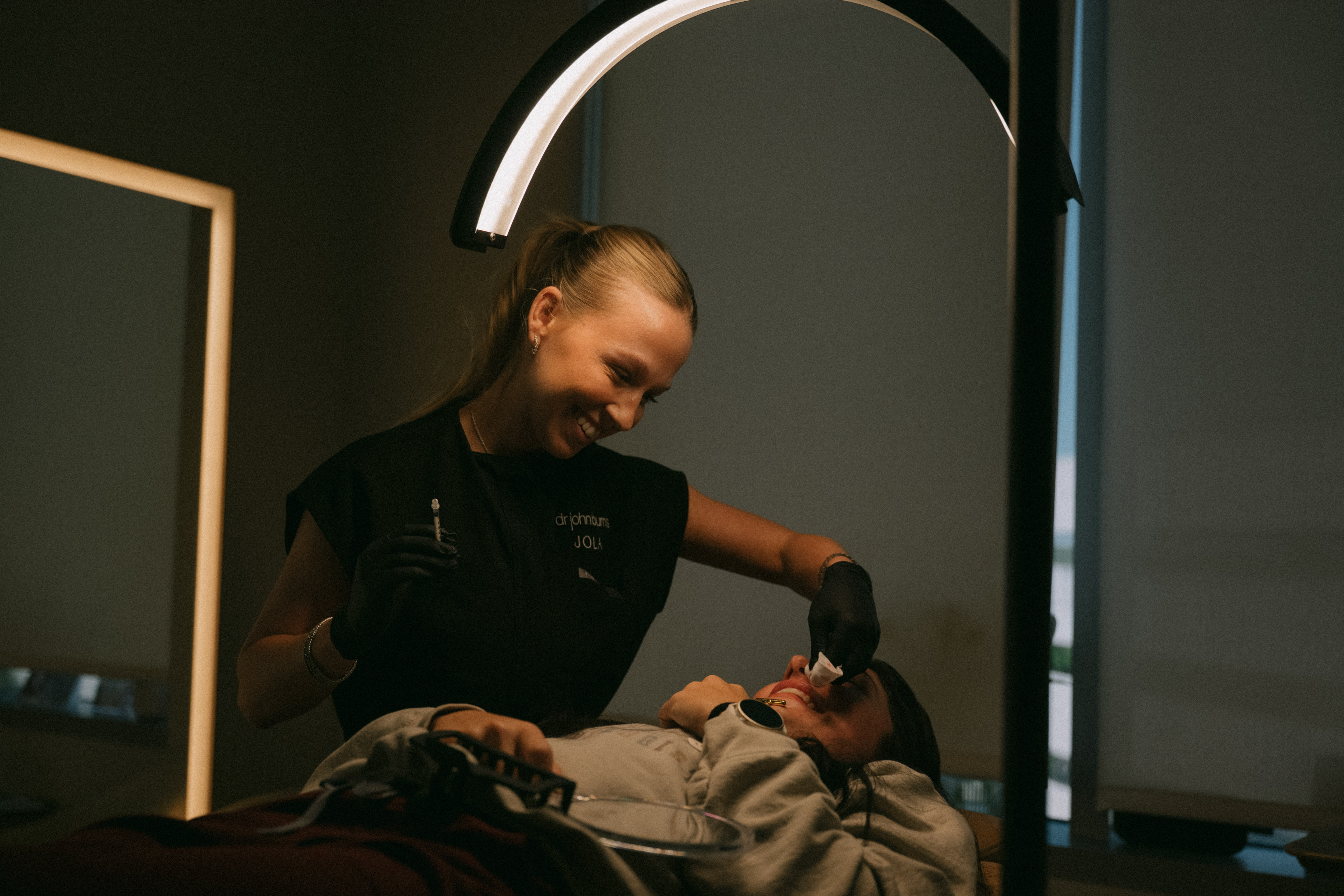
SYSTEM A
XERF
RADIOFREQUENCY
SYSTEM B
THERMAGE FLX
RADIOFREQUENCY
SAME FAMILY.
DIFFERENT SYSTEM.
Understanding what actually separates two non-invasive RF skin-tightening technologies.
01 / THE 30-SECOND ANSWER
XERF vs. Thermage FLX: What’s the Difference in RF Skin Tightening?
WHAT IS THE DIFFERENCE BETWEEN XERF AND THERMAGE?
Both XERF and Thermage FLX are non-invasive radiofrequency (RF) skin-tightening technologies, but they are different RF systems. XERF, by Cynosure Lutronic, is a multifrequency monopolar RF device combining 6.78 MHz and 2 MHz frequencies. Thermage FLX, by Solta Medical, is a monopolar, capacitively coupled RF system using approximately 6 MHz with an integrated vibration feature. They differ in RF architecture, delivery method, cooling, comfort technology, and typical treatment protocol. Neither is universally better — the appropriate choice depends on treatment area, anatomy, desired outcome, and clinical assessment.
XERF
CATEGORY
Radiofrequency
SYSTEM
Multifrequency monopolar RF (6.78 MHz + 2 MHz)
THERMAGE FLX
CATEGORY
Radiofrequency
SYSTEM
Monopolar, capacitively coupled RF (~6 MHz) with vibration
SAME ENERGY FAMILY. DIFFERENT ENGINEERING.
For patients in Dallas and Highland Park researching xerf vs thermage, the most important thing to understand is this: these two treatments use the same underlying energy family — radiofrequency — but they are not the same treatment. Radiofrequency is a category, not a single device. XERF vs Thermage FLX is not a question of which RF machine wins. It is a question of which RF architecture fits the concern, the treatment area, and the patient’s anatomy.
Same family. Different system.
02 / SIDE-BY-SIDE
The Side-by-Side Comparison
| SPECIFICATION | XERF | THERMAGE FLX |
|---|---|---|
| MANUFACTURER | Cynosure Lutronic | Solta Medical |
| TECHNOLOGY | Radiofrequency (RF) | Radiofrequency (RF) |
| RF CONFIGURATION | Multifrequency monopolar RF | Monopolar, capacitively coupled RF |
| VERIFIED FREQUENCY | 6.78 MHz + 2 MHz (dual) | Approximately 6 MHz (monopolar) |
| ENERGY DELIVERY | Dual-frequency delivery at multiple depths | Capacitive coupling via treatment tip |
| COOLING | Built-in cryogen cooling (up to 12 bursts per pass) | Integrated cryogen cooling via treatment tip |
| COMFORT TECHNOLOGY | Cryogen cooling pulses | Vibration integrated into handpiece (face/body) |
| FACE | Supported | FDA-cleared |
| JAWLINE | Commonly treated | Commonly treated |
| NECK | Commonly treated | Commonly treated |
| EYE AREA | Verify current supported zones with provider | FDA-cleared eyelid tip (specific tip) |
| BODY | Verify current supported zones with provider | FDA-cleared for body areas |
| TREATMENT DURATION | Varies by area and protocol | Varies by area; often cited ~45–90 min depending on area |
| TYPICAL TREATMENT NUMBER | Typically performed as a series | Typically positioned as a single treatment |
| DOWNTIME | Minimal; temporary effects possible | Minimal; temporary effects possible |
| RESULTS ONSET | Gradual over weeks to months | Gradual over weeks to months |
| CONSUMABLES | Treatment tips per protocol | Treatment tips with defined pulse counts |
| MAJOR STRENGTH | Dual-frequency depth flexibility | Established single-treatment protocol with vibration comfort |
| MAJOR LIMITATION | Not a surgical replacement; not for volume loss | Not a surgical replacement; not for volume loss |
VERIFIED AS OF PUBLICATION. MANUFACTURER SPECIFICATIONS AND REGULATORY CLEARANCES MAY CHANGE. ALWAYS CONFIRM CURRENT INFORMATION WITH A QUALIFIED PROVIDER.
03 / WHAT IS RADIOFREQUENCY SKIN TIGHTENING
First: What Is Radiofrequency Skin Tightening?
Radiofrequency (RF) skin tightening uses electromagnetic energy in the radiofrequency range to create a controlled thermal effect in tissue. When RF energy passes through tissue, the tissue’s natural resistance to the electrical current produces heat. That heat, delivered at controlled temperatures, is intended to stimulate a biological response in collagen and supporting tissue — a response associated with collagen remodeling and, over time, firmer-looking skin.
But RF is a category, not a single treatment. Non-invasive RF (like XERF and Thermage FLX) delivers energy through the surface of the skin without needles. RF microneedling (like Morpheus8) uses needles to deliver RF energy into the deeper dermis. Different RF systems use different frequencies, electrode configurations, delivery methods, cooling technologies, and protocols. Two devices can both be “RF” and still produce meaningfully different treatment experiences.
“RF” TELLS YOU THE ENERGY FAMILY. IT DOES NOT TELL YOU THE ENTIRE TREATMENT.
THE RF FAMILY
RADIOFREQUENCY
↓
NON-INVASIVE RF
XERF · Thermage
RF MICRONEEDLING
Morpheus8 & similar systems
SAME ENERGY FAMILY. DIFFERENT DELIVERY. DIFFERENT TREATMENT EXPERIENCE. DIFFERENT DECISION.
SIMPLIFIED EDUCATIONAL FRAMEWORK
04 / WHAT IS XERF
What Is XERF?
XERF is a non-invasive skin-tightening system manufactured by Cynosure Lutronic. It is described as the world’s first multifrequency monopolar radiofrequency treatment, combining two distinct frequencies — 6.78 MHz and 2 MHz — in a single device. The 6.78 MHz frequency addresses more superficial layers, while the 2 MHz frequency reaches deeper structural tissue, including the fibrous septa. This dual-frequency design allows energy delivery at multiple tissue depths rather than a single fixed depth.
XERF incorporates built-in cryogen cooling that delivers a cooling pulse with each energy pass, supporting patient comfort. The treatment is non-invasive, requires no needles, and is generally performed as a series of sessions. Results develop gradually as collagen remodeling progresses. For a full overview, see XERF at JOLA Dallas and What Is XERF?.
05 / WHAT IS THERMAGE FLX
What Is Thermage FLX?
Thermage FLX is a non-invasive skin-tightening system manufactured by Solta Medical. It is a monopolar, capacitively coupled radiofrequency system, commonly cited as operating at approximately 6 MHz. The system delivers RF energy through a treatment tip using capacitive coupling, with integrated cryogen cooling to protect the skin surface. The FLX platform incorporates a vibration feature on face and body treatments, which the manufacturer states is designed to aid patient comfort.
Thermage FLX is FDA-cleared for facial, eyelid, and body treatments, and is typically positioned by the manufacturer as a single-treatment procedure, though maintenance sessions may be discussed. Treatment tips are designed to deliver a specific number of pulses. JOLA Dallas does not imply that it offers Thermage; this section is provided for educational comparison only.
06 / RF ARCHITECTURE
Monopolar RF, Dual-Frequency RF and Why the Words Matter
RF devices are often described by their electrode configuration. Monopolar RF uses a single treatment electrode with a return path elsewhere on the body, allowing energy to pass through tissue. Bipolar RF uses two electrodes close together, confining energy to a smaller area. Multipolar systems combine multiple electrodes. Dual-frequency RF — as in XERF — combines two distinct frequencies in a single monopolar system to target different depths.
These terms matter because they describe how energy is delivered, not whether one is superior. Frequency, electrode configuration, energy delivery method, pulse architecture, cooling, and treatment protocol all influence the treatment experience. No single architecture is automatically better than another — the relevant question is which architecture fits the treatment goal.
RF IS NOT ONE THING.
RF IS A CATEGORY. YOUR TREATMENT PLAN SHOULD BE MORE SPECIFIC.
EXPLORE AESTHETIC CONSULTATION07 / THE FREQUENCY QUESTION
Does RF Frequency Matter?
Frequency is one of several engineering variables that influence how RF energy interacts with tissue. XERF uses two verified frequencies — 6.78 MHz and 2 MHz — in a multifrequency monopolar configuration. Thermage FLX is commonly cited as operating at approximately 6 MHz monopolar RF. Frequency influences the depth and distribution of energy delivery, but frequency alone does not determine treatment quality.
It would be inaccurate to claim that a lower frequency is automatically better, or that a higher frequency is automatically better. The relevant question is whether the frequency profile — combined with the electrode configuration, delivery method, and protocol — fits the anatomical layer being treated. Frequency is a design choice, not a ranking.
08 / WHICH GOES DEEPER
Which Goes Deeper: XERF or Thermage?
There is no valid head-to-head measurement that establishes one device as definitively “deeper” in a clinically superior sense. XERF is designed to deliver energy at multiple tissue depths via its dual-frequency architecture (6.78 MHz and 2 MHz). Thermage FLX delivers volumetric heating through its capacitive coupling tip. These are different engineering approaches to depth, not a ranking.
Marketing graphics showing arrows extending to different depths are not sufficient evidence of superiority. Depth without context is just a number. What matters is whether the depth being targeted corresponds to the anatomical layer responsible for the patient’s concern.
DEPTH WITHOUT CONTEXT IS JUST A NUMBER.
09 / THE RF DEPTH MAP
The RF Depth Map
RF DEPTH MAP — CONCEPTUAL
SURFACE ↓
EPIDERMIS
Outer protective layer
DEPTH TARGET
DERMIS
Collagen- and elastin-rich layer
DEPTH TARGET
SUBCUTANEOUS TISSUE
Fat and supporting tissue
DEPTH TARGET
DEEPER SUPPORTING TISSUES
Structural layers including fibrous septa
DEPTH TARGET
SIMPLIFIED EDUCATIONAL DIAGRAM — NOT TO SCALE
10 / TEMPERATURE
Why Temperature Matters — and Why Online Numbers Can Mislead
Surface temperature, tissue temperature, target temperature, device readout, and treatment endpoint are not interchangeable. A number quoted online — “heats the skin to X degrees” — may refer to a surface measurement, a deep-tissue estimate, or a device setting, and comparing those numbers across devices without equivalent measurement conditions is misleading.
Per manufacturer documentation, XERF targets skin temperatures in the range of approximately 55–65°C, with cryogen cooling protecting the surface. Thermage FLX is described as volumetrically heating the dermis. These figures should not be compared as if they measure the same thing under the same conditions. Temperature is a treatment variable managed by the provider, not a marketing scoreboard.
11 / XERF VS THERMAGE FOR THE JAWLINE
XERF vs Thermage for the Jawline
Jawline softness is rarely a single-factor concern. It may involve skin laxity, early jowling, submental fullness, chin projection, mandibular structure, and volume changes in the overlying tissue. Xerf vs thermage for the jawline is therefore not a device-vs-device question first — it is an anatomy question first.
Both XERF and Thermage are commonly used for jawline-area skin tightening in appropriately selected patients. Neither device addresses bone structure or restores lost volume. If the primary contributor to a softer jawline is volume loss or structural anatomy, RF tightening alone will not produce the result the patient expects. A full assessment determines whether the concern is actually laxity. See XERF for Jawline Tightening, Jawline & Chin Sculpting, and Facial Balancing.
12 / XERF VS THERMAGE FOR JOWLS
XERF vs Thermage for Jowls
Neither XERF nor Thermage literally “removes” jowls. Jowling is multifactorial — it may involve skin laxity, ligamentous and tissue changes, volume shifts, skeletal relationships, and submental anatomy. RF skin tightening may address the skin-firmness component, but it should not be expected to eliminate jowls that are primarily driven by tissue position or structural change.
Comparing xerf vs thermage for jowls without first identifying the primary contributor to the jowling is a common mistake. The clinical assessment determines whether the concern is skin, volume, or structure before any device is considered. See XERF for Jowls.
13 / XERF VS THERMAGE FOR THE NECK
XERF vs Thermage for the Neck
Neck concerns may involve skin laxity, neck texture, the jaw-to-neck transition, platysmal muscle, and submental fullness. Both XERF and Thermage may be discussed for neck-area treatment in appropriately selected patients. Neither addresses muscle banding or significant fat. The clinical assessment determines which component is primary and whether energy-based treatment is appropriate.
Comfort, treatment area, and desired magnitude all influence the decision. See XERF for Neck Tightening.
14 / XERF VS THERMAGE FOR THE LOWER FACE
XERF vs Thermage for the Lower Face
Lower-face aging is not synonymous with loose skin. Possible contributors include skin laxity, volume loss, tissue position, chin structure, jaw structure, and muscle activity. RF skin tightening may address one component — the skin-firmness component — but it will not restore volume, reposition tissue, or change skeletal structure.
Patients comparing xerf thermage comparison for the lower face should first determine which anatomical layer is creating the concern. The device follows the diagnosis.
15 / XERF VS THERMAGE FOR THE EYE AREA
XERF vs Thermage Around the Eyes
The eye area should not be lumped into “eyes.” It includes the brow, upper eyelid, lower eyelid, periorbital region, and temple — each with distinct anatomy and safety considerations. Thermage FLX has a specific FDA-cleared eyelid treatment tip. XERF’s specific periorbital clearance scope should be verified with a provider.
Stating this difference clearly increases credibility: where one device has a verified, specific indication and the other does not have an equivalent, that is a factual distinction worth discussing with a qualified provider. See XERF Hooded Eyes / Eye Area.
16 / XERF VS THERMAGE FOR THE BODY
XERF vs Thermage for the Body
Thermage FLX is FDA-cleared for body areas. XERF’s specific body-treatment clearance should be verified with a provider. Body skin laxity — including the abdomen, arms, thighs, and knees — may be discussed with either system where supported. RF skin tightening should not be confused with body contouring or fat reduction unless specifically supported by the manufacturer. Neither device is a weight-loss or fat-reduction treatment.
17 / WHICH IS BETTER FOR COLLAGEN
Which Is Better for Collagen?
There should be no unsupported “collagen winner.” Both XERF and Thermage may create controlled thermal effects associated with collagen remodeling where supported by manufacturer documentation. However, there is no valid direct comparative evidence showing that one device produces “more collagen” than the other. Collagen response is biological, varies by individual, and is not a percentage to put on a scorecard.
COLLAGEN IS NOT A PERCENTAGE TO PUT ON A SCORECARD.
18 / DOES XERF MELT FAT
Does XERF Melt Facial Fat?
XERF is a skin-tightening treatment, not a fat-reduction device. Radiofrequency used for skin tightening should not be confused with technologies specifically designed for intentional fat destruction. Patients with low facial volume should discuss concerns during consultation. For a detailed discussion, see Does XERF Melt Facial Fat?.
19 / DOES THERMAGE MELT FAT
Does Thermage Melt Facial Fat?
Thermage FLX is not designed or marketed as a fat-reduction device. It uses monopolar RF for skin tightening and collagen remodeling. Patients concerned about facial volume should discuss this with a provider rather than generalizing from other RF devices or from technologies designed for intentional fat destruction. Each RF system should be discussed according to its own evidence.
20 / THIN FACES
Why People With Thin Faces Ask This Question
Patients with low facial volume — in the temples, midface, or lower face — are often appropriately cautious about any treatment that could affect facial fat. “Tightening” and “slimming” are not synonymous, but the concern is understandable. The assessment should consider baseline volume, skin laxity, treatment zone, and desired result. In some cases, volume restoration may be a more appropriate first conversation than skin tightening. See Does XERF Melt Facial Fat?.
21 / AFTER GLP-1 OR WEIGHT LOSS
XERF vs Thermage After GLP-1 or Weight Loss
Facial changes after GLP-1 medication use or significant weight loss may involve both skin laxity and volume loss. Neither XERF nor Thermage restores missing facial volume. If the primary concern is laxity after volume loss, energy-based tightening may be discussed. If the concern is volume itself, filler, Sculptra, or facial balancing may be more appropriate. See XERF After Weight Loss / GLP-1, XERF + Sculptra, and Facial Balancing.
22 / WHICH HURTS MORE
Which Hurts More: XERF or Thermage?
There is no reliable head-to-head pain comparison between XERF and Thermage. Comfort depends on the cooling system, vibration (in Thermage), individual pain tolerance, treatment area, device settings, and provider protocol. Both incorporate cooling technology. Neither should be called painless. Patients with comfort concerns should discuss options during consultation rather than relying on anecdotal comparisons.
23 / HOW XERF MANAGES COMFORT
How XERF Manages Comfort
XERF incorporates built-in cryogen cooling that delivers a cooling pulse with each energy pass, supporting patient comfort. Per the manufacturer, numbing is generally not required for most patients. The sensation is typically described as warming rather than sharp pain. Individual tolerance, treatment area, and device settings all affect the experience.
24 / HOW THERMAGE MANAGES COMFORT
How Thermage FLX Manages Comfort
Thermage FLX includes integrated cryogen cooling and a vibration feature on face and body treatments. Per the manufacturer, the vibration has been shown to help aid patient comfort. The treatment-tip design and cooling work together with the vibration to manage the treatment experience. Individual tolerance and settings still apply.
25 / THE COMFORT COMPARISON
The Comfort Comparison
XERF
Energy delivery
Cryogen cooling
Treatment protocol
THERMAGE FLX
Energy delivery
Cryogen cooling
Vibration (face/body)
Treatment protocol
COMFORT IS A SYSTEM. NOT A SINGLE FEATURE.
26 / DOWNTIME
Which Has More Downtime?
Both XERF and Thermage FLX are positioned as having minimal to no downtime. It is important to distinguish true downtime — time away from normal activities — from temporary treatment effects. Possible temporary effects include mild redness, swelling, tenderness, or warmth, which typically resolve within hours. Neither requires recovery time in the traditional sense, but individual responses vary.
27 / HOW LONG DOES XERF TAKE
How Long Does XERF Take?
XERF treatment time varies by treatment area, protocol, and individual plan. The procedure is performed in-office and does not require numbing for most patients. Specific duration depends on the provider’s protocol and the areas being treated.
28 / HOW LONG DOES THERMAGE TAKE
How Long Does Thermage Take?
Thermage FLX treatment time varies by area; it is often cited as approximately 45 to 90 minutes depending on the treatment area and the treatment tip used. Specific duration depends on the provider’s protocol. Shorter is not inherently better — the relevant question is whether the protocol fits the treatment goal.
29 / HOW MANY XERF TREATMENTS
How Many XERF Treatments Do You Need?
XERF is typically performed as a series of treatments. The exact number depends on the patient’s anatomy, degree of laxity, treatment area, and goals. The protocol is determined by the provider during consultation. There is no universal number that applies to all patients. See How Many XERF Treatments Do You Need?.
30 / HOW MANY THERMAGE TREATMENTS
How Many Thermage Treatments Do You Need?
Thermage FLX is positioned by the manufacturer as a single-treatment procedure. However, some patients and providers discuss maintenance or additional sessions depending on individual response and goals. Treatment count should not be turned into a superiority claim — a single-treatment protocol and a series protocol are different design choices, not a quality ranking.
31 / WHEN DO XERF RESULTS APPEAR
When Do XERF Results Appear?
XERF results develop gradually. Some patients notice initial improvement in skin firmness within weeks. Peak results typically become visible over months as collagen remodeling progresses. Results are not immediate and develop progressively following the treatment course. See When Will You See XERF Results?.
32 / WHEN DO THERMAGE RESULTS APPEAR
When Do Thermage Results Appear?
Per the manufacturer, Thermage results develop gradually and may continue improving over several months as collagen production is stimulated. Initial changes may be noticeable within weeks, with progressive improvement over the following months.
33 / RESULTS TIMELINE
XERF vs Thermage Results Timeline
RESULTS TIMELINE — CONCEPTUAL
TREATMENT DAY
XERFTreatment performed; temporary warmth or flushing possible
THERMAGETreatment performed; temporary warmth or flushing possible
EARLY PERIOD
XERFInitial perception of firmness may be noticed
THERMAGEInitial perception of firmness may be noticed
WEEKS
XERFProgressive collagen remodeling continues
THERMAGEProgressive collagen remodeling continues
MONTHS
XERFContinued maturation of results over the treatment course
THERMAGEContinued maturation; results may develop over several months
MAINTENANCE
XERFMaintenance discussed as part of long-term plan
THERMAGEMaintenance discussed as part of long-term plan
CONCEPTUAL — INDIVIDUAL RESPONSE VARIES
34 / HOW LONG DO RESULTS LAST
How Long Do Results Last?
Result longevity for both XERF and Thermage depends on baseline laxity, age, treatment area, biological response, protocol, ongoing aging, maintenance, and other treatments. No exact duration can be guaranteed for either device. Maintenance should be discussed with a provider as part of a long-term plan. See How Long Do XERF Results Last?.
35 / BEFORE AND AFTER PHOTOS
XERF vs Thermage Before and After Photos
Before-and-after photos are only meaningful when the conditions are comparable. Look for the same angle, same lighting, same expression, same head position, same focal length, same time point, no makeup or contouring differences, and no concurrent treatments. A photo set that changes multiple variables at once cannot tell you what the treatment did.
A BEFORE-AND-AFTER PHOTO IS DATA ONLY IF THE CONDITIONS ARE COMPARABLE.
36 / IS XERF NEWER
Is XERF “Newer” Than Thermage?
Thermage is an established RF platform with a longer market history; XERF is a more recently introduced multifrequency monopolar RF system. But newer does not automatically mean better, and older does not automatically mean outdated. Technology should be evaluated based on engineering, evidence, indication, safety, treatment fit, and clinical application — not on launch date alone.
37 / IS XERF THE NEW THERMAGE
Is XERF the “New Thermage”?
That description is too simplistic. Both involve radiofrequency, but XERF should be understood as its own platform — a multifrequency monopolar RF system by Cynosure Lutronic — rather than simply a replacement generation of Thermage. The two systems use different RF architectures, different delivery methods, different cooling and comfort technologies, and different protocols. Calling XERF “the new Thermage” obscures the engineering differences that actually matter for treatment planning.
38 / IS XERF A THERMAGE ALTERNATIVE
Is XERF a Thermage Alternative?
XERF can belong to the same non-invasive RF skin-tightening decision set for certain concerns, making it a reasonable Thermage alternative Dallas patients might consider. However, “alternative” does not mean identical. The RF architecture, frequency profile, delivery method, comfort technology, and protocol differ. What must be compared is whether the technology fits the concern — not whether the brand names are interchangeable.
39 / VS SOFWAVE
XERF vs Thermage vs Sofwave
XERF
Radiofrequency
THERMAGE
Radiofrequency
SOFWAVE
Ultrasound
XERF and Thermage both use radiofrequency; Sofwave uses ultrasound. The energy category differs. See XERF vs Sofwave.
40 / VS ULTHERAPY
XERF vs Thermage vs Ultherapy
XERF
Radiofrequency
THERMAGE
Radiofrequency
ULTHERAPY
Microfocused ultrasound (MFU-V)
XERF and Thermage use radiofrequency; Ultherapy uses microfocused ultrasound with visualization to target specific depths including the SMAS. See XERF vs Ultherapy.
41 / VS MORPHEUS8
XERF vs Thermage vs Morpheus8
XERF
Non-invasive RF
THERMAGE
Non-invasive RF
MORPHEUS8
RF microneedling
The key difference is invasiveness — Morpheus8 uses needles to deliver RF energy into the deeper dermis, while XERF and Thermage do not. See XERF vs Morpheus8.
42 / VS FACELIFT
XERF vs Thermage vs Facelift
Energy-based skin tightening and surgical tissue repositioning are fundamentally different. A facelift surgically repositions tissue; XERF and Thermage stimulate collagen and skin firmness without surgery. Neither should be positioned as a facelift replacement without qualification. See XERF vs Facelift.
43 / VS SCULPTRA
XERF vs Thermage vs Sculptra
XERF and Thermage are energy-based RF treatments; Sculptra is an injectable biostimulator that works through a biological mechanism rather than energy. They address different layers and different concerns. See XERF vs Sculptra and XERF + Sculptra.
44 / VS FILLER
XERF vs Thermage vs Filler
RF (XERF, Thermage) is a skin-firmness conversation. Filler is a volume and structural conversation. Neither is universally better — they address different concerns. See Facial Balancing.
45 / WHAT IF IT ISN’T LOOSE SKIN
What If Your Problem Isn’t Actually Loose Skin?
YOU SAY: “MY JAWLINE ISN’T SHARP.”
POSSIBLE CONTRIBUTORS:
Skin · Jowls · Chin · Jaw structure · Submental fullness · Volume
YOU SAY: “MY FACE IS FALLING.”
POSSIBLE CONTRIBUTORS:
Skin · Volume · Tissue position · Structure
YOU SAY: “MY NECK IS AGING.”
POSSIBLE CONTRIBUTORS:
Skin · Muscle · Fat · Texture · Tissue position
THE BEST RF DEVICE CANNOT SOLVE A PROBLEM THAT ISN’T PRIMARILY AN RF PROBLEM.
46 / THE RF DECISION MAP
The RF Decision Map
THE RF DECISION MAP
MY SKIN FEELS LESS FIRM
↓
RF may enter the conversation
MY FACE LOOKS HOLLOW
↓
Explore Facial Balancing · Sculptra
MY JAWLINE LOOKS SOFTER
↓
Determine: skin? jowling? structure? fullness?
MY NECK LOOKS LOOSE
↓
Determine: skin? muscle? fullness?
MY TEXTURE / PIGMENT BOTHERS ME
↓
Explore Laser Treatments · Skin Health
I WANT A DRAMATIC LIFT
↓
Discuss limits of non-invasive RF
I DON’T KNOW WHAT I NEED
↓
Aesthetic Consultation
EDUCATIONAL ONLY — NOT A CANDIDACY TOOL
DON’T START WITH THE MACHINE. START WITH WHAT YOU WANT TO CHANGE.
EXPLORE XERF AT JOLA47 / THE JOLA RF FRAMEWORK
The JOLA RF Framework
THE JOLA RF FRAMEWORK
BEFORE CHOOSING AN RF DEVICE:
IDENTIFY THE CONCERN
↓IDENTIFY THE ANATOMICAL LAYER
↓CONFIRM RF IS RELEVANT
↓IDENTIFY THE TREATMENT AREA
↓DEFINE THE DESIRED MAGNITUDE
↓UNDERSTAND THE TECHNOLOGY
↓UNDERSTAND THE DEPTH
↓UNDERSTAND COMFORT
↓UNDERSTAND LIMITATIONS
↓THEN CHOOSE THE DEVICE
RF IS THE TOOL. THE TREATMENT PLAN IS THE STRATEGY.
48 / WHY JOLA CHOSE XERF
Why JOLA Chose XERF
JOLA selected XERF because its non-invasive multifrequency monopolar RF architecture fits JOLA’s consultation-led, anatomy-first treatment philosophy. The dual-frequency design allows energy delivery at multiple tissue depths, which supports treatment planning across different concerns. XERF’s built-in cryogen cooling supports patient comfort, and the platform integrates with JOLA’s broader treatment-planning approach, where energy-based tightening may complement other categories where appropriate. JOLA does not claim XERF is the “best RF device,” the “most powerful RF,” or “better than Thermage” — those claims require direct comparative evidence that does not exist.
49 / CHEY COPE
The RF Treatment Perspective
THE RF TREATMENT PERSPECTIVE
Chey Cope — Laser Specialist, JOLA Dallas
Choosing an energy-based treatment requires evaluating skin quality, degree of laxity, facial volume, jawline and neck structure, treatment history (including previous filler, biostimulators, and energy treatments), desired magnitude, comfort preferences, and downtime preferences. The device follows the diagnosis — not the other way around.
At JOLA Dallas, every RF conversation begins with a full assessment. The question is never “which RF machine is stronger?” — it is “what are you actually trying to change, and which technology fits that concern?”
50 / WHERE XERF MAY FIT
Where XERF May Be the More Logical Conversation
XERF may be particularly relevant when the concern involves skin firmness in a supported treatment area, the patient prefers non-invasive treatment, the dual-frequency depth profile fits the treatment goal, the expected magnitude aligns with what the device can realistically produce, and a JOLA clinical assessment supports candidacy. XERF’s multifrequency design may be relevant when the concern involves both surface skin quality and deeper structural support.
51 / WHERE THERMAGE MAY FIT
Where Thermage May Be the More Logical Conversation
Thermage FLX may be particularly relevant when a patient’s concern aligns with one of its verified FDA-cleared indications — particularly the eyelid treatment tip, which is a specific indication where the technologies differ in regulatory clearance. Thermage’s single-treatment protocol positioning and integrated vibration comfort feature may also suit patients who prefer a single-session approach. This transparency is strategically important — it builds trust and positions JOLA as a practice willing to explain where technologies genuinely differ, even when the answer is not the device offered by the practice.
52 / WHEN NEITHER IS THE RIGHT QUESTION
When Neither XERF nor Thermage Is the Right Question
- ✕Volume loss
- ✕Structural deficiency
- ✕Significant fat concern
- ✕Pigmentation
- ✕Vascular concern
- ✕Dynamic wrinkles
- ✕Significant surgical laxity
- ✕Unrealistic expectations
- ✕No meaningful concern
THE MOST EXPENSIVE DEVICE IS STILL THE WRONG DEVICE IF THE DIAGNOSIS IS WRONG.
53 / CHECKLIST
Questions to Ask Before Any RF Skin-Tightening Treatment
What exactly am I trying to improve?
Is the concern actually skin laxity?
What anatomical layer is responsible?
Why is RF appropriate?
What type of RF does this device use?
What frequency does it use?
Why does that frequency matter?
How is energy delivered?
What depth is being targeted?
Is deeper actually beneficial for my concern?
How is the skin cooled?
What should treatment feel like?
What areas can this device treat?
Is my exact area supported?
What magnitude of change is realistic?
What will RF not change?
Is fat reduction intended?
Could facial volume affect the result?
How many treatments are commonly discussed?
When should results be evaluated?
What temporary effects are expected?
Is there downtime?
How is maintenance approached?
Does previous filler matter?
Does previous Sculptra matter?
Does previous RF matter?
Does previous ultrasound matter?
Would another category make more sense?
Am I expecting a surgical result?
Why is THIS RF technology appropriate for MY anatomy?
54 / THE BOTTOM LINE
XERF vs. Thermage FLX: The Bottom Line
XERF and Thermage FLX are both radiofrequency technologies, but they are not identical systems. RF is a category, not a single treatment. RF configuration matters — XERF is multifrequency monopolar RF; Thermage FLX is monopolar, capacitively coupled RF. Frequency may matter, but frequency alone does not determine quality. Energy delivery matters. Cooling matters. Treatment protocol matters. Supported treatment areas matter.
Deeper is not automatically better. Hotter is not automatically better. Newer is not automatically better, and older is not automatically outdated. Collagen should not be treated as a marketing scoreboard. Neither device automatically “removes jowls.” Jawline concerns are multifactorial. Neck concerns are multifactorial. Neither restores missing volume. Neither creates skeletal structure. Neither should automatically be positioned as a facelift replacement.
Thin faces require thoughtful planning. Weight-loss changes may involve both skin and volume. Comfort varies. Downtime should be compared accurately. Results take context. Before-and-after photography must be interpreted carefully. XERF may be a Thermage alternative for some patients, but alternative does not mean identical. Some patients may need another treatment category. Some may need surgery. Some may need no treatment at all.
If you are deciding between XERF and Thermage, do not stop at “They’re both RF.” Ask: What type of RF? Where is the energy going? What is the treatment trying to change? And does that match my anatomy? That is where a useful comparison begins.
THE RIGHT TECHNOLOGY STARTS WITH THE RIGHT QUESTION.
BOOK A JOLA CONSULTATION214.515.0002 / info@joladallas.com
NOT ALL SKIN TIGHTENING IS THE SAME

FAQ
Frequently Asked Questions
Begin Your RF Skin-Tightening Consultation in Dallas
JOLA Dallas offers consultation-led, anatomy-first structural skin tightening for patients in Dallas, Highland Park, University Park, Preston Hollow, and the Park Cities. Begin with an honest clinical conversation about what your face actually needs — and which technology, if any, is the right path forward.
BEGIN CONSULTATION