

JOLA DALLAS / TECHNOLOGY EDITORIAL
XERF vs.
ULTHERAPY
Two technologies. Different energy. A more intelligent way to compare skin tightening.
JOLA DALLAS / AUGUST 2026
18 MIN READ
What is the difference between XERF vs Ultherapy? XERF and Ultherapy are both non-invasive energy-based treatments that may enter conversations about skin firmness, but they use different forms of energy. XERF uses radiofrequency technology. Ultherapy uses microfocused ultrasound with visualization. Their energy delivery, treatment characteristics, and patient experience differ. Neither is universally better — the appropriate option depends on the treatment area, anatomy, degree and type of laxity, patient goals, device protocol, contraindications, and provider assessment.
In Dallas and Highland Park, patients researching non surgical skin tightening Dallas increasingly encounter both names. Ultherapy has significant consumer awareness built over years of clinical use. XERF — a radiofrequency platform that is newer to many patient conversations — is now entering the same consideration set. The result is a natural and important question: XERF or Ultherapy? This guide explains how the technologies differ, what each may address, and why the more useful question is not "which is better" but "which technology fits my face."
At JOLA Dallas, device selection never begins with a brand preference. It begins with anatomy. Whether you are in University Park, Preston Hollow, or the Park Cities, the conversation should start with what you actually see — and what anatomical change is causing it — before any technology enters the plan.
SECTION 01
The 30-Second Answer
XERF
- ENERGY
- Radiofrequency
- CATEGORY
- Non-invasive energy-based treatment
- PRIMARY CONVERSATION
- Skin firmness / laxity
ULTHERAPY
- ENERGY
- Microfocused ultrasound
- CATEGORY
- Non-invasive energy-based treatment
- PRIMARY CONVERSATION
- Lifting / tightening per approved indications
Same category. Different technology.
The word "skin tightening" does not make two devices the same.
SECTION 02
Why Patients Are Comparing XERF and Ultherapy
Ultherapy has been part of the aesthetic conversation for years. Many patients in Dallas first learned about non-invasive skin tightening through Ultherapy's presence in consumer media and clinical practices. When a newer radiofrequency platform like XERF enters that same conversation, the natural question becomes: "Is XERF the new Ultherapy?"
The honest answer is that newer does not automatically mean better, and older does not automatically mean obsolete. The correct comparison is not chronological — it is technological and anatomical. XERF and Ultherapy use different forms of energy, interact with tissue through different mechanisms, and may be suited to different treatment scenarios. Understanding XERF vs Ultherapy requires understanding radiofrequency vs ultrasound skin tightening — not simply asking which device arrived most recently.
SECTION 03
RF vs Ultrasound: The Simple Explanation
Radiofrequency vs ultrasound skin tightening is a comparison of two different physical energy modalities. XERF uses radiofrequency energy — electromagnetic energy that generates controlled heat in tissue. Ultherapy uses microfocused ultrasound energy — focused sound waves that deposit energy at specific tissue depths. These are not brand names for the same thing. They are fundamentally different energy types that interact with tissue through different mechanisms.
This distinction matters because the energy modality influences delivery characteristics, treatment experience, protocol, and potentially the type of tissue response. A patient exploring RF vs ultrasound skin tightening should understand that the choice is not between two versions of the same technology — it is between two different energy categories that happen to share a general clinical goal.
RF and ultrasound are not brand names for the same thing. They are different energy modalities.
SECTION 04
How XERF Works
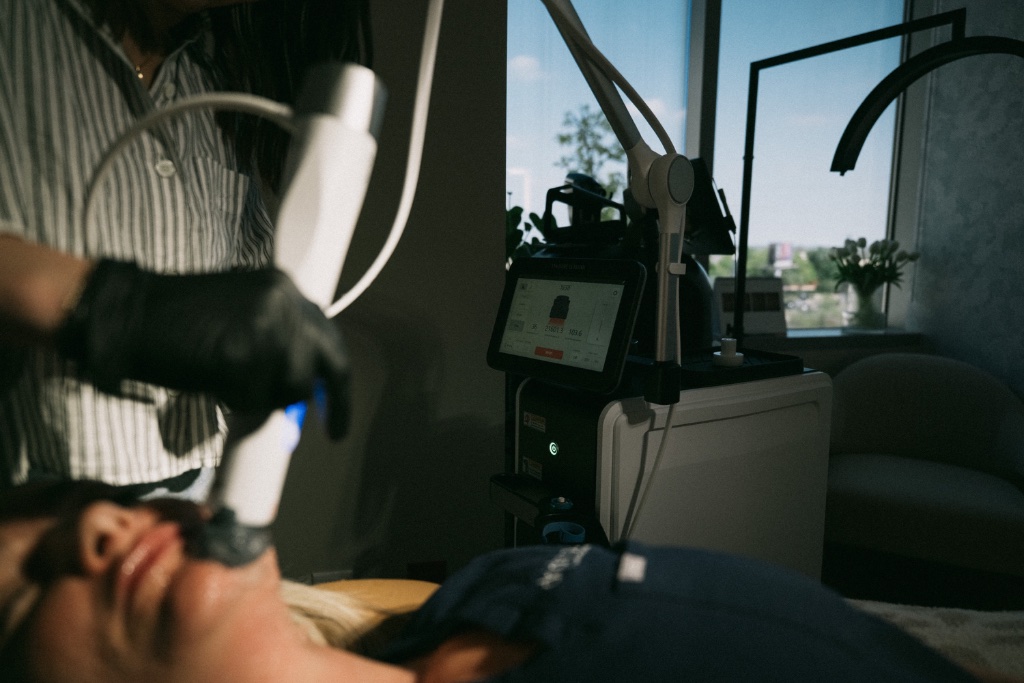
XERF is a radiofrequency skin-tightening platform. According to the manufacturer, it uses multifrequency monopolar RF energy designed to deliver controlled thermal energy into tissue. RF energy generates heat in the treatment zone, which is associated with collagen-related tissue response and gradual skin-firmness improvement over time. XERF is typically performed as a series of sessions and is positioned around structural skin firmness rather than immediate volumetric correction.
XERF is non-invasive — no incisions, no needles. Patients can generally return to their regular activities after treatment. For a deeper explanation of the platform, see What Is XERF? and the XERF Dallas treatment page. It is important to note that XERF is a skin-firmness treatment — it does not replace volume, restructure bone, or address concerns that are not related to skin laxity.
SECTION 05
How Ultherapy Works
Ultherapy is a branded microfocused ultrasound system — specifically, microfocused ultrasound with visualization (MFU-V). It uses focused ultrasound energy to deposit thermal energy at targeted tissue depths, with built-in visualization that allows the provider to see the treatment zone during delivery. According to the manufacturer and current regulatory information, Ultherapy is indicated for lifting and tightening skin on specific areas including the neck, under the chin, and eyebrow, and for improving lines and wrinkles on the décolletage.
Ultherapy is typically performed as a single treatment per its protocol, with results developing gradually over weeks to months. It is important to note that JOLA Dallas offers XERF as part of its treatment portfolio. This article does not imply that JOLA offers Ultherapy. Patients interested in Ultherapy should verify availability with a qualified provider.
SECTION 06
Is Ultherapy the Same as HIFU?
"HIFU" — high-intensity focused ultrasound — is a term often used broadly online for focused ultrasound aesthetic devices. However, Ultherapy is a specific branded microfocused ultrasound system with its own proprietary technology, built-in tissue visualization, regulatory clearances, and treatment protocols. It should not be casually treated as identical to every device labeled "HIFU" online.
When patients search XERF vs HIFU, they may be comparing radiofrequency to a general category of focused ultrasound devices. The distinction between branded platforms like Ultherapy and the broader HIFU category matters because device-specific technology, visualization, and regulatory status influence treatment characteristics. Not all ultrasound devices are the same, and not all focused ultrasound treatments are Ultherapy.
SECTION 07
The Energy Map
The conceptual framework below summarizes how the two energy modalities differ at a high level — in energy type, delivery, patient experience, clinical goal, and protocol. Device choice should involve more than marketing labels.
01 / ENERGY TYPE
Radiofrequency
XERF
- DELIVERY
- RF energy delivered through the skin surface into tissue
- EXPERIENCE
- Generally described as a warming sensation
- CLINICAL GOAL
- Skin firmness and structural support
- PROTOCOL
- Typically performed as a series of sessions
02 / ENERGY TYPE
Microfocused Ultrasound
ULTHERAPY
- DELIVERY
- Focused ultrasound energy with visualization
- EXPERIENCE
- Sensation varies by individual and treatment area
- CLINICAL GOAL
- Lifting and tightening per approved indications
- PROTOCOL
- Typically performed as a single treatment per protocol
DEVICE CHOICE SHOULD INVOLVE MORE THAN MARKETING LABELS — TREATMENT AREA, ANATOMY, AND CLINICAL GOAL MUST GUIDE SELECTION
DON'T CHOOSE THE DEVICE YET
Understand your anatomy first.
Explore Aesthetic Consultation→SECTION 08
What Does "Depth" Actually Mean?
Patients researching skin-tightening devices frequently encounter the concept of treatment depth. A common assumption is that "deeper is better." This is a misconception worth addressing directly. Different technologies are designed to deliver energy differently — and the deepest device is not automatically the best device.
Treatment depth should correspond to the target tissue, the anatomy of the treatment area, the device's design, and the clinical goal. A treatment that delivers energy deeply into tissue is not inherently superior to one that targets a different depth — it depends on what the patient's concern actually requires. Publishing numerical depth claims without verified primary-source information would be irresponsible. What matters is whether the energy reaches the tissue that needs to be addressed.
Deeper is not a beauty goal. Precision is.
SECTION 09
Which Treatment Is More Comfortable?
Comfort is one of the most searched aspects of XERF vs Ultherapy. It is also one where responsible language matters most. XERF is generally described by patients as producing a warming sensation. Ultherapy delivers focused ultrasound energy, and sensation varies by individual, treatment area, and protocol. No energy-based treatment should be universally called painless, and discomfort should not be exaggerated to make one device look better than another.
Treatment comfort depends on device settings, energy delivery, treatment protocol, individual sensitivity, treatment area, and provider technique. If manufacturer-supported XERF comfort features exist, they should be described precisely — not through invented pain scales. The most accurate comfort information comes from a consultation that considers your specific treatment plan.
SECTION 10
Does XERF Hurt?
XERF is generally described as producing a warming sensation rather than significant discomfort. Most patients tolerate the treatment well and return to their routine afterward. However, individual experience varies based on treatment settings, area treated, and personal sensitivity. No universal comfort promise should be made. Patients should discuss what to expect with their provider during consultation. For more on the treatment experience, see XERF Safety & Side Effects.
SECTION 11
Does Ultherapy Hurt?
Ultherapy delivers focused ultrasound energy, and sensation varies by individual, treatment area, and protocol. Some patients report discomfort during treatment, while others tolerate it well. Discomfort should not be exaggerated to make another device look better — that would be irresponsible and would not serve the patient. Patients should discuss comfort management options and expectations with a qualified provider before treatment.
SECTION 12
XERF vs Ultherapy Downtime
Both XERF and Ultherapy are designed as non-invasive treatments without required downtime. Mild, temporary effects such as warmth, flushing, or slight tenderness may occur after either treatment, typically resolving within hours. Individual responses vary based on treatment settings, area, and personal sensitivity. Blanket "zero downtime" claims should be verified with current manufacturer information. For XERF-specific expectations, see Does XERF Have Downtime?.
SECTION 13
When Do XERF Results Appear?
XERF results develop gradually. Some patients notice a subtle improvement in skin firmness beginning several weeks after their first session. The most meaningful change typically becomes apparent over the weeks to months following a treatment course, as collagen-related tissue remodeling progresses. Results are progressive — not immediate. For a detailed timeline, see When Will You See XERF Results?.
SECTION 14
When Do Ultherapy Results Appear?
Per current manufacturer information, Ultherapy results develop gradually over weeks to months following treatment as collagen-related remodeling progresses. The treatment is typically performed as a single session per protocol, with progressive improvement becoming noticeable over the subsequent months. Timelines should not be distorted to favor one technology — both involve progressive biological responses rather than instant transformation.
SECTION 15
Which Works Faster?
"Faster" may not be the most useful comparison for XERF vs Ultherapy. Both treatments involve progressive biological responses — the treatment-day experience and the final expected result are different things. Collagen-related tissue remodeling takes time regardless of which energy modality is used. The more relevant question is not which device produces results fastest, but which technology fits the anatomy and concern being addressed. A fast result that does not address the right tissue is not a good result.
Fastest does not necessarily mean best match.
SECTION 16
Which Lasts Longer?
Longevity depends on the technology, treatment protocol, baseline anatomy, aging, skin quality, individual response, and maintenance strategy. A universal longevity comparison between XERF and Ultherapy cannot be responsibly claimed without considering these variables. Manufacturer-supported timelines should guide expectations. For XERF-specific longevity information, see How Long Do XERF Results Last?.
SECTION 17
How Many Treatments Do You Need?
XERF is typically performed as a series of sessions spaced according to the provider's recommended protocol. Ultherapy is typically performed as a single treatment per its protocol. However, "one treatment" and "one treatment plan" are not necessarily the same concept — individual plans may vary based on provider assessment and patient response. The exact treatment count for either should be determined through clinical consultation, not assumed from general guidelines. See How Many XERF Treatments Do You Need?.
SECTION 18
Jawline: XERF or Ultherapy?
A softer jawline can reflect skin laxity, jowling, chin structure, jaw structure, submental fullness, neck anatomy, volume changes, or tissue position. Therefore, neither XERF nor Ultherapy should be automatically selected simply because the patient says "jawline." The relevant question is what anatomical factor is driving the concern. If skin laxity is the primary factor, an energy-based tightening conversation may be appropriate. If volume loss or structural change is driving the softening, facial balancing may be more relevant.
For patients whose jawline concern is primarily skin laxity, XERF may be considered as part of a jawline tightening plan. The choice between technologies depends on the individual's anatomy and a clinical assessment — not on a device preference.
SECTION 19
Jowls: XERF or Ultherapy?
Jowling is multifactorial. Skin firmness may be one component, but jowls can also involve volume changes, tissue descent, and structural factors. Neither XERF nor Ultherapy should be presented as universally capable of correcting all jowling. For patients whose jowling includes a skin-laxity component, energy-based tightening may be part of the conversation. See XERF for Jowls for a detailed discussion of lower-face anatomy.
SECTION 20
Neck: XERF or Ultherapy?
Neck concerns can involve skin laxity, neck anatomy, platysmal activity, submental contour, skin quality, and tissue position. Energy-based treatment may fit selected concerns — particularly skin laxity — but should not be assumed for all neck aging. For patients whose neck concern involves skin firmness, XERF for neck tightening may be considered. The choice between technologies depends on which factor is driving the concern and a clinical assessment.
SECTION 21
Under the Chin: XERF or Ultherapy?
It is important to distinguish between skin laxity and submental fat or fullness. A skin-tightening device — whether RF or ultrasound — should not be automatically positioned as a fat-reduction treatment. If the concern is primarily submental fullness, a different treatment category may be more appropriate. If the concern is skin laxity under the chin, see XERF for Double Chin / Under-Chin Tightening for a detailed discussion.
SECTION 22
The Lower-Face Decision Map
MY LOWER FACE LOOKS HEAVIER
Start with the observation, not the device
EDUCATIONAL ONLY — NOT A CANDIDACY ASSESSMENT
JAWLINE, JOWLS AND NECK ARE NOT THE SAME CONCERN
Explore XERF Treatment Planning at JOLA.
Explore Treatment Planning→SECTION 23
Can XERF or Ultherapy Cause Facial Fat Loss?
This is one of the most important and carefully searched questions in the XERF vs Ultherapy conversation. Patients ask it because they have heard anecdotes — online or through friends — about energy-based treatments affecting facial volume. These concerns deserve thoughtful, evidence-based discussion, not dismissal or sensationalization.
Whether any energy-based device may affect facial volume depends on several factors: whether fat is the intended treatment target, possible tissue effects, poor treatment selection, device settings and protocol, facial anatomy, and individual response. Neither technology should be claimed to "never affect fat" unless that is supportable from primary sources. The responsible approach is to discuss your specific anatomy, concerns, and treatment history with a qualified provider. For a thorough discussion, see Does XERF Melt Facial Fat?.
SECTION 24
What If You Have a Thin Face?
A thin face is not automatically a contraindication, but it should not automatically determine device selection either. Facial volume, skin thickness, treatment zone, existing laxity, and desired outcome should all be considered. Some patients with thin faces may benefit more from volume-focused treatment — such as biostimulation or filler — rather than tightening. The right approach follows the anatomy.
The goal is not to tighten everything that can be tightened.
SECTION 25
What If You Already Have Filler?
Existing filler changes treatment planning. There is no universal waiting interval — the relevant factors are filler type, location, age of filler, treatment zone, energy modality, manufacturer guidance, and provider protocol. Patients should disclose their full treatment history during consultation so the plan can be designed appropriately. For how XERF fits with facial balancing, see XERF + Facial Balancing and Skin Tightening, Filler or Both?.
SECTION 26
What If You Have Sculptra?
Biostimulator history such as previous Sculptra should be disclosed during consultation. Sculptra works by stimulating collagen over time, and sequencing with energy-based treatment should follow individualized planning — not a universal rule. The provider considers treatment timing, area, and goals. See XERF + Sculptra and XERF vs Sculptra for the relationship between tightening and biostimulation.
SECTION 27
What If You Have Botox?
Botox and energy-based skin tightening address different categories — neuromodulation vs skin firmness. Sequencing should follow treatment area and protocol. Botox does not automatically preclude XERF, but the full treatment history should be disclosed. For more on how neuromodulators fit within a comprehensive plan, see Botox vs Dysport.
SECTION 28
Can You Get XERF After Ultherapy?
Previous energy-based treatment should be disclosed to your provider. The provider considers when it was performed, what area was treated, the response, any complications, current tissue condition, and current goals before recommending a plan. No universal interval should be invented — individualized assessment guides sequencing. The treatment history is part of the diagnosis, and the diagnosis should precede the device.
SECTION 29
Can You Get Ultherapy After XERF?
The same principle applies in reverse. Previous XERF or any energy-based treatment should be disclosed. The provider evaluates treatment history, tissue condition, current goals, and appropriate timing. No universal interval should be invented — assessment guides the plan. The face's treatment history is a clinical variable, not a checklist item.
SECTION 30
Should You Combine XERF and Ultherapy?
Two skin-tightening technologies are not automatically better than one. There should be a specific clinical reason for each component of a plan. Stacking technologies simply because they are available is not a treatment strategy — it is device accumulation. Whether combining makes sense depends on anatomy, goals, and provider judgment — not on technology availability.
More energy is not the same thing as a better plan.
SECTION 31
XERF vs Ultherapy After Weight Loss
After significant weight loss, patients may experience skin laxity, facial volume change, jowling, neck changes, and more visible skeletal structure. These are not all skin-tightening problems. XERF may fit when skin laxity is a factor, but volume restoration or facial balancing may be more relevant. For a detailed discussion, see XERF After Weight Loss / GLP-1 Face and XERF vs Sculptra.
SECTION 32
XERF vs Ultherapy in Your 30s
Age should not prescribe treatment. Some patients in their 30s have no meaningful skin laxity and may need neither device. "Not yet" is a legitimate expert recommendation. Prejuvenation should not mean using the strongest technology as early as possible — it should mean treating a real concern appropriately and avoiding unnecessary intervention. See XERF for Prejuvenation and Best Age to Start Aesthetic Treatments.
SECTION 33
XERF vs Ultherapy in Your 40s
Patients in their 40s may notice changes in skin firmness, lower-face contour, jawline definition, neck skin, and volume relationships. These are common — but not universal — changes. The anatomy should lead the conversation, not the age. Some 40-year-old patients have meaningful laxity; others do not. Treatment selection should follow what the face actually presents, not a demographic assumption.
SECTION 34
XERF vs Ultherapy in Your 50s and Beyond
Non-surgical treatments can still be appropriate in your 50s and beyond — but expectations matter. More advanced tissue repositioning may exceed what energy-based treatments can accomplish. It would be irresponsible to imply that surgery is inevitable based on age, and equally irresponsible to overstate what a non-surgical device can achieve. An honest consultation weighs the desired magnitude of change against what the technology can realistically accomplish. See XERF vs Facelift.
SECTION 35
XERF vs Ultherapy for Prejuvenation
Prejuvenation should not mean using the strongest technology as early as possible. It should mean treating a real concern appropriately and avoiding unnecessary intervention. For some patients, the right prejuvenation answer is a skincare plan — not an energy device. For others, early-stage tightening may make sense. See XERF for Prejuvenation.
SECTION 36
Which Is Better If You Don't Want Needles?
Both XERF and Ultherapy are non-invasive, non-injectable treatments. However, "no needles" does not establish candidacy. If the concern is actually volume or structure, choosing a device solely to avoid injectables may not address the concern — it may simply delay the right treatment. The honest approach is to diagnose the concern first, then determine whether a non-injectable device can address it.
SECTION 37
Which Is Better If You Don't Want Surgery?
Both technologies may enter non-surgical skin-tightening conversations, but neither should be presented as equivalent to surgical lifting. If the desired change requires substantial tissue repositioning, an energy device may not produce a surgical-level result. Non-surgical treatment has real limitations — and an honest provider will say so. See XERF vs Facelift.
SECTION 38
XERF vs Ultherapy Cost
Treatment cost is influenced by treatment area, protocol, provider, geography, number of sessions, maintenance, and what is included in the treatment plan. JOLA does not publish generic device-versus-device pricing, and this article does not invent competitor pricing. The cheapest session is not necessarily the cheapest treatment strategy — a plan that requires fewer sessions or addresses the concern more accurately may represent better value over time. For current XERF pricing, see How Much Does XERF Cost in Dallas? or consult JOLA Dallas directly.
SECTION 39
Is XERF Newer Than Ultherapy?
Ultherapy has been available longer and has significant consumer awareness. XERF is a more recently introduced radiofrequency platform. However, newer does not automatically mean better. The relevant comparison is technological and anatomical — which energy modality and device protocol fit the patient's specific concerns — not a launch date.
Newer tells you when a technology arrived.
It doesn't tell you whether it fits your face.
SECTION 40
Is XERF an Ultherapy Alternative?
For a patient broadly researching non-invasive skin tightening, XERF and Ultherapy may appear in the same decision set — so in that general sense, patients may consider XERF as part of the Ultherapy alternative Dallas conversation. However, they should not be framed as exact substitutes. They use different energy modalities with different delivery characteristics. Whether one is an appropriate alternative depends on the individual's anatomy, concern, and provider assessment — not on the assumption that all skin-tightening devices are interchangeable.
SECTION 41
XERF vs Ultherapy vs Thermage vs Sofwave
For a broader view of the device landscape: XERF uses radiofrequency. Thermage uses radiofrequency. Ultherapy uses microfocused ultrasound. Sofwave uses ultrasound-based technology. Each platform is distinct in its delivery approach, parameters, and clinical philosophy. This article focuses specifically on the XERF vs Ultherapy comparison. For the complete multi-device overview, read XERF vs Thermage vs Sofwave vs Ultherapy.
SECTION 42
"Which Device?" — What Are You Actually Trying to Change?
What are you actually trying to change?
Select the concern that best describes what you notice. The routing is educational — not a device recommendation.
EDUCATIONAL ONLY — NOT A DEVICE RECOMMENDATION OR CANDIDACY ASSESSMENT
SECTION 43
The Device Comparison Matrix
ENERGY TYPE
DELIVERY APPROACH
VISUALIZATION
TREATMENT EXPERIENCE
JAWLINE CONVERSATION
JOWL CONVERSATION
NECK CONVERSATION
SUBMENTAL CONVERSATION
DOWNTIME
RESULT TIMELINE
TREATMENT PLAN
EXISTING FILLER
CANDIDACY
DESCRIPTIVE ONLY — NOT A CANDIDACY ASSESSMENT OR DEVICE RECOMMENDATION
SECTION 44
The JOLA Device Framework
Don't start with "which machine is best?" Start with the diagnosis. Technology should follow the face — not the other way around.
WHAT DO I SEE?
WHAT ANATOMICAL CHANGE IS CAUSING IT?
IS THIS ACTUALLY A SKIN-FIRMNESS PROBLEM?
WHAT TISSUE / AREA NEEDS TO BE ADDRESSED?
WHAT MAGNITUDE OF CHANGE DO I WANT?
WHAT TECHNOLOGY FITS THAT GOAL?
WHAT ARE THE LIMITATIONS?
WHAT ELSE HAS ALREADY BEEN DONE TO THE FACE?
WHAT CAN WAIT?
DO I NEED A DEVICE AT ALL?
Technology should follow the diagnosis.
Not the other way around.
SIGNATURE GRAPHIC
Energy is not the outcome.
RF
↓ DEVICE
XERF
ULTRASOUND
↓ DEVICE
Ultherapy
↓
↓
OUTCOME
SECTION 45
When XERF May Enter the Conversation
XERF may be relevant when skin firmness is a concern, when lower-face laxity is part of the concern, when jawline or neck skin is part of the concern, when a patient wants a non-invasive RF approach, when the treatment area is appropriate, and when expectations align with non-surgical treatment. This is not a diagnosis — it is a description of when the technology may enter the conversation. See XERF Dallas for more.
SECTION 46
When Ultherapy May Enter the Conversation
Ultherapy may enter the conversation based on its current approved indications and technology — which include lifting and tightening on the neck, under the chin, and eyebrow, and improving lines and wrinkles on the décolletage. JOLA Dallas offers XERF as part of its treatment portfolio. This article does not imply that JOLA offers Ultherapy. Patients interested in Ultherapy should verify availability with a qualified provider.
SECTION 47
When Neither May Be the Answer
If the concern is primarily facial volume loss, chin or jaw structure, pigmentation, dynamic lines, submental fat, or significant tissue descent, a skin-tightening device comparison may be the wrong starting point. The most expert answer to "XERF or Ultherapy?" can be "neither." The right treatment follows an accurate diagnosis of the underlying concern. For volume concerns, see XERF vs Sculptra. For structural concerns, see Facial Balancing.
The most expert answer to "XERF or Ultherapy?" can be "neither."
SECTION 48
When the Real Question Is Surgery
Non-surgical skin tightening has limitations. If the patient's desired change requires substantial tissue repositioning, an energy device may not produce a surgical-level result. This is not a failure of the technology — it is a category limitation. Surgery should not be shamed, and XERF should not be overstated. An honest provider helps the patient understand when a non-surgical approach can meet the goal and when it cannot. See XERF vs Facelift.
THE ENERGY-BASED TREATMENT PERSPECTIVE
Chey Cope
Laser Specialist, JOLA Dallas
Sophisticated device selection requires understanding skin quality, skin firmness, facial volume, treatment zone, previous filler, previous biostimulators, previous energy treatments, tissue concern, patient goals, treatment tolerance, and the realistic magnitude of change a given technology can accomplish.
At JOLA Dallas, the question is never simply which device is newest. The question is which technology — if any — fits the anatomy in front of us. That distinction is what separates a device-first approach from a diagnosis-first approach.
SECTION 50
How JOLA Thinks About Skin-Tightening Technology
JOLA does not begin with "which device do you want?" The consultation starts with: What bothers you? Where? Is it skin? Is it volume? Is it structure? Is it fullness? Is it muscle? Is it tissue position? What have you already tried? What result do you expect? What level of treatment experience are you comfortable with? What would you prefer not to change? Only after that diagnosis does the conversation about technology — if any — begin. The anatomy leads; the device follows.
SECTION 51
Questions to Ask Before Choosing XERF or Ultherapy
- 01
What exactly is causing the concern I see?
- 02
Is my problem actually skin laxity?
- 03
What energy does this device use?
- 04
Why is this technology appropriate for my anatomy?
- 05
What tissue is being targeted?
- 06
What would this treatment improve?
- 07
What would it not improve?
- 08
Is my jawline concern actually skin-related?
- 09
Are my jowls primarily a skin issue?
- 10
Is under-chin fullness contributing?
- 11
Is facial volume loss contributing?
- 12
Do I have existing filler?
- 13
Do I have a biostimulator such as Sculptra?
- 14
Have I previously had Ultherapy, HIFU, RF or another energy treatment?
- 15
How does that affect the plan?
- 16
What should the treatment feel like?
- 17
What temporary effects should I expect?
- 18
When should I expect to evaluate the result?
- 19
How many treatments are typically considered under this protocol?
- 20
What happens if I do nothing?
- 21
Is there another treatment category that fits better?
- 22
Is my desired change beyond what a non-surgical device can realistically accomplish?
SECTION 52
XERF vs. Ultherapy: The Bottom Line
XERF and Ultherapy are different technologies. XERF uses radiofrequency. Ultherapy uses microfocused ultrasound. Both may enter skin-firmness and tightening conversations, but they should not be treated as interchangeable. Energy type matters. Treatment delivery matters. Treatment area matters. Anatomy matters. Comfort matters. Previous filler, biostimulators, and energy treatments matter.
Jawline softness is not always skin laxity. Jowls are multifactorial. Neck concerns are multifactorial. Under-chin fullness is not automatically a skin-tightening problem. Facial fat concerns deserve thoughtful, individualized discussion — not blanket reassurance or alarm. Newer does not automatically mean better. Deeper does not automatically mean better. More energy does not automatically mean better. Neither device is universally best, and neither may be appropriate for a given patient.
Non-surgical tightening has real limitations. A consultation should always precede technology selection. If you are deciding between XERF vs Ultherapy, do not begin with "which machine is better?" Begin with "what exactly am I trying to change?" Then ask: "what technology is best suited to that anatomy?" That is a much more useful comparison.
TECHNOLOGY SHOULD FOLLOW THE FACE
Book a JOLA Consultation.
Schedule Consultation→Frequently Asked Questions
COMPARE THE TECHNOLOGY
Begin Your Skin-Tightening Consultation in Dallas
JOLA Dallas offers consultation-led, anatomy-first structural skin tightening for patients in Dallas, Highland Park, University Park, Preston Hollow, and the Park Cities. Begin with an honest clinical conversation about what your face actually needs — and whether XERF, Ultherapy, or neither is the right path forward. For the eye area specifically, see our guide to XERF and hooded eyes. For a broader RF vs ultrasound comparison, see XERF vs Sofwave.
BEGIN CONSULTATION