
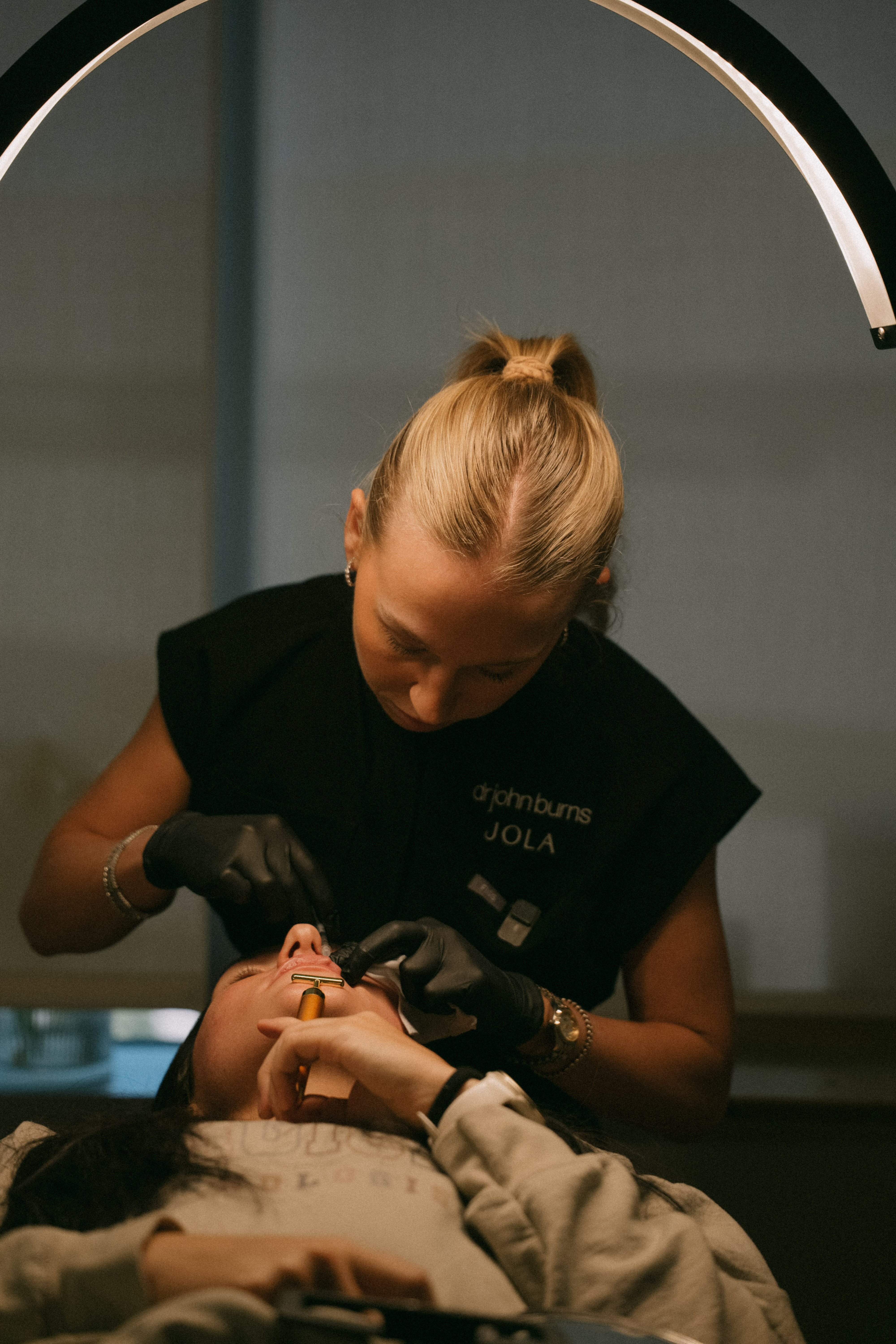
NON-SURGICAL FACE TIGHTENING / XERF DISCOVERY
HOW CAN YOU TIGHTEN YOUR FACE WITHOUT SURGERY?
A guide to XERF, RF, ultrasound & other options — and why the right question is not which device lifts the most, but what is actually loose.
JOLA DALLAS / AUG 2026
22 MIN READ
SECTION 01 / THE 30-SECOND ANSWER
Can You Actually Tighten Your Face Without Surgery?
Among the patients we see in Dallas — across Highland Park, University Park, Preston Hollow, and the Park Cities — one of the most searched questions in aesthetic medicine is deceptively simple: how to tighten face without surgery? The honest answer is that non-surgical facial tightening is possible for selected concerns — but only when the concern is genuinely skin laxity, and only when the desired magnitude is compatible with non-surgical treatment. Radiofrequency treatments such as XERF may be considered when improving skin firmness is the primary goal. Other technologies — RF microneedling, ultrasound-based treatments — differ in how energy is delivered. Injectables such as Sculptra or dermal filler address different concerns and should not automatically be described as skin-tightening treatments. If significant tissue descent or excess skin is present, surgery may provide a magnitude of lifting that non-surgical treatments cannot reproduce.
The correct approach begins by determining whether the concern is truly skin laxity. "Sagging" is a description, not a diagnosis — and the best non-surgical face-tightening treatment depends on what is actually creating the appearance of laxity.
NON-SURGICAL TREATMENT MAY MAKE SENSE WHEN
- +
Skin laxity is limited
- +
Firmness is the primary concern
- +
The desired change is subtle or moderate
- +
The patient accepts progressive results
- +
Surgery-level lifting is not expected
SURGERY MAY BECOME MORE RELEVANT WHEN
- −
There is significant excess skin
- −
Tissue descent is substantial
- −
The desired magnitude exceeds non-surgical capabilities
- −
Anatomical repositioning is needed
NON-SURGICAL TIGHTENING AND SURGICAL LIFTING ARE NOT THE SAME THING.
SECTION 02 / LAXITY
First: Is Your Skin Actually Loose?
Patients use the word "sagging" broadly. A softer lower face may result from skin laxity, jowling, volume loss, volume distribution, chin projection, jaw structure, submental fullness, weight change, tissue descent — or combinations of these. These are not interchangeable anatomical concerns. Before asking how to tighten loose skin on face, it is worth asking whether the concern is actually loose skin, or whether the appearance of laxity is being created by a different layer.
"SAGGING" IS A DESCRIPTION. IT IS NOT YET A TREATMENT PLAN.
This is why the facial-aging pillar and the sagging-skin decision guide come before any device comparison. Identifying the layer is more valuable than choosing a treatment by name.
SECTION 03
The Anatomy of a Softer Lower Face
The face is not one structure. It is a set of layers — and treatments interact with different levels. Two devices that both advertise "lifting" may be addressing completely different tissue depths. Understanding this is essential to understanding non surgical face tightening in Dallas.
SKIN
Collagen · Elasticity · Firmness · Laxity
SUBCUTANEOUS TISSUE
Soft-tissue layer beneath the skin
FAT COMPARTMENTS
Volume · Distribution · Contour
MUSCLE / SMAS
Facial expression · Structural layer conceptually
SKELETAL SUPPORT
Bone · Chin · Jaw · Midface relationships
TREATMENTS INTERACT WITH DIFFERENT LEVELS — THEY SHOULD NOT BE COMPARED SOLELY BECAUSE THEY ALL "LIFT"
SECTION 04
What Does "Skin Tightening" Actually Mean?
"Tightening" is often used loosely. In clinical terms, it may refer to firmness (the skin's structural support), elasticity (the skin's ability to return), skin laxity (the degree of looseness), collagen remodeling (the biological process that may support firmness over time), and visual contour (how the face appears in profile and shadow). None of these should be equated with surgical repositioning. A treatment that improves firmness is not the same as a treatment that repositions tissue — and the language used to describe results should reflect the mechanism.
SECTION 05 / RF
What Is Radiofrequency Skin Tightening?
Radiofrequency (RF) skin tightening uses controlled electrical energy to generate tissue heating in the deeper layers of the skin. Where supported, this thermal effect may influence collagen-related remodeling over time. RF is a non-surgical treatment category — but it is not one treatment. Devices differ in frequency, delivery, depth, and protocol. Radiofrequency skin tightening in Dallas is a category conversation, not a single-device conversation.
RADIOFREQUENCY, SIMPLY
CONTROLLED ENERGY
RF uses electrical energy to generate controlled tissue heating in the deeper skin layers.
COLLAGEN-RELATED REMODELING
Where supported, the thermal effect may influence collagen-related remodeling over time.
NON-SURGICAL CATEGORY
RF is a technology category — not one treatment. Devices differ in delivery, depth, and protocol.
"RF" IS A TECHNOLOGY CATEGORY. IT IS NOT ONE TREATMENT.
SECTION 06 / XERF
What Is XERF?
XERF is a non-invasive radiofrequency skin-tightening treatment by Cynosure Lutronic. It delivers controlled RF energy to support the skin's structural foundation — without microneedles, without incisions, and without injectables. It is designed for patients whose primary concern is skin firmness in areas such as the jawline, lower face, and neck. Results are typically progressive, developing over weeks to months as the skin's collagen response builds.
XERF should not be positioned as a facelift replacement for every patient, a volume replacement, a fat-removal treatment, a filler replacement, or a universal solution to facial aging. It is a category for one layer — the firmness layer — and it is most valuable when that layer is the one that changed. For the full overview, see XERF Dallas and What Is XERF RF Skin Tightening?
XERF — RADIOFREQUENCY SKIN TIGHTENING
What it is
XERF is a non-invasive radiofrequency treatment. It delivers controlled RF energy to support the skin's structural foundation — without microneedles, without incisions, and without injectables. It is designed for patients whose primary concern is skin firmness.
XERF is a Cynosure Lutronic technology. Treatment areas may include the jawline, lower face, and neck, depending on anatomy and consultation.
What it is not
- −
Not a laser
- −
Not RF microneedling
- −
Not an injectable
- −
Not a facelift replacement for every patient
- −
Not a volume replacement
- −
Not a fat-removal treatment
SECTION 07
Why XERF Is Different From a Laser
XERF is not a laser. Radiofrequency uses electrical energy to generate controlled tissue heating. Lasers use light at specific wavelengths. They are different energy categories that work through different mechanisms and address different layers. Laser typically addresses surface concerns — pigment, texture, resurfacing. XERF addresses deeper structural firmness. For more, see XERF Dallas and Laser Treatments Dallas.
SECTION 08 / MICRONEEDLING
Why XERF Is Different From RF Microneedling
XERF delivers RF without microneedles. RF microneedling delivers RF through a needle system that enters the skin. Treatment goals, depths, recovery, and experience can differ. They are the same energy family, but different delivery — and the concern should choose the delivery.
XERF
RF delivered without microneedles.
Non-invasive radiofrequency delivered to the skin's deeper layers without penetrating the surface.
RF MICRONEEDLING
Needles enter the skin; RF energy is delivered through the device's needle system.
Treatment goals, depths, recovery, and experience can differ from non-invasive RF.
SAME ENERGY FAMILY. DIFFERENT DELIVERY.
SECTION 09
XERF vs. Morpheus8
This is one of the highest-search comparison questions in non-surgical tightening. Both use radiofrequency, but they do not deliver it the same way. If avoiding needles and focusing on non-invasive skin firmness is important, XERF may be worth discussing. If texture or scar-related concerns requiring an RF microneedling approach are relevant, Morpheus8 may enter the conversation. No universal winner — the concern should choose the delivery.
XERF VS. MORPHEUS8 — NEUTRAL COMPARISON
CRITERIA
XERF
MORPHEUS8
TECHNOLOGY
Non-invasive radiofrequency
RF delivered through microneedles
NEEDLES
No
Yes
SKIN PENETRATION
None
Needles enter the skin
PRIMARY CONVERSATION
Skin firmness
Texture, scarring where relevant, firmness
DOWNTIME
Generally low
May differ; consult for current information
If avoiding needles and focusing on non-invasive skin firmness is important, XERF may be worth discussing. If texture or scar-related concerns requiring an RF microneedling approach are relevant, another technology may enter the conversation. No universal winner — the concern should choose the delivery.
Read the full comparison →SECTION 10 / ULTRASOUND
What About Ultrasound Skin Tightening?
Focused and microfocused ultrasound technologies differ from radiofrequency. Ultrasound uses sound-wave energy delivered to specific tissue depths. Devices such as Ultherapy and Sofwave use ultrasound-based mechanisms, but they are not equivalent to each other or to RF. The treatment conversation depends on the technology, the concern, and the anatomy.
ULTRASOUND SKIN TIGHTENING
Focused and microfocused ultrasound technologies differ from radiofrequency. Ultrasound uses sound-wave energy delivered to specific tissue depths. Devices such as Ultherapy and Sofwave use ultrasound-based mechanisms, but they are not equivalent to each other or to RF. The treatment conversation depends on the technology, the concern, and the anatomy.
SECTION 11
XERF vs. Ultherapy
RF vs. Ultrasound
ENERGY MODALITY
XERF uses radiofrequency; Ultherapy uses microfocused ultrasound.
TREATMENT EXPERIENCE
Both are non-invasive, but delivery and sensation differ.
NEEDLES
Neither uses needles.
SKIN-FIRMNESS GOALS
Both may address skin firmness, through different mechanisms.
Neither is universally superior. The technology should fit the concern and anatomy — not a general superiority claim.
Read the full XERF vs Ultherapy comparison →SECTION 12
XERF vs. Sofwave
RF vs. Ultrasound — Sofwave
ENERGY MODALITY
XERF uses radiofrequency; Sofwave uses ultrasound-based energy.
DELIVERY
Different energy categories, different mechanisms.
CONVERSATION
The choice depends on the concern, anatomy, and consultation.
No unsupported superiority claims. The comparison should be based on verified device information and individual anatomy.
Read the full XERF vs Sofwave comparison →SECTION 13
XERF vs. Thermage
RF vs. RF — Different Systems
ENERGY FAMILY
Both belong to radiofrequency conversations.
SYSTEMS
Different systems and treatment approaches. Device specifications should be verified with current manufacturer information.
COMPARISON BASIS
The comparison should be based on verified specifications, not general RF assumptions.
Both are RF, but not the same treatment. The comparison matters — and it should be grounded in current documentation.
Read the full XERF vs Thermage FLX comparison →SECTION 14
What About Laser for Loose Skin?
"Laser" is too broad a category to answer universally. Some laser technologies may involve collagen remodeling, resurfacing, texture, or other skin-quality goals. Not all lasers meaningfully tighten laxity. Laser is generally a different conversation from radiofrequency firmness treatments such as XERF. The technology should match the concern. For the full range, see Laser Treatments Dallas.
SECTION 15
Does Microneedling Tighten Skin?
Traditional microneedling and RF microneedling are different. Traditional microneedling addresses surface texture and skin quality. RF microneedling delivers radiofrequency through needles and may be relevant for firmness and texture. Treatment selection should follow the dominant concern — and should not be assumed to equal non-invasive RF tightening such as XERF. See XERF vs RF Microneedling.
SECTION 16 / SCULPTRA
Does Sculptra Tighten the Face?
Sculptra is an injectable poly-L-lactic acid biostimulator. It should not simply be described as an energy-based "skin-tightening treatment." Its role may involve collagen stimulation and facial support according to anatomy and treatment planning, but it is a different category from radiofrequency. XERF does not create volume; Sculptra does not tighten loose skin through the same mechanism. They may be complementary in some plans. For more, see Sculptra Dallas, XERF vs Sculptra, and XERF + Sculptra.
SECTION 17 / FILLER
Does Filler Tighten Loose Skin?
Filler can alter volume and contour. It does not make loose skin biologically equivalent to tighter skin. Adding volume to compensate for laxity is not always the appropriate strategy — and may create a heavier, less defined appearance. If the concern is truly skin laxity, an energy-based treatment such as XERF may be more appropriate than filler. For more, see Facial Balancing.
DON'T USE VOLUME TO SOLVE A SKIN PROBLEM UNLESS VOLUME IS ALSO PART OF THE PROBLEM.
SECTION 18
Can Botox Tighten the Face?
Neuromodulators such as Botox and Dysport primarily alter muscle activity and movement lines. They should not be presented as broad facial skin-tightening treatments. Certain uses may influence contour or positioning in selected treatment plans, but Botox does not tighten loose skin, restore volume, or reposition tissue. For more, see Botox Dallas and Botox vs Dysport.
SECTION 19
What About Thread Lifts?
Thread-based treatments are a separate category with different considerations. They are not disparaged here, nor recommended unless a practice offers them and current protocols support inclusion. The key point is that threads are not the same as energy-based tightening, injectables, or surgery — and should not be conflated with any of those categories.
SECTION 20
What Is a "Non-Surgical Facelift"?
The phrase "non-surgical facelift" is widely used in aesthetic marketing but can be misleading. Non-surgical treatments cannot universally reproduce tissue removal, surgical repositioning, SMAS manipulation, or the magnitude of change achievable with appropriately performed facelift surgery. Using the phrase loosely can create expectations that non-surgical treatment cannot meet.
NON-SURGICAL REJUVENATION IS NOT SURGERY WITHOUT THE INCISION.
SECTION 21 / SURGERY
Can XERF Replace a Facelift?
Not universally. XERF may be appropriate for selected patients seeking non-invasive improvement in skin firmness. A facelift addresses a different magnitude and type of anatomical change — tissue repositioning and excess skin. XERF does not reproduce surgical outcomes, and representing it as such would be clinically misleading. For the full comparison, see XERF vs Facelift.
SECTION 22
The Non-Surgical Tightening Spectrum
Not every face is at the same point on the tightening spectrum. The appropriate conversation depends on where the anatomy sits — from skin quality through significant tissue descent. This is a simplified educational framework, not a candidacy tool.
THE NON-SURGICAL TIGHTENING SPECTRUM
A simplified progression — not a candidacy tool.
SKIN QUALITY
→ Skincare / resurfacing / appropriate skin treatments
EARLY FIRMNESS CHANGES
→ Appropriate energy-based treatments
MILD LAXITY
→ XERF / other appropriate technologies depending on anatomy
MULTI-LAYER AGING
→ Combination planning
SIGNIFICANT TISSUE DESCENT / EXCESS SKIN
→ Surgical consultation may be appropriate
SIMPLIFIED EDUCATIONAL FRAMEWORK — NOT A CANDIDACY TOOL
SECTION 23 / JOWLS
Can You Tighten Jowls Without Surgery?
Sometimes the appearance of jowls may improve when skin laxity contributes. But jowls may also involve tissue descent, volume distribution, chin and jaw structure, pre-jowl anatomy, and submental contour. Non-surgical treatment does not promise elimination of jowls. When skin laxity is a contributing factor, XERF for jowls may enter the conversation. A consultation determines which layer is dominant.
SECTION 24 / JAWLINE
How to Tighten the Jawline Without Surgery
A jawline is influenced by skin, jowls, chin projection, mandibular structure, submental tissue, neck, and volume. "Jawline tightening" may therefore involve different categories. When skin laxity contributes, XERF for jawline may be relevant. When volume or structure is the issue, facial balancing may be more appropriate.
SECTION 25 / NECK
How to Tighten the Neck Without Surgery
Neck changes may involve skin laxity, crepey texture, platysmal activity, submental fullness, and sun damage. Each requires different thinking. When skin firmness is the concern, XERF for neck may be relevant. When muscle or submental fullness dominates, other categories may be more appropriate.
SECTION 26
What About the Lower Face?
The lower face — jawline, jowls, chin, lower cheek, and neck transition — is one of the most searched areas for tightening. This is where multiple aging layers converge: skin laxity, tissue position, volume distribution, and skeletal relationships all meet at the jawline. When skin laxity contributes, XERF for the lower face may enter the conversation.
SECTION 27
Can You Tighten Your Face Without Filler?
Potentially, yes. If the concern is primarily skin firmness, a volume-adding treatment may not be necessary. XERF and other energy-based treatments do not require adding dermal filler. But if true volume or structural deficiency is part of the concern, avoiding filler categorically may leave that component untreated. The treatment should match the layer that changed.
SECTION 28
Can You Tighten Your Face Without Needles?
Some energy-based treatments are non-invasive and do not use needles. XERF is a non-invasive radiofrequency treatment — no microneedles, no injectables. This contrasts with RF microneedling, Sculptra, and filler, all of which involve needles. Whether a needle-free approach is appropriate depends on the concern and anatomy — not on a universal preference. For patients who want to avoid needles and whose concern is skin firmness, XERF may be a particularly relevant conversation.
SECTION 29
Can You Tighten Your Face After Weight Loss?
It depends on the degree. Mild skin laxity following weight loss may respond to energy-based treatment such as XERF. Significant loose skin following substantial weight loss may not be appropriate for non-surgical correction. Skin, volume, rate of weight loss, baseline anatomy, age, and individual tissue characteristics all influence the answer. For more, see XERF After Weight Loss / GLP-1 Facial Changes.
SECTION 30
What About "Ozempic Face"?
"Ozempic face" is a popular consumer term, not a formal diagnosis. Facial changes following substantial weight loss may involve volume loss, skin laxity, changes in facial proportions, or combinations. Not all facial changes should be attributed directly to a medication. Treatment should be individualized based on the patient's anatomy and goals. For more, see XERF After Weight Loss / GLP-1.
SECTION 31
Face Tightening in Your 30s
In the 30s, changes are typically subtle — early laxity, early firmness changes, skin-quality shifts. Treatment is not automatically necessary. Prejuvenation with XERF may be considered when skin firmness is an early concern, but the decision should be based on anatomy and goals, not age alone. For more, see XERF for Prejuvenation and Best Age to Start Aesthetic Treatments.
SECTION 32
Face Tightening in Your 40s
In the 40s, lower-face firmness, jawline, neck, volume changes, and skin quality may become more noticeable. Multiple layers may begin contributing at once — which is why this is often when patients first ask how to tighten face without surgery. XERF may be relevant when skin firmness is a primary concern; combination planning may be considered when multiple layers are involved. Prioritization matters.
SECTION 33
Face Tightening in Your 50s and Beyond
Non-surgical treatment may still have a role. Candidacy depends heavily on degree of laxity, desired result, anatomy, and expectations — not age alone. Age does not automatically make someone a poor candidate. Some goals may be better served by surgery; others by non-surgical treatment. The decision is based on anatomy and desired outcome.
SECTION 34
How Much Tightening Can Non-Surgical Treatments Really Create?
Results vary by baseline laxity, technology, treatment parameters, tissue characteristics, age, treatment area, number and timing of treatments, and individual biological response. Non-surgical tightening does not reproduce surgical lifting. No credible estimate can be given without consultation — and invented percentages or measurements should be treated with caution. The honest answer is that the magnitude depends on the anatomy and the technology, assessed in person.
SECTION 35
How Long Does Non-Surgical Skin Tightening Take to Work?
Timelines vary by technology. For collagen-remodeling treatments such as XERF, results may develop progressively over weeks to months. Not every technology follows the same timeline. Current manufacturer information should be verified for specific timing. For XERF-specific detail, see When Will You See XERF Results?
SECTION 36
How Long Does Non-Surgical Skin Tightening Last?
Longevity is technology-specific and patient-specific. Aging continues after treatment. Maintenance may be considered. Sun exposure and overall skin health matter. Non-surgical results are not permanent, and no credible treatment promises permanent tightening. For XERF-specific detail, see How Long Do XERF Results Last?
SECTION 37
How Many Treatments Do You Need?
There is no universal number. Treatment count depends on the technology, protocol, baseline anatomy, and individual response. Verified XERF information should guide planning. A consultation establishes the appropriate plan for the individual. For more, see How Many XERF Treatments Do You Need?
SECTION 38
Is Non-Surgical Face Tightening Worth It?
"Worth it" depends on desired magnitude, downtime tolerance, budget, needle preference, surgery preference, baseline laxity, timeline, and expectations. For patients whose concern is skin firmness and whose goals are compatible with non-surgical treatment, XERF may be a meaningful option. For patients whose goals require surgical magnitude, non-surgical treatment may not satisfy. For more, see Is XERF Worth It?
SECTION 39 / DECISION
The "What Kind of Tightening Do I Need?" Map
Different concerns point to different conversations. The map below is educational — not a candidacy tool — but it illustrates how the same word ("tightening") may lead to very different treatment categories.
THE "WHAT KIND OF TIGHTENING DO I NEED?" MAP
Select a concern to explore what it may actually involve.
EDUCATIONAL ONLY — NOT A CANDIDACY TOOL
SECTION 40
The JOLA Tightening Framework
Before choosing a "lifting" treatment, JOLA works through a series of questions designed to identify what is actually loose — and what magnitude of change is desired.
THE JOLA TIGHTENING FRAMEWORK
Before choosing a "lifting" treatment:
WHAT LOOKS LOOSE?
↓IS IT ACTUALLY SKIN?
↓IS VOLUME INVOLVED?
↓ARE JOWLS INVOLVED?
↓IS FACIAL STRUCTURE CONTRIBUTING?
↓IS THE NECK INVOLVED?
↓WHAT MAGNITUDE OF CHANGE IS DESIRED?
↓ARE NEEDLES ACCEPTABLE?
↓HOW MUCH DOWNTIME IS ACCEPTABLE?
↓IS A NON-SURGICAL RESULT ENOUGH?
↓WHICH TECHNOLOGY MATCHES THE CONCERN?
↓WOULD SURGERY BE MORE APPROPRIATE?
TIGHTENING IS A GOAL.
THE ANATOMY DETERMINES THE PATH.
SECTION 41
XERF Comparison Matrix
A side-by-side comparison across the major treatment categories that patients often conflate. No device is universally "best" — the matrix is educational, not a ranking.
CRITERIA | XERF | RF MICRONEEDLING | ULTRASOUND | SCULPTRA | DERMAL FILLER | FACELIFT |
|---|---|---|---|---|---|---|
Treatment category | Non-invasive RF | Minimally invasive RF | Non-invasive ultrasound | Injectable biostimulator | Injectable | Surgery |
Energy / material | Radiofrequency | Radiofrequency via needles | Ultrasound | Poly-L-lactic acid | Hyaluronic acid (typically) | Surgical repositioning |
Needles? | No | Yes | No | Yes | Yes | No (incisions instead) |
Incisions? | No | No | No | No | No | Yes |
Adds volume? | No | No | No | May support volume-related planning | Yes | No |
Primary conversation | Skin firmness | Texture / firmness | Skin firmness | Collagen support / volume | Volume / contour | Tissue repositioning |
Skin firmness | Primary | May be relevant | Primary | Not primary | Not primary | Not primary |
Texture | Not primary | May be relevant | Not primary | Not primary | Not primary | Not primary |
Volume | No | No | No | May support | Yes | No |
Structural contour | May support | May support | May support | May support | Yes | Yes |
Tissue repositioning | No | No | No | No | No | Yes |
Downtime | Generally low | May differ | Generally low | Injection-related | Injection-related | Surgical recovery |
Progressive result? | Yes, where supported | May be progressive | May be progressive | Yes, progressive | Often immediate | Surgical timeline |
Surgical? | No | No | No | No | No | Yes |
Best-fit concern | Skin laxity / firmness | Texture / firmness | Skin firmness | Volume / collagen support | Volume / contour | Significant tissue descent |
Major limitation | Does not reposition tissue | Needles required | Does not reposition tissue | Not an energy treatment | Does not tighten skin | Surgical recovery required |
EDUCATIONAL COMPARISON — NO DEVICE IS UNIVERSALLY "BEST" — CONSULTATION REQUIRED
SECTION 42
Why JOLA Doesn't Call Everything a "Lift"
Marketing language can blur tightening, firming, volumizing, contouring, repositioning, resurfacing, and lifting. These are not the same mechanism. Using "lift" loosely can create expectations that a treatment cannot meet. JOLA uses precise language — because if the mechanism is different, the promise should be different too.
IF THE MECHANISM IS DIFFERENT, THE PROMISE SHOULD BE DIFFERENT TOO.
SECTION 43
Why XERF Matters in JOLA's Treatment Toolkit
Historically, patients often thought facial rejuvenation meant Botox or filler. XERF gives JOLA another category to discuss when the concern is skin firmness — a layer that Botox and filler do not address. That distinction is strategically important. XERF is not universally better than injectables; it is complementary. It fills a gap for patients whose primary concern is firmness.
SECTION 44
When the Question Is Skin Firmness
WHEN THE CHANGE IS IN THE SKIN

LASER SPECIALIST / JOLA DALLAS
Chey Cope
LASER SPECIALIST — ENERGY-BASED TREATMENTS
Energy-based treatment planning at JOLA may involve assessing skin quality, firmness, laxity, pigment, texture, jawline, neck, previous laser, previous RF, previous ultrasound, previous filler, previous Sculptra, skin tone, history of pigmentation, downtime preference, and desired magnitude. The goal is to understand whether an energy-based treatment — such as XERF — fits the concern, or whether another category is more appropriate.
@MAISON.DE.CHEYSECTION 45
When XERF May Make Sense
XERF may enter the conversation when skin firmness is the concern, when facial skin laxity contributes, when lower-face, jawline, or neck skin is a priority, when the patient prefers a non-invasive approach, when avoiding microneedles matters, and when the desired change is compatible with non-surgical treatment. This is not candidacy criteria — it is an educational summary.
XERF MAY ENTER THE CONVERSATION WHEN
- +
Skin firmness is the concern
- +
Facial skin laxity contributes
- +
Lower-face skin is a priority
- +
Jawline skin is a priority
- +
Neck skin is a priority
- +
The patient prefers a non-invasive approach
- +
Avoiding microneedles matters
- +
The desired change is compatible with non-surgical treatment
XERF MAY NOT BE THE ENTIRE ANSWER WHEN
- −
Significant excess skin is the dominant concern
- −
Substantial tissue descent is present
- −
Volume loss is the primary issue
- −
Skeletal deficiency contributes
- −
Submental fat is the primary concern
- −
Pigment or acne scars dominate
- −
Deep texture or movement lines dominate
THIS IS NOT CANDIDACY CRITERIA — CONSULTATION REQUIRED
SECTION 46
When XERF May Not Be the Entire Answer
If the dominant concern is significant excess skin, substantial tissue descent, volume loss, skeletal deficiency, submental fat, pigment, acne scars, deep texture, or movement lines, then another or additional category may be more appropriate. This section is essential for trust — because a treatment that is excellent in its appropriate range is inappropriate outside it.
SECTION 47
When a Facelift Consultation May Be More Appropriate
A facelift consultation may be more appropriate when there is significant excess skin, substantial tissue descent, a desired magnitude that exceeds non-surgical capabilities, longevity expectations aligned with surgery, and willingness to undergo surgery and recovery. Surgery should not be framed as failure — it is a different category for a different magnitude of change.
THE MOST NATURAL PLAN IS SOMETIMES THE ONE THAT ACKNOWLEDGES THE LIMITS OF NON-SURGICAL TREATMENT.
SECTION 48
How JOLA Decides What to Recommend
JOLA begins with what bothers you, then asks which anatomical change creates it — skin, volume, structure, fat, movement, or texture. The magnitude of desired change is evaluated. The treatment category follows the concern, not the other way around. For more, see Aesthetic Consultation, Treatment Planning, and About JOLA's Treatment Philosophy.
SECTION 49
Questions to Ask Before Any Skin-Tightening Treatment
A 30-question checklist for your consultation — designed to clarify the concern, the technology, and the expectation before any treatment is chosen.
QUESTIONS TO ASK BEFORE ANY SKIN-TIGHTENING TREATMENT
A 30-question checklist for your consultation.
Is my concern actually loose skin?
How much laxity do I have?
Are jowls part of the issue?
Is volume loss contributing?
Is my chin contributing?
Is my jaw structure contributing?
Is submental fullness contributing?
Is my neck part of the concern?
What technology is being recommended?
Is it RF?
Is it ultrasound?
Is it laser?
Does it use needles?
Does it add volume?
What tissue does it target?
What does it realistically improve?
What will it not improve?
How much change is realistic?
How quickly should results appear?
Are results progressive?
What downtime is expected?
What temporary effects are common?
Does skin tone affect planning?
Does PIH history matter?
Does previous filler matter?
Does previous Sculptra matter?
Does previous RF matter?
Would another treatment category fit better?
Would surgery better match my desired result?
Would doing nothing yet be reasonable?
SECTION 50
How Can You Tighten Your Face Without Surgery? The Bottom Line
Non-surgical facial tightening is possible for selected concerns — but not every "sagging" face has the same anatomy. Loose skin differs from volume loss. Jowls are multifactorial. Jawline softness is multifactorial. Neck aging is multifactorial. RF is a technology category. XERF uses RF. XERF is not a laser. XERF does not use RF microneedles. XERF is not filler and does not restore volume. XERF is not surgery. RF microneedling is a separate category. Ultrasound technologies are different. Lasers are different. Sculptra is different. Filler is different. Botox is different. A facelift creates a different magnitude and mechanism of change.
No device is universally "best." Desired magnitude matters. Anatomy matters. Expectations matter. Some patients need one category. Some may need combination planning. Some may be better served by surgery. Some may not need treatment — and that is also a valid answer. The best non-surgical result starts with realistic anatomy, not with a device name.
If you are searching "how do I tighten my face without surgery," start with an even more useful question: what is making my face look loose? Skin? Jowls? Volume? Structure? Jawline? Neck? Once that answer is clear, the treatment comparison becomes far more meaningful. XERF becomes especially relevant when the answer is: the skin.
WHAT ARE YOU ACTUALLY TRYING TO TIGHTEN?
"TIGHTENING" IS NOT ONE ANATOMICAL PROBLEM.
CTA 01
BEFORE YOU CHOOSE A TIGHTENING DEVICE,
FIND OUT WHAT IS ACTUALLY LOOSE.
Begin with the anatomy — not the device you heard about.
EXPLORE JOLA TREATMENT PLANNINGCTA 02
SKIN? JOWLS? VOLUME? STRUCTURE?
THE ANSWER CHANGES THE TREATMENT.
A consultation identifies which layer matters most before any treatment is chosen.
EXPLORE AESTHETIC CONSULTATIONFrequently Asked Questions
WHAT ARE YOU TRYING TO TIGHTEN?
JOLA DALLAS
THE BEST NON-SURGICAL RESULT STARTS
WITH REALISTIC ANATOMY.
Don't start by asking which device lifts the most. Start by asking what is actually loose. A JOLA consultation begins with the anatomy — not with a treatment name.
214.515.0002