
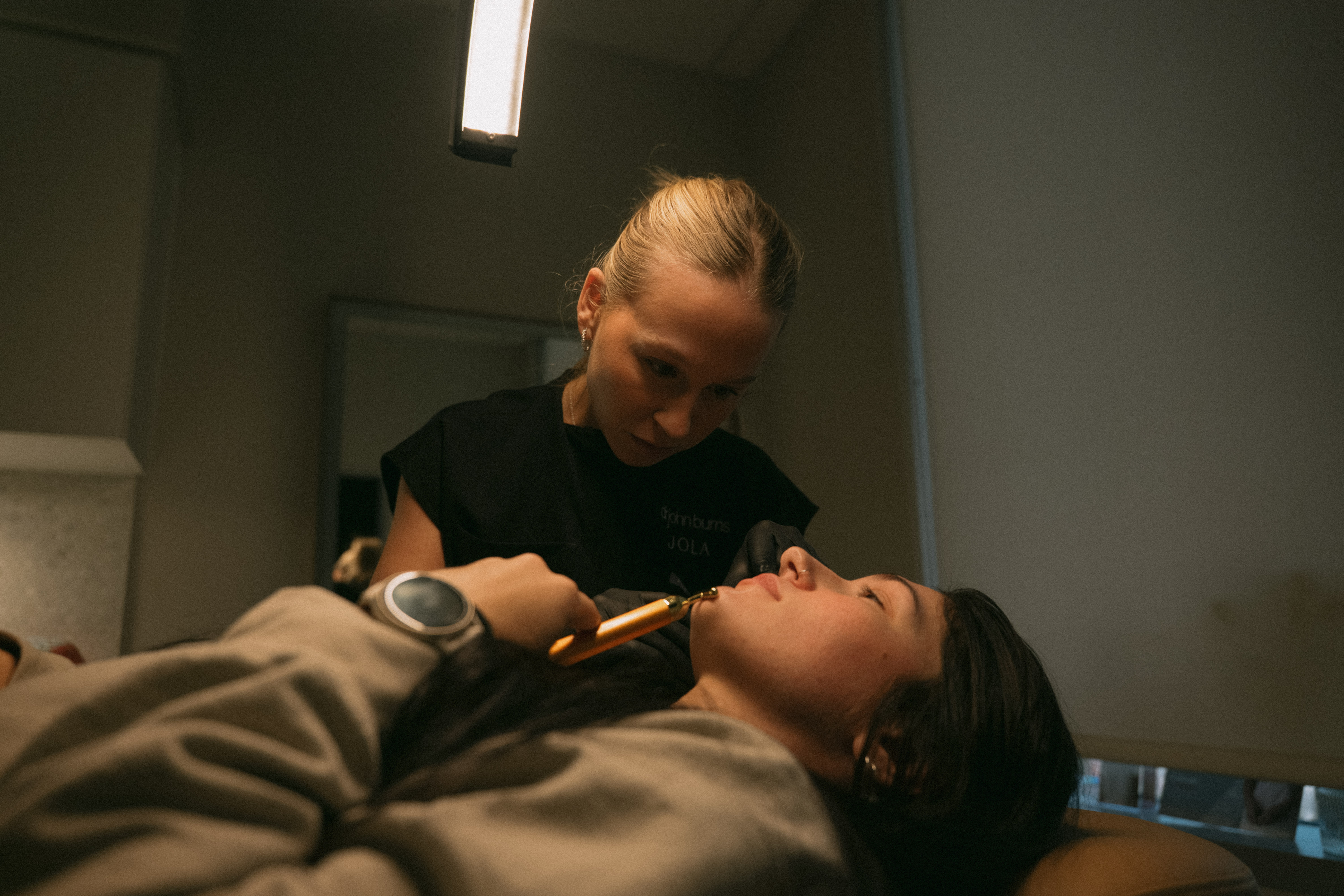
FACIAL ANATOMY / NON-SURGICAL TIGHTENING
JOLA DALLAS
XERF FOR
SAGGING SKIN
Can you actually tighten loose facial skin without surgery? Before choosing a tightening treatment, understand what actually changed. XERF, facial anatomy, and non-surgical treatment planning at JOLA Dallas.
JOLA DALLAS / AUGUST 2026
18 MIN READ
THE 30-SECOND ANSWER
Can XERF tighten sagging skin?
XERF for sagging skin is a non-invasive radiofrequency treatment that may be considered when skin laxity contributes to the appearance of sagging. It delivers controlled thermal energy to support skin firmness and collagen remodeling in treated areas. For patients in Dallas, Highland Park, University Park, Preston Hollow, and the Park Cities, it has become a frequently discussed option within the broader non surgical skin tightening Dallas conversation.
But not all facial sagging is caused by loose skin. Jowls, facial volume loss, tissue position, skeletal structure, and submental fullness can create similar visual concerns. XERF does not restore missing volume, create bone structure, or reposition tissue surgically. It should not be described as equivalent to a facelift. Candidacy depends on anatomy, severity of laxity, and the desired magnitude of change.
The central idea at JOLA Dallas is simple: "sagging" is not a diagnosis. Before choosing any tightening treatment, it helps to understand what actually changed.
XERF MAY ADDRESS
- +Skin firmness
- +Skin laxity
- +Supported face and neck treatment areas
XERF DOES NOT CREATE
- —Facial volume
- —Chin projection
- —Jaw bone structure
- —Surgical tissue repositioning
First determine whether "sagging" is actually a skin problem.
BEFORE YOU TIGHTEN IT, UNDERSTAND IT
Skin? Volume? Structure? The right plan starts with the right question.
A consultation at JOLA Dallas begins with what you actually see — not with a device. Understanding which anatomical layer is contributing to the concern is the first step in determining whether XERF belongs in the treatment plan.
EXPLORE AESTHETIC CONSULTATIONFACIAL AGING
Why does the face start to look "saggy"?
The aging face is a multi-layer system. Skin, collagen, elastin, fat compartments, facial volume, ligamentous and tissue changes, bone and skeletal support, muscle, gravity, sun exposure, and weight changes all contribute to how the face reads over time. No single cause explains everyone, and no single treatment addresses every layer.
What patients often describe as "sagging" is usually several of these changes layered together. The skin may be less firm. Fat compartments may shift or diminish. Supporting ligaments may lengthen. Bone structure may recede subtly. The result is a face that looks different — but the word "sagging" does not tell you which layer is responsible.
This is why sagging skin treatment Dallas conversations at JOLA begin with anatomy, not with a device name. Understanding the layer is the first step in understanding whether xerf loose skin treatment is even the right question.
THE FIVE-LAYER VIEW
The face does not age in one layer.
SKIN
The outermost layer — collagen, elastin, firmness, texture.
FAT / VOLUME
Fat compartments that give the face fullness and softness.
SUPPORTING TISSUES
Ligaments and connective structures that hold tissue in position.
MUSCLE
Dynamic movement that shapes expression and contour.
BONE / STRUCTURE
Skeletal framework — chin, jaw, cheekbone architecture.
A tightening device does not treat every layer the same way.
Simplified educational model — not a diagnostic tool
DEFINITION
What does "loose skin" actually mean?
Laxity, elasticity, firmness, texture, wrinkling, and crepiness are related but not identical concepts. Laxity refers to how well the skin holds its position. Elasticity refers to how well it returns after being stretched. Firmness refers to the structural density of the tissue. Texture, wrinkling, and crepiness describe surface and superficial qualities. A patient may have excellent surface texture but underlying laxity — or firm skin with visible wrinkling — and each pattern tells a different story.
When patients ask about loose skin treatment Dallas, the first question is what kind of "loose" they are seeing. XERF addresses the skin-firmness and laxity dimension. It does not address volume, structure, or tissue position. Clarifying what "loose" means for each patient is essential before any treatment recommendation.
Loose skin is not the same thing as an aging face.
THE TREATMENT
What is XERF?
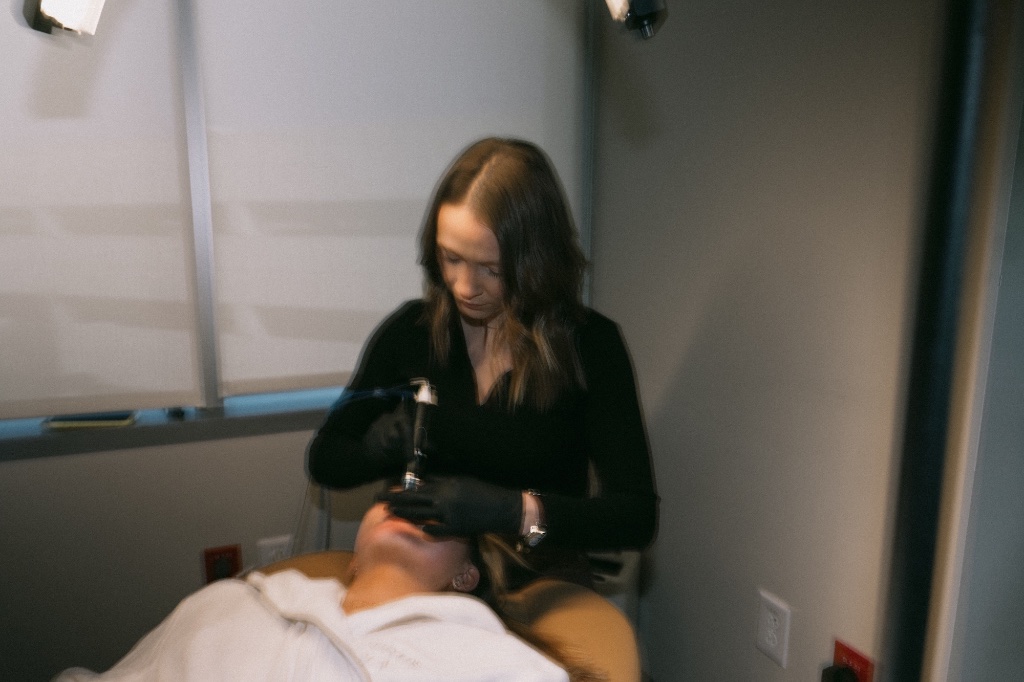
XERF is a non-invasive radiofrequency skin-tightening platform developed by Cynosure (Lutronic). It delivers multifrequency monopolar radiofrequency energy into the skin's deeper tissue layers to support collagen remodeling and skin firmness. The system uses verified RF architecture with specific frequencies and supported treatment areas, including the face and neck. Energy is delivered through the skin surface without needles, and the platform includes an integrated cooling system for patient comfort.
XERF is positioned as a no-numbing, no-downtime treatment. Its mechanism is collagen-related: controlled thermal energy encourages a remodeling response in the dermal layer where collagen resides. It does not physically shrink tissue dramatically, weld structures, or create surgical-level repositioning. It is a skin-firmness tool within the broader radiofrequency skin tightening Dallas category. Learn more in our guide to what XERF is and why JOLA is a leading practice and on the XERF treatment page.
MECHANISM
How can radiofrequency tighten skin?
Radiofrequency energy works by delivering controlled thermal energy to the dermal layer of the skin. This thermal stimulus encourages a collagen-related response: existing collagen may contract, and over time, the body generates new collagen as part of its natural remodeling process. The result is progressive support for skin firmness in the treated area.
It is important to be clear about what RF does not do. It does not physically shrink skin dramatically. It does not "weld" tissue. It does not create a facelift. And it does not tighten all loose skin — only skin where the laxity falls within the range non-invasive treatment can address. The collagen treatment Dallas conversation is about supporting the skin's biology, not overriding it.
REALISTIC EXPECTATIONS
How much can XERF actually tighten?
This is one of the most important questions to answer honestly. Non-invasive skin tightening generally aims for refinement, not surgical repositioning. Results vary based on baseline laxity, age, skin quality, treatment area, protocol, biological response, and desired magnitude. JOLA does not provide a fake tightening percentage — because there is no honest universal number.
What can be said is that XERF works within a specific range of change. For patients with mild to moderate laxity whose goal is subtle, progressive refinement, that range may be well-matched. For patients whose desired magnitude approaches surgical-level repositioning, that range will not be sufficient.
The question isn't whether XERF can tighten skin. It's whether the amount of change XERF can reasonably create matches the change you want.
THE SAGGING SPECTRUM
01
MINIMAL / EARLY LAXITY
Subtle softening of skin firmness. Often the earliest signal.
↓
02
MODERATE VISIBLE LAXITY
More noticeable laxity. Jawline and neck transitions may read differently.
↓
03
MORE ADVANCED TISSUE DESCENT
Significant tissue change. Desired magnitude becomes especially important.
As laxity becomes more significant, desired magnitude becomes increasingly important in determining whether non-invasive treatment can meet expectations.
Conceptual only — candidacy requires assessment
TERMINOLOGY
Does XERF lift the face?
The words firming, tightening, lifting, and repositioning are often used interchangeably in marketing, but they are not clinically identical. Firming and tightening refer to supporting skin quality and firmness. Lifting implies physically raising tissue. Repositioning implies surgically moving tissue to a new position. XERF may support firming and tightening. It should not be described as a lift or a repositioning procedure.
This distinction matters because patients searching for a non surgical facelift Dallas may encounter language that blurs these categories. A non-surgical treatment that supports skin firmness is not the same as a surgical facelift, and understanding the difference protects patients from mismatched expectations.
LOWER FACE
XERF for lower-face sagging
The lower face — the lower cheek, pre-jowl area, jawline, and chin-jaw relationship — is where many patients first notice change. Lower face tightening Dallas is one of the most common reasons patients inquire about XERF. But lower-face "sagging" may involve more than skin: jowling, volume redistribution, and structural changes all contribute. XERF addresses the skin-firmness layer; it does not address every contributor. For the jowl-specific conversation, see our guide to XERF for lower-face and jowl skin tightening.
JOWLS
XERF for jowls
Jowls may reflect skin laxity, tissue position, volume changes, jaw structure, chin structure, and aging anatomy. Jowls treatment Dallas patients ask about XERF because it may address the skin-firmness component when appropriate. It does not create a larger mandible or reposition tissue surgically. Whether XERF fits a jowl concern depends on which anatomical factors are contributing. See our dedicated XERF for jowls article for the full discussion.
JAWLINE
XERF for the jawline
Jawline definition is a relationship between skin, jowls, chin projection, mandibular structure, submental contour, neck, and volume. Jawline tightening Dallas patients who ask about XERF are often seeing softening that involves several of these factors. XERF may support the skin-firmness layer along the jawline when skin laxity is contributing. It does not create bone structure or restore volume. For the full jawline conversation, see XERF for jawline tightening and our approach to facial balancing.
NECK
XERF for loose neck skin
The neck may show laxity, crepey texture, submental skin changes, platysmal activity, submental fullness, and jaw-neck transition changes. These are different concerns. Neck tightening Dallas patients should understand that XERF addresses skin firmness, not muscle banding or submental fat. If the neck concern is primarily skin laxity, XERF may be relevant. If muscle or fat is the primary contributor, tightening alone will not address it. See our XERF for neck tightening guide.
SUBMENTAL
What about a double chin?
Loose skin and submental fullness are not the same. A patient may have skin laxity, submental fat, both, or neither. XERF is not a universal double-chin treatment — it addresses skin firmness, not fat reduction. If the concern is primarily submental fullness without skin laxity, a different treatment category may be more appropriate. See our guide to XERF and the double chin for the full distinction.
CHEEKS
XERF for sagging cheeks
A cheek that appears "lower" may reflect volume changes, midface structure, tissue position, skin quality, or weight loss. XERF addresses skin firmness and does not restore cheek volume. If volume loss is the primary contributor, treatments such as facial balancing, Sculptra, or dermal fillers may be more relevant than tightening.
WEIGHT LOSS
XERF after weight loss
Weight loss may reveal skin laxity, facial volume loss, more visible skeletal contours, jowling, and neck laxity. Different changes require different treatment categories. XERF may address the skin-firmness component when relevant, but it cannot replace lost volume. Weight-loss patients often need multi-category planning rather than tightening alone. See our guide to XERF after weight loss and GLP-1 facial changes.
GLP-1
Can XERF help "Ozempic face" or GLP-1 facial changes?
"Ozempic face" is a colloquial term, not a clinical diagnosis. GLP-1 medications do not create one universal facial condition. Changes may relate to the amount of weight lost, rate of weight loss, baseline anatomy, age, skin elasticity, and volume loss. XERF may address skin firmness where relevant but cannot replace lost volume. Treatment planning should assess volume separately from skin laxity.
COMPARISON
XERF vs filler for sagging
IF THE ISSUE IS SKIN LAXITY
Energy-based tightening may enter the conversation.
IF THE ISSUE IS VOLUME / STRUCTURAL SUPPORT
Filler may enter the conversation.
IF BOTH
Staged or combination planning may be considered.
Filler does not tighten skin, and XERF does not restore volume. The treatment should follow the anatomy. See our guides to facial balancing and dermal fillers for the volume conversation.
VOLUME CONCERNS
Can filler make sagging look worse?
Adding volume without understanding anatomy can create unwanted heaviness or imbalance in some treatment plans. But filler itself should not be portrayed as inherently making faces sag. The question is where, why, how much, and what the actual deficit is. Volume placed thoughtfully as part of an anatomy-first plan is different from volume added without assessment.
Volume is not a substitute for tightening. Tightening is not a substitute for volume.
COMPARISON
XERF vs Sculptra for sagging skin
XERF is an energy-based radiofrequency treatment focused on skin firmness. Sculptra is an injectable biostimulatory treatment focused on collagen support through a different mechanism. They are different categories with different treatment planning. In some patients, combination treatment may be considered. See our XERF vs Sculptra comparison, XERF + Sculptra, and whether Sculptra actually works.
COMPARISON
XERF vs Botox for sagging
Botox and Dysport address muscle movement. XERF addresses skin firmness through energy-based treatment. Neither should be treated as interchangeable. If dynamic muscle movement is contributing to the concern, neuromodulators may be relevant. If skin laxity is the concern, XERF may be relevant. They serve different anatomical purposes.
BRIEF COMPARISONS
Other skin-tightening comparisons
XERF vs RF microneedling: XERF is non-invasive RF; RF microneedling combines needles with RF. Different delivery categories. Full comparison.
XERF vs Sofwave: XERF uses radiofrequency; Sofwave uses ultrasound. Different energy types. Full comparison.
XERF vs Ultherapy: XERF uses RF; Ultherapy uses ultrasound.Full comparison.
XERF vs Thermage: Both are RF systems but with different architectures. Full comparison.
SURGERY
XERF vs facelift
XERF is non-invasive energy-based treatment. Facelift surgery physically repositions and addresses tissues through a surgical approach. They should not be treated as equivalent. They are different categories of result, with different magnitudes of change. See our XERF vs facelift guide for the full comparison.
Non-surgical does not mean surgery without the incision. It is a different category of result.
CANDIDACY LIMITS
When is skin too loose for XERF?
There is no hard age or laxity cutoff. The issue is whether baseline anatomy, degree of laxity, tissue descent, desired magnitude, and treatment limitations align. Someone wanting dramatic repositioning may not be satisfied by non-invasive tightening. The question is not whether XERF can do something — it is whether what it can do matches what the patient wants.
SURGICAL CONSULTATION
How do you know when a facelift makes more sense?
Signs that should prompt a surgical consultation discussion include: desired magnitude exceeds non-invasive expectations, significant tissue descent, the patient wants structural repositioning, or the patient is repeatedly pursuing non-invasive treatments expecting surgical-level change. JOLA does not diagnose surgical candidacy — but we will say clearly when surgery may be the more appropriate conversation.
The goal should determine the category. Not fear of the category.
PREJUVENATION
Can you start XERF before skin becomes very loose?
Some patients explore skin-firmness treatments before substantial laxity develops. This does not mean everyone in their 20s or 30s needs XERF. Prejuvenation is a considered conversation, not a universal recommendation. See our XERF for prejuvenation article and our guide to the best age to start aesthetic treatments.
BY DECADE
XERF for sagging skin by age
IN YOUR 30s
Some patients in their 30s notice early skin-quality or laxity changes. XERF may be discussed if skin laxity is genuinely present and the patient desires subtle, progressive support. Treatment is not necessary for everyone in this age group.
IN YOUR 40s
Patients in their 40s may notice skin quality changes, early-to-moderate laxity, jawline changes, neck changes, and volume shifts. XERF may be appropriate when skin laxity is contributing and expectations align with non-surgical treatment. Age alone does not determine candidacy.
IN YOUR 50s AND BEYOND
Age alone does not determine candidacy. Desired magnitude becomes particularly important. Non-invasive treatment may still be appropriate for selected goals, but it should not be expected to replace surgery when surgical-level repositioning is desired.
FACIAL FAT
Does XERF melt facial fat?
Facial fat concerns deserve individualized evaluation with any energy-based facial treatment. This question matters particularly for patients who already feel their face looks deflated. See our dedicated article on whether XERF affects facial fat for a complete, transparent discussion.
THIN FACES
Can tightening make a thin face look thinner?
A patient with low facial volume, prominent bone structure, temporal hollowing, or midface volume loss may interpret facial changes differently. Treatment planning should assess volume separately from skin laxity. If volume loss is the primary concern, tightening alone may not be the right first step.
PRACTICAL QUESTIONS
Comfort, downtime, results, and maintenance
WHAT DOES XERF FEEL LIKE?
XERF is designed with an integrated cooling and comfort system and is positioned as a no-numbing treatment. Treatment sensation varies by individual. Patients should discuss comfort expectations with their provider during consultation.
DOES XERF HAVE DOWNTIME?
XERF is positioned as a no-downtime treatment. Temporary post-treatment effects may occur but are distinct from downtime. See our XERF downtime guide.
WHEN WILL SKIN LOOK TIGHTER?
XERF results are progressive. Collagen remodeling develops over weeks to months. See our XERF results timeline.
HOW MANY TREATMENTS?
Treatment count depends on anatomy and response. More treatment is not automatically better. See how many XERF treatments you may need.
HOW LONG DO RESULTS LAST?
Results longevity varies. Ongoing aging continues. See how long XERF results last.
MYTH
Can XERF prevent future sagging?
No aesthetic treatment stops aging. Skin-support strategies may be part of long-term maintenance, but aging continues. XERF should not be described as preventing future sagging. It may support skin firmness in treated areas, but it does not halt the aging process.
BEYOND TREATMENT
What else helps support skin firmness?
Sun protection, skincare, retinoids where medically appropriate, healthy lifestyle, weight stability, skin treatments, and collagen-supporting aesthetic categories all contribute to skin quality over time. These should not be overstated in their effect on established laxity, but they form the foundation of long-term skin health. See our clinical skincare guide and skin health programs.
SKIN? VOLUME? STRUCTURE? JOWLS?
The right plan starts with the right question.
Before any tightening treatment, JOLA Dallas evaluates which anatomical layer is actually contributing to what you see. Treatment planning at JOLA is consultation-led, anatomy-first, and built around your specific concerns — not around a device.
EXPLORE JOLA TREATMENT PLANNINGTHE "WHY DOES MY FACE LOOK SAGGY?" MAP
Start with what you see.
YOU SEE
MY JAWLINE IS DISAPPEARING
POSSIBLE CONTRIBUTORS
YOU SEE
MY LOWER FACE LOOKS HEAVY
POSSIBLE CONTRIBUTORS
YOU SEE
MY CHEEKS LOOK LOWER
POSSIBLE CONTRIBUTORS
YOU SEE
MY NECK LOOKS LOOSE
POSSIBLE CONTRIBUTORS
YOU SEE
MY FACE LOOKS DEFLATED
POSSIBLE CONTRIBUTORS
Do not automatically tighten.
YOU SEE
MY FACE LOOKS BOTH LOOSE AND HOLLOW
POSSIBLE CONTRIBUTORS
May require multi-category planning.
Educational only — not a diagnostic tool
YOU SEE
"SAGGING"
↓
JOLA ASKS
Treat the anatomy. Not the word "sagging."
"Sagging" can mean five different things.
One word. Multiple anatomical questions.
PHILOSOPHY
Why JOLA doesn't automatically treat "sagging" with filler
Historically, some aesthetic treatment plans attempted to address many age-related changes primarily by adding volume. Modern anatomy-first planning recognizes that volume loss, skin laxity, structure, tissue position, and skin quality are separate variables. Filler is an excellent tool when volume is the actual deficit. It is not the right tool when the concern is skin laxity. JOLA chooses the category based on the concern — not on habit.
PHILOSOPHY
Why JOLA doesn't automatically treat it with XERF either
Owning a technology should not determine the diagnosis. XERF should be recommended when the anatomy and treatment goal fit the treatment — not because a patient used the word "sagging." If the primary concern is volume, structure, or tissue position, XERF is not the first step. The device should never create the diagnosis.
The device should never create the diagnosis.
CANDIDACY
When XERF may fit, when it may not, and when combination makes sense
WHEN XERF MAY MAKE SENSE
- +Skin laxity is genuinely part of the concern
- +Desired result is subtle and progressive
- +Treatment area is supported
- +Patient prefers a non-invasive approach
- +Expectations align with non-surgical treatment
- +Assessment supports candidacy
WHEN XERF MAY NOT BE THE FIRST STEP
- —Primary issue is volume loss
- —Primary issue is skeletal structure
- —Significant submental fat
- —Dynamic muscle movement
- —Pigment or texture is the dominant concern
- —Surgical-level repositioning is desired
- —There is minimal meaningful laxity
- —Treatment is unnecessary
WHEN COMBINATION TREATMENT MAY MAKE SENSE
Skin, volume, movement, and texture may require different categories. Potential combinations may include XERF + facial balancing, XERF + Sculptra, XERF + Botox/Dysport, or XERF + laser and skin treatments. Sequencing is determined through consultation.
Chey Cope
LASER SPECIALIST
JOLA DALLAS
Evaluating a patient for XERF involves more than looking for "loose skin." Assessment may include skin quality, degree of laxity, jawline, jowls, neck, facial volume, previous weight loss, previous filler, previous biostimulators, previous RF or ultrasound, previous laser, desired magnitude, downtime preference, and full treatment history.
The goal is to determine whether skin laxity is genuinely part of the concern — and whether XERF's non-invasive radiofrequency approach aligns with the patient's anatomy and desired magnitude of change.
CONSULTATION
How JOLA decides whether "sagging" is actually a XERF question
The JOLA consultation follows a structured sequence: What do you notice? Where do you notice it? What changed? Which anatomical layer is contributing? How much change do you want? Which category can realistically create that change? What should not be treated? This is consultation-led, anatomy-first care. See our approach to treatment planning and JOLA's treatment philosophy.
CHECKLIST
Questions to ask before any non-surgical skin-tightening treatment
Is my concern actually loose skin?
Could it be volume loss instead?
Are jowls contributing?
Is chin structure contributing?
Is jaw structure contributing?
Is submental fullness contributing?
Is my neck concern skin, muscle or fat?
How much laxity do I actually have?
What treatment area is being targeted?
What technology is being used?
What type of energy does it use?
What tissue is the treatment intended to affect?
What magnitude of change is realistic?
What will the treatment not change?
Does it restore volume?
Does it create structural support?
Is fat reduction intended?
Could facial volume influence my result?
What does treatment feel like?
What temporary effects are expected?
Is there downtime?
When should results be evaluated?
How many treatments are typically considered?
How is maintenance approached?
Does previous filler matter?
Does previous Sculptra matter?
Does previous RF or ultrasound matter?
Would another treatment category fit better?
Would surgery better match my desired magnitude?
What happens if I choose not to treat this yet?
THE BOTTOM LINE
Can XERF tighten sagging skin? The bottom line
XERF is a non-invasive radiofrequency treatment that may be considered when skin laxity contributes to the concern. "Sagging" is not a diagnosis. Skin is only one layer of facial aging. Facial volume matters. Fat distribution matters. Tissue position matters. Skeletal structure matters. Jawline concerns are multifactorial. Jowls are multifactorial. Neck concerns are multifactorial.
XERF cannot create facial volume, jaw bone, or chin projection. It should not be described as a facelift. It does not stop aging. Results should be expected to be non-surgical. Treatment magnitude matters. Thin faces require thoughtful planning. Weight-loss patients may have both skin and volume changes. Filler and XERF are not substitutes. Sculptra and XERF are not substitutes. Botox and XERF are not substitutes. Surgery and XERF are not substitutes. Combination planning may make sense. More treatment is not automatically better. Some patients may need another category. Some may need surgery. Some may need nothing.
If your face looks "saggier" than it used to, do not begin by asking what machine you should get. Begin with what actually changed. Skin? Volume? Structure? Jowling? The neck? Several layers at once? Once that answer is clear, whether XERF belongs in the treatment plan becomes much easier to determine.
DON'T TREAT 'SAGGING.' TREAT WHAT ACTUALLY CHANGED.
Book a JOLA consultation.
Schedule a consultation at JOLA Dallas in Highland Park to find out whether XERF — or another treatment category — actually fits your anatomy and goals. The conversation starts with what you see, not with a device.
BOOK A JOLA CONSULTATIONWHAT ARE YOU ACTUALLY TRYING TO CHANGE?

QUESTIONS
Frequently asked questions
JOLA DALLAS / HIGHLAND PARK
Treat the anatomy. Not the word "sagging."
JOLA Dallas offers consultation-led, anatomy-first skin tightening for patients in Dallas, Highland Park, University Park, Preston Hollow, and the Park Cities. Begin with an honest clinical conversation about what actually changed.
BEGIN CONSULTATION