
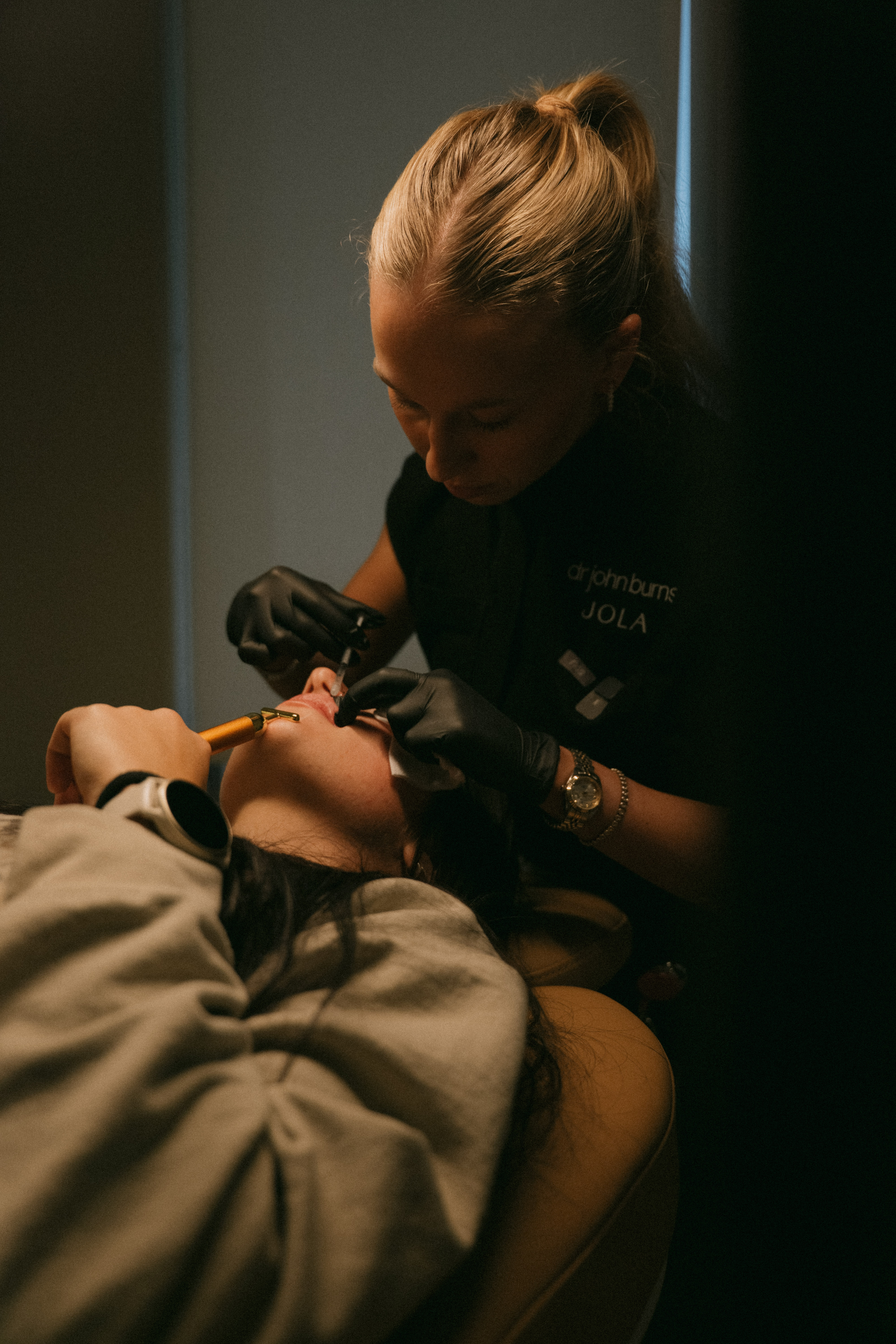
FACIAL AGING / TREATMENT PLANNING
WHY DO I LOOK DIFFERENT?
The seven changes that can quietly alter how rested, defined, and balanced your face appears.
A JOLA Dallas guide to facial aging, XERF, injectables, skin quality, and treatment planning.
JOLA DALLAS / AUG 2026
18 MIN READ
SECTION 01 / THE 30-SECOND ANSWER
Why Does My Face Suddenly Look Older?
Among the patients we see in Dallas — across Highland Park, University Park, Preston Hollow, and the Park Cities — one of the most common questions is surprisingly simple: why does my face look older all of a sudden? The feeling is real, but the word "older" does not tell us which layer changed. A face may appear older or more tired because several gradual changes become noticeable at the same time — skin-quality changes, loss of firmness, facial volume changes, jowling, changes in facial proportions, movement-related lines, or pigment and sun damage. The correct treatment depends on which change is actually contributing.
XERF may be relevant when skin firmness or laxity is part of the concern. Sculptra or filler may enter the conversation when volume or structural support is relevant. Botox or Dysport may be relevant when muscle movement contributes. Laser or skin treatments may be relevant when pigment, texture, redness, or skin quality is dominant. Some patients may need multiple categories. Some may need only one. Some may not need treatment. This is how JOLA Dallas approaches the question — not by naming a treatment first, but by identifying the change.
WHAT YOU NOTICE
- "I look tired."
- "I look heavy."
- "My face looks flatter."
- "My jawline disappeared."
- "My skin looks different."
- "I don't look like myself."
WHAT MAY ACTUALLY BE CHANGING
- Skin quality
- Firmness
- Volume
- Tissue position
- Structure
- Movement
- Pigment / texture
THE WORD "OLDER" DOESN'T TELL US WHICH LAYER CHANGED.
SECTION 02
You Probably Didn't Age "All of a Sudden"
The perception of sudden change is common, but the changes themselves are usually gradual. What often shifts is not the face but the moment of noticing — a photograph taken at a certain angle, a change in lighting, a new mirror, a different season, a period of poor sleep or stress, a change in makeup or hair, or a recent weight fluctuation. Any of these may make gradual changes suddenly visible. Why does my face look different is often a question about perception as much as anatomy.
It is also important to distinguish cosmetic awareness from medical change. If a physical change is genuinely sudden, unexplained, asymmetric, painful, or associated with other symptoms, it should be medically evaluated rather than assumed to be cosmetic aging. Aesthetic treatment is not a substitute for medical assessment when the change is outside the scope of normal, gradual facial aging.
SECTION 03
The Face Ages in Layers
Understanding why does my face look older requires understanding that the face is not one structure. It is a set of layers — surface, skin, volume, movement, support, and contour — each of which changes independently and at its own pace. A face rarely looks older because of one thing. It looks different because multiple layers shifted, and one or two became visible enough to notice.
SURFACE
Pigment · Texture · Hydration · Fine lines
SKIN
Collagen · Elasticity · Firmness
VOLUME
Fat compartments · Soft-tissue fullness
MOVEMENT
Facial expression · Dynamic lines
SUPPORT
Bone · Chin · Jaw · Midface relationships
CONTOUR
Jowls · Jawline · Neck
NO SINGLE AESTHETIC TREATMENT ADDRESSES EVERY LAYER
SECTION 04 / CHANGE 01
Your Skin Doesn't Reflect Light the Same Way
The surface of the skin — its texture, hydration, fine lines, pigment, sun damage, redness, and surface regularity — strongly influences how rested and luminous the face appears. When skin quality changes, the face may look tired, dull, or less rested even when facial structure has not changed significantly. This is why two people with similar facial structure can look differently "aged" — the difference may live in the skin surface, not the skeleton.
Skin-quality concerns may involve skin health programs, laser treatments, HydraFacial, or a custom skincare strategy. These categories address the surface layer — pigment, texture, hydration, and tone — rather than structure or volume.
SECTION 05 / CHANGE 02
Your Skin May Be Less Firm
Beneath the surface, the skin's structural layer — its collagen and elastin — changes over time. Reduced firmness, early laxity, jawline softness, and neck changes may develop gradually. When skin firmness is actually part of the concern, XERF may enter the treatment conversation. XERF is a radiofrequency treatment that delivers controlled energy to support the skin's structural foundation. It is not a laser, not an injectable, and not surgery — it is a non-invasive energy-based category for patients whose primary concern is firmness.
XERF is most relevant for patients with early to moderate skin laxity in the jawline, neck, or lower face. It does not address volume, movement, or pigment — it addresses firmness. When firmness is the layer that changed, XERF may be a meaningful part of the plan. When it is not, another category is more appropriate.
For a full overview, see What Is XERF RF Skin Tightening? and the XERF Dallas treatment page.
SECTION 06
What XERF Can and Cannot Address
XERF is a valuable category when used for the right concern. Understanding its scope is part of understanding why does my face look older — because if the change is not in the firmness layer, XERF is not the answer.
XERF MAY ENTER THE CONVERSATION FOR
- +
Skin firmness
- +
Skin laxity
- +
Jawline skin
- +
Lower-face skin
- +
Neck skin
- +
Supported treatment areas
XERF DOES NOT CREATE
- −
Cheek volume
- −
Temple volume
- −
Chin projection
- −
Jaw bone
- −
Surgical tissue repositioning
FIRMNESS IS ONE PART OF FACIAL AGING
SECTION 07 / CHANGE 03
Your Face May Have Lost Volume
Facial volume lives in the fat compartments and soft-tissue fullness of the midface, temples, cheeks, and under-eye relationships. Over time, these compartments may shift and diminish — sometimes from age-related changes, sometimes from weight loss. A volume-deficient face may appear tired, hollow, or less supported, even when the skin itself is firm.
Not all volume loss should be replaced. But when volume is the actual concern, categories like facial balancing, Sculptra, or dermal fillers may enter the conversation. The question is not whether volume loss exists, but whether it is the layer contributing most to the overall impression of change.
SECTION 08
Why "Just Add Filler" Isn't Always the Answer
Adding volume should have a specific anatomical purpose. If the primary issue is skin laxity, texture, pigment, or muscle movement, simply adding filler may not address the actual concern — and may create a heavier, less defined appearance. Can too much filler make a face look heavy? Yes. Volume should solve a volume problem, not a firmness problem, a movement problem, or a pigment problem.
VOLUME SHOULD SOLVE A VOLUME PROBLEM.
This is why JOLA's approach to injectables is consultation-led and restraint-oriented. For more on this philosophy, see How Much Filler Is Too Much? and Why Natural-Looking Results Require More Planning Than People Think.
SECTION 09 / CHANGE 04
The Lower Face May Be Changing
The lower face — jowls, pre-jowl area, jawline, lower cheek, chin-jaw relationship, and neck transition — is often where patients first say "I suddenly look older." This is because the lower face is where multiple aging layers converge: skin laxity, tissue position, volume distribution, and skeletal relationships all meet at the jawline. Why is my jawline disappearing is often a question about this convergence.
When skin laxity contributes to lower-face change, XERF for jowls and XERF for jawline may enter the conversation. When volume or structure is the primary contributor, facial balancing may be more appropriate.
SECTION 10
Why Do Jowls Make the Face Look Different?
Jowling changes the transition between cheek, jaw, chin, and neck. Even subtle jowling can alter the overall impression of the face because it softens the jawline — the structural edge that frames the lower face. But jowls are multifactorial. Potential contributors include skin laxity, tissue position, volume changes, and skeletal relationships. XERF does not universally eliminate jowls; it may enter the conversation when skin laxity is a contributing factor. A consultation determines which layer is dominant.
SECTION 11 / CHANGE 05
Your Facial Proportions May Look Different
Small changes in chin, jawline, midface, cheek, temple, lip, facial thirds, or profile can alter overall facial harmony. The face is perceived as a proportional whole — a shift in one area may change the balance of the entire picture. This is why some patients say "I don't look like myself" even when they cannot identify a specific change. The change may be proportional rather than structural.
Facial balancing is the category that addresses proportional relationships — not by adding volume everywhere, but by assessing how the face works as a whole.
SECTION 12
What Facial Balancing Actually Means
Facial balancing is not simply "getting filler everywhere." It is a proportional assessment — an evaluation of measurements, relationships, profile, symmetry without chasing perfect symmetry, restraint, and structure. The goal is harmony, not volume. A balanced face is not a filled face; it is a face whose proportions work together.
For more, see What Is Facial Balancing, and Why Do the Best Results Start With Precise Measurements?
SECTION 13 / CHANGE 06
Movement Lines May Stay Longer
Dynamic lines — forehead, glabella, crow's feet — are created by repeated facial expression. Over time, these lines may remain visible at rest. Neuromodulators like Botox and Dysport address muscle activity, which is a different mechanism from XERF. Botox treats movement; XERF treats firmness. They are not interchangeable categories — they address different layers.
SECTION 14
Can Botox Make You Look More Rested?
For appropriately selected patients, softening certain movement-related lines may create a more rested appearance. But Botox does not restore volume, tighten loose skin, resurface sun damage, or create jaw structure. It is one category, not a universal rejuvenation treatment. If the primary concern is not movement, Botox may address a layer that is not the main contributor — which is why some patients say they still look tired after Botox. The treatment did not fail; it simply treated a layer that was not the priority.
SECTION 15 / CHANGE 07
Pigment, Redness, and Texture Can Age the Appearance of Skin
Brown spots, uneven pigment, redness, visible vessels, texture, pores, fine lines, and sun damage may make skin appear less luminous and less rested. Skin quality strongly influences perceived age — sometimes more than wrinkles. Laser treatments and skin health programs address this layer, which is distinct from the firmness layer that XERF addresses.
SECTION 16
Why Skin Quality Can Matter More Than Wrinkles
A face with movement can still look fresh when skin quality is strong. Conversely, uneven tone and texture may make skin appear less luminous even without significant wrinkles. This is why some patients who have never had Botox look rested, while others who have had extensive treatment still look tired — the difference may live in the skin surface, not in the muscle or volume layer.
LOOKING RESTED IS NOT THE SAME AS HAVING NO LINES.
SECTION 17
The "I Look Tired" Map
Different areas of the face may look "tired" for different reasons. The map below is educational — it is not a diagnostic tool — but it illustrates how the same word ("tired") may point to different layers depending on where the concern is noticed.
THE "I LOOK TIRED" MAP
Select a concern to explore possible contributors.
EDUCATIONAL ONLY — NOT A DIAGNOSTIC TOOL
SECTION 18
Do I Need XERF or Filler?
This is one of the most common questions, and the answer depends entirely on which layer changed. If the primary concern is skin firmness or laxity, XERF or another energy-based treatment may enter the conversation. If the primary concern is volume or structural support, filler may enter the conversation. If both are present, combination planning may be considered. Neither is automatically "better."
XERF vs. Filler
IF THE PRIMARY CONCERN IS
Skin firmness / laxity
Jawline softening, neck laxity, lower-face skin changes, early jowling where skin laxity contributes.
IF THE PRIMARY CONCERN IS
Volume / structural support
Midface flattening, temple hollowing, chin projection, specific structural deficits.
XERF addresses firmness. Filler addresses volume. They work through different mechanisms on different layers. The treatment should match the layer that changed.
SECTION 19
Do I Need XERF or Sculptra?
XERF is a non-invasive radiofrequency treatment for skin firmness. Sculptra is an injectable poly-L-lactic acid biostimulator for collagen support and volume-related treatment planning. They are different categories that work through different mechanisms. XERF does not create volume; Sculptra does not tighten loose skin. They may be complementary in some plans, but they are not interchangeable.
XERF vs. Sculptra
IF THE PRIMARY CONCERN IS
Skin firmness
Non-invasive RF for patients whose primary concern is laxity, jawline softness, or neck firmness.
IF THE PRIMARY CONCERN IS
Collagen support / volume-related planning
Injectable PLLA biostimulator for patients whose primary concern involves volume or structural support.
XERF and Sculptra are different categories. The choice depends on which layer is the primary concern. They may be sequenced together in some plans.
SECTION 20
Do I Need XERF or Botox?
XERF addresses skin firmness. Botox and Dysport address muscle activity and movement lines. If someone has jawline laxity and forehead movement lines, those are two separate concerns that may require different categories. They are not interchangeable, and choosing one over the other should be based on which layer is the actual concern.
XERF vs. Botox
IF THE PRIMARY CONCERN IS
Skin firmness
Jawline, neck, lower-face laxity.
IF THE PRIMARY CONCERN IS
Muscle movement
Forehead, glabella, crow's feet, dynamic expression lines.
XERF and Botox address different mechanisms. A patient may benefit from both if both layers are concerns — but each should be chosen for a reason.
SECTION 21
Do I Need XERF or Laser?
"Laser" is a broad category. Generally, the firmness and laxity conversation (XERF) is distinct from the pigment, texture, and resurfacing conversation (laser), depending on the technology. It is critical to understand: XERF is a radiofrequency treatment, not a laser. Radiofrequency and laser are different energy categories that work through different mechanisms and address different layers.
XERF vs. Laser
IF THE PRIMARY CONCERN IS
Skin firmness / laxity
Radiofrequency for deeper structural support — jawline, neck, lower face.
IF THE PRIMARY CONCERN IS
Pigment / texture / resurfacing
Laser technologies for surface concerns — brown spots, redness, texture, fine lines.
XERF is RF, not laser. If the concern is laxity, XERF may be relevant. If the concern is pigment or texture, laser may be relevant. They address different layers.
SECTION 22
What If I Have All of These Changes?
This is common. A patient may have movement, skin quality, mild laxity, and volume changes at the same time. This does not mean they need four treatments immediately. Prioritization matters. The most meaningful improvement often comes from addressing the one or two layers contributing most to the overall impression — not from treating every visible change.
A GOOD PLAN DOES NOT TREAT EVERYTHING IT CAN SEE. IT TREATS WHAT MATTERS MOST.
SECTION 23
Is There One Treatment That Makes the Whole Face Look Younger?
Usually, no. Treatments work through different mechanisms on different layers. But this does not mean every patient needs multiple treatments. When one concern dominates — for example, when skin laxity is the primary issue and everything else is secondary — one carefully selected treatment may make a meaningful difference. The key is identifying which layer matters most, not stacking treatments by default.
SECTION 24
How to Look More Refreshed Without Looking "Done"
JOLA's philosophy for natural-looking results is built on several principles: diagnose the concern before choosing the treatment, prioritize what matters most, use restraint, respect anatomy, preserve movement, preserve identity, avoid unnecessary volume, support skin quality, and allow progressive treatments to remain progressive. The goal is not to eliminate every sign of age — it is to make the face look more like itself, just more rested.
THE GOAL IS NOT TO LOOK TREATED. THE GOAL IS TO MAKE THE TREATMENT HARD TO IDENTIFY.
For more, see What to Do First If You Want to Look Refreshed, Not Treated.
SECTION 25
How to Look More Refreshed Without Filler
Depending on the concern, options may include XERF, Botox or Dysport, laser, skin rejuvenation, skincare, or HydraFacial. But if volume loss is the actual problem, refusing all volume treatment may leave the primary concern unaddressed. How to look refreshed without filler is a valid question — and the answer depends on which layer changed. If the layer is not volume, non-volume treatments may be the right answer. If it is volume, filler or Sculptra may be the most appropriate category.
SECTION 26
How to Look More Refreshed Without Botox
If movement lines are not the main concern, other categories may matter more — skin quality, firmness, volume, pigment, or texture. Botox is one category, not a universal rejuvenation treatment. Choosing not to use Botox is a valid decision when movement is not the layer that changed. Botox is not framed negatively here; it is simply one tool, appropriate when movement is the concern and unnecessary when it is not.
SECTION 27
How to Look More Refreshed Without Surgery
Non-invasive and minimally invasive aesthetic categories may address skin quality, firmness, volume, movement, and pigment. However, non-surgical treatment is not equivalent to facelift surgery. Some goals may be better served by surgery, and some by non-surgical treatment. How to look younger without surgery is a common question, and the honest answer is that it depends on the magnitude of change desired and the anatomy involved. For more, see XERF vs. Facelift.
SECTION 28
Why Your Face May Look Different After Weight Loss
Weight loss may affect facial volume, skin laxity, neck changes, jowls, and the visibility of skeletal structure. The face may appear less supported or less firm after significant weight reduction. Treatment planning depends on which layer is most affected — XERF for firmness, Sculptra or filler for volume, or combination planning. For more, see XERF After Weight Loss.
SECTION 29
What About GLP-1 Facial Changes?
Facial changes associated with substantial weight loss may involve volume, skin, and tissue relationships, and differ from patient to patient. GLP-1 use does not create one universal facial condition. XERF may enter when skin firmness is relevant; Sculptra or filler may enter when volume is relevant. Combination planning may sometimes be considered, but treatment should be individualized based on the patient's anatomy and goals — not assumed from a medication category.
SECTION 30
Why Your Face May Look Different in Your 30s
In the 30s, patients may notice early movement lines, skin-quality changes, early volume changes, early firmness changes, and lifestyle-related sun exposure effects. These changes are typically subtle. Not everyone should start treatment in their 30s — treatment is optional and should be based on anatomy and goals, not age alone. For more on this philosophy, see What Is the Best Age to Start Aesthetic Treatments?
SECTION 31
Why Your Face May Look Different in Your 40s
In the 40s, skin firmness, volume, lower-face changes, pigment, texture, movement, and collagen-related changes may become more noticeable. This is often when patients first say "I suddenly look older" — not because aging accelerated, but because multiple gradual layers became visible at the same time. Why does my face look different in my 40s is often a question about layer convergence. Prioritization matters: identifying the one or two layers contributing most is more valuable than treating all of them.
SECTION 32
Why Your Face May Look Different in Your 50s and Beyond
Age alone does not define aesthetic candidacy. In the 50s and beyond, multiple layers may become more relevant, and desired magnitude becomes important. Natural-looking treatment is still possible. Surgery may be a more appropriate category for some goals, while non-surgical treatment may be appropriate for others. The decision is based on anatomy and desired outcome, not on age.
SECTION 33
Why You May Look "Tired" Even If You Have No Wrinkles
Tired appearance is not reducible to wrinkles. It may involve under-eye anatomy, skin tone, volume, pigment, brow and eye relationships, skin quality, facial proportions, and health or sleep considerations. A face with no movement lines can still look tired if the skin is dull, the under-eye area is hollow, or the facial proportions have shifted. This is why treating wrinkles alone does not always address the concern — the tired layer may be elsewhere.
SECTION 34
Why You May Look "Older" Even After Botox
Botox treats movement. It does not necessarily address skin quality, volume, pigment, laxity, jowls, neck, or structure. If the dominant concern was not movement, Botox may have addressed only one layer — and the face may still look older or tired because the other layers were not treated. This does not mean Botox failed. It may simply have addressed a layer that was not the primary contributor to the overall impression.
SECTION 35
Why You May Still Look Tired After Filler
Filler addresses specific volume and structural concerns. If the dominant issue is skin, movement, pigment, texture, or laxity, more filler may not be the answer. Adding volume to a face whose primary concern is not volume may not produce the desired result — and may create a heavier appearance. This is why identifying the layer that changed matters more than choosing a treatment by name.
SECTION 36
Why More Treatment Can Sometimes Make the Answer Less Clear
Treatment stacking — chasing every minor feature, losing prioritization, adding unnecessary volume, or repeating device treatment without a clear endpoint — can sometimes make the face look more treated without looking more refreshed. More treatment is not the same as more refinement. The ability to treat something is not the same as a reason to treat it.
MORE TREATMENT IS NOT THE SAME AS MORE REFINEMENT.
SECTION 37
The JOLA "Why Do I Look Older?" Framework
When a patient says "I look older," JOLA does not start with a treatment name. We start with a series of questions designed to identify which layer changed — and whether treatment is even needed.
THE JOLA "WHY DO I LOOK OLDER?" FRAMEWORK
You say: "I look older." JOLA asks:
IS IT THE SKIN SURFACE?
↓IS IT SKIN FIRMNESS?
↓IS IT FACIAL VOLUME?
↓IS IT MOVEMENT?
↓IS IT JOWLING?
↓IS IT FACIAL STRUCTURE?
↓IS IT THE NECK?
↓IS IT WEIGHT-RELATED CHANGE?
↓IS IT MULTIPLE LAYERS?
↓WHAT ACTUALLY BOTHERS YOU?
↓HOW MUCH CHANGE DO YOU WANT?
↓DOES IT NEED TREATMENT AT ALL?
THE GOAL IS NOT TO TREAT AGE.
THE GOAL IS TO UNDERSTAND THE CHANGE.
SECTION 38
The "Treatment by Concern" Map
Once the layer is identified, the treatment category follows. The map below is an educational framework — not a treatment prescription. The actual plan depends on anatomy, goals, and consultation.
THE "TREATMENT BY CONCERN" MAP
MOVEMENT
Botox / Dysport
SKIN FIRMNESS
XERF / appropriate energy treatment
VOLUME
Sculptra / filler / facial balancing depending on anatomy
PIGMENT
Appropriate laser / skin treatment
TEXTURE
Laser / microneedling / skin refinement depending on concern
JAWLINE
XERF / facial balancing / combination planning depending on anatomy
MULTIPLE LAYERS
Staged treatment planning
THIS IS AN EDUCATIONAL FRAMEWORK, NOT A TREATMENT PRESCRIPTION
SECTION 39
Where XERF Fits Into Facial Aging
XERF belongs specifically in the conversation around skin firmness, skin laxity, jawline skin, jowling where skin laxity contributes, lower-face skin, neck skin, and collagen-related remodeling where supported. It should not be positioned as a universal facial-aging treatment. It is a category for one layer — the firmness layer — and it is most valuable when that layer is the one that changed.
XERF DOESN'T NEED TO TREAT EVERYTHING TO BE VALUABLE. IT NEEDS TO TREAT THE RIGHT THING.
SECTION 40
Why XERF Has Become Part of JOLA's Treatment-Planning Conversation
XERF provides another category for patients whose concern is not primarily volume or movement. Before XERF, the conversation was often framed as "Botox or filler?" Now JOLA can consider movement, volume, skin, structure, texture, and energy-based treatment as separate categories — each appropriate for a different layer. This allows for more precise planning. XERF is not superior to other categories; it is complementary. It fills a gap for patients whose primary concern is firmness.
SECTION 41
When the Change Is in the Skin
WHEN THE CHANGE IS IN THE SKIN

LASER SPECIALIST / JOLA DALLAS
Chey Cope
LASER SPECIALIST — ENERGY-BASED TREATMENTS
Energy-based treatment planning at JOLA may involve assessing skin quality, firmness, laxity, pigment, texture, jawline, neck, previous laser, previous RF, previous ultrasound, previous filler, previous Sculptra, skin tone, history of pigmentation, downtime preference, and desired magnitude. The goal is to understand whether an energy-based treatment — such as XERF — fits the concern, or whether another category is more appropriate.
@MAISON.DE.CHEYSECTION 42
Why the Consultation Should Come Before the Treatment
Patients increasingly arrive saying "I want XERF," "I want Sculptra," "I want Botox," or "I want filler." But the better starting point may be: "I want my jawline to look more defined." "I look tired." "My skin changed." "My face feels less balanced." Then the category is determined by the concern — not the other way around. This is why treatment planning and the JOLA consultation come before any treatment decision.
SECTION 43
What JOLA May Say "Not Yet" To
JOLA may say "not yet" to filler when no meaningful volume deficit exists, Botox when movement is not the concern, XERF when laxity is not the concern, laser when pigment or texture does not justify treatment, Sculptra when biostimulation or volume support does not fit the goal, and combination treatment simply because multiple treatments exist. The ability to treat something is not the same as a reason to treat it.
THE ABILITY TO TREAT SOMETHING IS NOT THE SAME AS A REASON TO TREAT IT.
SECTION 44
The Refreshed, Not Treated Checklist
A refined plan should ask these twenty questions before any treatment is chosen.
THE REFRESHED, NOT TREATED CHECKLIST
A refined plan should ask:
What specifically changed?
Is the concern visible at rest?
Is it movement-related?
Is it skin quality?
Is it skin laxity?
Is it volume?
Is it facial structure?
Are jowls involved?
Is the neck involved?
Did weight change?
Is pigment contributing?
Is texture contributing?
Is the under-eye actually the primary concern?
What treatment category matches it?
What should NOT be treated?
How much change is desired?
Is the desired result non-surgical?
Can one treatment address the priority?
Should treatment be staged?
Would doing nothing yet also be reasonable?
SECTION 45
What Should I Do First If I Just Want to Look Better?
Start by identifying the one or two changes contributing most to the overall impression. Then prioritize. Do not start with a treatment name — start with what changed. For more, see What to Do First If You Want to Look Refreshed, Not Treated.
SECTION 46
Why Does My Face Look Older? The Bottom Line
Faces do not age in one layer. They age across surface, skin, volume, movement, support, and contour — each at its own pace. Sudden awareness does not necessarily mean sudden aging; it often means that multiple gradual changes became visible at the same time. Skin quality matters. Firmness matters. Volume matters. Movement matters. Structure matters. Jowls matter. Pigment and texture matter. Neck changes matter. Weight loss may alter multiple layers.
"Tired" does not automatically mean under-eye filler. "Sagging" does not automatically mean XERF. "Hollow" does not automatically mean filler. Wrinkles do not automatically mean Botox. XERF is radiofrequency, not laser. XERF does not restore volume. Sculptra is a different category from XERF. Botox is a different category from XERF. Laser is a broad category. Treatment should match anatomy, not a trend.
Treatment does not need to address every visible change. Combination treatment should have a reason. Natural results often depend on restraint. Some patients may benefit from surgery for the magnitude they want. Some may need one treatment. Some may need several categories over time. Some may need nothing — and that is also a valid answer.
If you look in the mirror and think "I suddenly look older," resist the urge to immediately ask: what should I get? Start with: what changed? Skin quality? Firmness? Volume? Movement? Structure? Jawline? Neck? Once the change is identified, the treatment decision becomes considerably more precise. That is the difference between treating age and treating anatomy.
YOU DON'T LOOK "OLDER."
YOU'RE NOTICING A CHANGE.
IDENTIFY THE LAYER.
THEN CHOOSE THE CATEGORY.
CTA 01
YOU DON'T NEED TO KNOW THE TREATMENT NAME.
START WITH WHAT CHANGED.
Begin with the layer that changed — not the treatment you heard about.
EXPLORE JOLA TREATMENT PLANNINGCTA 02
SKIN? VOLUME? MOVEMENT? STRUCTURE?
THE ANSWER CHANGES THE PLAN.
A consultation identifies which layer matters most before any treatment is chosen.
EXPLORE AESTHETIC CONSULTATIONFrequently Asked Questions
WHAT CHANGED?
JOLA DALLAS
LOOK MORE LIKE YOURSELF.
NOT MORE "TREATED."
Don't treat age. Identify the change. A JOLA consultation begins with what changed — not with a treatment name.
214.515.0002