
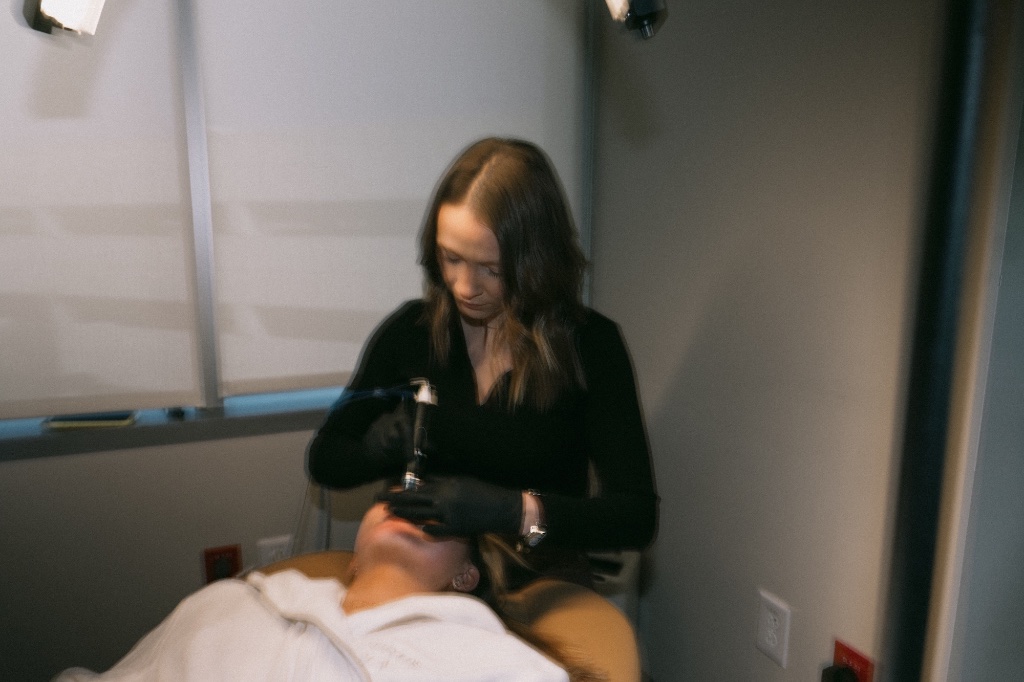
THE TREATMENT WARDROBE / eCO2 3D + COMBINATION TREATMENT PLANNING
CO2 Laser Combination Treatments: How JOLA Builds a Complete Skin & Facial Rejuvenation Plan
What belongs
with it?
One treatment does not need to solve every layer of the face.
FITTING ROOM / SELECT A WORD
What are you
trying to change?
Different concerns live in different treatment categories. This is a teaching tool, not a diagnosis. It shows why one device rarely owns every word on this list.
THE 60-SECOND ANSWER
What can you combine with CO2 laser?
CO2 laser resurfacing can be part of a broader treatment plan with other aesthetic modalities when those treatments address different concerns. Depending on the patient, JOLA may discuss XERF radiofrequency, ULTRA non-ablative laser, the K-LUXE pairing of XERF and ULTRA, neuromodulators such as Botox or Dysport, dermal filler, Sculptra, Hydrafacial and medical-grade skincare.
Combining treatments does not necessarily mean performing them together. Combined means part of the same broader strategy. Simultaneous means performed during the same appointment. Order and timing depend on the procedure, treatment area, skin, healing, clinical goal, medical history and provider protocol, and some steps may be weeks or months apart.
CO2 primarily belongs to the resurfacing conversation. It does not automatically solve dynamic muscle movement, facial volume loss, significant structural laxity, every type of pigmentation, or every component of skin quality. Combination planning is therefore not about adding procedures. It is about assigning each concern to the appropriate tool, and sometimes concluding that one tool, or none, is enough.
COMBINED
Part of the same broader treatment strategy.
SIMULTANEOUS
Performed during the same appointment.
ONE FACE.DIFFERENT JOBS.ONE PLAN.
01
The Foundation
Before adding anything, understand what CO2 is responsible for.
LOOK 01.01
What does eCO2 3D actually do?
eCO2 3D is a fractional ablative CO2 laser from Cynosure Lutronic operating at 10,600 nm. It creates controlled microscopic treatment zones in the skin, surrounded by untreated tissue, to support resurfacing and remodeling. It belongs to the resurfacing conversation.
Fractional means the laser treats a pattern of columns rather than the entire surface at once. Ablative means those columns vaporize a small amount of tissue. The intact skin between columns supports healing. That is the full mechanism a combination plan needs to understand here. Settings, depth and density are chosen by the treating provider, and they change both the result and the recovery. The technology is covered in depth in the pillar guide, so this page focuses on what CO2 is responsible for when other treatments are also on the table.
Read the eCO2 3D Dallas guide →LOOK 01.02
What CO2 resurfacing is good at addressing
Fractional CO2 resurfacing is supported by clinical literature for selected acne scars, uneven texture, fine lines and rhytides, photoaging, and certain surface irregularities. Response varies by scar type, skin, settings and healing, and no single session result is guaranteed.
These are surface and upper-dermal objectives. They involve how skin reflects light, how smooth it appears, and how its structure has been altered by sun, time or past inflammation. When the primary concern lives here, CO2 may be a central tool. When the concern lives somewhere else, such as muscle activity or the position of deeper tissue, CO2 is not the tool doing that job, even if it still has a role elsewhere in the plan.
See how to read eCO2 3D results →LOOK 01.03
What CO2 does not automatically fix
CO2 does not relax muscle movement, restore lost volume, reposition significant structural laxity, resolve every pigment disorder, correct every scar type, or address every sign of facial aging. Those concerns belong to other categories of treatment, or sometimes to surgery.
This is not a weakness of the device. It is a definition of its job. A resurfacing laser that is asked to compensate for volume loss, or for a strong frown muscle, will be judged against a result it was never designed to produce. Knowing the boundary early protects the patient from disappointment and protects the skin from settings chosen to chase the wrong endpoint.
MOVEMENT.VOLUME.STRUCTURAL LAXITY.EVERY PIGMENT PROBLEM.EVERY SCAR TYPE.EVERY SIGN OF AGING.
LOOK 01.04
Why this matters for combination treatment
When a patient has several different concerns, asking one modality to solve all of them can lead to over-treatment, unrealistic expectations or poor treatment selection. Combination planning exists to give each concern to the tool that is actually responsible for it.
Consider a face with acne scarring, a strong glabellar frown and early flattening in the midface. Treating all three with more aggressive resurfacing would increase recovery and risk without addressing two of the three concerns. Assigning surface to resurfacing, movement to a neuromodulator and volume to an appropriate injectable is not doing more. It is doing each thing in the right place. Whether any of those treatments is needed, and in what order, is still decided in consultation.
DON'T MAKEONE TOOLDO FIVE JOBS.
Is CO2 right for me →02
The Surface
Texture. Scars. Tone. Skin quality.
LOOK 02.01
Can you combine eCO2 3D and ULTRA?
eCO2 3D and ULTRA can both belong to one long-term plan, but they are different technologies with different jobs. eCO2 3D is fractional ablative CO2 at 10,600 nm. LaseMD ULTRA is a 1927 nm non-ablative fractional thulium laser. JOLA does not assume they are performed together.
Both sit in the skin-quality conversation, which is why patients ask about them together. The difference is intensity and target. CO2 removes microscopic columns of tissue and is generally discussed for scars, deeper texture and photoaging. ULTRA is non-ablative and is generally discussed for superficial tone, pigment, texture and radiance with a lighter recovery profile. We do not claim a proven synergy between them. A provider might consider them in the same plan because they serve different objectives at different points in time, for example a resurfacing phase followed later by lighter surface maintenance.
Read the ULTRA laser Dallas guide →LOOK 02.02
CO2 + ULTRA: why would someone need both?
Someone might have both in a plan when they have a concern that warrants ablative resurfacing and a separate, ongoing surface goal that a lighter non-ablative laser may serve. Many patients need only one. The decision depends on goals, recovery tolerance and assessment.
Different goals: a scar-focused resurfacing phase is not the same objective as periodic tone and radiance maintenance. Different intensity: ablative and non-ablative treatments carry different recovery and risk profiles. Different recovery windows: a patient may be able to schedule one meaningful recovery a year but prefer lighter treatments between. Maintenance architecture: the question becomes which tool maintains what the other started, if anything needs maintaining at all.
NOT:CO2 PLUS MORE CO2.INSTEAD:DIFFERENTRESURFACINGSTRATEGIES.
LOOK 02.03
Can you get a Hydrafacial with CO2 laser?
Hydrafacial and CO2 can both appear in a skin plan, but they do very different work. Hydrafacial is a cleansing, exfoliation, extraction and hydration treatment. CO2 is fractional ablative resurfacing. Hydrafacial is not performed on healing post-CO2 skin unless your treating provider clears it.
Hydrafacial maintains the surface. CO2 remodels it. One does not substitute for the other, and a Hydrafacial will not reproduce what ablative resurfacing does. Patients often ask this question because they enjoy Hydrafacial and want to know whether it fits around a CO2 phase. It may, at points where the skin is intact and the provider agrees it serves a purpose.
Explore Hydrafacial at JOLA →LOOK 02.04
Hydrafacial before CO2
JOLA does not publish a universal rule for Hydrafacial before CO2. Whether a pre-procedure facial is useful, and how close to treatment it may be scheduled, is decided by your treating provider based on your skin and the planned settings.
Some patients already receive Hydrafacial as maintenance and simply continue until the provider asks them to pause. Others never need one. A facial is not required preparation for CO2 by default, and any pre-procedure instructions you receive from JOLA take priority over general information here.
LOOK 02.05
Hydrafacial after CO2
After CO2, the skin needs to complete its healing before any exfoliating or suctioning treatment is considered. There is no universal interval published here. Timing depends on the depth of treatment, how your skin heals and provider clearance at follow-up.
Healing skin is not ready for extraction or exfoliation, even when it looks calm on the surface. Your provider will assess recovery and tell you when maintenance treatments may resume. If anyone gives you a fixed number of days without having seen your skin, treat that number as a generalization, not a plan.
Understand CO2 laser recovery →LOOK 02.06
CO2 + medical-grade skincare
Medical-grade skincare supports a CO2 plan before, during and after treatment, but it does not replace resurfacing. Its roles are preparation as directed by your provider, gentle support during recovery, photoprotection and long-term maintenance between procedures.
The procedure is a single day. Skincare is every day. That asymmetry is why home care matters. Preparation may involve adjusting or pausing certain actives, but only as your clinician directs. Recovery generally calls for simplicity rather than ambition. Long-term, a considered regimen and daily sun protection help support skin health after the procedure. We do not prescribe individualized regimens on this page because the right one depends on your skin, your medications and your treatment.
THE PROCEDUREIS ONE DAY.SKINCAREIS EVERY DAY.
Read the clinical skincare guide →LOOK 02.07
CO2 + retinol and retinoids
There is no universal stop and restart schedule for retinoids around CO2 that applies to everyone. Whether and when to pause, and when to resume, is set by your treating provider. Do not stop or start a prescription retinoid without your prescriber’s guidance.
Retinoids can increase skin sensitivity, which is why they are discussed before resurfacing. Prescription retinoids are medications, and changes should come from the clinician who prescribed them in coordination with your laser provider. Isotretinoin history is a separate, important candidacy discussion covered in the candidacy guide.
CO2 laser candidacy →LOOK 02.08
CO2 + vitamin C
Vitamin C may belong in a long-term regimen, but potentially irritating actives are not applied to freshly treated skin. When a topical antioxidant can return after CO2 is decided by your provider at follow-up, not by a general schedule.
Healing skin has a compromised barrier. Acidic or active formulas that feel fine on intact skin may sting or irritate during recovery. The safest general principle is to follow the aftercare you are given and reintroduce actives only when cleared.
LOOK 02.09
CO2 + sunscreen
Photoprotection is part of every responsible resurfacing plan. Daily sun protection and sun avoidance, as directed by your provider, help protect healing and treated skin. Which product and when to begin applying it after treatment follows JOLA aftercare instructions.
Dallas sun is not a minor variable. UV exposure is one of the factors discussed in relation to pigment changes after resurfacing, particularly for patients at higher risk of post-inflammatory hyperpigmentation. Sun protection is not a product recommendation here. It is a behavior that belongs in the plan before treatment is scheduled.
LASERWITHOUTPHOTOPROTECTIONIS ANINCOMPLETE PLAN.
CO2 laser pigmentation risk →LOOK 02.10
CO2 + custom skincare
Custom skincare means a regimen selected for your skin, concerns and treatment phase rather than a standard kit. Around CO2, personalization matters because preparation, recovery and maintenance each call for different priorities.
A patient prone to pigment, a patient with active acne and a patient with dry, sensitive skin may all receive CO2, and they should not all go home with the same routine. JOLA approaches home care as part of the plan, discussed in consultation and adjusted as the skin changes.
JOLA skincare plan →03
The Structure
Laxity. Firmness. Support.
LOOK 03.01
Can you combine XERF and CO2 laser?
XERF and CO2 can belong to the same treatment strategy because they address different objectives. eCO2 3D is fractional ablative laser resurfacing. XERF is a Cynosure Lutronic multifrequency radiofrequency treatment, not a laser, used in conversations about skin firmness. Combined does not mean same day.
The logic is surface plus a deeper tissue objective. CO2 works on the skin surface and upper dermis through ablative columns. XERF delivers radiofrequency energy as heat to deeper tissue in a non-ablative way. Both are associated with collagen remodeling, but they do not reach the same tissue in the same way and they are not interchangeable. We do not claim that XERF tightens what CO2 cannot, or that the two multiply each other. What we can say is that a patient with both a surface concern and a firmness concern may have two separate questions, and each question may have its own tool.
RESURFACETHE SKIN.ADDRESSA DIFFERENTDEPTH.
XERF skin tightening Dallas →LOOK 03.02
Why CO2 + XERF may enter the same treatment plan
CO2 and XERF may enter one plan when a patient has a surface concern and a separate firmness concern, for example texture with early laxity, photoaging with a firmness question, or scarring alongside softening along the jawline. Not everyone with one concern has the other.
The test is whether each treatment has a distinct job. If laxity is minimal, XERF may not be needed. If texture is mild and laxity is the real concern, CO2 may not be needed. If laxity is significant enough that a surgical conversation is more appropriate, neither energy treatment should be presented as a substitute for surgery. A combination is justified by assessment, not by availability.
Skin tightening, filler or both →LOOK 03.03
CO2 before or after XERF?
There is no universal order for CO2 and XERF. Sequence depends on the treatment plan, areas treated, recovery, skin, clinical objective, manufacturer guidance and provider assessment. Your treating provider decides which comes first, and how far apart they are scheduled.
Some plans lead with the concern that matters most to the patient. Others lead with the treatment that has the longer recovery so that the lighter treatment can follow when the skin is ready. Others separate them by season or by event dates. What should not happen is choosing an order because it appears on a generic checklist.
LOOK 03.04
Can XERF and CO2 be done the same day?
Whether XERF and CO2 should be performed in the same visit is determined by the treating provider. JOLA does not publish a general same-day policy for this pairing on this page, and patients should not assume same-day treatment when they hear the word combination.
Same-day treatment depends on areas, settings, recovery, manufacturer guidance and the clinician’s judgment. If you are considering both, ask directly during consultation whether they would be staged and why.
LOOK 03.05
CO2 + K-LUXE
K-LUXE is the Cynosure Lutronic treatment concept that pairs XERF radiofrequency with ULTRA fractional laser. It does not include CO2. eCO2 3D may exist elsewhere in a broader, staged plan for a patient who also has K-LUXE, but the two remain separate.
This distinction matters for search and for safety. K-LUXE is not CO2 plus XERF plus ULTRA. It is XERF plus ULTRA. If a patient has a scar-focused resurfacing need and a separate surface and firmness maintenance goal, a provider might discuss CO2 at one point and K-LUXE at another. That is two different conversations in one plan, not a merged treatment.
K-LUXEIS NOTCO2.K-LUXE=XERF + ULTRA.
K-LUXE Dallas →LOOK 03.06
Why someone might have CO2 and K-LUXE in the same long-term plan
CO2 and K-LUXE might share a long-term plan because they involve different depths, goals, downtime windows and maintenance strategies. One is ablative resurfacing. The other is a non-ablative laser paired with radiofrequency. Same-day treatment is not assumed.
A patient might use a planned recovery window for CO2 and use K-LUXE at other times of year, when a lighter recovery fits their calendar. Another patient may need only K-LUXE. Another may need only CO2. The plan follows the face, and the calendar follows the plan.
K-LUXE event timing →LOOK 03.07
CO2 + RF microneedling
JOLA does not currently list RF microneedling, including Morpheus8, among its services, so this section is educational. RF microneedling delivers radiofrequency through needles. CO2 uses ablative laser columns. Both are discussed for texture and scarring, through different mechanisms.
Patients often compare them because both can involve a recovery period and both appear in acne scar conversations. They overlap in some indications and differ in delivery, depth control and recovery. Neither is universally better. At JOLA, the conversation about structure and firmness usually involves XERF, and the conversation about resurfacing may involve eCO2 3D or ULTRA, depending on the concern.
K-LUXE vs Morpheus8 →LOOK 03.08
CO2 vs RF microneedling vs combining them
Sometimes the answer is CO2. Sometimes it is RF microneedling. Sometimes a staged plan uses more than one modality. Sometimes the answer is neither. Combination is an option to be justified, never the default.
The useful question is not which device wins. It is what the scar or texture actually is, what depth it involves, how the skin is likely to respond, and how much recovery the patient can accept. Those answers come before any device name.
COMBINATIONIS AN OPTION.NOTTHE DEFAULT.
04
The Movement
Expression. Muscle. Dynamic lines.
LOOK 04.01
Can you get Botox and CO2 laser?
Botox and CO2 can appear in the same comprehensive facial plan because they work through different mechanisms. CO2 resurfaces skin. Botox is a neuromodulator that reduces activity in selected muscles. JOLA offers neuromodulators, and timing between the two is set by your provider.
A line that appears only when you frown is driven largely by movement. A line etched into the skin at rest may involve surface change as well. Many real faces have both components. That is why a plan might assign movement to a neuromodulator and surface to resurfacing. Neither treatment does the other’s job.
SURFACE+MOVEMENT.
Explore injectables at JOLA →LOOK 04.02
CO2 + Dysport
Dysport is also a neuromodulator offered at JOLA. The same framework applies: Dysport addresses selected muscle movement, CO2 addresses surface. The choice between Botox and Dysport is a separate clinical decision made by your injector.
Patients sometimes ask whether one neuromodulator combines better with CO2 than another. There is no basis on this page for claiming that. Product choice depends on the area, the patient’s history and the injector’s judgment.
Botox vs Dysport at JOLA →LOOK 04.03
Botox before or after CO2?
There is no universal answer to whether Botox should come before or after CO2. Sequencing depends on the areas, the timing of your last neuromodulator treatment, the planned resurfacing and your provider’s protocol. Ask your treating provider for your specific sequence.
Sequencing matters because both treatments involve the same face, sometimes the same area, and because swelling, healing and product settling all have their own timelines. A provider weighs those factors together. A fixed interval quoted without assessment is not a plan.
LOOK 04.04
Can Botox and CO2 be done the same day?
Whether a neuromodulator and CO2 are performed in the same visit is determined by your treating provider. JOLA does not publish a general same-day policy for this pairing on this page. Do not assume same-day treatment.
If convenience matters to you, say so in consultation. The provider can explain whether a single visit is appropriate for your areas, or whether staging is preferable.
LOOK 04.05
Why CO2 does not replace Botox
CO2 does not relax muscles. Resurfacing can improve the appearance of etched lines and surface texture, but the muscle activity that creates dynamic lines continues after treatment. Movement belongs to a different category.
Patients sometimes hope one deep resurfacing will remove the need for neuromodulators. That expectation sets up disappointment. A line created by repeated expression will continue to form while the muscle continues to act.
TEXTUREIS NOTMOVEMENT.
LOOK 04.06
Why Botox does not replace CO2
Botox does not resurface skin. It does not treat acne scars, sun-related texture or surface irregularities. Reducing muscle activity may soften dynamic lines, but surface change already present in the skin is a different concern.
This is the mirror image of the previous answer. A neuromodulator can be the right first conversation for a patient whose lines are mostly dynamic. It is not a resurfacing treatment.
MOVEMENTIS NOTTEXTURE.
LOOK 04.07
Static vs dynamic lines
Dynamic lines are visible primarily with expression. Static lines are visible at rest. Most real faces have both, in varying proportions, and that mix helps a provider decide whether a movement treatment, a surface treatment, both or neither is appropriate.
This is a teaching distinction, not a self-diagnosis tool. Lighting, skin thickness, sleep position and hydration all change how lines appear. The assessment happens in person, with expression and rest both observed.
05
The Volume
Proportion. Support. Contour.
LOOK 05.01
Can you combine filler and CO2 laser?
Filler and CO2 can share a plan because they address different concerns. CO2 resurfaces skin. Dermal filler addresses selected volume and contour concerns depending on product and indication. JOLA offers dermal fillers, and the sequence between the two is set by your provider.
Volume changes how light falls across the face. Texture changes how light reflects from the skin. A cheek that has flattened will not be restored by resurfacing, and a scarred surface will not be smoothed by adding volume underneath it in most cases. When both concerns are present, the plan may include both treatments, staged as the provider sees fit.
SURFACE+VOLUME / CONTOUR.
Dermal filler at JOLA →LOOK 05.02
Filler before or after CO2?
There is no universal interval between filler and CO2. Sequence depends on the area, the product, any existing inflammation, healing, provider preference and manufacturer guidance. Your injector and laser provider decide the order for your face.
Swelling after either treatment can temporarily change how the face looks, which affects assessment. Some providers prefer to evaluate volume on calm skin. Others plan around the patient’s schedule. The right order is the one that lets each treatment be assessed fairly.
LOOK 05.03
Can filler and CO2 be done the same day?
Whether filler and CO2 are performed in the same visit is determined by your treating provider. JOLA does not publish a general same-day policy for this pairing on this page, and combination does not imply same-day treatment.
If you have an injection appointment already planned, mention it when booking CO2 so the team can sequence the two appropriately.
LOOK 05.04
CO2 + lip filler
Lip filler and perioral CO2 address different objectives. Lip filler relates to lip shape, definition and volume. Resurfacing around the mouth relates to the texture of the skin and etched lines in that area. One does not substitute for the other.
Fine vertical lines above the lip may involve movement, volume and surface together. A provider evaluates which component dominates before suggesting anything. Lip enhancement at JOLA is approached with restraint, and perioral resurfacing is its own conversation.
Natural-looking lip filler →LOOK 05.05
CO2 + cheek filler
Cheek filler relates to support and proportion in the midface. CO2 relates to the skin surface. A patient might have flattening and texture together, in which case the two concerns may be planned separately.
Adding volume to compensate for surface texture is not the goal, and resurfacing to compensate for lost support is not the goal either. Each concern is assigned to its own tool.
LOOK 05.06
CO2 + chin filler
Chin filler relates to contour and profile. CO2 relates to the skin surface. They answer different questions about the lower face and are not substitutes.
A chin that recedes in profile and skin with textural scarring on the chin are two different findings. One may need attention and the other may not.
Facial balancing at JOLA →LOOK 05.07
CO2 + jawline filler
Where jawline filler is appropriate, it relates to definition and contour along the mandible. CO2 relates to surface. Jawline softening can also involve laxity, which is a separate structural question.
The jawline is not one tissue. Bone, volume, laxity and skin quality all contribute. That is why JOLA assesses what is creating the change before discussing filler, XERF, resurfacing, or a surgical referral.
The lower face study →LOOK 05.08
CO2 + Sculptra and biostimulators
JOLA offers Sculptra, a collagen-stimulating injectable. It works gradually from beneath the skin, while CO2 remodels through ablative laser columns at the surface. Both are associated with collagen, but combining them does not automatically produce more collagen.
Collagen is a word that appears in many treatment descriptions, which makes it easy to assume that two collagen-related treatments must add up. The mechanisms, depths and objectives differ. A biostimulator may be discussed for gradual volume support. Resurfacing may be discussed for texture. Whether both belong in a plan depends on whether both concerns are present.
TWOCOLLAGEN-RELATEDTREATMENTSDO NOTAUTOMATICALLYMEANTWICE THE COLLAGEN.
Sculptra at JOLA →06
The Finish
Hydration. Maintenance. Polish.
LOOK 06.01
CO2 + Hydrafacial as maintenance
Once skin has fully healed and your provider has cleared it, Hydrafacial may serve as periodic surface maintenance in a broader plan. It is a maintenance treatment, not a substitute for resurfacing, and it is not used on healing skin.
Think of it as care between bigger decisions. It may help with cleansing and hydration over time. It does not continue the remodeling that CO2 started, and it does not need to be part of every plan.
MAINTENANCEIS NOTRESURFACING.
Hydrafacial at JOLA →LOOK 06.02
CO2 + facials
Facial is too broad a category to give universal timing around CO2. A gentle hydrating facial, an extraction facial and a peel-based facial carry very different implications for treated skin. Your provider decides which, if any, is appropriate and when.
When a patient asks whether they can get a facial after CO2, the useful follow-up is which facial. JOLA offers medical-grade facials, and the answer depends on what the facial involves and how the skin has healed.
Medical-grade facials →LOOK 06.03
CO2 + dermaplaning
Dermaplaning is not listed among JOLA’s current services, so this is educational. As a mechanical exfoliation, it is not appropriate on healing skin. Any exfoliation before or after CO2 should follow your provider’s instructions.
Patients who dermaplane at home or elsewhere should tell their provider, because recent exfoliation can matter for treatment planning.
LOOK 06.04
CO2 + chemical peels
Chemical peels and CO2 can both resurface or disrupt the skin, depending on the peel. JOLA offers chemical peels, but they are not combined with CO2 simultaneously without a provider protocol. Each is planned on its own merits and timeline.
A light peel and an ablative laser are not equivalent, yet both affect the barrier. Stacking resurfacing approaches without a clear reason increases risk without a clear benefit. If a peel belongs in your long-term plan, your provider will place it where it makes sense.
Chemical peels at JOLA →LOOK 06.05
CO2 + skincare maintenance
Long-term skincare and sun protection support skin health after CO2, but they do not permanently preserve results. Skin continues to age and respond to its environment. Maintenance protects the investment rather than freezing it.
This is where many plans succeed or fail quietly. The procedure creates change on one day. What happens across the following months, sun behavior, consistent care and appropriate reassessment, shapes how that change is experienced.
TREATMENTCREATES CHANGE.MAINTENANCEPROTECTSTHE INVESTMENT.
LOOK 06.06
CO2 + PRP, exosomes and growth factors
JOLA offers PRP and PRF treatments, and some JOLA skincare includes exosome-supportive technology. Their role alongside CO2 is not established on this page, and evidence for topical exosomes after resurfacing is still developing. Ask your provider whether any regenerative option is appropriate for you.
Regenerative add-ons are frequently marketed as accelerating healing or improving results. We do not make that claim. If your provider recommends something, ask what it is responsible for, what evidence supports that, and what happens if you skip it.
PRF vs PRP →07
The Sequence
The order is part of the plan.
NOTEVERYTHINGBELONGSON THESAME DAY.
THE JOLA TREATMENT RAIL
Each tag is a separate tool. Its place on the rail is not fixed. A provider moves the tags according to your concern, your healing and your calendar, and many plans use only one or two of them.
THE JOLA SEQUENCING BOARD
- 01PREPARATION
- 02PRIMARY PROCEDURE
- 03RECOVERY
- 04REASSESSMENT
- 05SECONDARY CONCERN
- 06MAINTENANCE
TREAT.HEAL.ASSESS.THEN DECIDEWHAT'S NEXT.
THE ORDER IS PART OF THE PLAN.
LOOK 07.01
Why treatment order matters
Treatment order matters because each procedure affects healing, inflammation and how the face can be assessed afterward. Order also reflects the tissue target, the risk profile and the desired endpoint. A plan without a sequence is a list, not a plan.
Swelling after one treatment can disguise the need for, or the result of, another. Inflammation can raise the stakes for pigment. A treatment area that has not healed is not ready for another procedure. The order is how a provider keeps each step legible.
THE ORDERIS PARTOF THE PLAN.
LOOK 07.02
What should you do first?
Start with the primary concern. Identify what matters most to you, determine which treatment is responsible for that concern, and let the rest of the plan follow. There is no universal first step that applies to every face.
For one patient the first step is managing active acne. For another it is a neuromodulator for movement. For another it is a CO2 resurfacing phase scheduled around a recovery window. For another it is nothing more than better daily skincare and sun protection.
START WITHTHE PRIMARYCONCERN.
LOOK 07.03
Should you do CO2 first?
Sometimes. CO2 may come first when surface concerns are the priority and the patient has a recovery window available. It may come later when other concerns, such as active inflammation or volume assessment, need attention first. Not always.
LOOK 07.04
Should you do XERF first?
It depends. XERF may lead when firmness is the primary concern or when a lower-recovery step suits the calendar. It may follow resurfacing in other plans. The order is chosen by the provider after assessing both concerns.
LOOK 07.05
Should you do Botox first?
It depends. Some patients begin with a neuromodulator because movement is their primary concern, and the result helps clarify what remains. Others schedule it around resurfacing. Your provider sets the order for your areas.
LOOK 07.06
Should you do filler first?
It depends. Volume assessment may come before or after resurfacing, based on area, product, swelling and the provider’s preference. A fixed rule would ignore the face in front of the provider.
LOOK 07.07
Should you prep the skin first?
Skin preparation before CO2 is provider-specific. Some patients receive preparation guidance, others do not need special preparation. Follow JOLA’s pre-treatment instructions rather than general online routines.
LOOK 07.08
Why JOLA does not use a universal aesthetic order of operations
A universal order of operations treats every face as the same problem. JOLA sequences treatments according to the concern, the tissue involved, healing, risk and the patient’s calendar, and reassesses after each step before deciding the next.
Plans change when the skin responds differently than expected, when a concern resolves sooner, or when a patient decides one treatment was enough. Reassessment is built in so the plan can get smaller as well as larger.
A FACEIS NOTA CHECKLIST.
Aesthetic treatment plan Dallas →08
The Result
Not more. More specific.
THE JOLA FULL-FACE FRAMEWORK
One face, seven layers
SKIN SURFACE
Scars, texture, fine lines, photoaging.
This concern may lead to a conversation about eCO2 3D, ULTRA.
NOT A DIAGNOSIS. NOT A RECOMMENDATION.
THE TREATMENT CLOSET / UNRANKED
Each tool, labeled by its job
eCO2 3D
ROLE: RESURFACING
- WHAT IT DOES
- Fractional ablative CO2 at 10,600 nm for selected scars, texture, fine lines and photoaging.
- WHAT IT DOESN'T DO
- Does not relax muscle, restore volume or reposition structural laxity.
- WHY IT MAY BE COMBINED
- When surface concerns sit alongside movement, volume or firmness concerns.
- WHEN IT MAY STAND ALONE
- When the primary concern is surface and nothing else needs a separate tool.
- DOWNTIME CATEGORY
- Meaningful recovery, varies by settings
XERF
ROLE: FIRMNESS / RADIOFREQUENCY
- WHAT IT DOES
- Non-ablative multifrequency radiofrequency used in skin firmness conversations. Not a laser.
- WHAT IT DOESN'T DO
- Does not resurface scars or texture, add volume or replace surgery.
- WHY IT MAY BE COMBINED
- When a firmness concern accompanies a surface concern.
- WHEN IT MAY STAND ALONE
- When firmness is the concern and the surface is healthy.
- DOWNTIME CATEGORY
- Generally minimal, provider assessed
ULTRA
ROLE: NON-ABLATIVE SURFACE
- WHAT IT DOES
- LaseMD ULTRA, a 1927 nm non-ablative fractional thulium laser for tone, superficial pigment, texture and radiance.
- WHAT IT DOESN'T DO
- Is not CO2 and is not designed for the same depth of resurfacing.
- WHY IT MAY BE COMBINED
- As a lighter surface strategy at a different point in a plan.
- WHEN IT MAY STAND ALONE
- When surface goals are superficial and recovery tolerance is low.
- DOWNTIME CATEGORY
- Lighter than ablative, provider assessed
K-LUXE
ROLE: XERF + ULTRA
- WHAT IT DOES
- The Cynosure Lutronic concept pairing XERF radiofrequency with ULTRA fractional laser.
- WHAT IT DOESN'T DO
- Does not include CO2.
- WHY IT MAY BE COMBINED
- In a long-term plan where CO2 is used separately for a different objective.
- WHEN IT MAY STAND ALONE
- When surface and firmness goals do not call for ablative resurfacing.
- DOWNTIME CATEGORY
- Combined profile of XERF and ULTRA
BOTOX / DYSPORT
ROLE: SELECTED MUSCLE MOVEMENT
- WHAT IT DOES
- Neuromodulators that reduce activity in selected muscles.
- WHAT IT DOESN'T DO
- Do not resurface skin, treat scars or restore volume.
- WHY IT MAY BE COMBINED
- When dynamic lines accompany surface change.
- WHEN IT MAY STAND ALONE
- When lines are mostly dynamic.
- DOWNTIME CATEGORY
- Typically little
FILLER
ROLE: SELECTED VOLUME / CONTOUR
- WHAT IT DOES
- Dermal fillers for selected volume and contour concerns depending on product and indication.
- WHAT IT DOESN'T DO
- Does not resurface skin or correct texture.
- WHY IT MAY BE COMBINED
- When volume or contour concerns accompany surface concerns.
- WHEN IT MAY STAND ALONE
- When volume is the primary concern.
- DOWNTIME CATEGORY
- Variable, product and area dependent
HYDRAFACIAL
ROLE: SURFACE MAINTENANCE
- WHAT IT DOES
- Cleansing, exfoliation, extraction and hydration.
- WHAT IT DOESN'T DO
- Does not reproduce laser resurfacing.
- WHY IT MAY BE COMBINED
- As maintenance once skin is fully healed and cleared.
- WHEN IT MAY STAND ALONE
- For patients whose goals are maintenance and polish.
- DOWNTIME CATEGORY
- Typically none
SKINCARE
ROLE: DAILY SUPPORT / MAINTENANCE
- WHAT IT DOES
- Preparation as directed, recovery support, photoprotection and long-term care.
- WHAT IT DOESN'T DO
- Does not replace resurfacing or permanently preserve results.
- WHY IT MAY BE COMBINED
- In every phase, adjusted by provider.
- WHEN IT MAY STAND ALONE
- Always present in some form.
- DOWNTIME CATEGORY
- None
Do I need CO2?
Do I need XERF too?
- WHAT CO2 IS RESPONSIBLE FOR
- Surface and upper-dermal resurfacing.
- WHAT THE SECOND TREATMENT IS RESPONSIBLE FOR
- Radiofrequency for firmness at a different depth.
- WHERE THEY OVERLAP
- Both are associated with collagen remodeling.
- WHERE THEY DON'T
- Different delivery, depth and recovery. XERF does not resurface; CO2 is not a firmness device.
- WHY THEY MAY BE SEQUENCED
- Recovery and areas are planned separately by the provider.
- WHEN ONE MAY BE ENOUGH
- When only surface or only firmness is a concern.
LOOK 08.01
Why combination treatment can look more natural
Combination treatment does not automatically look natural. It can, when each concern is addressed by the appropriate tool, because no single treatment is forced to compensate for a problem it was not designed to solve.
Overfilling to compensate for laxity, over-resurfacing to compensate for volume loss, and expecting a neuromodulator to change acne scars are all examples of one tool doing another tool’s job. Each tends to produce a result that looks treated. When each treatment is asked to do less, and only what it is responsible for, the face is more likely to look like itself.
THE GOALIS NOTTO DO MORE.THE GOALIS TO ASKLESS OFEACH TREATMENT.
LOOK 08.02
Example plan 01: texture and laxity
A patient with surface texture and early laxity may lead to a conversation about eCO2 3D for surface and XERF for firmness. This is an example architecture, not a recommendation. Assessment may show that only one is needed.
LOOK 08.03
Example plan 02: texture and dynamic lines
A patient with surface texture and expression-driven lines may lead to a conversation about eCO2 3D and a neuromodulator. The neuromodulator addresses movement. CO2 addresses surface. Sequence is set by the provider.
LOOK 08.04
Example plan 03: texture and volume loss
A patient with texture and midface flattening may lead to a conversation about eCO2 3D and filler or a biostimulator. Each addresses a different layer. Neither replaces the other.
LOOK 08.05
Example plan 04: acne scarring and active acne
When active acne is present, it may need management before scar-focused resurfacing is planned. This is not stacking procedures. It is putting the right step first, so the skin being resurfaced is not still producing new inflammation.
Scars are not one shape. Rolling, boxcar and ice-pick scars, and pigment marks that are not scars at all, can each call for a different approach. That is why acne scarring is one of the more common reasons a plan involves more than one tool over time.
SCARSARE NOTONE SHAPE.THEREFORETHE PLANMAY NOT BEONE TOOL.
Acne marks vs acne scars →LOOK 08.06
Example plan 05: photoaging and maintenance
A patient with photoaging might move from CO2 to recovery, to a skincare and sun-protection routine, and later to a lighter maintenance modality if appropriate. No timeline is specified here because it depends on healing and reassessment.
LOOK 08.07
Example plan 06: laxity, pigment and texture
A patient with laxity, pigment and texture illustrates why one device may not be the answer. Each concern may belong to a different category, and some pigment conditions call for caution with any resurfacing. The plan begins with identifying which concern leads.
PIH after CO2 →LOOK 08.08
Example plan 07: the patient who wants everything
When a patient asks for everything, the answer begins with assessment. A plan built on wanting everything has no priority, no sequence and no way to measure success. JOLA starts by asking what you most want to change.
"EVERYTHING"IS NOTA TREATMENT PLAN.
LOOK 08.09
Why JOLA doesn’t combine treatments just to create a package
JOLA does not combine treatments to build a package. Combination therapy should not be upselling, procedure collecting, trend stacking or device stacking. Every treatment needs a job, a reason, a sequence, a recovery plan and a measurable objective.
Packages often bundle treatments because they sell well together, not because a particular face needs them together. Personalization works the other way. It starts with a face and removes everything that does not have a clear reason to be there.
MOREIS NOTMORE PERSONALIZED.IF WE CAN'TEXPLAIN WHYIT'S THERE,IT DOESN'TBELONGIN THE PLAN.
LOOK 08.10
How assessment and imaging fit into a combination plan
A combination plan begins with in-person assessment of skin, movement, volume, laxity and pigment. Photography and documentation can help track change over time. Imaging does not diagnose disease, predict exact outcomes or determine candidacy automatically.
Some practices use 3D imaging systems such as Aura 3D for visualization. This page does not describe a JOLA Aura 3D protocol, and no imaging tool replaces clinical judgment. Measurement is useful when it informs a decision a clinician is making.
MEASUREBEFOREADDING.
What happens at a JOLA consultation →LOOK 08.11
CO2 and the facial aging plan
Facial aging involves multiple systems: surface, movement, volume, laxity and pigment. CO2 belongs to the surface system. A plan that considers aging as a whole may involve CO2, another tool, or neither, depending on which systems are changing.
AGINGDOES NOTHAPPENIN ONE LAYER.
LOOK 08.12
CO2 and full-face rejuvenation
Full-face rejuvenation means considering the whole face when planning, not treating every part of it. A non-surgical plan may include CO2 and other JOLA treatments, but it does not reproduce surgical lifting, and when surgery is the appropriate category, JOLA says so.
FULL-FACEDOES NOT MEANEVERYTHING.IT MEANSWHOLE-FACETHINKING.
Full-face rejuvenation plan →LOOK 08.13
When more treatments are not the better plan
More treatment is not the better plan when the concern is already adequately addressed, treatments overlap without reason, recovery burden is too high, a medical contraindication exists, the skin has not healed, inflammation is active, an event is approaching, expectations are unrealistic, the patient does not want more downtime, or there is no clear clinical objective.
Each of those situations is a reason to pause, simplify or stop. Saying no to an additional treatment is a clinical decision, not a lost opportunity.
IF ONEIS ENOUGH,ONEIS THE PLAN.
Why saying no matters →THE JOLA APPROACH
One face, one plan
At JOLA, combination treatment does not mean a package of everything. It means identifying what belongs to the surface, what belongs to movement, what belongs to volume, what belongs to laxity, what belongs to pigment and what belongs to daily skincare, then assigning each concern appropriately.
A patient may need one treatment, two treatments, a staged plan, maintenance, or nothing additional. Each of those outcomes is a legitimate plan. The consultation is where the plan gets smaller as often as it gets larger.
- WHAT BELONGS TO THE SURFACE?
- WHAT BELONGS TO MOVEMENT?
- WHAT BELONGS TO VOLUME?
- WHAT BELONGS TO LAXITY?
- WHAT BELONGS TO PIGMENT?
- WHAT BELONGS TO DAILY SKINCARE?
WE DON'TBUILD A PLANAROUNDHOW MANY THINGSWE CAN DO.WE BUILD ITAROUNDHOW FEW THINGSNEED TO BE DONEWELL.
The goal is not more procedures. It is more precision.
ONE FACE.DIFFERENT JOBS.ONE PLAN.LUXURY IN THE DETAILS.
THE BOTTOM LINE
What should you combine with CO2 laser? The bottom line
THE ANSWERIS NOT"EVERYTHING."
CO2 laser resurfacing can be a powerful component of an aesthetic treatment plan. It is still one tool. A face may have texture, pigment, movement, volume, laxity, contour, hydration and scarring, and these are not interchangeable concerns. Each lives in a different layer, responds to different mechanisms and is measured in a different way.
A CO2 laser should not be expected to replace neuromodulators for movement, replace filler for selected volume concerns, replace deeper tissue treatments for every laxity concern, replace skincare, replace surgery when surgery is the appropriate category, or solve every pigmentation disorder. Likewise, Botox cannot resurface acne scars. Filler cannot replace resurfacing. Hydrafacial cannot reproduce ablative resurfacing. XERF is not CO2. ULTRA is not CO2. K-LUXE is not CO2.
Combination does not necessarily mean same day. It can mean the same long-term strategy. A plan may move through preparation, treatment, healing, reassessment, another modality and maintenance. Some of those steps happen in one visit. Many do not. The decision about whether two treatments share an appointment belongs to the treating provider, informed by areas, settings, manufacturer guidance and how the skin heals.
CO2 and XERF illustrate the logic. A surface concern and a deeper firmness concern may lead to a multimodal conversation, because resurfacing and radiofrequency do different work at different depths. But not every CO2 patient needs XERF, and not every XERF patient needs CO2. CO2 and ULTRA illustrate a different point. Two resurfacing strategies of different intensity may belong to different phases of one plan, yet many patients need only one. K-LUXE remains what it is: XERF plus ULTRA. It is not redefined by appearing in the same plan as CO2.
Neuromodulators are a movement conversation. Filler is a volume and contour conversation. Hydrafacial is a maintenance conversation. Skincare is a daily conversation. A procedure occurs at a point in time, while skincare and sun protection exist between procedures and shape how the skin is cared for afterward, without permanently preserving any result.
The biggest misconception is that combination therapy is better because it includes more treatments. If one treatment adequately addresses the concern, one may be the correct plan. If several distinct concerns require several different approaches, a staged combination plan may make sense. No treatment should be added because it is trending, because it comes in a package, because a friend received it, because the patient has credits, or because another treatment sounds more comprehensive. Every treatment needs a job, a reason, a sequence, a recovery plan and a goal.
Full-face rejuvenation does not mean treating every part of the face. It means considering the face as a whole before deciding what, if anything, to treat. That distinction is central to JOLA. A high-quality plan may be CO2 alone, CO2 and XERF, CO2 with another appropriately selected modality, CO2 followed by maintenance, or no CO2 at all. The plan follows the assessment. The patient does not follow the menu.
If you are considering eCO2 3D in Dallas and wondering what else belongs with it, start with the concern you most want to change. Bring your history, your calendar and your questions. Ask what each proposed treatment is responsible for, why it is in the plan, when it would happen and what recovery it involves. If the answer to any of those is unclear, the treatment probably does not belong yet.
ONE FACE.
MORE THAN ONE LAYER.
SURFACE. PIGMENT. COLLAGEN. LAXITY.
MOVEMENT. VOLUME. CONTOUR. HYDRATION.
DIFFERENT PROBLEMS.
DIFFERENT TOOLS.
ONE PLAN.
CO2 DOES NOT NEED TO DO EVERYTHING.
XERF DOES NOT NEED TO DO EVERYTHING.
ULTRA DOES NOT NEED TO DO EVERYTHING.
BOTOX DOES NOT NEED TO DO EVERYTHING.
FILLER DOES NOT NEED TO DO EVERYTHING.
THE GOAL IS NOT MORE.
THE GOAL IS MORE SPECIFIC.
COMBINATION IS NOT ACCUMULATION.
MORE IS NOT MORE PERSONALIZED.
A FACE IS NOT A CHECKLIST.
"EVERYTHING" IS NOT A TREATMENT PLAN.
NOT EVERYTHING BELONGS ON THE SAME DAY.
THE ORDER IS PART OF THE PLAN.
TREAT. HEAL. ASSESS.
THEN DECIDE WHAT'S NEXT.
IF ONE IS ENOUGH, ONE IS THE PLAN.
THE GOAL IS TO ASK LESS OF EACH TREATMENT.
ONE FACE. DIFFERENT JOBS. ONE PLAN.
LUXURY IN THE DETAILS.
An in-person assessment that may end with one treatment, a staged plan, or no treatment at all.
THE QUESTION ARCHIVE / 215 ANSWERS
CO2 combination treatment FAQs
These answers explain categories and planning logic. They do not set personal timing or clear anyone for treatment. Where no universal interval exists, we say so.
215 matching questions
001What can I combine with CO2 laser?
Depending on your concerns, CO2 may share a plan with XERF, ULTRA, K-LUXE, neuromodulators such as Botox or Dysport, dermal filler, Sculptra, Hydrafacial and medical-grade skincare at JOLA. Combined means part of the same strategy, not necessarily the same appointment.
002What treatments work well with CO2 laser?
Treatments work well with CO2 when they address a different concern than CO2 does. Movement, volume, firmness and daily skin care each belong to different tools. Treatments that duplicate CO2’s job usually add recovery without adding purpose.
003What is the best treatment to combine with CO2?
There is no single best pairing. The best second treatment is the one responsible for your second concern, if you have one. For some patients that is XERF, for others a neuromodulator or filler, and for many it is simply skincare and sun protection.
004Do I need another treatment with CO2?
Not necessarily. If your concern is primarily surface texture, scarring or photoaging, CO2 alone may be the plan. Another treatment is considered only when a separate concern exists that CO2 is not responsible for.
005Can CO2 be part of a full-face treatment plan?
Yes. CO2 can be one component of a whole-face plan that also considers movement, volume, firmness and pigment. Whole-face thinking does not mean treating every area. It means considering every layer before deciding.
006Can I combine multiple aesthetic treatments?
Multiple treatments can be part of one plan when each has a distinct job. Whether they are performed together or staged across weeks or months is a provider decision based on healing, risk and your goals.
007Does combining treatments give better results?
Not automatically. Combining treatments helps only when each addresses a concern the others cannot. Adding treatments without a clear reason increases recovery and risk without a predictable benefit.
008Are combination treatments safer?
Combination is not inherently safer or riskier. Safety depends on each treatment, how they are sequenced, how the skin heals and the provider’s judgment. Spacing treatments appropriately is one way providers manage risk.
009Can combination treatments be done the same day?
Some may and many are staged. JOLA does not publish universal same-day policies. Your treating provider decides whether two treatments share an appointment based on areas, settings, recovery and manufacturer guidance.
010Does combination treatment mean same-day treatment?
No. Combined means part of the same broader treatment strategy. Simultaneous means performed during the same appointment. Many combination plans are staged weeks or months apart.
011Can I do CO2 and XERF?
CO2 and XERF can belong to the same plan when you have both a surface concern and a firmness concern. CO2 resurfaces. XERF is non-ablative radiofrequency, not a laser. Sequence and spacing are set by your provider.
012Can XERF be done after CO2?
There is no universal interval between CO2 and a later XERF treatment that applies to everyone, and JOLA does not publish one here. Timing depends on the areas treated, the depth of resurfacing, how your skin heals, any product or manufacturer guidance and your treating provider's protocol. Your provider sets your interval after assessing you.
013Can CO2 be done after XERF?
There is no universal interval between XERF and a later CO2 treatment that applies to everyone, and JOLA does not publish one here. Timing depends on the areas treated, the depth of resurfacing, how your skin heals, any product or manufacturer guidance and your treating provider's protocol. Your provider sets your interval after assessing you.
014Should I do XERF before CO2?
There is no universal order for XERF and CO2. Sequence depends on your primary concern, the areas involved, recovery, swelling, the clinical objective and provider assessment. Some plans lead with XERF, some lead with CO2, and some need only one of them.
015Should I do XERF after CO2?
There is no universal order for XERF and CO2. Sequence depends on your primary concern, the areas involved, recovery, swelling, the clinical objective and provider assessment. Some plans lead with XERF, some lead with CO2, and some need only one of them.
016Can XERF and CO2 be done the same day?
Whether XERF and CO2 should be performed in the same visit is determined by the treating provider. JOLA does not publish a general same-day policy for this pairing, and a combination plan does not imply same-day treatment. Ask in consultation whether your plan would be staged and why.
017Why combine XERF and CO2?
They address different objectives. CO2 targets surface concerns such as texture and scarring. XERF is used in firmness conversations through radiofrequency at a different depth. When both concerns are present, both tools may have a job.
018Do I need XERF if I get CO2?
Only if firmness is a separate concern. Many CO2 patients do not need XERF. Your provider assesses laxity separately from surface texture.
019Do I need CO2 if I get XERF?
Only if you also have a surface concern that calls for ablative resurfacing. Many XERF patients have healthy surface skin and do not need CO2.
020Is XERF better than CO2?
Neither is better in general. They do different jobs. XERF is radiofrequency for firmness. CO2 is ablative laser resurfacing for surface concerns. The right choice depends on what you want to change.
021Can I do CO2 and ULTRA?
CO2 and ULTRA can appear in the same long-term plan for different objectives. CO2 is ablative at 10,600 nm. ULTRA is a 1927 nm non-ablative fractional thulium laser. They are often used at different points in a plan, not assumed to be performed together.
022Can ULTRA be done after CO2?
There is no universal interval between CO2 and a later ULTRA treatment that applies to everyone, and JOLA does not publish one here. Timing depends on the areas treated, the depth of resurfacing, how your skin heals, any product or manufacturer guidance and your treating provider's protocol. Your provider sets your interval after assessing you.
023Can CO2 be done after ULTRA?
There is no universal interval between ULTRA and a later CO2 treatment that applies to everyone, and JOLA does not publish one here. Timing depends on the areas treated, the depth of resurfacing, how your skin heals, any product or manufacturer guidance and your treating provider's protocol. Your provider sets your interval after assessing you.
024Should I do ULTRA before CO2?
There is no universal order for ULTRA and CO2. Sequence depends on your primary concern, the areas involved, recovery, swelling, the clinical objective and provider assessment. Some plans lead with ULTRA, some lead with CO2, and some need only one of them.
025Should I do ULTRA after CO2?
There is no universal order for ULTRA and CO2. Sequence depends on your primary concern, the areas involved, recovery, swelling, the clinical objective and provider assessment. Some plans lead with ULTRA, some lead with CO2, and some need only one of them.
026Can ULTRA and CO2 be done the same day?
Whether ULTRA and CO2 should be performed in the same visit is determined by the treating provider. JOLA does not publish a general same-day policy for this pairing, and a combination plan does not imply same-day treatment. Ask in consultation whether your plan would be staged and why.
027Why combine ULTRA and CO2?
A patient may need ablative resurfacing for scars or deeper texture and, at another time, lighter non-ablative work for tone and radiance. They are different resurfacing strategies, not more of the same thing.
028Do I need ULTRA if I get CO2?
Usually not by default. ULTRA may enter a plan later as a lighter surface strategy if your goals call for it. Many CO2 patients do not need it.
029Is ULTRA an alternative to CO2?
For some superficial concerns ULTRA may be a lower-recovery option, and for some deeper concerns CO2 may be more appropriate. They are not equivalent. Your provider explains which fits your concern.
030Can I do CO2 and K-LUXE?
CO2 and K-LUXE may share a long-term plan for different objectives. K-LUXE is XERF plus ULTRA and does not include CO2. The two would typically be planned as separate steps.
031Can K-LUXE be done after CO2?
There is no universal interval between CO2 and K-LUXE that applies to everyone, and JOLA does not publish one here. Timing depends on the areas treated, the depth of resurfacing, how your skin heals, any product or manufacturer guidance and your treating provider's protocol. Your provider sets your interval after assessing you.
032Can CO2 be done after K-LUXE?
There is no universal interval between K-LUXE and CO2 that applies to everyone, and JOLA does not publish one here. Timing depends on the areas treated, the depth of resurfacing, how your skin heals, any product or manufacturer guidance and your treating provider's protocol. Your provider sets your interval after assessing you.
033What is K-LUXE?
K-LUXE is the Cynosure Lutronic treatment concept that pairs XERF radiofrequency with LaseMD ULTRA fractional laser to address firmness and surface quality in one coordinated strategy.
034Is K-LUXE CO2?
No. K-LUXE does not include CO2. It pairs XERF radiofrequency with ULTRA non-ablative laser.
035Is K-LUXE XERF plus ULTRA?
Yes. K-LUXE equals XERF plus ULTRA. It should not be described as CO2 plus XERF plus ULTRA.
036Why would someone get CO2 and K-LUXE?
A patient might use CO2 for a scar-focused or deeper resurfacing objective at one time, and K-LUXE for firmness and surface maintenance at another, when lighter recovery fits. Many patients need only one.
037Can CO2, XERF and ULTRA be part of one treatment plan?
They can, in a staged long-term plan where each has a distinct job. That does not make them one treatment, and it does not imply they are performed together.
038Can I do CO2 and Botox?
Yes, CO2 and Botox can share a plan because they work through different mechanisms. Botox reduces selected muscle activity. CO2 resurfaces skin. Sequence is set by your provider.
039Can Botox be done after CO2?
There is no universal interval between CO2 and Botox that applies to everyone, and JOLA does not publish one here. Timing depends on the areas treated, the depth of resurfacing, how your skin heals, any product or manufacturer guidance and your treating provider's protocol. Your provider sets your interval after assessing you.
040Can Botox be done before CO2?
There is no universal interval between Botox and CO2 that applies to everyone, and JOLA does not publish one here. Timing depends on the areas treated, the depth of resurfacing, how your skin heals, any product or manufacturer guidance and your treating provider's protocol. Your provider sets your interval after assessing you.
041Should I get Botox before or after CO2?
There is no universal order for Botox and CO2. Sequence depends on your primary concern, the areas involved, recovery, swelling, the clinical objective and provider assessment. Some plans lead with Botox, some lead with CO2, and some need only one of them.
042Can Botox and CO2 be done the same day?
Whether Botox and CO2 should be performed in the same visit is determined by the treating provider. JOLA does not publish a general same-day policy for this pairing, and a combination plan does not imply same-day treatment. Ask in consultation whether your plan would be staged and why.
043How long after CO2 can I get Botox?
There is no universal interval between CO2 and Botox that applies to everyone, and JOLA does not publish one here. Timing depends on the areas treated, the depth of resurfacing, how your skin heals, any product or manufacturer guidance and your treating provider's protocol. Your provider sets your interval after assessing you.
044How long after Botox can I get CO2?
There is no universal interval between Botox and CO2 that applies to everyone, and JOLA does not publish one here. Timing depends on the areas treated, the depth of resurfacing, how your skin heals, any product or manufacturer guidance and your treating provider's protocol. Your provider sets your interval after assessing you.
045Does Botox improve CO2 results?
Botox does not change what CO2 does to the skin. It addresses movement, which CO2 does not. Some patients see both concerns improve because both were treated, not because one enhanced the other.
046Does CO2 replace Botox?
No. CO2 does not relax muscles. Dynamic lines caused by expression continue to form while the muscle remains active.
047Does Botox replace CO2?
No. Botox does not resurface skin, treat scars or correct surface texture. Movement is not texture.
048Why combine Botox and CO2?
Because many lines have both a movement component and a surface component. Assigning movement to a neuromodulator and surface to resurfacing lets each treatment do only its own job.
049Can I get Dysport and CO2?
Yes, Dysport is a neuromodulator offered at JOLA, and the same framework applies. Dysport addresses selected muscle movement and CO2 addresses surface. Sequencing is decided by your provider.
050Should Dysport be before or after CO2?
There is no universal order for Dysport and CO2. Sequence depends on your primary concern, the areas involved, recovery, swelling, the clinical objective and provider assessment. Some plans lead with Dysport, some lead with CO2, and some need only one of them.
051Can Dysport and CO2 be done the same day?
Whether Dysport and CO2 should be performed in the same visit is determined by the treating provider. JOLA does not publish a general same-day policy for this pairing, and a combination plan does not imply same-day treatment. Ask in consultation whether your plan would be staged and why.
052Can I do CO2 and filler?
Yes, filler and CO2 can share a plan because they address different concerns. Filler addresses selected volume and contour. CO2 resurfaces the surface. Your provider decides the sequence.
053Can filler be done after CO2?
There is no universal interval between CO2 and filler that applies to everyone, and JOLA does not publish one here. Timing depends on the areas treated, the depth of resurfacing, how your skin heals, any product or manufacturer guidance and your treating provider's protocol. Your provider sets your interval after assessing you.
054Can filler be done before CO2?
There is no universal interval between filler and CO2 that applies to everyone, and JOLA does not publish one here. Timing depends on the areas treated, the depth of resurfacing, how your skin heals, any product or manufacturer guidance and your treating provider's protocol. Your provider sets your interval after assessing you.
055Should filler be done before or after CO2?
There is no universal order for filler and CO2. Sequence depends on your primary concern, the areas involved, recovery, swelling, the clinical objective and provider assessment. Some plans lead with filler, some lead with CO2, and some need only one of them.
056Can filler and CO2 be done the same day?
Whether filler and CO2 should be performed in the same visit is determined by the treating provider. JOLA does not publish a general same-day policy for this pairing, and a combination plan does not imply same-day treatment. Ask in consultation whether your plan would be staged and why.
057How long after CO2 can I get filler?
There is no universal interval between CO2 and filler that applies to everyone, and JOLA does not publish one here. Timing depends on the areas treated, the depth of resurfacing, how your skin heals, any product or manufacturer guidance and your treating provider's protocol. Your provider sets your interval after assessing you.
058How long after filler can I get CO2?
There is no universal interval between filler and CO2 that applies to everyone, and JOLA does not publish one here. Timing depends on the areas treated, the depth of resurfacing, how your skin heals, any product or manufacturer guidance and your treating provider's protocol. Your provider sets your interval after assessing you.
059Does CO2 affect filler?
Heat-based and resurfacing treatments over areas with filler are a topic providers consider when planning. The answer depends on product, depth, area and settings. Tell your provider about any filler you have had so they can plan accordingly.
060Can CO2 dissolve filler?
CO2 is not a filler-dissolving treatment. Whether resurfacing over a filled area affects that product is a planning question for your provider, which is why your injection history matters.
061Can CO2 damage filler?
This page does not claim that it does or does not. It is a question to raise with your provider, who will consider the product, area and treatment depth when planning.
062Do I need filler if I get CO2?
Only if volume or contour is a separate concern. CO2 does not add volume, but many CO2 patients have no volume concern at all.
063Does CO2 replace filler?
No. Resurfacing does not restore lost volume or change contour.
064Does filler replace CO2?
No. Filler does not resurface skin or correct surface texture. Volume is not texture.
065Why combine filler and CO2?
When a face has both lost support and surface change, each concern may need its own tool. Asking one to compensate for the other tends to produce an overtreated look.
066Can I get lip filler and CO2?
They can share a plan. Lip filler relates to lip shape and volume. Perioral resurfacing relates to skin texture and etched lines around the mouth. They are different objectives.
067Should lip filler be before or after CO2?
There is no universal order for lip filler and CO2. Sequence depends on your primary concern, the areas involved, recovery, swelling, the clinical objective and provider assessment. Some plans lead with lip filler, some lead with CO2, and some need only one of them.
068Can I get cheek filler and CO2?
Yes, they may share a plan. Cheek filler relates to midface support and proportion. CO2 relates to the skin surface. Sequencing is set by your provider.
069Can I get chin filler and CO2?
They may share a plan. Chin filler relates to contour and profile. CO2 relates to surface. Your provider decides whether both are needed and in what order.
070Can I get jawline filler and CO2?
Where jawline filler is appropriate, it may share a plan with CO2. Jawline definition can also involve laxity, which is a separate question that may involve XERF or a surgical conversation.
071Can I get Sculptra and CO2?
JOLA offers Sculptra, and it may share a plan with CO2 when both a gradual volume concern and a surface concern are present. They work through different mechanisms. Sequencing is provider-determined.
072Can biostimulators and CO2 be combined?
They can be part of one plan when each has a distinct job. A biostimulator works gradually beneath the skin. CO2 resurfaces from the surface. Whether both are needed is decided at assessment.
073Does combining collagen treatments make more collagen?
Not automatically. Two collagen-related treatments do not mean twice the collagen. They differ in mechanism, depth and objective, and we do not claim a multiplied effect.
074Can I do CO2 and Hydrafacial?
They can be part of one plan with different roles. Hydrafacial cleanses, exfoliates and hydrates. CO2 resurfaces. Hydrafacial is not used on healing post-CO2 skin unless your provider clears it.
075Can I get a Hydrafacial before CO2?
JOLA does not publish a universal rule. Whether a facial before CO2 is useful, and how close to treatment, is decided by your provider. A facial is not required preparation by default.
076Can I get a Hydrafacial after CO2?
Only after the skin has fully healed and your provider has cleared it. There is no universal interval because healing depends on depth, settings and your skin.
077How long after CO2 can I get a Hydrafacial?
There is no universal interval between CO2 and Hydrafacial that applies to everyone, and JOLA does not publish one here. Timing depends on the areas treated, the depth of resurfacing, how your skin heals, any product or manufacturer guidance and your treating provider's protocol. Your provider sets your interval after assessing you.
078Should I get Hydrafacial before CO2?
Only if your provider believes it serves a purpose. Some patients continue Hydrafacial as regular maintenance until asked to pause. Others never need one around CO2.
079Does Hydrafacial improve CO2 results?
We do not claim that it does. Hydrafacial is surface maintenance. It does not continue or enhance the remodeling that ablative resurfacing creates.
080Does Hydrafacial replace CO2?
No. Hydrafacial cannot reproduce ablative resurfacing. Maintenance is not resurfacing.
081Can I get a facial after CO2?
It depends on which facial and how your skin has healed. A gentle hydrating facial and an extraction or peel facial carry different implications. Your provider decides when, and which.
082How long after CO2 can I get a facial?
There is no universal interval between CO2 and a facial that applies to everyone, and JOLA does not publish one here. Timing depends on the areas treated, the depth of resurfacing, how your skin heals, any product or manufacturer guidance and your treating provider's protocol. Your provider sets your interval after assessing you.
083Can I dermaplane before CO2?
Dermaplaning is not among JOLA’s listed services. If you dermaplane elsewhere or at home, tell your provider, who will advise whether to pause before treatment.
084Can I dermaplane after CO2?
Mechanical exfoliation is not appropriate on healing skin. Wait for your provider’s clearance before any exfoliation after CO2.
085Can I get a chemical peel with CO2?
JOLA offers chemical peels, but a peel and CO2 are not performed simultaneously without a provider protocol. Both can affect the barrier, so they are planned separately.
086Can I get a chemical peel before CO2?
There is no universal interval between a chemical peel and CO2 that applies to everyone, and JOLA does not publish one here. Timing depends on the areas treated, the depth of resurfacing, how your skin heals, any product or manufacturer guidance and your treating provider's protocol. Your provider sets your interval after assessing you.
087Can I get a chemical peel after CO2?
There is no universal interval between CO2 and a chemical peel that applies to everyone, and JOLA does not publish one here. Timing depends on the areas treated, the depth of resurfacing, how your skin heals, any product or manufacturer guidance and your treating provider's protocol. Your provider sets your interval after assessing you.
088Can CO2 and a peel be done together?
Whether a chemical peel and CO2 should be performed in the same visit is determined by the treating provider. JOLA does not publish a general same-day policy for this pairing, and a combination plan does not imply same-day treatment. Ask in consultation whether your plan would be staged and why.
089Can I microneedle after CO2?
There is no universal interval between CO2 and microneedling that applies to everyone, and JOLA does not publish one here. Timing depends on the areas treated, the depth of resurfacing, how your skin heals, any product or manufacturer guidance and your treating provider's protocol. Your provider sets your interval after assessing you.
090Can I microneedle before CO2?
There is no universal interval between microneedling and CO2 that applies to everyone, and JOLA does not publish one here. Timing depends on the areas treated, the depth of resurfacing, how your skin heals, any product or manufacturer guidance and your treating provider's protocol. Your provider sets your interval after assessing you.
091Can CO2 and microneedling be combined?
JOLA offers microneedling, and both may appear in a long-term plan for scarring or texture. They are not assumed to be combined in one session. Your provider decides whether either, both or neither fits.
092Do I need microneedling if I get CO2?
Not by default. Many patients need one resurfacing approach, not two. A second is considered only when it has a distinct job.
093Can I do CO2 and RF microneedling?
JOLA does not currently list RF microneedling among its services. Educationally, RF microneedling and CO2 are different mechanisms that some practices stage for scarring. JOLA discusses resurfacing with eCO2 3D or ULTRA and firmness with XERF.
094Can I do CO2 and Morpheus8?
Morpheus8 is not among JOLA’s listed services. Any practice combining the two would set its own protocol. At JOLA, the firmness conversation usually involves XERF.
095Should Morpheus8 be before or after CO2?
Because JOLA does not offer Morpheus8, we do not publish a sequence. Ask the practice providing it, and tell your JOLA provider about any recent RF microneedling.
096Can Morpheus8 and CO2 be done the same day?
JOLA does not offer Morpheus8 and has no same-day policy for this pairing. Same-day decisions belong to the treating provider performing both.
097Is Morpheus8 better than CO2?
Neither is better in general. RF microneedling delivers radiofrequency through needles. CO2 uses ablative laser columns. The right tool depends on scar type, depth, skin and recovery tolerance.
098Why would someone get both Morpheus8 and CO2?
Some practices stage different mechanisms for complex scarring or texture. It is not a default. Combination is an option to be justified, not a starting point.
099Can I use skincare before CO2?
Yes, with guidance. Some actives may need to be paused before treatment. Follow JOLA’s pre-treatment instructions, and do not stop prescription products without your prescriber’s direction.
100What skincare should I use before CO2?
That depends on your skin and the planned treatment. Your provider gives preparation instructions. This page does not prescribe an individualized regimen.
101What skincare should I use after CO2?
Follow the aftercare provided by JOLA. Healing skin generally calls for simplicity rather than actives. Products are reintroduced only when your provider clears them.
102Can I use retinol before CO2?
Retinoids are often discussed before resurfacing because they can increase sensitivity. Whether and when to pause is set by your provider. Do not change a prescription retinoid without your prescriber.
103Can I use retinol after CO2?
Not on healing skin. When retinol may return is a provider decision at follow-up, not a universal schedule.
104When can I restart retinol after CO2?
There is no universal interval between CO2 and restarting retinol that applies to everyone, and JOLA does not publish one here. Timing depends on the areas treated, the depth of resurfacing, how your skin heals, any product or manufacturer guidance and your treating provider's protocol. Your provider sets your interval after assessing you.
105Can I use tretinoin after CO2?
Tretinoin is a prescription medication. Restarting it after CO2 should be coordinated between your laser provider and your prescriber. There is no universal timeline here.
106Can I use vitamin C after CO2?
Potentially irritating actives are not applied to freshly treated skin. When vitamin C can return is decided by your provider.
107Can I use hyaluronic acid after CO2?
Only the products included in your JOLA aftercare should be used during healing. Ask your provider before adding anything, including hydrating serums.
108Can I use niacinamide after CO2?
Ask your provider before adding any active, including niacinamide, during recovery. Reintroduction timing depends on how your skin heals.
109Can I use moisturizer after CO2?
Recovery care is part of JOLA aftercare. Use what your provider recommends during healing rather than switching to products on your own.
110Can I use sunscreen after CO2?
Sun protection is essential after resurfacing. When to begin applying sunscreen and which type to use follows JOLA aftercare instructions.
111What sunscreen should I use after CO2?
Your provider will advise based on your healing stage and skin. This page does not recommend specific products.
112Does skincare make CO2 results last longer?
Consistent skincare and sun protection support skin health after treatment. They do not permanently preserve results, because skin continues to age and respond to its environment.
113Does medical-grade skincare improve CO2 results?
Medical-grade skincare supports preparation, recovery and maintenance. We do not claim it improves the resurfacing result itself.
114Do I need medical-grade skincare after CO2?
A thoughtful regimen and sun protection are part of most plans. Whether medical-grade products specifically are appropriate is a personal decision discussed with your provider.
115Can skincare replace CO2?
No. Topical products cannot reproduce ablative resurfacing.
116Can CO2 replace skincare?
No. A procedure happens once. Skin health is a daily practice.
117Can I get PRP with CO2?
JOLA offers PRP and PRF treatments. Whether any regenerative treatment belongs alongside CO2 for you is a provider decision. We do not claim it accelerates healing or improves results.
118Can I get exosomes with CO2?
Some JOLA skincare includes exosome-supportive technology. Evidence for topical exosomes after resurfacing is still developing, and no product should be applied to healing skin without provider clearance.
119Can I use growth factors after CO2?
Only if your provider includes them in aftercare. Do not add products to healing skin on your own.
120Does JOLA use exosomes with CO2?
This page does not describe a JOLA protocol pairing exosomes with CO2. Ask your provider whether any exosome-supportive product is appropriate for your recovery or maintenance.
121Does JOLA use PRP with CO2?
JOLA offers PRP and PRF, but this page does not describe a standard PRP plus CO2 protocol. Your provider will tell you whether it is relevant to your plan.
122What is the evidence for exosomes after CO2?
Research is ongoing and still developing. Marketing claims often move faster than evidence. Ask what any product is responsible for and what supports that claim.
123Can I combine CO2 treatments for acne scars?
Acne scarring often involves several scar types, so a multimodal plan over time may be considered. Each step should have a clear target. Combination is not a default.
124What treatments can be combined with CO2 for acne scars?
Depending on scar type, a plan may discuss eCO2 3D, ULTRA, microneedling, scar revision approaches or acne management at JOLA. Your provider evaluates morphology first.
125Is CO2 enough for rolling scars?
Sometimes, and sometimes not. Rolling scars can involve tethering beneath the skin, which resurfacing alone may not fully address. Assessment determines the approach.
126Is CO2 enough for boxcar scars?
Boxcar scars are often discussed for resurfacing. Depth, width and skin response affect whether CO2 alone is sufficient.
127Is CO2 enough for ice-pick scars?
Ice-pick scars are narrow and deep, and resurfacing alone may have limits. Other approaches may be discussed. Your provider will explain realistic expectations.
128Can different acne scars need different treatments?
Yes. Scars are not one shape, so the plan may not be one tool.
129Should active acne be treated before CO2?
Active acne often needs management before scar-focused resurfacing. Your provider will assess whether acne is controlled enough to proceed.
130Can CO2 and acne treatment be part of the same plan?
Yes. Acne management and scar resurfacing are different steps with different goals, often sequenced rather than combined in one visit.
131What can be combined with CO2 for wrinkles?
If wrinkles are partly dynamic, a neuromodulator may be discussed. If they relate to volume loss, filler or Sculptra. If they are surface-etched, CO2 itself may be the main tool.
132What can be combined with CO2 for fine lines?
Fine lines are often a surface concern that CO2 or ULTRA may address. Whether anything else is needed depends on whether movement or volume contributes.
133What can be combined with CO2 for dynamic wrinkles?
Dynamic wrinkles are driven by muscle activity, which neuromodulators such as Botox or Dysport address. CO2 may address any etched surface component.
134What can be combined with CO2 for laxity?
CO2 is not primarily a laxity treatment. Firmness concerns at JOLA usually lead to a conversation about XERF or K-LUXE, or a surgical referral when laxity is significant.
135What can be combined with CO2 for jowls?
Jowls involve laxity, volume and structure. CO2 addresses surface. XERF, filler or a surgical conversation may be relevant depending on the cause.
136What can be combined with CO2 for pores?
Pore appearance has several causes. ULTRA, medical-grade facials and skincare may be discussed alongside or instead of CO2.
137What can be combined with CO2 for texture?
Texture is a core CO2 conversation. A second tool is considered only if a separate concern exists.
138What can be combined with CO2 for sun damage?
Photoaging may involve texture and pigment. CO2 may address texture, while some pigment components may be discussed with other tools and daily photoprotection.
139What can be combined with CO2 for pigmentation?
Pigmentation has many causes and not all respond well to resurfacing. ULTRA, pigment correction programs and skincare may be discussed. PIH risk is an important factor.
140What can be combined with CO2 for melasma?
Melasma requires caution with any resurfacing and is managed as a chronic condition. Your provider will discuss whether CO2 is appropriate at all.
141Can CO2 be combined with a pigment laser?
Different lasers may appear in a staged plan for different targets. They are not assumed to be combined in one session.
142Can CO2 be combined with skin tightening?
CO2 may share a plan with XERF when both surface and firmness concerns exist. Sequence and spacing are provider-determined.
143Can CO2 be combined with radiofrequency?
At JOLA, radiofrequency means XERF. CO2 and XERF can share a plan for different objectives.
144Can CO2 be combined with injectables?
Yes. Neuromodulators address movement and fillers address volume and contour, neither of which CO2 addresses. Timing is set by your provider.
145Can CO2 be combined with facials?
Facials may serve maintenance before or after healing, depending on the facial and your provider’s clearance.
146Can CO2 be combined with skincare?
Always. Skincare and sun protection are part of every phase, adjusted by your provider.
147Can CO2 be combined with multiple lasers?
Multiple lasers may appear in a long-term plan only when each has a distinct job. Stacking lasers without reason adds recovery and risk.
148Can you do too many treatments?
Yes. Too many treatments, too close together, or without clear purpose can over-treat skin and produce an unnatural result.
149Is more treatment always better?
No. Combination is not accumulation, and more is not more personalized.
150Can combination treatments over-treat the skin?
They can, if overlapping treatments are stacked without a plan. Spacing, reassessment and restraint are how providers prevent that.
151How do you know when one treatment is enough?
When your primary concern has been adequately addressed and no separate concern remains that another tool is responsible for. If one is enough, one is the plan.
152What does CO2 treat that Botox does not?
Surface texture, selected acne scars, etched lines and photoaging. Botox does not resurface skin.
153What does Botox treat that CO2 does not?
Selected muscle activity that creates dynamic lines. CO2 does not relax muscles.
154What does filler treat that CO2 does not?
Selected volume and contour concerns. Resurfacing does not add volume.
155What does XERF treat that CO2 does not?
XERF is used in firmness conversations through radiofrequency at a different depth. We do not claim it tightens what CO2 cannot, only that it has a different job.
156What does ULTRA treat that CO2 does not?
ULTRA offers a non-ablative approach to superficial tone, pigment and texture with a lighter recovery profile. It is a different strategy, not a stronger or weaker version of CO2.
157What does Hydrafacial do that CO2 does not?
Hydrafacial offers periodic cleansing, extraction and hydration without resurfacing recovery. It is maintenance, not remodeling.
158Why doesn’t one treatment fix everything?
Because facial change happens in different layers: surface, pigment, movement, volume and structure. Each responds to different mechanisms.
159Can CO2 fix volume loss?
No. Volume loss is addressed by volume-related treatments such as filler or biostimulators.
160Can CO2 fix dynamic wrinkles?
CO2 may improve etched surface components, but muscle activity continues. Movement is addressed by neuromodulators.
161Can CO2 fix jowls?
Not on its own. Jowls involve laxity, volume and structure beyond the skin surface.
162Can CO2 replace a facelift?
No. Resurfacing does not reposition tissue. When surgery is the appropriate category, JOLA says so.
163Can CO2 replace skin tightening?
No. CO2 is a resurfacing treatment. Firmness concerns are a separate conversation, often involving XERF at JOLA.
164Can CO2 treat every type of pigmentation?
No. Some pigment conditions, including melasma, require caution with resurfacing, and PIH risk varies by skin. Pigment is assessed before any laser is chosen.
165Can CO2 fix every acne scar?
No. Scar morphology, depth and tethering affect response. Some scars may need other approaches.
166What is a full-face rejuvenation plan?
A plan built from whole-face assessment that considers surface, pigment, movement, volume, laxity and contour, then treats only what needs treatment, in a deliberate order.
167What is combination facial rejuvenation?
Using more than one treatment within one strategy because the face has more than one concern, with each treatment assigned a distinct job.
168What is multimodal facial rejuvenation?
Another name for combination planning: multiple modalities, each responsible for a different layer, coordinated in one plan.
169What is a staged aesthetic treatment plan?
A plan that separates treatments over time to allow healing, reassessment and clear evaluation of each step before deciding the next.
170What order should aesthetic treatments be done?
There is no universal order. Start with the primary concern, then sequence according to healing, risk, areas and your calendar.
171Should laser come before injectables?
Sometimes. It depends on areas, swelling, product and the provider’s preference. No universal rule applies.
172Should injectables come before laser?
Sometimes. A neuromodulator first can clarify what remains for resurfacing, and other plans reverse that order.
173Should skin tightening come before resurfacing?
It depends on which concern leads and on recovery planning. Your provider decides.
174Should resurfacing come before skin tightening?
In some plans, yes, and in others, no. Sequence follows assessment, not a checklist.
175Should I treat skin before filler?
Sometimes. Volume may be easier to assess on calm skin, while other plans address volume first.
176Should I treat volume before skin?
In some faces volume is the primary concern and leads the plan. In others, surface does.
177Should I treat laxity before texture?
If laxity is the main concern, it may lead. If texture is, CO2 may lead. Laxity is not texture.
178What should I do first if I want several treatments?
Book an assessment and identify the one concern you most want to change. The plan builds from there.
179How does JOLA decide treatment order?
By assessing the primary concern, tissue involved, healing, risk, events and your recovery tolerance, then reassessing after each step.
180Why does treatment sequencing matter?
Because healing, inflammation and swelling from one treatment affect the safety and assessment of the next.
181Do treatments need to heal before the next procedure?
Generally, a treated area needs to recover before another procedure in that area. Your provider confirms readiness.
182Can I do everything in one appointment?
Rarely, and only when the provider determines it is appropriate. Not everything belongs on the same day.
183Is it better to space aesthetic treatments?
Often spacing allows healing and fair assessment. Whether spacing is needed depends on the specific treatments.
184Why would JOLA stage treatments?
To let each step heal, to reassess before adding anything and to keep each result legible. Staging can also reveal that fewer treatments are needed.
185Can I combine treatments before a wedding?
Possibly, with enough lead time. Recovery and reassessment need room in the calendar. Plan early and tell your provider the date.
186How should I plan multiple treatments before an event?
Work backward from the date, leave buffer for healing, and avoid trying something new close to the event.
187Can I combine treatments before vacation?
Sun exposure and travel affect recovery, especially after resurfacing. Discuss your travel plans before scheduling.
188How far ahead should I plan combination treatments?
There is no universal lead time. Your provider estimates based on the treatments, your skin and your event dates.
189Does Aura 3D help plan combination treatments?
This page does not describe a JOLA Aura 3D protocol. Imaging can support documentation and visualization where used, but it does not replace clinical assessment.
190Can Aura 3D tell me which treatment I need?
No imaging system determines treatment or candidacy automatically. Imaging does not diagnose conditions or predict exact outcomes.
191Can AI create my aesthetic treatment plan?
AI can help you prepare questions. It cannot examine your skin, review your medical history or take clinical responsibility.
192Do I need an in-person consultation for combination treatments?
Yes. Movement, volume, laxity and skin are assessed in person before any combination is planned.
193Is combination treatment more expensive?
Multiple treatments usually involve more total investment than one. A good plan includes only what is needed.
194Does combining treatments save money?
Not inherently. The most efficient plan is the one without unnecessary treatments.
195Are combination packages worth it?
A package is worth it only if every treatment in it has a job for your face. Personalization usually removes items rather than adding them.
196Does JOLA offer combination treatment plans?
JOLA builds individualized treatment plans that may include one or several treatments, staged as appropriate. JOLA does not sell combinations as default packages.
197Does JOLA customize combination treatments?
Yes. Every plan follows assessment of your face, concerns, history and calendar.
198Can I get CO2 combination treatments in Dallas?
JOLA in Dallas offers eCO2 3D alongside XERF, ULTRA, K-LUXE, neuromodulators, fillers, Hydrafacial and skincare as part of consultation-led treatment planning. Whether both treatments belong in your plan, and in what order, is decided after an in-person assessment. Booking begins through JOLA's online scheduler.
199Where can I get eCO2 3D in Dallas?
JOLA in Dallas offers eCO2 3D fractional CO2 resurfacing as part of consultation-led treatment planning. Whether both treatments belong in your plan, and in what order, is decided after an in-person assessment. Booking begins through JOLA's online scheduler.
200Where can I get full-face rejuvenation in Dallas?
JOLA in Dallas offers whole-face assessment and staged rejuvenation planning as part of consultation-led treatment planning. Whether both treatments belong in your plan, and in what order, is decided after an in-person assessment. Booking begins through JOLA's online scheduler.
201Where can I get XERF and CO2 in Dallas?
JOLA in Dallas offers both XERF and eCO2 3D as part of consultation-led treatment planning. Whether both treatments belong in your plan, and in what order, is decided after an in-person assessment. Booking begins through JOLA's online scheduler.
202Where can I get Botox and CO2 in Dallas?
JOLA in Dallas offers neuromodulators and eCO2 3D as part of consultation-led treatment planning. Whether both treatments belong in your plan, and in what order, is decided after an in-person assessment. Booking begins through JOLA's online scheduler.
203Where can I get filler and CO2 in Dallas?
JOLA in Dallas offers dermal fillers and eCO2 3D as part of consultation-led treatment planning. Whether both treatments belong in your plan, and in what order, is decided after an in-person assessment. Booking begins through JOLA's online scheduler.
204Where can I get CO2 and Hydrafacial in Dallas?
JOLA in Dallas offers eCO2 3D and Hydrafacial as part of consultation-led treatment planning. Whether both treatments belong in your plan, and in what order, is decided after an in-person assessment. Booking begins through JOLA's online scheduler.
205How do I know which treatments I actually need?
Through assessment. Ask what each proposed treatment is responsible for. If no one can explain it, it does not belong in the plan.
206What if I only need one treatment?
Then one treatment is the plan. If one is enough, one is the plan.
207Can JOLA tell me I don’t need a combination?
Yes. Consultation can conclude with one treatment, a different treatment, a delay or nothing.
208Is doing nothing an option?
Yes. Not yet and not this are legitimate outcomes of an honest consultation.
209What is the best combination with CO2?
The one that assigns each of your distinct concerns to the right tool, and nothing more.
210What is the best anti-aging treatment combination?
There is no universal best. Facial aging happens in several layers, and the plan depends on which are changing in your face.
211What is the best combination for skin texture and laxity?
A plan may discuss eCO2 3D for texture and XERF for firmness, if both concerns are confirmed. This is an example, not a recommendation.
212What is the best combination for wrinkles and volume loss?
A plan may discuss a neuromodulator, filler or Sculptra, and possibly resurfacing for etched lines, depending on what drives each change.
213What is the best combination for acne scars and pigmentation?
Scar type and pigment cause are assessed separately. PIH risk shapes the resurfacing discussion, and pigment may need its own approach.
214What is the best combination for pores and skin laxity?
Pores are a skin-quality concern and laxity is a structural one. ULTRA, facials or skincare may address pores, while XERF may be discussed for firmness.
215Is a customized treatment plan better than a package?
A customized plan is built around your face. A package is built around a menu. JOLA builds the former.
THE COLLECTION / RELATED
The technology pillar
eCO2 3D Dallas →
The Recovery Study
eCO2 3D downtime →
The Pigment Study
CO2 laser and skin tone →
The Results Study
eCO2 3D results →
The Candidacy Study
Who is a candidate for eCO2 3D →
Radiofrequency firmness
XERF Dallas →
Non-ablative resurfacing
ULTRA laser Dallas →
XERF + ULTRA
K-LUXE Dallas →
Injectables at JOLA
Botox, Dysport and filler →
Surface maintenance
Hydrafacial Dallas →
Daily support
Medical-grade skincare →
Consultation-led planning
Aesthetic treatment plan Dallas →