
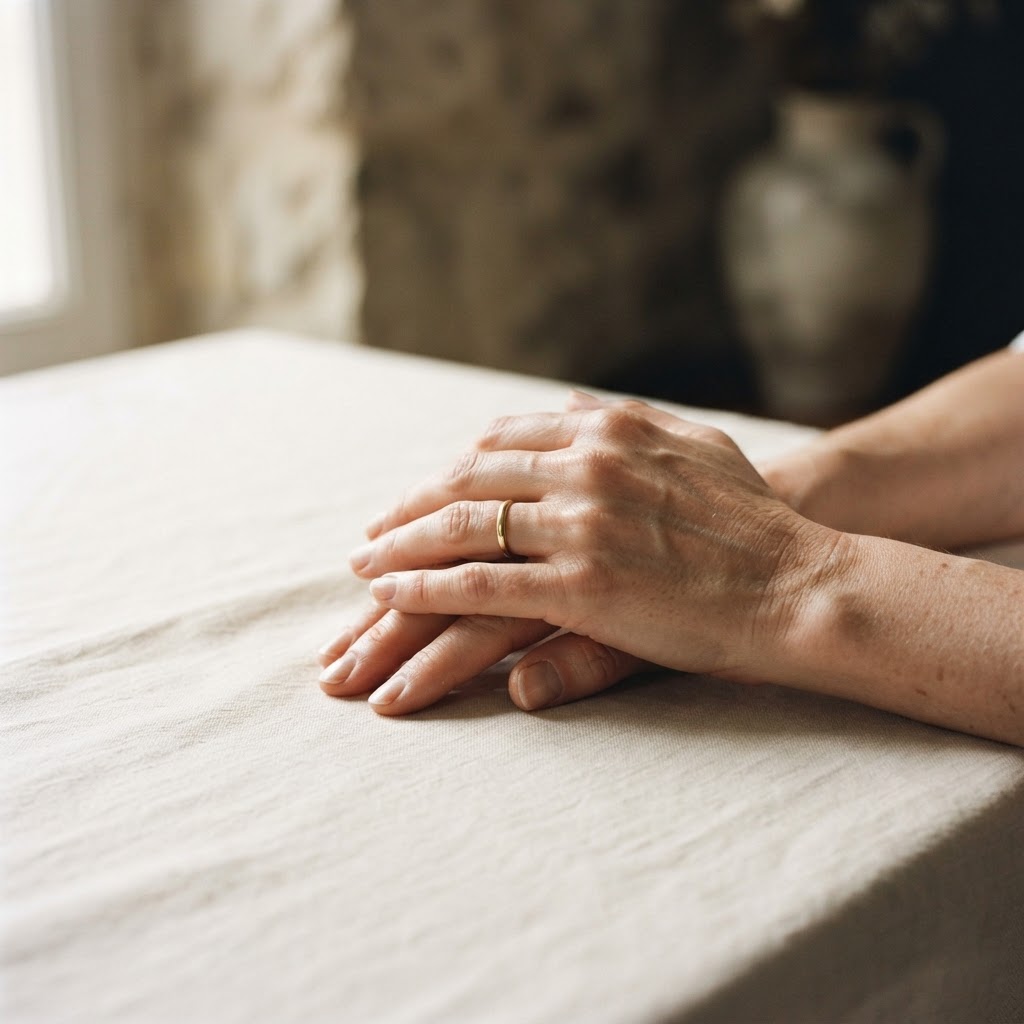
JOLA / THE HAND STUDY / 011
Aging Hands: Why Hands Show Age and What Actually Helps
THE HANDS
ARE THE FACE
WE FORGOT
TO PROTECT.
Aging hands, sun spots, veins and volume, and why the hands deserve the same plan as the face.
CUSHIONVEINSPIGMENTSKINLIGHTUSEHARMONY
STAGE 1 / 4 · THE HAND
01THE HAND
02THE CUSHION
03THE SUN
04THE SURFACE
YOU NOTICED
YOUR HANDS.HERE IS WHAT THEY
HAVE BEEN
TELLING YOU.
THE 60-SECOND ANSWER
Why do hands look older, and what actually helps?
Hands show age through four changes, and each one has its own answer. The soft-tissue cushion on the back of the hand thins, so tendons, veins, joints and knuckles become visible. Sun produces freckles and sun spots on an area almost never protected. Skin loses collagen and becomes thinner and crepier. And constant use, washing and sanitizer change the surface itself. Because hands are exposed daily and protected rarely, they often look older than a face that has been cared for.
The options map to the layers rather than to the search term. Volume can be restored in selected hands with a filler, and JOLA lists Radiesse for hand rejuvenation. Pigment responds to laser, light-based treatment and peels, with skin type deciding the risk. Skin quality responds to resurfacing, peels, boosters and clinical skincare over time. Prevention, which is sunscreen reapplied after handwashing and gloves for driving, gardening and sport, changes what the next decade adds.
Two findings are not cosmetic. A spot that changes, bleeds or looks different should be checked by a dermatologist before it is treated. A vein that is new, painful or swollen is a medical question rather than an aesthetic one. Prominent veins in general are normal anatomy showing through thinner skin, not a circulation problem.
Most hand plans combine two layers rather than one, because pigment, skin and volume are three different mechanisms that no single treatment addresses well. Softer, more even and in harmony with the face is realistic. A hand that looks like someone else’s is not, and the hands were never ageing faster than the face. They were simply being treated less.
Hand rejuvenation at JOLA →Pigment correction →Clinical skincare →THE HANDS ARE THE FACEWE FORGOTTO PROTECT.
CHAPTER
01
WHY DO HANDSSHOW AGE SOCLEARLY?
The hands show age earlier than the face for practical reasons rather than faster ones. The back of the hand carries a thin soft-tissue cushion, almost no oil glands, and skin that is washed many times a day. It is also the part of the body that receives the most sun and the least sunscreen. Four changes do most of the visible work.
The cushion is the change most people notice first without being able to name it. The back of the hand holds a thin layer of soft tissue over the extensor tendons and the metacarpal bones, and that layer thins with time and with weight change. Nothing new appears when it thins. Tendons, veins, joints and knuckles simply become visible, and a hand that read as smooth begins to read as structural.
Pigment is the change people notice second, and it is the one most clearly tied to exposure rather than to time. The hands are uncovered every day of the year and are almost never treated with sunscreen, so freckles and sun spots accumulate from driving, walking, gardening and sport. This is why hands are so often the first place a patient sees a spot they did not expect.
Skin quality is the change people describe as thinness. Hand skin has fewer oil glands and less subcutaneous support than facial skin, and it is washed, dried and sanitized far more often. Barrier lipids are removed repeatedly, collagen and elastin decline as they do elsewhere, and the surface begins to hold fine crepe rather than springing back flat.
Two distinctions matter before anything else in this study. First, this is appearance rather than disease. Arthritis, eczema, psoriasis and any unexplained or changing spot are medical questions, and they belong with a physician or a dermatologist rather than in an aesthetic plan. Second, the hands are not ahead of the face on any clock. They have simply been cared for less, which happens to be the part that can change.
THE HANDS DO NOTAGE FASTER.THEY ARE TREATEDLESS.
Clinical skincare →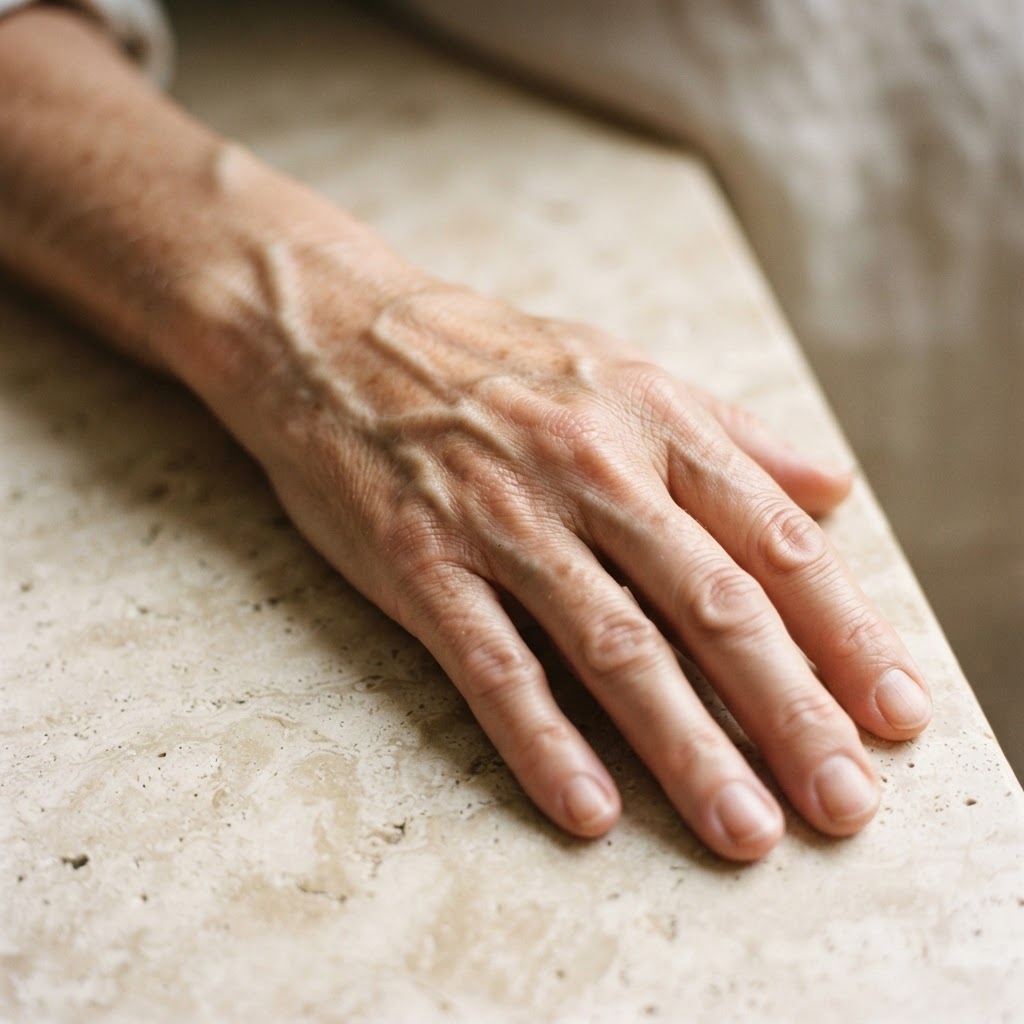
CHAPTER 02 / THE HAND MAP
ONE HAND.
SEVEN
LAYERS.
The Hand Map is JOLA’s editorial framework for reading the back of the hand. A hand that looks older than the face usually involves several of these layers at once, which is why one treatment rarely answers the whole question. Not every layer can be changed. Not every layer should be treated.
01
CUSHION
WHAT IT IS
The soft-tissue volume on the back of the hand.
WHY IT CHANGES
The back of the hand carries a thin layer of soft tissue over the tendons and the metacarpals. As that cushion thins, structures that were always there begin to show.
WHAT CONVERSATION IT OPENS
A volume conversation, which may include a filler or a biostimulator placed on the back of the hand in selected patients.
WHAT IT IS CONFUSED WITH
Veins. A vein and a tendon are different structures, and a thin cushion reveals both.
02
VEINS
WHAT IT IS
Normal veins showing through thinner skin and less cushion.
WHY IT CHANGES
Hand veins are normal anatomy. They become more visible as the cushion above them thins and the skin itself becomes thinner and more translucent.
WHAT CONVERSATION IT OPENS
An expectations conversation about what can reasonably change, and a medical evaluation if a vein is new, painful or swollen.
WHAT IT IS CONFUSED WITH
A vascular disorder. Visible does not mean diseased.
03
PIGMENT
WHAT IT IS
Freckles and sun spots on an area that rarely sees sunscreen.
WHY IT CHANGES
The hands are exposed to sun every day of the year and are almost never protected. Pigment responds to cumulative exposure rather than to time alone.
WHAT CONVERSATION IT OPENS
A pigment conversation, which may include laser, light-based treatment or a peel, after any changing spot has been checked.
WHAT IT IS CONFUSED WITH
All spots being harmless. Any spot that changes should be seen before it is treated.
04
SKIN
WHAT IT IS
Thin, crepey skin with less collagen than the face.
WHY IT CHANGES
Hand skin is thin to begin with and has fewer oil glands, and it is washed many times a day. Collagen and elastin decline as they do elsewhere, and the surface loses resilience.
WHAT CONVERSATION IT OPENS
A skin-quality conversation, which may include resurfacing, a peel, a booster or clinical skincare.
WHAT IT IS CONFUSED WITH
Volume loss. A crepey surface is a skin finding, not a loss of cushion.
05
LIGHT
WHAT IT IS
Unprotected ultraviolet exposure, daily and cumulative.
WHY IT CHANGES
Most people apply sunscreen to the face and neck and stop there. Driving, walking, gardening and sport expose the hands to sun that is never accounted for.
WHAT CONVERSATION IT OPENS
A prevention conversation, which is the only layer where the goal is to change what happens next.
WHAT IT IS CONFUSED WITH
Genetics. Genetics set the baseline. Light does most of the writing.
06
USE
WHAT IT IS
Constant washing, sanitizer, cold, work and sport.
WHY IT CHANGES
The hands are used, washed and dried more than any other part of the body. Repeated washing and sanitizer remove barrier lipids, and cold weather and friction add to it.
WHAT CONVERSATION IT OPENS
A barrier and habits conversation, which may include a cream, gloves and how the hands are washed.
WHAT IT IS CONFUSED WITH
Aging alone. Dryness and irritation are often habits rather than years.
07
HARMONY
WHAT IT IS
How the hands relate to the face, neck and chest.
WHY IT CHANGES
A treated face, an untreated neck and untreated hands can read as three different ages because they are compared against each other rather than on their own.
WHAT CONVERSATION IT OPENS
A whole-person planning conversation that considers the face, neck, chest and hands together.
WHAT IT IS CONFUSED WITH
A single-area fix. Changing one area changes the comparison for all of them.
CHAPTER
03
WHY DO MY HANDSLOOK BONYOR VEINY?
Bony and veiny hands are usually one finding described two ways: the soft-tissue cushion on the back of the hand has thinned, and structures that were always beneath it now read through the skin. Tendons, metacarpals, knuckles and veins become visible. This is a volume conversation, and it is worth separating from the pigment and skin conversations it is often confused with.
The extensor tendons are the ridges that run from the wrist toward the knuckles. They are visible in every hand, and how visible they are depends almost entirely on how much soft tissue sits above them. When a patient says their hands have become bony, the tendons and the metacarpal bones are usually what they are describing.
Veins behave the same way but are read differently. Hand veins are normal anatomy, and they become more prominent as the cushion thins and the skin itself becomes thinner and more translucent. Visible veins are not evidence of poor circulation, they are evidence of thinner cover. A vein that is new, painful, swollen or warm deserves medical evaluation before it is treated cosmetically, as does any swelling in the hand that does not resolve.
Weight belongs in this chapter because it is the most common non-age cause. Significant or rapid weight loss, including weight loss supported by a GLP-1 medication, reduces the cushion on the hands as well as on the face, and the hands then read bonier than the rest of the body. For patients in that situation, the useful conversation is about the whole plan rather than about the hands alone.
What follows from the anatomy is a straightforward expectation. Volume can be added to the back of a hand, and doing so can soften how tendons and veins read. What cannot be done is remove a tendon or make a hand look like a different hand. The goal is a hand that reads as less structural, not a hand without anatomy.
A VEIN IS NOTA PROBLEM.IT IS WHAT THIN SKINSHOWS.
Hand rejuvenation at JOLA →CHAPTER 04 / THE LAYER STUDY
SWITCH EACH
LAYER ON.
The same hand appears in each view. Nothing is added or removed between them; what changes is which layer is being looked at. Turn them on together and the reason a single treatment rarely answers the whole question becomes visible.
CUSHION
The thin soft-tissue layer over the extensor tendons and the metacarpals. As it thins, structures that were always present begin to read through the skin. This is the layer a volume treatment addresses, and the only layer it addresses.
FOUR LAYERS.FOUR DIFFERENTCONVERSATIONS.
CHAPTER
05
CAN FILLER RESTOREVOLUME INTHE HANDS?
In selected patients, a filler placed on the back of the hand can restore part of the soft-tissue cushion and soften how tendons, veins, joints and knuckles read. JOLA lists Radiesse for hand rejuvenation, a calcium hydroxylapatite product that adds immediate volume and is described by its manufacturer as supporting collagen over time. Whether it is appropriate for a given hand is an assessment question.
What volume treatment can do is specific rather than general. Restoring cushion on the back of the hand changes how the structures beneath the skin read: tendons appear less like ridges, veins appear less prominent, and the hand as a whole looks softer and less structural. That is a real and visible change, and it is also the whole of the claim.
What it cannot do is equally specific. It does not change the skin surface, so crepe and fine lines remain. It does not remove pigment, so sun spots remain and often become more noticeable once the contour has softened. It does not make a hand look like a younger person’s hand. Most patients who are pleased with hand volume treatment are also treating skin or pigment, or planning to.
Candidacy is where the honest work happens. Hand volume treatment is generally considered for hands where the cushion has thinned and the structures are visible, in patients who understand that the result is refinement rather than transformation. It is generally not the first conversation where there is a changing spot, an unexplained swelling, a painful or newly prominent vein, an active skin condition or a circulatory concern.
Biostimulatory products are a separate category. A biostimulator works through the skin’s own collagen response over months rather than through immediate volume, and its labeling is written for the face. JOLA does not present a biostimulator as a standard hand treatment, and where a patient asks about it, the answer is a consultation conversation rather than a claim.
Because the hands are used constantly, recovery expectations are practical rather than aesthetic. Swelling and bruising are possible, and temporary stiffness can occur while swelling settles. Most patients return to ordinary hand use quickly, and a clinician explains what to expect in the first days. Any decision about volume should include what the following week looks like.
VOLUME IS A HANDCONVERSATION TOO.
Hand rejuvenation at JOLA →Biostimulators vs dermal fillers →CHAPTER
06
WHAT CAN BE DONEABOUT SUN SPOTSON THE HANDS?
Sun spots and freckles on the hands are pigment, and pigment is the most treatable layer of this study. Lasers, light-based treatments and chemical peels can target sun-driven pigment, with candidacy depending on skin type and on how the pigment responds. One rule sits in front of all of them: any spot that changes, bleeds, itches, or looks different from the others should be seen by a dermatologist before it is treated cosmetically.
Different tools suit different pigment. Laser and light-based treatments target pigment selectively and are chosen by skin type and by the kind of spot. Peels work on the surface and can improve both tone and texture at the same time. Which device is used on a hand, and in what sequence, is a clinical decision made at an assessment rather than from a menu.
Skin type is the variable that decides most of the risk. Darker skin types carry a higher risk of pigment change after light-based treatment, so parameters, spacing and sometimes the choice of modality change accordingly. This is not a reason to avoid treatment. It is a reason to have it assessed rather than purchased, and to be suspicious of any plan that does not ask about skin type first.
Sun protection is the part of this chapter that is not optional. Pigment that is treated and then exposed recurs, because the mechanism that produced it is still running. For hands, that means a broad-spectrum sunscreen reapplied through the day, and gloves where sun exposure is predictable: driving, gardening, walking, sport. Without that, treatment becomes a repeating expense rather than a result.
One boundary belongs at the end of this chapter rather than in a footnote. Pigment on the hands is common and overwhelmingly benign, but it is not universally so. A spot that is new, changing, asymmetrical, bleeding, itching or simply different from its neighbours is a dermatology question, and it should be answered before any cosmetic plan begins. Cosmetic treatment can follow a clean answer; it should not replace one.
THE SUN WRITESON THE HANDSBEFORE ANYTHINGELSE DOES.
Pigment correction →CHAPTER
07
CAN CREPEY HANDSKIN BEIMPROVED?
Yes, within bounds. Resurfacing, chemical peels, skin boosters and clinical skincare can improve the texture and quality of crepey hand skin, and the improvement is real rather than cosmetic in the marketing sense. The bound is that hand skin behaves differently from facial skin: it is thinner, it has fewer oil glands, and it heals more slowly after anything that creates a wound.
Texture and volume are two different complaints, and the distinction decides the plan. Crepe is a skin-quality finding, so it responds to treatments that work on the skin itself. Tendons and veins showing is a volume finding, so it responds to cushion. A patient describing their hands as old is often describing both at once, and treating one layer while ignoring the other produces a hand that looks softer but not younger.
Resurfacing and peels work on the surface. Both create controlled injury and let the skin rebuild, which improves crepe, fine lines and, in the case of peels, uneven tone as well. The reason to be conservative on hands is healing: thinner skin with fewer appendages to regenerate from takes longer to recover, and the price of pushing energy on a hand is paid in pigment change rather than in results.
Skin boosters and clinical skincare work more gradually. Boosters deliver hydration and support to the skin over a series of visits, and evidence-based skincare supports the barrier and quality over months. Neither reshapes a hand. Both make the surface read healthier, and both combine well with a pigment plan because neither interrupts it.
Expectations should be set in the same sentence as the plan. Crepey skin can look smoother, better hydrated and more even, and it can hold that improvement with maintenance and protection. It cannot be replaced with the skin of a twenty-year-old, and the honest goal is a hand that reads healthy and cared for rather than a hand that reads untouched by any decade.
CREPE IS SKIN.CREAM IS NOTCUSHION.
Chemical peels →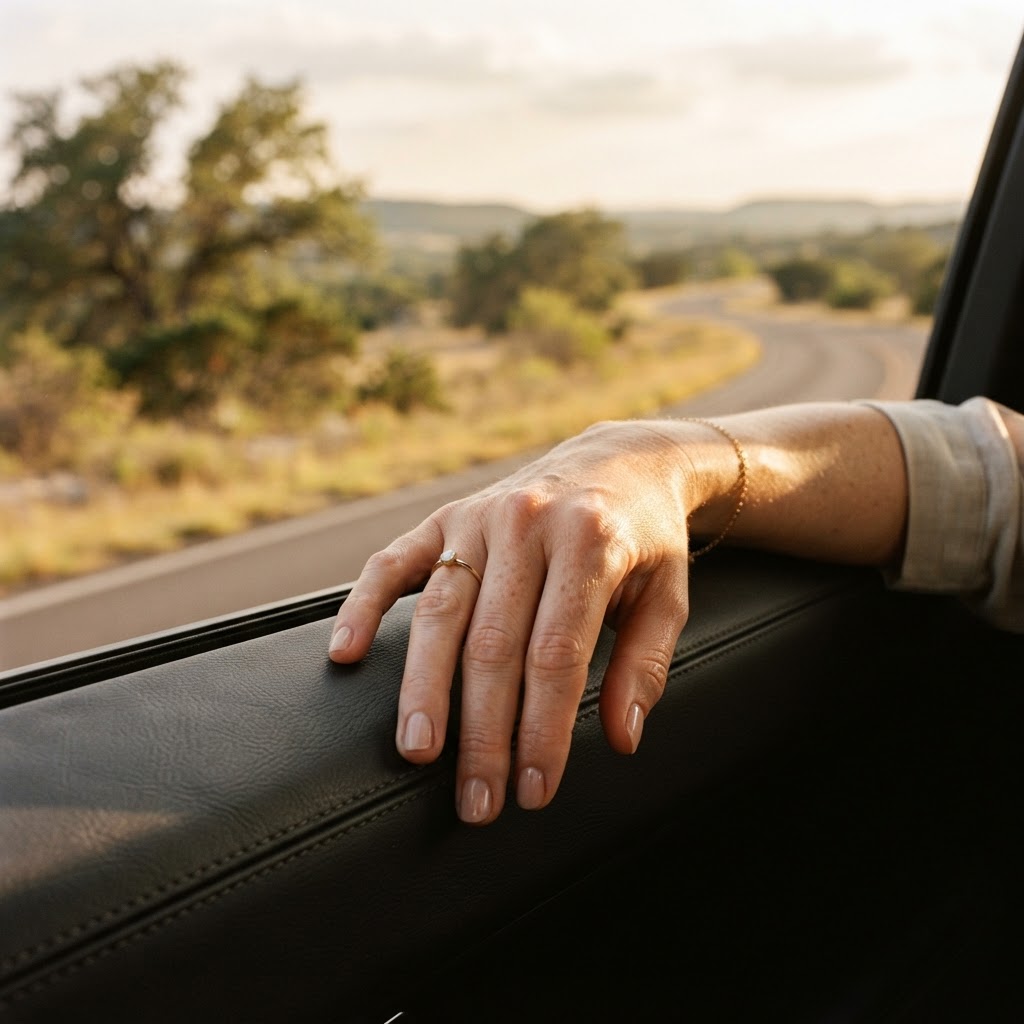
THE SUN WRITESON THE HANDS FIRST.
CHAPTER 08 / THE LIGHT STUDY
THE SAME HAND
IN TWO LIGHTS.
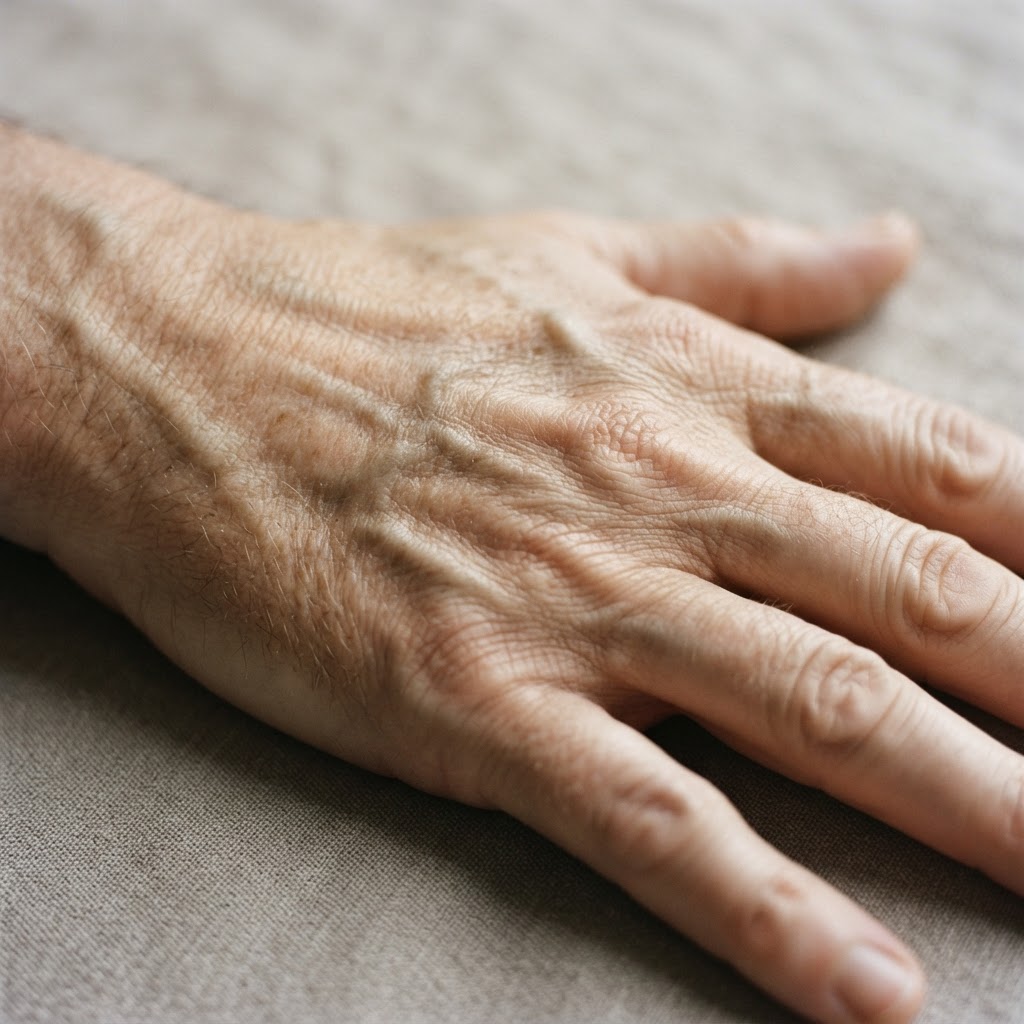
Hands are more sensitive to lighting direction than almost any other area of the body, because so much of what reads as age is contour rather than color. This is the same hand, drawn the same way, lit two ways.
Side light rakes across the surface. Every tendon, vein and fine line deepens, and the same hand reads older in the same second.
LIGHTING IS NOT A DIAGNOSIS.
CHAPTER
09
WHAT CAN SKINCARE,SPF ANDGLOVES DO?
This is the layer with the longest horizon and the least glamour. Daily broad-spectrum sun protection reapplied after handwashing addresses the exposure that produces both pigment and collagen loss. A hand cream suited to the barrier, used consistently, addresses the dryness that makes texture look worse. Gloves for driving, gardening, cleaning and sport remove the sun and the friction that no product can undo afterwards.
Sunscreen on the hands has one practical problem, which is that hands are washed. Any sunscreen applied in the morning is gone by mid-morning in most routines, so the honest instruction is not a higher SPF but a reapplying habit: a sunscreen kept in a bag or at a desk, applied again after washing, and used on the backs of the hands as naturally as on the face.
Gloves are the more reliable half of prevention, because they do not depend on remembering. Driving gloves, gardening gloves, work gloves and sport gloves reduce cumulative exposure without any daily discipline beyond keeping them where the exposure happens. Texas sun makes this relevant for most of the year rather than for a season, and a pair of gloves in a car is the most efficient thing in this article.
Barrier care is where skincare earns its place. Hand skin has fewer oil glands and is washed more often than any other part of the body, so a cream that supports lipids is doing structural work rather than cosmetic work. Evidence-based actives such as a retinoid can improve skin quality over time and should be introduced slowly on hand skin, because thin skin tolerates them less well than a face does.
None of this is a prescription and none of it replaces an assessment. What it does replace is the assumption that hand care is not a category. The hands are the part of the body most consistently exposed and least consistently protected, and prevention is the only layer of this study where the outcome is decided by what happens before anything is treated.
THE CHEAPEST PARTOF THIS STUDYIS ALSO THE MOSTEFFECTIVE.
JOLA Store →CHAPTER
10
WHY HAND PLANSUSUALLY COMBINETREATMENTS
Volume, pigment and skin are three layers with three different mechanisms, and no single tool addresses more than one of them well. That is why a hand plan is usually a sequence rather than a decision. The sequence itself is individualized: what is treated first depends on what is most visible, what the calendar allows, and which layer responds fastest for that particular hand.
The most common combination is pigment plus skin. Sun spots and uneven tone are visible from across a room, they respond relatively quickly, and the surrounding skin usually benefits from the same treatment. A patient whose complaint is that their hands look old is frequently describing tone and texture together, and that plan is built around one recovery period rather than two.
Volume plus pigment is the second common pairing. Softening the contour of the back of the hand makes pigment more noticeable rather than less, because a smoother surface reflects light more evenly and the spots are what remains. This is not a reason to avoid volume; it is a reason to plan pigment and volume as one sequence instead of discovering the interaction after the fact.
Order matters for practical reasons. Treatments with a recovery period need spacing from each other rather than stacking, and the sun-sensitive period after pigment work constrains what can follow and when. A clinician plans the year rather than the visit, which is why a hand conversation at JOLA is a planning conversation first and a treatment conversation second.
Maintenance is the part that decides how a result ages. Prevention runs continuously, pigment work recurs on the schedule the skin dictates rather than on a fixed calendar, skin quality responds to consistency, and volume has a lifespan that varies by product and by patient. A plan that ends when the treatment ends has usually planned the treatment rather than the result.
COMBINATION IS NOTACCUMULATION.
Treatment planning →CHAPTER
11
DO MY HANDS NEEDTO MATCHMY FACE?
Harmony is the quietest of the hand conversations and one of the most common reasons patients come in at all. A treated face above untreated hands creates a comparison, and the comparison reads as a mismatch rather than as youth. The same is true in the other direction: a patient who treats only their hands usually finds that the face now looks less cared for.
The reason a mismatch reads so clearly is that the hands and the face are usually seen together. Both are visible in conversation, both are photographed, and both are seen at the same time. A face that has been maintained while the hands have only been washed and used creates a visible contrast in care rather than a contrast in age, and that is what people register.
The neck and the chest sit inside the same conversation. They are exposed, they are frequently omitted from sunscreen routines, and they behave more like hand skin than facial skin in terms of thinness and healing. The Neck Study in this series makes the same argument from the other direction, and a whole-person plan usually considers face, neck, chest and hands as one system rather than as four decisions.
What harmony does not mean is treating everything. A patient who chooses to treat only one area is making a legitimate choice, and the result is still an improvement in that area. The value of naming the comparison is that the choice is made knowingly rather than discovered later, when a treated face sits above hands that were never part of the plan.
The practical version of this chapter is a single question at the start of a consultation: which areas are we planning for? The answer is often broader than the patient expected and narrower than they feared, and it changes the order of the whole plan. Deciding that the hands belong in the plan is usually the step that makes the plan make sense.
THE HANDS SHOULDMATCH THE FACENOT OUTRUN IT.
The Neck Study →The Horizontal Line Study →
CHAPTER
12
DOES AGE, SEX ORSKIN TYPE CHANGETHE CONVERSATION?
Yes, and the shifts are systematic rather than individual. In the thirties and forties the conversation is usually pigment and prevention, because hands often look younger than the face and the useful work is protecting what is there. From the fifties onward, volume and skin quality come to the front. Men typically arrive with more cumulative sun exposure. Skin type changes the risk attached to light-based treatment.
In the thirties and forties, hands usually show freckling and early tone change rather than structural change, so the conversation is pigment and prevention: a sunscreen habit and a pair of gloves change the trajectory rather than polishing a result. From the fifties onward the structural conversation arrives, as the cushion thins and tendons, veins and joints read more clearly. That is usually when patients describe their hands as looking older than their face.
Sex makes a real difference to exposure rather than to anatomy. Men are more likely to work outdoors, to drive without sun protection on the hands, and to have no skincare routine at all, which means they frequently arrive with more cumulative pigment and more visible structure for the same age. The clinical conversation is unchanged; the starting point is simply further along.
Skin type decides what can be done and how carefully. Lighter skin burns and freckles more readily and tends to show pigment earlier. Darker skin is less likely to burn but carries a higher risk of pigment change after light-based treatment, which shapes device choice, settings and spacing. Neither is a limitation on treatment. Both are reasons the assessment comes before the plan rather than after it.
Weight change runs across all of these. Significant loss, including loss supported by a GLP-1 medication, reduces the cushion in the hands as well as in the face, so hands can become bonier in a few months in a way that has nothing to do with age. For patients in that situation, the hands are usually one part of a broader volume conversation that makes more sense in the whole face than in a single area.
THE SAME HANDREADS DIFFERENTLYAT EVERY AGE.
GLP-1 and your face →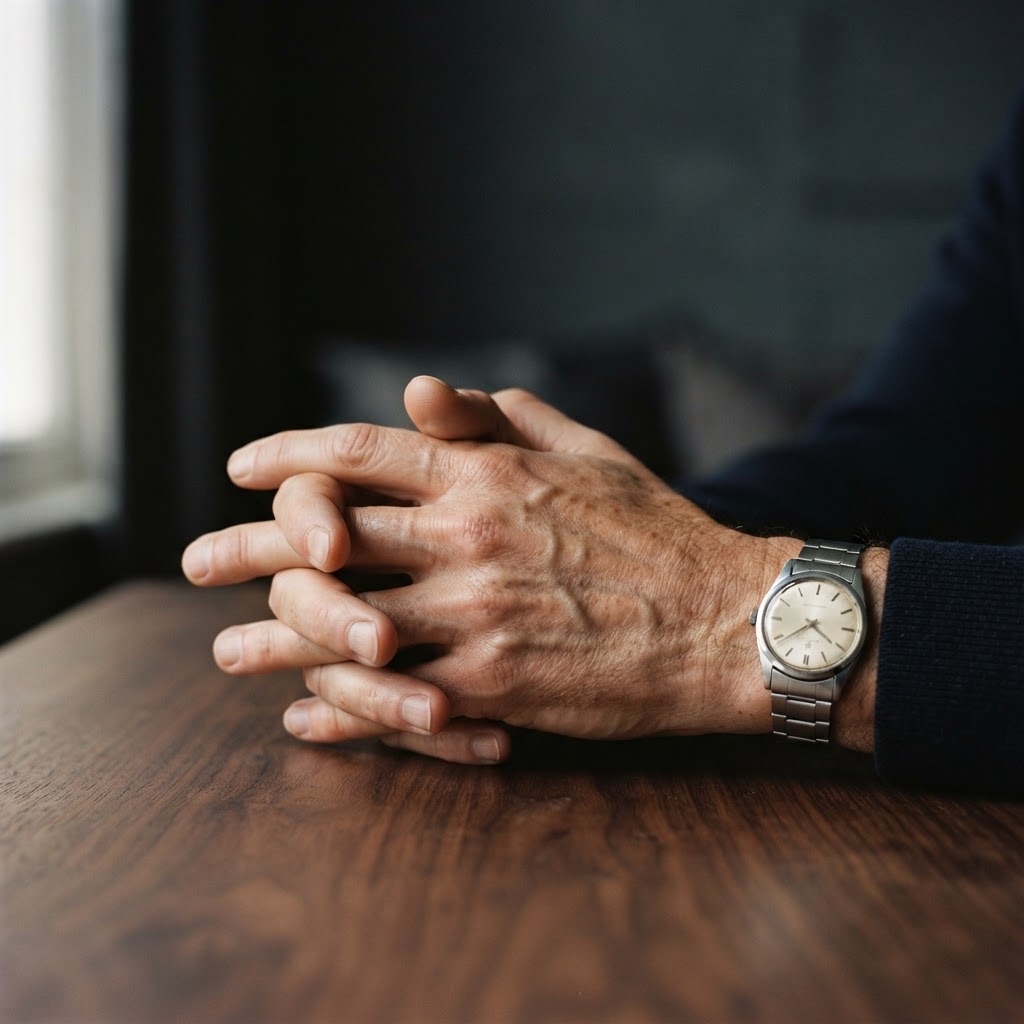
CHAPTER
13
WHO IS A CANDIDATE,AND WHOIS NOT?
A candidate for hand treatment is someone whose concern matches a mechanism that can be treated, whose skin and history make the treatment reasonable, and whose expectations match what the treatment can produce. Someone who is not a candidate is equally specific, and the reasons are usually medical rather than aesthetic.
The straightforward candidacy is a patient with visible structure and a preference for softening it, or with sun-driven pigment and a preference for clearing it, or with texture change and a preference for improving it. Candidacy is decided per layer rather than for hands as a whole, because a patient may be an excellent candidate for pigment treatment and a poor one for volume treatment in the same visit.
Active skin conditions pause the aesthetic plan. Eczema, psoriasis, dermatitis, an active infection or broken skin all change what can safely be done, and they are often the reason a patient notices their hands in the first place. Treating the condition comes first, and the aesthetic conversation resumes when the skin is stable rather than on the date originally booked.
Skin findings that need an answer are not cosmetic. A spot that has changed, a mole that looks different from its neighbours, a lesion that bleeds or itches, a new or painful vein, an unexplained swelling, or a hand that has changed shape without explanation all route to a physician or dermatologist first. This is the clearest line in this study and it does not move for convenience.
History matters in ways that are easy to overlook. Previous hand surgery, circulation concerns, bleeding disorders, some medications, and a history of poor healing or of pigment change after laser all shift what is appropriate. None of them automatically rules out treatment. All of them are part of the assessment, which is why a hand plan built from a product page is not a plan.
A NOT-YET IS STILLA CLINICALDECISION.
The JOLA consultation →CHAPTER
14
WHAT ARETHE RISKS?
Every treatment in this study has risks, and they are ordinary rather than exotic. Volume treatment can produce swelling, bruising, temporary stiffness, a feeling of fullness, and in some cases lumps or irregularity, with rare vascular complications. Laser, light and peel treatments on the hands can produce redness, swelling, pigment change, and slower healing than the same treatment on the face.
Volume risks are mostly short-lived and visible. Swelling and bruising are expected rather than exceptional, and because hands are used constantly they are also more noticeable than the same swelling on a face. Temporary stiffness or a feeling that the hand is fuller than usual is common while swelling settles. Lumps and irregularity can occur, and their management depends on the product, the timing and the assessment.
Vascular complications are rare and serious, which is why they are named rather than glossed. Filler placed near vessels carries a small risk of vascular occlusion anywhere on the body, and hand anatomy includes a rich vascular network. This is one of the reasons hand volume treatment belongs with an experienced clinician who can assess, recognize and manage a complication.
Pigment treatment carries its own predictable risks. Redness and swelling after laser or light are expected and temporary. The risk that matters most is pigment change: lightening or darkening of the treated area, which is more likely in darker skin types and in patients with recent sun exposure. Peels add the possibility of prolonged redness and of uneven results if aftercare and sun protection are not followed.
Hands heal more slowly than faces, and the plan is built around that fact rather than in spite of it. Thinner skin with fewer oil glands and constant use means recovery can be less predictable, and the same settings that would be conservative on a face may be aggressive on a hand. Conservative planning is the risk management, and it is why hand treatment is usually spread across visits.
CONSERVATIVE IS NOTA WEAKER PLAN.IT IS THE HAND PLAN.
Provider judgment →CHAPTER
15
HOW LONG DORESULTS LAST?
Results last differently by layer, and the reason is that the hands keep working. Volume gradually settles as the product is metabolized or as the skin’s own response runs its course, and its lifespan varies by product and by patient rather than by a fixed number. Pigment improvement holds as long as sun exposure is controlled. Skin quality holds with maintenance. Prevention compounds.
Volume has the most variable lifespan and the most product-dependent one. A calcium hydroxylapatite product behaves differently from a hyaluronic acid product, and how long either lasts in a specific hand depends on the tissue, the amount placed and the patient’s own metabolism. A clinician can describe what has typically been observed and cannot promise what will happen in a given hand.
Pigment results last as long as the cause is managed. Treatment clears what is there; sun exposure writes more. Every study in this series says the same thing in a different place, and on the hands it is unusually literal: hands are washed constantly and covered rarely, so how long hand pigment results last is almost entirely a question about sunscreen habits and gloves.
Skin quality lasts with consistency. Boosters and skincare produce results that are maintained rather than permanent, and they fade with the routine that supported them. This is not a defect of the treatment. It is how skin behaves everywhere, and the reason the maintenance conversation is part of the plan rather than an upsell after it.
The most durable result in this study is prevention, and it is also the least measurable. Sunscreen reapplied after handwashing and gloves worn where exposure is predictable reduce what the next decade adds rather than remove what the last one wrote. That is a slower kind of result, which is exactly why it is worth starting before the treatment conversation rather than after it.
RESULTS FADE.HABITS COMPOUND.
Natural-looking results →CHAPTER
16
WHAT DOES HANDREJUVENATION COSTIN DALLAS?
JOLA does not list prices for hand treatment online, and the reason is that a price list assumes a plan that has not been made yet. Cost in this area is driven by how many layers are being treated, what each layer requires, how many visits that takes, and the products involved. A single figure would be accurate for almost nobody.
The factors are specific. A pigment-only plan and a pigment-plus-skin plan are different financial conversations. Volume treatment is priced by the product used and the number of areas, and it is the most expensive single item in most hand plans. Series treatments, whether for pigment or for skin quality, are priced as series because that is how the result is produced.
The honest comparison is not between practices but between plans. Two quotes for hand filler can differ because they involve different products, different amounts, or because one includes an assessment that decides whether filler is the right layer at all. The number on a page tells a patient what something costs without telling them what it will do, which on the hands is the more important half of the question.
Value in this area is unusually easy to reason about, because prevention is free and it compounds. A patient who begins with sunscreen on the hands, a barrier cream and a pair of driving gloves has already changed the trajectory of the next decade at negligible cost, and any treatment that follows is working on a lower starting point ten years from now.
A consultation is where the numbers become real. Assessment, a plan by layer, an order of treatment and an itemized cost all arrive together, and the patient decides with the anatomy in front of them rather than with a price list in front of them. Nothing in a hand plan needs to be decided on the day it is described.
A PRICE IS NOTA PLAN.
The JOLA consultation →Treatment planning →THE HAND DECISION MAP
WHAT ARE YOU
NOTICING?
This is not a diagnostic tool and it does not prescribe a treatment. It helps you name what you see so the conversation can begin in the right place.
WHAT YOU SEEIS THE BEGINNINGOF THECONVERSATION.NOT THETREATMENTPLAN.
THE JOLA TREATMENT MATRIX
Which tool belongs to which finding?
No yes or no, no best or worst. Each cell describes the general relationship between a treatment category and a finding on the back of the hand. It is editorial education, not a treatment recommendation, and an individual assessment can change any cell.
| FINDING | HAND FILLER (RADIESSE) | BIOSTIMULATOR | LASER / LIGHT (PIGMENT) | RESURFACING | CHEMICAL PEEL | SKIN BOOSTER | SKINCARE + SPF | GLOVES / HABITS | MEDICAL EVAL |
|---|---|---|---|---|---|---|---|---|---|
| VISIBLE TENDONS / BONY HANDS | P | S | N | N | N | S | N | N | N |
| PROMINENT VEINS (NORMAL) | S | S | N | N | N | N | N | N | A |
| SUN SPOTS / FRECKLES | N | N | P | S | S | N | S | S | A |
| CHANGING OR UNUSUAL SPOT | N | N | N | N | N | N | N | N | X |
| CREPEY, THIN SKIN | S | S | N | P | S | S | P | S | N |
| DRY, CHAPPED SKIN | N | N | N | N | N | N | P | P | A |
| EARLY CHANGES, PREVENTION | N | N | S | N | S | N | P | P | N |
| MIXED CONCERNS | A | A | A | A | A | A | A | A | A |
PPRIMARY CONVERSATION
SPOSSIBLE SUPPORTING ROLE
DDIFFERENT TARGET
NNOT THE PRIMARY MECHANISM
XMEDICAL EVALUATION MAY BE MORE RELEVANT
ADEPENDS ON ASSESSMENT
Educational framework. Not a treatment plan.
This matrix is an educational tool, not a diagnosis. It must be reviewed by a JOLA clinician before publication.
NATURAL RESULTS
A natural hand result still looks like a hand
A natural result on the hands is not a hand without tendons, veins or joints. It is a hand in which the structures read more softly, the tone is more even, the skin looks healthier, and nothing about it suggests a procedure.
Overfilled hands have their own signature, and it is recognised as easily as an overfilled face. The contour turns puffy rather than soft, the tendons disappear entirely, knuckles flatten, and the hand stops matching the wrist and forearm above it. Volume without restraint does not read as youth. It reads as volume, and the hands are one of the few places where it is difficult to disguise.
The alternative is a hand that keeps its anatomy and loses some of its harshness. Tendons still visible in some lights, veins still present, joints still there, but with a softer transition between them and with skin that looks maintained rather than treated. That is a quieter result, and it is the one that holds up in photographs, in daylight and next to a face that has been treated with the same restraint.
Natural-looking results →What makes a result look expensive →SOFTER CONTOURIS NOTA DIFFERENTHAND.
PHOTOGRAPHY INTEGRITY
How hands should be photographed
Hands are unusually sensitive to lighting and to the camera that photographs them. Raking side light makes every tendon and every crease deeper, frontal light flattens them, a wide-angle lens distorts the proportions of the fingers, and a slightly clenched hand reads older than a relaxed one. A meaningful comparison controls all of it.
Credible images of hands need the same lens, the same distance, the same lighting direction, the same hand position and, ideally, the same time of day. A comparison in which the light has changed is a comparison of light rather than of results, and hands are more vulnerable to this than faces because so much of what is visible is contour rather than color.
Editorial photography makes the opposite choice deliberately. The images in this study use raking light and close framing because they are illustrating a mechanism rather than documenting an outcome, and the captions say so. They are models, not patients, and none of them is presented as a result of anything. That distinction is the reason the study can show a tendon clearly without implying what a treatment will do to yours.
Hand rejuvenation at JOLA →LIGHTING IS NOTA DIAGNOSIS.
THE MYTH INDEX / 18
Eighteen things people believe about aging hands
MYTH 01
HANDS AGE FASTER THAN FACES.
REALITY
They are protected less. The change is partly exposure and partly habits, not a faster clock.
MYTH 02
VEINY HANDS MEAN POOR CIRCULATION.
REALITY
Usually they mean thinner skin and less cushion. A vein that is new, painful or swollen needs medical evaluation.
MYTH 03
AGE SPOTS ARE CAUSED BY AGE.
REALITY
They are mostly caused by sun. Time accumulates, but light writes.
MYTH 04
ALL SPOTS ON THE HANDS ARE HARMLESS.
REALITY
Most are. Any spot that changes, bleeds or looks different should be checked before it is treated.
MYTH 05
HAND CREAM CAN RESTORE VOLUME.
REALITY
A cream supports the skin barrier and quality. It cannot restore a cushion or soften a tendon.
MYTH 06
FILLER IN THE HANDS IS EXPERIMENTAL.
REALITY
Hand volume restoration is an established conversation with specific products; whether it is right for a given hand is an assessment question.
MYTH 07
YOU CANNOT USE YOUR HANDS AFTER TREATMENT.
REALITY
Most people return to normal use quickly. Swelling and bruising are possible and temporary, and a clinician explains what to expect.
MYTH 08
LASERS ARE ONLY FOR THE FACE.
REALITY
Several are used on the hands, with conservative planning, because hand skin behaves differently from facial skin.
MYTH 09
SUNSCREEN ON THE HANDS IS POINTLESS BECAUSE YOU WASH THEM.
REALITY
That is exactly why it needs reapplying rather than skipping.
MYTH 10
GLOVES ARE JUST FOR WINTER.
REALITY
Driving and gardening gloves reduce sun on the hands, which is the layer most people never address.
MYTH 11
ONLY WOMEN TREAT THEIR HANDS.
REALITY
Men often carry more cumulative sun exposure and fewer prevention habits, which makes the conversation more relevant rather than less.
MYTH 12
BONY HANDS MEAN YOU ARE UNDERWEIGHT.
REALITY
Volume loss on the hands is common with age and with weight change, at any weight.
MYTH 13
ONE TREATMENT FIXES EVERYTHING.
REALITY
Volume, pigment and skin are different layers. One tool addresses one layer well and the others poorly.
MYTH 14
HANDS DO NOT NEED TO MATCH THE FACE.
REALITY
A mismatch is one of the quiet tells. Harmony is the goal, not a new pair of hands.
MYTH 15
CREPEY HANDS CANNOT BE IMPROVED.
REALITY
Skin quality can improve with the right plan and patience. It cannot be replaced with the skin of a twenty-year-old.
MYTH 16
EVERYONE WITH OLDER-LOOKING HANDS NEEDS TREATMENT.
REALITY
Sometimes the most valuable outcome of a consultation is clarity: SPF, gloves and a barrier cream.
MYTH 17
YOUNGER-LOOKING HANDS IS THE GOAL.
REALITY
Healthier, more even and in harmony with the face is the goal. Younger is a by-product of those, not the target.
MYTH 18
THE SEARCH TERM CHOOSES THE TREATMENT.
REALITY
The anatomy does.
THE JOLA APPROACH
Anatomy before treatment
The order never changes: anatomy before treatment, diagnosis before device, skin quality before filters, precision before aggression. A patient who arrives asking for hand filler may need a pigment conversation, a sunscreen habit and a pair of gloves first, or a dermatology referral before anything else.
This is not a refusal of the treatment that was asked for. It is a decision about sequence, made on the same evidence that decides everything else in a plan: what is producing what the patient sees, what can change it, and what order produces the most result for the least intervention. Sometimes that means the requested treatment is second rather than first. Occasionally it means it is not indicated at all.
The hands reward this approach more than most areas because so much of what improves them is preventive and quiet. Resurfacing a crepey hand while the patient washes it a dozen times a day without protection is a plan that fights itself. Naming that is the most useful thing a consultation can do, and it is usually the reason a patient leaves with a clearer idea than they arrived with.
JOLA treatment philosophy →REFINEMENT IS NOTERASURE.
DALLAS
Hand treatment in Dallas, and why the sun matters here
JOLA sees patients from Dallas, Highland Park, University Park, the Park Cities, Preston Hollow and across DFW. In this region the sun is not a seasonal consideration: it is a daily one, and the hands are the part of the body least likely to be protected from it.
Practical context matters more here than anywhere else in this study. Driving exposes the backs of the hands through glass on a routine commute, a walk at midday exposes them entirely, and a Texas spring reaches the intensity of a northern summer. Patients who protect their face carefully often have no habit at all for the hands, and that gap, repeated daily, is what produces a visible difference between the two.
Dallas also means gloves are realistic rather than fussy. Driving gloves, gardening gloves and sport gloves are normal equipment in this climate rather than an affectation, and they do more for the hands than any product applied in the morning and washed off by ten. Any plan made at JOLA starts with what the patient can actually maintain in their own week.
Treatment planning →JOLA treatment philosophy →Contact JOLA →THE SUN HERE ISA DAILY FACTNOT ASEASON.
THE BOTTOM LINE
Aging Hands: The Bottom Line
THE HANDS ARE THEFACE WE FORGOTTO PROTECT.
The hands are the part of the body that ages visibly for reasons that have almost nothing to do with the hands themselves. They are exposed every day, washed more than anything else, and protected less than the face, the neck or the chest. That is the whole thesis, and it is a repairable one.
Four layers explain almost everything a patient notices. The cushion on the back of the hand thins, so tendons, veins, joints and knuckles read through skin that covers them less well than it did. Pigment accumulates from sun that was never accounted for. Skin loses collagen and barrier lipids and stops springing back flat. And constant use, washing and weather change the surface itself.
A VEIN IS NOTA PROBLEM.IT IS WHAT THINSKIN SHOWS.
The distinction that matters most before any treatment is between what can be changed and what should be named rather than treated. Volume can be restored in selected hands, pigment can be cleared, skin quality can be improved. But a spot that changes, bleeds or looks different belongs with a dermatologist first, and a vein that is new, painful or swollen is a medical question rather than an aesthetic one.
Prevention deserves a better reputation than it has. Sunscreen reapplied after handwashing and gloves worn where sun exposure is predictable, driving, gardening, walking, sport, address the layer that produces both pigment and collagen loss, and they cost almost nothing. Every study in this series argues for restraint on the treatment side and consistency on the prevention side, and on the hands the argument is at its most concrete because the exposure is so routine and so unrecognised.
CREAM IS NOTCUSHION.
Harmony is the quietest argument in this study and often the reason a patient arrives. A maintained face above hands that were never part of the plan creates a comparison, and the comparison reads as a mismatch rather than as youth. The Neck Study makes the same point from the other direction. The hands do not need to be treated intensively to be part of the plan. They need to be included in it.
THE HANDS SHOULDMATCH THE FACENOT OUTRUN IT.
What is realistic is worth stating once, plainly. Softer contour, more even tone and healthier skin are achievable in most hands with the right plan and patience. A hand without tendons, veins or joints is not achievable, and not desirable: overfilled hands have their own signature, recognised as easily as an overfilled face.
So the answer is not that the hands aged faster. They were treated less, exposed more and protected rarely, and every layer of that is addressable. Start with light and habits, treat the layer that is producing what you see, and let the face be the comparison rather than the contradiction.
- THE HANDS ARE THE FACE WE FORGOT TO PROTECT.
- THEY DO NOT AGE FASTER. THEY ARE TREATED LESS.
- A VEIN IS NOT A PROBLEM.
- THE SUN WRITES ON THE HANDS FIRST.
- VOLUME IS A HAND CONVERSATION TOO.
- CREAM IS NOT CUSHION.
- A CHANGING SPOT IS A DOCTOR'S CONVERSATION.
- THE HANDS SHOULD MATCH THE FACE.
- THE SEARCH TERM DOES NOT CHOOSE THE TREATMENT.
- THE ANATOMY DOES.
- LUXURY IN THE DETAILS.
THE ARCHIVE / 60 QUESTIONS
Aging hands and hand rejuvenation: frequently asked questions
60 matching questions
001Why do my hands look older than my face?
Because they are exposed more and protected less. The back of the hand carries a thin soft-tissue cushion, has few oil glands, and is washed many times a day. It also receives sun every day of the year and is almost never treated with sunscreen. The cushion thins, pigment accumulates and the skin loses collagen, so structures beneath the skin become visible. The hands are not on a faster clock. They are simply cared for less than the face.
002Why are my hands so veiny?
Veins on the back of the hand are normal anatomy, and they become more visible as the cushion above them thins and the skin itself becomes thinner and more translucent. Visible veins are not a sign of poor circulation. They are a sign of thinner cover, which is why they appear on lean hands and older hands and not on fuller ones. A vein that is new, painful, swollen or warm should be evaluated medically before it is treated cosmetically.
003Why do my hands look bony?
Bony hands mean the soft-tissue cushion on the back of the hand has thinned, so the extensor tendons, metacarpal bones, joints and knuckles read through the skin. That happens with age and with weight change, including weight loss supported by a GLP-1 medication. Nothing new has appeared. The cover has simply become thinner, which makes a structure that was always there visible. It is a volume finding rather than a skin one.
004What causes age spots on the hands?
Sun exposure, accumulated over decades. Pigment cells respond to ultraviolet light by producing more pigment, and the hands receive that light almost every day without protection. Genetics set the baseline, but exposure does most of the writing, which is why freckles and sun spots on the hands usually appear earlier than the same change on a covered area. Any spot that changes, bleeds, itches or looks different from its neighbours should be checked by a dermatologist first.
005Does handwashing age your hands?
Washing does not age skin in the way sun does, but it does affect the barrier. Frequent washing and drying removes the lipids that hold water in the skin, and hands are washed far more often than any other part of the body. Over time that shows as dryness, roughness and a duller surface, which reads as older. Consistent barrier care and reapplying sunscreen after washing address most of it.
006Does hand sanitizer age your hands?
Alcohol-based sanitizer strips barrier lipids in the same way repeated washing does, and it is used constantly through the day. It does not produce pigment or change the structure of the hand, but it can leave skin dry, rough and irritated, which reads as older. The practical answer is a moisturizer or barrier cream used as routinely as the sanitizer, and sunscreen reapplied afterwards rather than skipped.
007Are aging hands genetic?
Partly. Genetics influence how thin your skin starts, how quickly collagen declines and how readily you freckle, so two people of the same age with the same sun exposure can look quite different. But genetics set the baseline rather than the outcome. Exposure, habits, weight and skin care account for a large share of what is visible, and that share is the one that can still be changed.
008Does smoking affect how hands age?
Smoking affects skin quality throughout the body, and the hands are no exception. It is associated with reduced collagen and elastin, slower healing and a duller surface, and it compounds the effects of sun exposure on pigment. It is one of the few lifestyle factors that changes more than one layer of this study at once. Stopping is a medical conversation with a clinician rather than an aesthetic one, and it is worth having.
009What is the dorsal hand?
The dorsal hand is the back of the hand, the surface that faces outward when the palm faces down. It contains the metacarpal bones, the extensor tendons that straighten the fingers, the veins that drain the hand, and a thin layer of soft tissue over all of them. Almost everything visible in an aging hand is a structure in the dorsal hand showing through thinner skin and a thinner cushion.
010Why do tendons show on the back of the hand?
The extensor tendons run from the wrist toward the knuckles and are always present. How visible they are depends almost entirely on how much soft tissue sits above them. As the cushion thins, the tendons read as ridges rather than as smooth transitions, and the hand looks more structural. Nothing has been added to the hand. The cover above it changed.
011Why do veins show on the hands?
Hand veins sit close to the surface because the back of the hand has little fat and thin skin above them. As the cushion thins and skin loses thickness, the veins become more visible. This is anatomy rather than disease. It is worth knowing that visible veins and poor circulation are different things, and that a vein which is new, painful or swollen deserves medical evaluation rather than cosmetic treatment.
012Why is the skin on the hands so thin?
Hand skin is thin to begin with, has fewer oil glands than the face and very little subcutaneous fat beneath it on the back of the hand. It is also washed, dried, sanitized and used constantly. All of that means less barrier, less support and less resilience than facial skin, which is why the same amount of sun exposure and the same amount of time produce a more visible change on the hands.
013Why do knuckles look bigger as you age?
Knuckles do not usually grow. They appear more prominent as the soft tissue around them thins, so the bone and the joint beneath read more sharply than they did when the surrounding hand was fuller. Loss of cushion and loss of skin thickness both contribute. This is why volume treatment can soften how knuckles read without changing the joints themselves.
014Why do hands bruise easily?
Hand skin is thin, its blood vessels sit close to the surface, and the hands take constant minor impact through ordinary use. Skin that has lost some collagen and support cushions less, so a knock that once left nothing can leave a mark. Certain medications also increase bruising. Persistent or unexplained bruising is a medical question and should be discussed with a physician rather than treated cosmetically.
015What is the best treatment for aging hands?
There is no single best treatment, because aging hands are several findings at once. Visible tendons and veins are a volume conversation. Freckles and sun spots are a pigment conversation. Crepey, thin skin is a skin-quality conversation. Dryness is a barrier conversation. Most hands need two of those addressed, and the useful first step is an assessment that identifies which layer is producing what you see rather than choosing a treatment from a page.
016What is hand filler?
Hand filler is a soft-tissue filler placed on the back of the hand to restore part of the cushion that thins with age and weight change. Restoring that cushion can soften how tendons, veins, joints and knuckles read. It does not change the skin surface, remove pigment or make the hand look like a different hand. JOLA lists Radiesse for hand rejuvenation; whether volume treatment is appropriate for a given hand is an assessment question.
017What is Radiesse for hands?
Radiesse is a calcium hydroxylapatite filler, and it is the product JOLA lists for hand rejuvenation. It adds volume immediately and is described by its manufacturer as supporting collagen over time. Used on the back of the hand, its purpose is to restore cushion so the structures beneath the skin read less sharply. Exact labeling and current indications are a matter for a consultation, and a clinician can explain what the product is and is not indicated for.
018Can Sculptra be used on the hands?
Sculptra is a poly-L-lactic acid biostimulator, and its labeling is written for the face. JOLA does not present Sculptra as a standard hand treatment, and this article does not claim that it is used on hands. Biostimulators work by supporting the skin’s own collagen response over months rather than by adding immediate volume, which is a different mechanism from hand filler. If you are interested in biostimulation, that is a consultation conversation about the face and about what is appropriate for you.
019What are the alternatives to hand filler?
It depends what you are treating. For pigment, laser, light-based treatment and peels. For skin quality, resurfacing, peels, skin boosters and clinical skincare. For dryness, barrier care. For prevention, sunscreen reapplied after washing and gloves for driving, gardening and sport. Volume is the one layer where filler is the tool, and it is very often not the first thing a hand needs.
020Can hand treatment be combined with other treatments?
Yes, and most hand plans do combine layers, usually pigment with skin quality or volume with pigment. Combining is planned rather than stacked: treatments with a recovery period are spaced from each other, and the period after pigment work constrains what can follow and when. A clinician sequences the plan around your calendar and your skin rather than treating everything at once.
021How many treatments will I need?
It depends entirely on the layer. Volume treatment is often a single visit. Pigment and skin-quality work usually involve a series, because both work through the skin’s own response and are planned conservatively on hands. Prevention is continuous and never finishes. A clinician sets the series at the assessment and reviews it by how the skin responds rather than by a fixed number, and no article can tell you what your hands will need.
022Can lasers remove sun spots on the hands?
Laser and light-based treatments can target sun-driven pigment on the hands, and improvement is usually visible. Candidacy depends on skin type, because darker skin carries a higher risk of pigment change after light-based treatment, and on the kind of spot being treated. Any spot that has changed, bleeds or looks different should be evaluated by a dermatologist before cosmetic treatment. Results also depend on protection afterwards, since treated pigment recurs with continued exposure.
023Do chemical peels help the hands?
Peels can improve both tone and texture on the hands, which makes them useful where a patient has pigment and crepe at the same time. They work on the surface layers of the skin. Hand skin is thinner than facial skin and heals more slowly, so peels are planned more conservatively on hands than on a face. Aftercare and sun protection are part of the treatment rather than optional additions to it.
024Do skin boosters help the hands?
Skin boosters deliver hydration and support to the skin and improve surface quality over a series of visits. They do not restore volume and they do not clear pigment, so they belong to the skin layer rather than to the volume or pigment conversations. On hands, where dryness and thin skin are common, they can be a useful part of a plan alongside barrier care and prevention. Whether they are right for you is an assessment question.
025Can veins on the hands be treated?
A vein that is new, painful, swollen, warm or changing should be evaluated medically first, because that is a medical question rather than a cosmetic one. Normal hand veins that simply show through thinner skin are usually addressed indirectly, by restoring the cushion above them rather than by treating the vein itself. This article does not recommend self-treatment of hand veins, and any vascular treatment should follow a proper assessment.
026Do hand creams actually work?
A good hand cream does real work, but it works on one layer. It supports the skin barrier, improves hydration and makes dry, crepey skin look smoother. It cannot restore volume, remove pigment or soften a tendon. The most useful way to think about it is as barrier care rather than as anti-aging treatment: it holds the ground that everything else is built on, and it is the cheapest thing on this list.
027Does tretinoin help the hands?
Retinoids are among the most evidence-supported topical ingredients for skin quality, and they can improve texture and surface tone over time. Hand skin is thinner and more sensitive than facial skin, so a retinoid is usually introduced slowly and used as tolerated rather than applied aggressively. This is general information rather than a prescription, and any topical plan should be discussed with a clinician who can look at your skin.
028Hand filler vs biostimulator: which is better for hands?
They are different mechanisms rather than competing versions of the same thing. Hand filler adds volume immediately, which changes how tendons and veins read. A biostimulator works through the skin’s own collagen response over months, and its labeling is written for the face rather than the hands. JOLA lists Radiesse for hand rejuvenation and does not present a biostimulator as a standard hand treatment, so the comparison is mainly useful for understanding why the two categories are not interchangeable.
029Laser vs peel for hand spots
Both can improve sun-driven pigment on the hands, and they differ in how they work and what else they change. Laser and light-based treatments target pigment more selectively and are chosen by skin type and spot type. Peels work on the surface and can improve tone and texture together, which suits a hand with pigment and crepe at once. The choice is clinical, and on hands it is made conservatively because hand skin heals more slowly than facial skin.
030Hand treatment vs skincare: what actually changes hands?
Skincare supports the barrier and skin quality and can improve how the surface looks over months. Treatment addresses a specific layer: pigment, volume or skin quality, generally faster and more visibly. Neither replaces the other. A hand plan that skips prevention will lose ground between treatments, and a plan that is only prevention will not restore cushion or clear existing pigment. Most good plans use both.
031Do gloves help more than sunscreen?
Gloves are more reliable than sunscreen because they do not depend on remembering to reapply after every wash. Sunscreen is more universal, because hands are exposed in situations where no one wears gloves. Together they cover the layer almost completely: a sunscreen you can keep in a bag or at a desk, and gloves kept where exposure happens, in the car, in the garden, in the gym bag.
032Is prevention or treatment more important for hands?
Prevention, and it is not close. Sun protection and gloves reduce what accumulates in the first place, cost almost nothing, and compound over the years rather than fading. Treatment can clear pigment, improve skin quality and restore cushion, and it is genuinely worth doing when a layer is visible. But every treatment on the hands is working uphill against continued exposure, which is why the first recommendation in this study is light rather than a device.
033Am I a candidate for hand treatment?
Candidacy is decided per layer rather than for hands as a whole. You may be an excellent candidate for pigment treatment and a poor candidate for volume treatment in the same visit. Broadly, a candidate has a visible finding that matches a treatable mechanism, skin and history that make treatment reasonable, and expectations that match what the treatment can produce. That is what a consultation is for.
034Can I treat my hands if I have arthritis or eczema?
Arthritis itself does not prevent treatment of the skin and volume of the hand. Active eczema, dermatitis, psoriasis or any broken or inflamed skin does pause it, because treating skin that is already irritated changes what is safe and how well it heals. The skin condition is treated first, and the aesthetic conversation resumes when the skin is stable rather than on the date originally booked.
035What if I have a spot that has changed?
Have it checked by a dermatologist before anything cosmetic happens to it. A spot that is new, changing, asymmetrical, bleeding, itching or simply different from its neighbours is a medical question, and it should be answered before a treatment plan is made. Cosmetic treatment can follow a clean answer. It should never replace the question, and no aesthetic practice should treat a changing spot without one.
036Can men treat their hands?
Yes, and men are often the patients who gain the most from a hand conversation. Men tend to accumulate more sun exposure on the hands and to have fewer prevention habits, so they frequently arrive with more visible pigment and structure for the same age. The clinical conversation is identical. The starting point is simply further along, which makes sunscreen and gloves more important rather than less.
037Can I have hand treatment if I have a medical condition or take medication?
Often yes, but it depends on the condition and the medication. Circulation concerns, bleeding disorders, some anticoagulants, a history of poor healing or of pigment change after laser all change what is appropriate, and none of them is a question this article can answer for you. They are part of a medical history, which is one of the reasons a hand plan should be built at an assessment rather than chosen from a page.
038Is there an age limit for hand treatment?
There is no age at which hands stop being treatable, and there is no age at which treatment becomes automatic. What changes with age is which layer is most visible and how conservatively treatment is planned, since thinner skin and slower healing apply more as time goes on. A patient in their thirties usually needs prevention and pigment work. A patient in their sixties may be considering volume. Neither is too early or too late.
039Can I have hand treatment while pregnant or breastfeeding?
Filler, biostimulators and most laser or peel treatments are generally deferred during pregnancy and breastfeeding, and this is a conversation for your physician and your clinician rather than for an article. Prevention, barrier care and sun protection are entirely appropriate and are the most valuable things to do during that period. Any treatment plan can be reviewed afterwards, and nothing about hand care is urgent.
040Will my hands look natural after treatment?
Natural means the hand still looks like a hand: tendons and veins softer rather than absent, tone more even, skin healthier, and the hand matching the wrist and forearm above it. Overfilled hands have their own signature, with a puffy contour and knuckles that flatten. The goal is a hand that reads cared for rather than altered, and restraint is what produces it.
041How soon will I see a change?
It depends on the layer. Volume change is visible when swelling settles rather than immediately, because swelling is part of the early picture. Pigment improvement becomes visible as the skin clears, which happens over weeks rather than days. Skin quality improves gradually with a series. Prevention has the longest horizon of all, because it changes what accumulates rather than what is already there.
042Will the veins on my hands disappear?
No, and that is worth saying plainly. Restoring cushion on the back of the hand can make veins read less prominently, which is often the patient’s actual goal. It does not remove them, and a hand without veins is not an achievable or desirable result. What changes is how visible they are against the surrounding contour, not whether the veins are there.
043Will sun spots come back after treatment?
They can, because treatment clears existing pigment without changing the exposure that produced it. That is why sun protection is part of the treatment rather than a suggestion after it. Hands are washed constantly and covered rarely, so pigment results on the hands depend more on daily habit than results almost anywhere else on the body. A patient who protects consistently usually needs less retreatment.
044Can hands look overfilled?
Yes, and it is easier to recognise than people expect. An overfilled hand loses the transition between the back of the hand and the wrist, the tendons disappear entirely, the knuckles flatten, and the hand reads puffy rather than soft. It is the hand equivalent of an overfilled face, and it is one of the reasons volume treatment on hands is approached conservatively and in stages rather than generously in one visit.
045What is recovery like after hand filler?
Swelling and bruising are possible and usually temporary, and because hands are used constantly they tend to be more noticeable than the same swelling on a face. Temporary stiffness or a feeling that the hand is fuller than usual can occur while swelling settles. Most patients return to ordinary hand use quickly, and a clinician explains what to expect in the first days and what to avoid rather than leaving it to be discovered.
046What is recovery like after laser on the hands?
Redness and swelling after laser on the hands are expected and temporary, and the skin may feel sensitive while it settles. The risk that matters most is pigment change, which is why parameters and spacing are conservative on hand skin and why sun protection afterwards is not optional. Hand skin heals more slowly than facial skin, so a plan that would be routine on a face is planned more carefully here.
047What is recovery like after a peel on the hands?
A peel on the hands typically produces redness and some surface flaking as the skin renews, and it settles over the days that follow. Because hand skin is thinner and heals more slowly than facial skin, peels on the hands are planned at conservative depths and spaced rather than repeated quickly. Aftercare, moisturizer and sun protection are part of the treatment plan rather than extras.
048Can I have hand treatment before a wedding or event photos?
Plan the timing rather than hoping. Treatments with a recovery period should be completed with enough space for swelling and redness to settle before an event, and pigment work has its own sun-sensitive interval afterwards. A clinician will build the sequence around your date, and it is usually better to complete hand work months ahead than to fit it in the final fortnight.
049What are the risks of hand filler?
Swelling, bruising, temporary stiffness and a feeling of fullness are the common and short-lived risks, and lumps or irregularity can occur. Rare but serious vascular complications are possible with filler anywhere on the body, and the hand has a rich vascular network. This is why hand volume treatment belongs with an experienced clinician who can assess candidacy, recognize a complication and manage it. Your clinician will discuss risks and what to do afterwards.
050What are the risks of laser treatment on the hands?
Redness and swelling are expected and temporary. The risk that matters most is pigment change: lightening or darkening of the treated area, which is more likely in darker skin types and after recent sun exposure. Hand skin heals more slowly than facial skin, so recovery can be less predictable than the same treatment on a face. Skin type, history and current medications all shape the plan and the settings.
051Can I use my hands normally after treatment?
Most people return to ordinary hand use quickly, and a clinician will explain what to expect and what to avoid in the first days. Because hands are used for everything, patients notice swelling and stiffness more than they would elsewhere. If you have an event, a demanding week or a physical job, mention it at the assessment so the timing can be planned around it rather than discovered afterwards.
052How do I keep my hands looking their best?
Protect them, treat what is visible, and be consistent. Broad-spectrum sunscreen reapplied after handwashing, gloves for driving, gardening and sport, a barrier cream used as routinely as hand soap, and treatment for the layer that is actually visible. Prevention is the part that never finishes, which is why it is also the part that produces the most over a decade.
053How often should I reapply sunscreen on my hands?
After washing them, which in most routines means several times a day. That is the practical answer to a question that is usually answered with a number of hours. A sunscreen you can keep in a bag or at a desk and apply again after washing will do more for the hands than a higher factor applied once in the morning and washed off by mid-morning.
054How long do hand treatment results last?
It varies by layer. Volume has the most variable lifespan, depending on the product, the amount placed and the individual. Pigment improvement lasts as long as exposure is controlled. Skin quality is maintained rather than permanent. Prevention compounds. A clinician can describe what has typically been observed rather than promising a number of months in a specific hand, and reviews are scheduled by response rather than by formula.
055What affects the cost of hand rejuvenation in Dallas?
How many layers are being treated, what each layer requires, how many visits that takes, and the products involved. A pigment-only plan and a pigment-plus-skin plan are different financial conversations, and volume treatment is priced by product and areas. The useful comparison is between plans rather than between practices, because two quotes for hand filler can differ in what they actually include.
056Why does JOLA not list prices for hand treatment online?
Because a price list assumes a plan that has not been made yet, and a single figure would be accurate for almost nobody. Hand treatment cost depends on which layers apply to your hands, what that requires and how your skin responds. Prices are discussed at the consultation, where the plan is in front of you and the numbers can be real. Nothing needs to be decided on the day it is described.
057What happens at a JOLA consultation for hands?
An assessment first: what you are noticing, which layer is producing it, your history, medications, skin type and what has changed recently. Then a plan by layer, an order of treatment, and an honest statement about what treatment can and cannot change. Sometimes the most valuable outcome is a sunscreen habit, a barrier cream and a pair of gloves, or a referral to a dermatologist before anything else.
058How do I book a hand consultation in Dallas?
Book through the JOLA consultation link, which schedules with the practice directly. Bring your questions, your history and, if you have them, photographs of your hands in different light. A consultation can be about the hands alone or about the hands as part of a face, neck and chest plan, and you can decide which once you have heard what is involved.
059Do you see patients from Highland Park, University Park and Preston Hollow?
Yes. JOLA sees patients from Dallas, Highland Park, University Park, the Park Cities, Preston Hollow and across DFW. The hands come up in consultations here more often than in most places, because the Texas sun reaches them daily and the difference between a protected face and unprotected hands is visible for most of the year.
060What should I bring to a hand consultation?
Your medical history and a list of current medications, since both shape candidacy. Photographs of your hands in natural daylight if you have them, because hands photograph differently under different light and a recent picture is useful context. And a clear idea of what you are expecting, whether that is softer contour, more even tone or healthier-looking skin. Expectations are part of the assessment rather than a detail after it.
Editorial imagery for illustration. Not patient photographs.